June 25, 2026
Brazil's Rail Concession Crisis: Why the Vale and the Government Standoff Stalls the Railway Agenda
Infrastructure investment cycles in emerging markets rarely fail in isolation. When a single unresolved dispute between a major operator and the federal government begins cascading through project timelines, auction calendars, and capital allocation frameworks simultaneously, the systemic nature of the problem becomes impossible to ignore. That is precisely the situation unfolding across Brazil's freight rail sector right now, where the Vale and the government standoff stalls the railway agenda in Brazil, freezing one of Latin America's most consequential railway expansion programmes.
Understanding why this standoff carries such outsized consequences requires looking beyond the bilateral commercial dispute itself. Examining the structural role that freight rail plays in Brazil's commodity export economy, the institutional architecture governing concession agreements, and the compounding risk factors now converging on a sector already burdened by chronic underinvestment reveals the full picture.
When big ASX news breaks, our subscribers know first
Brazil's Freight Rail Gap: A Structural Competitiveness Problem
Brazil operates one of the world's largest commodity export economies, yet its logistics infrastructure remains disproportionately dependent on road transport. Rail accounts for roughly 15% of total freight movement in Brazil, compared to more than 40% in the United States and significantly higher shares in major commodity-exporting competitors such as Australia. This structural gap imposes a persistent cost disadvantage that compounds across every tonne of iron ore, soybeans, corn, and copper moving from Brazil's interior to its coastal export terminals.
The legacy railway network reflects historical development priorities rather than modern logistics needs. Existing corridors were largely engineered to serve specific mining and agribusiness operations, creating a point-to-point architecture rather than an integrated freight network. Large portions of Brazil's agricultural heartland, particularly across the Center-West and Northern regions, remain without viable rail access, forcing commodity producers onto a deteriorating road network where fuel cost volatility and axle load restrictions directly erode export margins.
Closing this gap has become a strategic priority not simply for economic efficiency, but for maintaining Brazil's competitive position as global commodity demand patterns shift. Furthermore, rival exporters in Australia, the United States, and Canada continue upgrading rail logistics infrastructure, meaning Brazil's relative disadvantage widens with each year of delayed investment. These resource export challenges are well understood by competing nations that have moved decisively to address them.
The Concession Architecture and Its Built-In Tension
Brazil's freight rail sector operates through a concession model in which private operators manage government-owned infrastructure under long-term agreements defining investment obligations, usage rights, and revenue arrangements. This structure has historically attracted private capital into an asset class that would otherwise require sustained public expenditure. However, the model carries an inherent vulnerability: when governments seek to revise concession terms, the resulting uncertainty tends to freeze capital allocation decisions across the entire operator ecosystem.
Vale occupies a uniquely central position within this architecture. The company operates the Estrada de Ferro Carajás (EFC), commonly known as the Carajás Railway, which stretches approximately 892 kilometres from the Carajás mine complex in Pará state to the Port of Itaqui in Maranhão. It also operates the Estrada de Ferro Vitória-Minas (EFVM), a 905-kilometre corridor connecting iron ore mining operations in Minas Gerais to the Port of Tubarão in Espírito Santo.
Together, these two corridors constitute the backbone of Brazil's iron ore export logistics and collectively move hundreds of millions of tonnes of freight annually.
The EFC and EFVM are not simply company assets. They are national infrastructure arteries whose operational reliability and investment trajectory have direct consequences for Brazil's position in global iron ore markets.
The Core of the Dispute: Unwinding Premature Concession Extensions
The current negotiating impasse centres on a policy decision made by the incoming federal administration to revisit concession arrangements established under the previous Bolsonaro-era government. During that period, Vale secured extensions to the EFC and EFVM concessions pushing their expiry dates out to 2057, under terms the current administration views as having granted insufficient public benefit relative to the value of the infrastructure access provided.
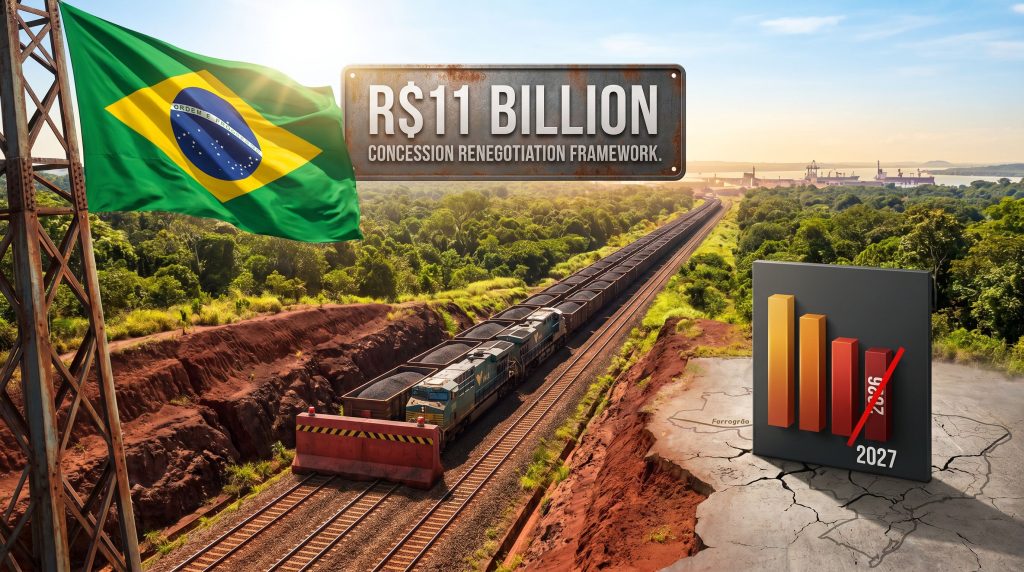
A preliminary renegotiation framework was established in late 2024, under which Vale would pay up to 11 billion reais (approximately US$1.78 billion) to formalise revised concession terms. This figure represents a substantial financial commitment, yet the agreement has not been fully implemented. Both parties remain in a state of extended negotiating limbo, with technical, legal, and political factors each contributing to the delay.
The institutional complexity of finalising such an agreement is considerable. Any major concession renegotiation in Brazil requires coordinated sign-off from the Ministry of Transport, the national land transport regulator (ANTT), and the federal audit court (TCU), whose independent review mandate introduces procedural timelines that are difficult to compress regardless of political will on either side. Indeed, Vale and the Brazilian government have so far failed to bridge the remaining gaps, leaving the renegotiation unresolved.
How the Standoff Has Disrupted the 2026 Auction Calendar
The most immediate and measurable consequence of the Vale dispute has been the systemic displacement of Brazil's 2026 railway auction pipeline. Projects scheduled for tender this year have been pushed into 2027 across multiple fronts, reflecting both the direct administrative bandwidth consumed by the Vale renegotiation and the broader regulatory uncertainty it projects across the sector.
| Railway Project | Original Timeline | Current Outlook | Primary Constraint |
|---|---|---|---|
| Ferrogrão Grain Railway | 2026 auction | Deferred to 2027 | Incomplete technical studies |
| North-South Railway Extensions | 2026 auction | Deferred to 2027 | Slow tender documentation |
| Additional concession renewals | 2026 | Deferred | TCU review processes |
| Rio-São Paulo High-Speed Rail | Construction 2027 | Operations from 2032 | Financing complexity |
The deferral of Ferrogrão carries particularly significant implications. This proposed approximately 1,000-kilometre freight corridor would connect Sinop in Mato Grosso to the Port of Miritituba in Pará, creating a dedicated logistics route for soybean and corn exports from one of Brazil's most productive agricultural zones. Its continued postponement denies agribusiness exporters a critical infrastructure pathway that could materially reduce dependence on congested road networks.
North-South Railway extensions face a similar trajectory. This longitudinal freight spine, designed to link Brazil's northern and southern regions, represents one of the country's most strategically significant long-term infrastructure investments. Delays to its expansion directly extend the period during which commodity producers in the interior must absorb elevated road freight costs.
Operational Risk: Indigenous Protests and the Carajás Blockades
Why Social Disruption Compounds Regulatory Uncertainty
Layered on top of the regulatory standoff is an operational risk dimension that infrastructure investors find particularly difficult to model. Since March 2025, Vale's Carajás Railway has experienced intermittent blockades driven by indigenous and social protest movements, causing disruptions to freight throughput that compound the uncertainty already created by the unresolved concession negotiations.
These blockades are distinct from the government dispute in origin but converge with it in their effect on investor confidence. When regulatory uncertainty and operational disruption occur simultaneously, the combined risk premium required to justify new infrastructure investment rises sharply. For prospective concession bidders evaluating Brazil's rail sector, the Carajás disruptions serve as a tangible illustration of the operational vulnerabilities that even established, high-volume freight corridors can face.
The three primary risk categories now facing Brazil's rail investment environment can be summarised as follows:
- Regulatory risk arising from unresolved concession terms and the broader policy review of Bolsonaro-era rail arrangements
- Execution risk stemming from deferred auctions, incomplete technical studies, and TCU review timelines
- Operational risk created by social and indigenous protest activity affecting existing freight corridors
These mining geopolitical risks are increasingly factored into capital allocation decisions by institutional investors operating across the global resources sector.
The next major ASX story will hit our subscribers first
Comparing Brazil's Concession Governance to Regional Peers
Positioning Brazil within a regional context helps clarify why the current environment is dampening infrastructure investment appetite. Chile operates a sector-specific regulatory framework with stable, predictable concession terms that have consistently attracted private capital. Mexico maintains long-term private concession structures with limited state intervention, producing moderate but consistent investment flows.
Argentina's history of frequent policy reversals and state-heavy intervention, however, has produced a chronically underinvested rail network. Brazil's current trajectory, while structurally distinct from Argentina's, is exhibiting governance friction that places it toward the lower end of regional regulatory clarity rankings at precisely the moment it needs to attract significant private capital.
| Country | Concession Governance | Regulatory Predictability | Private Investment Climate |
|---|---|---|---|
| Chile | Stable, sector-specific regulator | High | Active |
| Mexico | Long-term private, limited state intervention | Medium | Moderate |
| Brazil | Multi-stakeholder, contested renegotiation | Currently low | Dampened |
| Argentina | State-heavy, policy reversal history | Low | Limited |
Scenarios for Breaking the Deadlock
What Are the Most Likely Resolution Pathways?
Three plausible resolution pathways exist for the Vale and government standoff, each carrying distinct implications for Brazil's railway investment timeline.
Scenario 1: Negotiated Settlement on Revised Payment Terms. Vale and the federal government finalise the 11 billion reais renegotiation framework with clear implementation timelines. This outcome would unlock Vale's capital allocation decisions, restore momentum to the auction pipeline, and send a positive signal to other concession holders. Resolution probability depends on both parties accepting commercially viable terms without further political escalation.
Scenario 2: Regulatory Arbitration and TCU Adjudication. Negotiations fail to produce agreement within a defined window, and the dispute is referred to formal arbitration or TCU determination. This scenario provides legal certainty but extends timelines and risks establishing precedents that affect other rail concession holders, potentially introducing new uncertainty into a sector that already struggles with investor confidence.
Scenario 3: Prolonged Stalemate and Continued Deferrals. Neither party reaches resolution, and Brazil's railway auction pipeline remains suspended beyond 2027. This is the highest-cost outcome in terms of foregone infrastructure investment, eroded logistics competitiveness, and compounded commodity export cost disadvantages. Election cycle dynamics and the entrenchment of negotiating positions make this scenario non-trivial in probability.
The Capex Freeze and Its Downstream Consequences
One of the least visible but most consequential effects of the standoff is what infrastructure economists sometimes refer to as the capex freeze effect. When a major operator cannot finalise its concession rights and obligations, it cannot commit to long-term capital expenditure plans. Consequently, rolling stock procurement programmes are deferred, track upgrade timelines slip, and capacity expansion decisions remain in suspension.
For Vale, which operates two of Brazil's most heavily utilised freight corridors, this freeze has direct operational implications. Furthermore, other rail operators and prospective new entrants treat the Vale negotiations as a reference point for the broader concession governance environment. If the resolution process is seen as arbitrary, protracted, or commercially unreasonable, it calibrates investor expectations downward for the entire sector.
When the bellwether concession negotiation in a market produces prolonged uncertainty rather than efficient resolution, it functions as a negative signal multiplier across every subsequent infrastructure investment decision in that sector.
What Resolution Would Mean for Brazil's Export Economy
The stakes of resolving this standoff extend well beyond railway policy. Brazil's commodity export competitiveness is directly tied to logistics cost efficiency, and logistics cost efficiency is fundamentally constrained by the current state of freight rail development. The iron ore demand outlook remains a critical variable, given that Brazil's ore must compete on price with Australian supply chains that benefit from far more efficient rail infrastructure.
Every year that rail investment is deferred, the structural cost disadvantage of road freight dependency compounds, eroding producer margins and diminishing Brazil's pricing power in global iron ore, soybean, and copper markets. This is particularly consequential given current China steel demand dynamics, which are placing fresh pressure on iron ore pricing and export competitiveness globally.
Infrastructure economists estimate that modernising Brazil's freight rail network could reduce commodity logistics costs by 10% to 30% depending on corridor and commodity type. This translates into billions of dollars in annual efficiency gains for exporters and improved competitiveness in price-sensitive global markets. The commodity price impacts of sustained logistics inefficiency are, however, already visible in producer margins across multiple commodity classes.
The path to those gains runs directly through the resolution of the current concession standoff. Until that resolution materialises, the Vale and the government standoff continues to stall the railway agenda in Brazil in ways that compound with each passing quarter of inaction.
This article is intended for informational purposes only and does not constitute financial or investment advice. Infrastructure project timelines, financial figures, and regulatory outcomes referenced herein are subject to change based on ongoing negotiations and government decisions.
Want to Track the ASX Commodity Players Best Positioned to Benefit from Global Infrastructure Shifts?
Discovery Alert's proprietary Discovery IQ model delivers real-time alerts the moment significant mineral discoveries hit the ASX, transforming complex commodity data into clear, actionable insights for investors at every level — explore historic discovery returns on the Discovery Alert discoveries page to see what's possible, then begin your 14-day free trial at Discovery Alert to position yourself ahead of the broader market.