August 20, 2026

When a Single Mine Becomes a Market Barometer: Understanding Peru's Copper Vulnerabilities
Few commodities reveal the fragility of global industrial supply chains quite like copper. Unlike oil, which benefits from a globally distributed network of producers, refiners, and strategic reserves, copper concentrate markets operate through a small number of high-output nodes connected to processing infrastructure by logistics corridors that have no redundancy. When one of those nodes goes offline, even briefly, the ripple effects travel far beyond the mine gate.
The Las Bambas mine halt in Peru that began on August 18, 2026 is the latest episode in a long pattern of supply disruptions at one of the world's most consequential copper operations. However, understanding why this particular halt matters, and what it reveals about structural vulnerabilities in global copper markets, requires looking beyond the immediate incident. Broader copper supply crunch dynamics make this episode especially significant.
When big ASX news breaks, our subscribers know first
Las Bambas: Scale, Ownership, and Strategic Weight
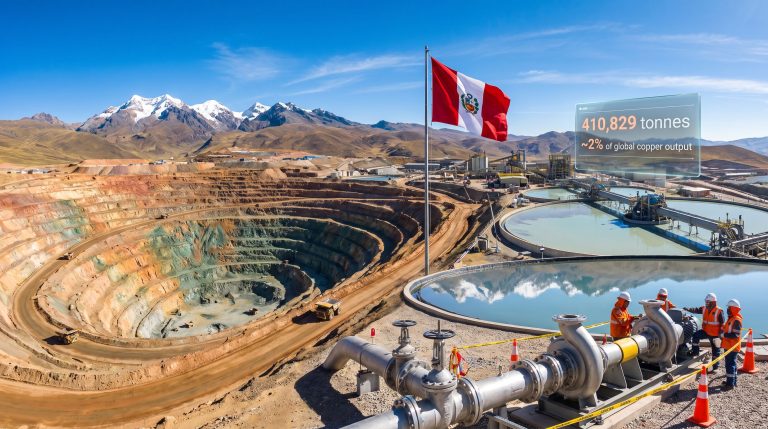
Located in the Apurímac Region of southern Peru, Las Bambas is an open-pit copper operation run by MMG Ltd. (HKG: 1208), a Hong Kong-listed mining company wholly owned by China Minmetals Corp., a Chinese state enterprise. The mine produced 410,829 tonnes of copper in 2025, a figure that represented approximately 28% growth over its 2024 output and accounted for roughly 2% of total global mined copper supply, according to Peru's Ministry of Energy and Mines.
That two-percent figure can sound modest, but in a commodity market where marginal supply and demand balances drive significant price movements, a single asset contributing two percent of global output is not a peripheral concern. Peru itself ranks as the world's third-largest copper producer, which means that disruptions at Las Bambas carry national and global significance simultaneously.
Furthermore, the mine's concentrate does not reach export markets by ship from a nearby port. It travels overland along a roughly 450-kilometre road corridor to the Port of Matarani on the Pacific coast. This route passes through multiple community territories, and there is currently no alternative export pathway in operation. That single-corridor dependency is the root of most of the mine's historical vulnerability.
The August 2026 Accident: What Happened and Why It Differs
On August 18, 2026, a fatal workplace accident occurred during pump replacement work at a clarification pond located approximately nine kilometres from the main processing plant. Two workers were killed and three others were injured. MMG suspended all mining operations immediately following the incident.
Peru's national labour inspection authority, Sunafil (Superintendencia Nacional de Fiscalización Laboral), dispatched inspectors to the site and opened a formal investigation. MMG communicated an expectation of a progressive operational restart beginning August 21, 2026, and notably did not revise its 2026 copper production guidance, signalling management's view that the interruption would be brief.
This halt has a fundamentally different character from Las Bambas's prior stoppages. Regulatory investigations following workplace fatalities operate within defined procedural frameworks, with identifiable endpoints. Social conflicts, by contrast, can escalate unpredictably, stall under political pressure, or morph into broader community grievances that extend stoppages for months.
The comparison below illustrates how different disruption types have historically played out at Las Bambas:
| Disruption Type | Primary Cause | Estimated Duration | Regulatory Body | Risk Profile |
|---|---|---|---|---|
| August 2026 Fatality | Fatal pump accident | Days (est. restart Aug 21) | Sunafil | Lower, time-bounded |
| 2022 Land Re-entry | Community re-occupation of sold land | 30+ days | Government mediation | High, unpredictable |
| 2019 Corridor Protests | Truck emissions, farmland loss | 100+ days | National intervention | Severe, prolonged |
| 2024 Blockades | Failed development contribution talks | Weeks | Negotiated resolution | Moderate to high |
A Decade of Operational Fragility
Since ramping up production in 2015 and 2016, Las Bambas has accumulated hundreds of days of operational downtime. The mine's disruption history is not a series of unfortunate coincidences — it is the predictable outcome of a structural tension between large-scale industrial mining and communities that bear disproportionate costs from the operation while receiving contested benefits.
Key episodes in that history include:
- 2019: Community protests along the 450-km transport corridor over truck emissions and lost agricultural land halted operations for more than 100 days, requiring national-level government engagement to resolve.
- 2022: Two communities that had previously sold land for the project re-entered those properties, forcing a complete mine shutdown lasting over one month. One community was subsequently evicted; Huancuire remained on the land according to MMG's own disclosures.
- January 2023: MMG publicly warned that ongoing supply chain disruptions were creating critical shortages of operational inputs, raising the spectre of a forced production halt even without a formal blockade.
- April 2024: Renewed blockades on the primary haulage corridor followed the collapse of negotiations over local development contributions, again severing both outbound concentrate shipments and inbound supplies.
Why the Transport Corridor Is a Structural Weakness, Not a Fixable Problem
The 450-km overland route is not merely a logistical challenge. It is a political and social interface between a globally significant mining asset and communities whose relationship with the project has been defined by conflict almost since the beginning. Road blockades at any point along this corridor can simultaneously stop concentrate exports and cut off the fuel, reagents, and equipment the mine needs to operate.
The corridor's communities have learned that blocking this route is an effective lever, and that knowledge does not diminish over time. Unlike port-adjacent operations or mines connected to multiple transport options, Las Bambas has no routing alternative currently in service. Until that changes structurally, the corridor will remain a recurring chokepoint that sophisticated copper market participants must price into their supply models.
Compounding Pressures Across South America
The Las Bambas mine halt in Peru does not occur in an isolated market environment. A convergence of supply-side disruptions across South America is amplifying pressure on global copper concentrate availability that was already tight heading into the second half of 2026. Indeed, global copper production trends indicate that simultaneous disruptions across key regions create outsized market effects.
Lundin Mining (TSX: LUN) reduced its annual copper production guidance by 10,000 tonnes following storm-related interruptions at its Chilean operations. Chile and Peru together dominate global copper mine supply, meaning simultaneous disruptions in both countries compound each other's market impact in ways that single-country analyses tend to understate. The Chile copper market outlook further highlights how vulnerable Andean supply corridors have become.
Consider the arithmetic of a disrupted supply picture:
| Operation | Country | Disruption Type | Estimated Copper Impact |
|---|---|---|---|
| Las Bambas (MMG) | Peru | Fatal accident, regulatory suspension | Short-term loss, days of output |
| Lundin Mining operations | Chile | Severe weather events | 10,000 tonne guidance cut confirmed |
| Las Bambas historical average | Peru | Community conflicts | Hundreds of days since 2016 |
At Las Bambas's 2025 run-rate of 410,829 tonnes annually, the mine produces approximately 34,000 tonnes per month. A two-week delay beyond the projected August 21 restart would remove an estimated 17,000 tonnes from the concentrate pipeline. Combined with Lundin's confirmed 10,000-tonne reduction, South American supply disruptions in a compressed window could approach 27,000 tonnes or more — a figure material enough to move spot concentrate markets and tighten treatment charge and refining charge spreads.
Understanding TC/RC Spreads: Why Smelters Watch Las Bambas Closely
Treatment charges and refining charges (TC/RC) are the fees that copper smelters charge mining companies to process concentrate into refined copper. When concentrate supply is abundant, smelters command higher TC/RC rates, reflecting their bargaining power. When supply tightens, TC/RC rates fall, squeezing smelter margins and increasing competition for available material.
Chinese smelters, which process a substantial share of global copper concentrate including significant volumes from Peru, are particularly exposed to Andean supply disruptions. Any extended Las Bambas halt during a period of already tight concentrate availability would be expected to put downward pressure on TC/RC rates, affecting smelter profitability across the processing chain.
Sunafil and Peru's Regulatory Architecture for Mining Safety
For market participants assessing restart timeline risk, understanding Sunafil's operational mandate is essential. Sunafil is Peru's national labour inspection authority with the power to investigate workplace fatalities, restrict operations pending safety audits, and impose corrective action requirements and financial penalties.
Following a fatal accident at a mine, Sunafil inspectors assess site conditions against national labour law requirements and sector-specific safety regulations administered jointly with the Ministry of Energy and Mines. The investigation's scope determines whether restrictions apply only to the affected work area or extend to broader site operations.
International operators like MMG are simultaneously subject to internal corporate safety frameworks, shareholder ESG expectations, and potential reputational consequences from fatal incidents. Consequently, even where Sunafil confirms compliance relatively quickly, management may implement additional internal safety reviews that extend the effective downtime beyond the minimum regulatory requirement.
The next major ASX story will hit our subscribers first
Community Relations: The Risk That Doesn't Have a Defined Endpoint
There is a critical distinction between a disruption that has a procedural resolution pathway and one that is driven by grievances with no administrative endpoint. The August 2026 Las Bambas halt begins in the first category, but proximity to unresolved social tensions means it could migrate toward the second.
The structural roots of community conflict at Las Bambas are well-documented:
- Communities that sold land for the project have disputed the adequacy of compensation arrangements and repeatedly re-entered those properties.
- The 450-km haulage route passes through communities that absorb the environmental costs of heavy truck traffic — including dust, road damage, and safety risks — without receiving financial benefits proportional to their burden.
- Local employment and procurement commitments have consistently fallen short of community expectations.
- Institutional trust between MMG, community groups, and government mediators has been eroded by hundreds of days of conflict across multiple episodes since 2016.
Fatal workplace accidents at large mines can function as catalysts for latent grievances. Where community groups perceive a fatality as evidence of inadequate safety standards or corporate negligence, they may use the disruption period to reassert demands that stalled during normal operations. This secondary escalation risk is not reflected in MMG's projected August 21 restart timeline but represents the scenario that copper market participants should stress-test in their supply models.
What Investors and Supply Chain Planners Should Take Away
The Las Bambas mine halt in Peru reinforces several strategic principles that sophisticated copper market participants have reason to revisit. Understanding the underlying copper price drivers is essential context for interpreting why these disruptions carry such outsized market consequences.
For short-term traders and concentrate buyers:
- Monitor Sunafil investigation communications and MMG's official operational updates as the primary indicators of restart certainty.
- Assess spot concentrate inventory buffers against a two-to-four week supply gap from Peruvian sources, recognising that the Lundin shortfall is additive rather than independent.
- Watch TC/RC rate movements as a real-time proxy for how the broader smelter community is pricing the combined South American disruption.
For long-term investors in copper equities or copper-dependent industries:
- Las Bambas should be modelled with a persistent structural disruption premium, not treated as an asset with stable production that experiences occasional interruptions. Its disruption history is not episodic — it is characteristic.
- Peru's mining sector offers world-class geological endowments, but the social licence environment at corridor-dependent operations carries risks that simpler jurisdictional risk assessments systematically underweight.
- Geographic diversification of copper concentrate sourcing is not merely a best practice recommendation — it is a financial risk management imperative demonstrated repeatedly by the Las Bambas track record. In addition, reviewing available copper investment strategies can help portfolio managers build more resilient exposure to this critical metal.
For supply chain planners in copper-intensive manufacturing:
- Single-corridor, single-origin concentrate dependencies create correlated risk exposures that are difficult to hedge through financial instruments alone.
- The Las Bambas case is a textbook illustration of why copper supply security requires operational redundancy, not just contractual volume commitments.
Frequently Asked Questions
How much copper does Las Bambas produce annually?
Las Bambas produced 410,829 tonnes of copper in 2025, approximately 28% above its 2024 output and equivalent to roughly 2% of global mined copper supply.
Who owns Las Bambas?
The mine is operated by MMG Ltd. (HKG: 1208), a subsidiary of China Minmetals Corp., a Chinese state-owned enterprise.
Why did Las Bambas halt operations in August 2026?
A fatal workplace accident on August 18, 2026 during pump replacement work at a clarification pond approximately nine kilometres from the processing plant killed two workers and injured three others. Peru's labour authority Sunafil launched an investigation and MMG suspended operations.
How does this halt differ from previous stoppages?
Previous Las Bambas disruptions were primarily driven by community blockades and social conflicts with no defined procedural endpoint. The August 2026 halt stems from a regulatory safety investigation, which has a more bounded resolution pathway, giving it a different, though not negligible, risk profile.
What is the broader market impact?
The halt compounds an existing South American supply disruption environment that includes a 10,000-tonne copper guidance reduction by Lundin Mining due to Chilean weather events. If the Las Bambas restart is delayed beyond two weeks, the combined output loss from both disruptions could approach 27,000 tonnes, placing significant pressure on global copper concentrate availability and TC/RC spreads.
For ongoing coverage of South American copper supply dynamics and Las Bambas operational developments, the Canadian Mining Journal provides regular reporting on developments across the region's mining sector.
Want to Know When the Next Major Copper Discovery Hits the ASX?
Discovery Alert's proprietary Discovery IQ model scans ASX announcements in real time, instantly identifying significant mineral discoveries — including copper — and delivering actionable alerts before the broader market has had a chance to react. Start your 14-day free trial today, or explore Discovery Alert's discoveries page to see how major mineral finds have historically generated substantial returns for well-positioned investors.