August 20, 2026
When Routine Maintenance Becomes a Tragedy: What the Las Bambas Mine Accident Reveals About Mining Safety
Across the global mining industry, the most dangerous moments are rarely the dramatic ones. Blasts, structural collapses, and equipment failures attract the most attention, yet a significant proportion of fatal incidents occur during what crews classify as routine maintenance. It is the predictable, repetitive tasks, performed in technically complex environments, where complacency and systemic gaps in safety governance can converge with fatal consequences. The Las Bambas mine accident in Peru, which claimed two lives in August 2026, fits this pattern with uncomfortable precision.
When big ASX news breaks, our subscribers know first
What Happened at Las Bambas on 18 August 2026
On Tuesday, 18 August 2026, two workers lost their lives during a pump replacement task at a clarification pond located approximately nine kilometres from the main Las Bambas processing facility. Three additional workers sustained injuries and were placed under medical care following the incident.
The two fatalities were identified as Richard José Flores Rhea, a direct employee of Las Bambas, and Tony Nilson González Challa, a contractor working through SINAR Perú S.A.C. The fact that the victims came from both sides of the mine's workforce structure, one permanent employee and one contracted worker, immediately drew attention to the adequacy of safety integration across the site's dual-workforce model.
A clarification pond is a large settling basin used in mineral processing to separate suspended solids from liquid tailings or process water. Working in or around these structures involves exposure to chemical slurries, pressurised pumping systems, and, in some configurations, partially enclosed or difficult-to-evacuate environments. At high altitude, each of these hazards is compounded by additional physiological and mechanical factors.
MMG Limited, the Chinese state-linked operator of Las Bambas, confirmed the incident publicly, announced an immediate temporary suspension of operations, and stated that a phased restart would begin on 21 August 2026. The company also confirmed full cooperation with Peruvian regulatory authorities and disclosed that internal investigation processes had commenced.
Understanding Las Bambas: Scale, Altitude, and Strategic Weight
To understand why this incident attracted immediate international attention, it helps to appreciate the scale of what Las Bambas represents within global copper supply chains.
| Metric | Detail |
|---|---|
| Location | Apurímac region, southern Peru |
| Altitude | More than 4,000 metres above sea level |
| Nearest town | Challhuahuacho |
| Provinces | Cotabambas and Grau |
| Operator | MMG Limited (Chinese state-linked) |
| Commercial production start | 2016 |
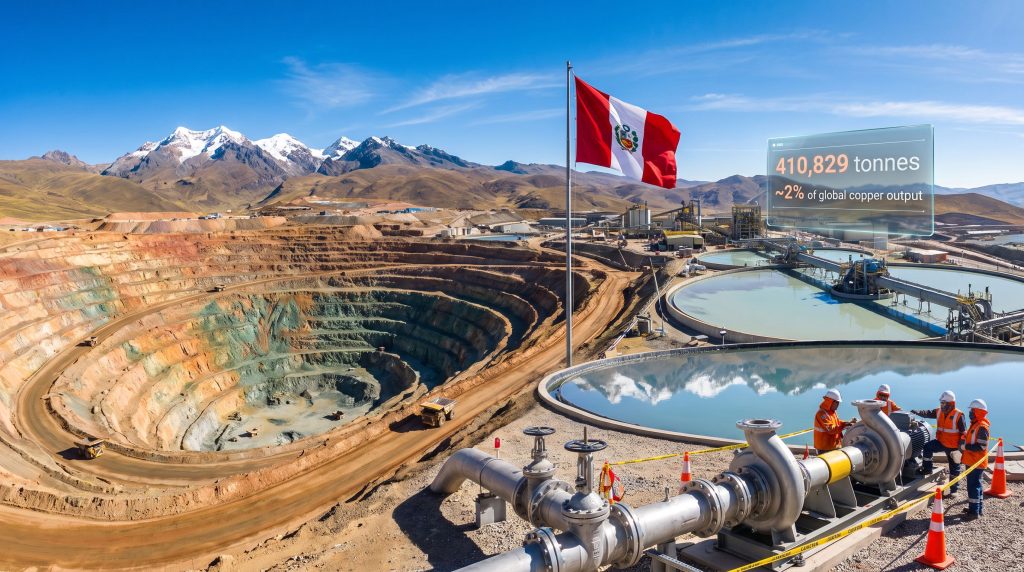
| 2025 copper output | 410,829 tonnes |
| Year-on-year production growth | 28% above the 2024 supply forecast |
| Share of global copper output | Approximately 2% |
| Distance of incident site from plant | ~9 kilometres |
A single mine contributing roughly 2% of all copper produced globally carries outsized influence over spot prices, smelter schedules, and downstream manufacturing supply chains. Copper's role in electrification infrastructure, from EV motors to grid cabling and renewable energy installations, means that disruptions at Tier 1 operations like Las Bambas reverberate well beyond Peru's borders. Furthermore, the broader copper supply crunch makes such disruptions particularly consequential for global markets.
The mine's 28% production increase in 2025 relative to its prior-year supply forecast is also significant context. Rapid production ramp-ups frequently intensify maintenance workloads and can stretch safety oversight capacity, particularly in contractor-heavy operational environments where workforce turnover is higher and institutional knowledge shallower.
The Specific Hazards of High-Altitude Mining Maintenance
Operating above 4,000 metres introduces a cluster of hazards that are poorly understood outside specialist occupational health and mining engineering circles. These are not marginal concerns; they are documented, measurable factors that affect both human physiology and mechanical system performance.
Physiological Risks for Workers
- Reduced oxygen availability at altitude impairs cognitive function, reaction time, and physical endurance, even in acclimatised workers
- Altitude-related fatigue increases the probability of procedural errors during complex maintenance tasks
- Emergency medical evacuation from remote high-altitude sites takes significantly longer than at sea-level operations, reducing the survival window following serious trauma
Mechanical and Engineering Complications
- Reduced atmospheric pressure affects the performance of pumping systems, including head pressure calculations and cavitation thresholds, directly relevant to the type of maintenance being conducted at the time of the accident
- Fluid dynamics in processing ponds behave differently at altitude, requiring site-specific engineering parameters rather than standard sea-level specifications
- Temperature extremes in the Apurímac highlands accelerate material fatigue in seals, gaskets, and pump casings, increasing the likelihood of unexpected system failures during maintenance windows
These are not abstract engineering considerations. They are factors that competent persons conducting risk assessments for maintenance tasks in high-altitude processing environments must account for explicitly. Whether those assessments were conducted, reviewed, and communicated to the workers involved on 18 August is now central to Sunafil's investigation.
Consequently, mining safety and sustainability frameworks must evolve to explicitly address these altitude-specific variables rather than applying generic sea-level standards to operations like Las Bambas.
Peru's Regulatory Response: Sunafil Under the Microscope
Peru's National Superintendency of Labor Inspection, known by its Spanish acronym Sunafil, opened a formal investigation immediately following the incident. Inspectors were deployed to the Las Bambas site to independently verify the circumstances of the accident, separate from MMG's own internal review.
Sunafil holds broad enforcement powers in Peru's mining sector, including the authority to:
- Issue financial penalties against operators found in breach of workplace safety standards
- Mandate operational suspensions pending compliance verification
- Require the implementation of enhanced safety protocols before operations resume
- Refer findings to prosecutorial authorities where criminal negligence is indicated
High-profile incidents at flagship copper operations typically sharpen regulatory focus not just on the specific site but across the broader sector. Inspectors and policymakers tend to use such moments to benchmark compliance standards industry-wide, meaning the Las Bambas mine accident in Peru may generate flow-on scrutiny across the country's extensive copper and gold mining operations.
Peru consistently ranks among the world's top two or three copper-producing nations, alongside Chile and the Democratic Republic of Congo. Las Bambas alone represents a meaningful share of national copper export revenue. Operational disruptions, whether safety-driven or community-related, therefore carry direct implications for Peru's fiscal position and its attractiveness as a destination for long-term foreign mining investment. In addition, the copper demand drivers powering global electrification make stable output from operations like Las Bambas increasingly critical.
Contractor Safety Integration: The Systemic Challenge Nobody Solves
The death of Tony Nilson González Challa, a contracted worker employed through a third-party firm rather than directly by the mine, places the Las Bambas accident within a persistent and largely unresolved challenge across the global mining industry.
Industry data compiled over multiple decades consistently shows that contractor fatalities account for a disproportionate share of total workplace deaths in large-scale mining operations. The reasons are structural:
- Contractors often receive compressed or less comprehensive site induction training compared to permanent employees
- Task-specific risk briefings for contractors are not always conducted by personnel with equivalent knowledge of the contractor's specific technical role
- Supervision ratios for contracted crews during maintenance windows are frequently lower than for direct workforce activities
- Contractor management systems often focus on administrative compliance (documentation, certification verification) rather than real-time safety behaviour monitoring
Dual-workforce models, where permanent employees and multiple layers of subcontractors work side by side, require genuinely unified safety management systems. In practice, these systems often operate as parallel structures with imperfect integration at the point of task execution. Investigations into contractor fatalities frequently reveal gaps not in written policy but in operational application. Modern mine risk management frameworks increasingly emphasise the need to close this execution gap rather than simply improve documentation.
The next major ASX story will hit our subscribers first
Las Bambas's History of Operational Disruption
The August 2026 accident is a distinct event from Las Bambas's longer history of operational stoppages, however, understanding that history provides essential context for assessing the mine's broader governance challenges.
| Disruption Type | Primary Driver | Pattern |
|---|---|---|
| Community blockades | Local demands for economic benefit-sharing from mining revenues | Recurring since 2016 |
| Transport corridor interruptions | Protests targeting concentrate haulage routes | Multiple documented incidents |
| Safety-triggered suspensions | Fatalities and regulatory compliance reviews | Periodic |
Since commercial production commenced in 2016, Las Bambas has faced repeated stoppages linked to community opposition in Cotabambas and surrounding areas. Local communities have consistently sought greater participation in the economic returns generated by one of the world's highest-output copper operations sitting on their ancestral lands. These disputes have periodically disrupted copper concentrate logistics, with downstream effects on smelters and commodity traders.
The August 2026 accident adds a workplace safety dimension to this pre-existing pattern of operational fragility, and raises questions about whether a history of community-related disruptions has drawn management attention and resources away from internal safety governance. Effective mining risk communication with all stakeholders, from local communities to regulators, remains an ongoing challenge for the operation.
What Needs to Change: A Framework for Reform
The operational and regulatory implications of the Las Bambas mine accident in Peru extend beyond a single incident investigation. They point toward a set of structural reforms that the industry has debated for years without fully implementing.
- Mandatory integrated safety audits covering both direct employees and all contractor tiers, assessed against identical standards rather than parallel frameworks
- Altitude-specific risk assessment protocols for maintenance tasks in processing environments, built into permit-to-work systems rather than left to supervisory discretion
- Enhanced emergency response infrastructure at remote, high-altitude sites, including pre-positioned medical resources and faster medevac capability
- Real-time contractor supervision accountability, where named individuals are formally assigned responsibility for contractor crew safety at the task level, not just the administrative level
- Transparent incident reporting timelines that allow communities, investors, and regulators to assess corporate safety culture rather than just compliance documentation
- Structured community engagement frameworks that address the underlying economic grievances driving protest-related disruptions, reducing the management distraction created by recurring external conflicts
Disclaimer: This article draws on publicly reported information from the incident as reported by Mining Technology and Reuters. Details surrounding the precise cause of the accident remain subject to ongoing investigation by Sunafil and MMG's internal review. No findings of negligence or liability have been established at this time. Readers should not interpret any analysis in this article as a legal assessment of responsibility.
Frequently Asked Questions: Las Bambas Mine Accident in Peru
What happened at the Las Bambas mine in August 2026?
Two workers died and three were injured on 18 August 2026 during pump replacement maintenance at a clarification pond approximately nine kilometres from the Las Bambas process plant in Peru's Apurímac region.
Who were the victims of the Las Bambas accident?
The two fatalities were Richard José Flores Rhea, a direct Las Bambas employee, and Tony Nilson González Challa, a contractor from SINAR Perú S.A.C.
Who operates Las Bambas and where is it located?
Las Bambas is operated by MMG Limited, a Chinese state-linked mining company. The mine is located in the Apurímac region of Peru, more than 4,000 metres above sea level, and began commercial production in 2016.
How much copper does Las Bambas produce?
In 2025, Las Bambas produced 410,829 tonnes of copper, representing a 28% increase above its 2024 supply forecast and accounting for approximately 2% of total global copper output.
Which authority is investigating the accident?
Peru's National Superintendency of Labor Inspection, Sunafil, opened a formal investigation and deployed inspectors to the site. MMG is also conducting a parallel internal investigation.
Did Las Bambas suspend operations after the accident?
Yes. MMG implemented a temporary operational suspension following the incident, with a phased restart planned from 21 August 2026.
Has Las Bambas experienced other disruptions?
The mine has experienced multiple operational stoppages since 2016, primarily driven by community protests over economic benefit-sharing. The August 2026 accident is a separate, safety-related disruption.
Want to Stay Ahead of Significant ASX Mineral Discoveries?
Discovery Alert's proprietary Discovery IQ model delivers real-time alerts on major ASX mineral discoveries, turning complex data across more than 30 commodities into clear, actionable insights for both short-term traders and long-term investors — explore the historic returns major discoveries have generated and begin your 14-day free trial today to position yourself ahead of the broader market.