August 20, 2026
The Hidden Vulnerability of High-Altitude Copper Mining
When investors evaluate copper producers, their analysis typically centres on ore grade, strip ratios, processing costs, and sovereign risk. What rarely appears as a line item in pre-investment due diligence is the structural fragility of power transmission infrastructure at elevations exceeding 3,000 metres above sea level. Yet in 2026, this precise vulnerability forced Lundin Chile operations impacted by winter storm conditions to revise annual output targets — not once but twice within a single southern hemisphere winter season.
The Atacama Desert is synonymous with extreme aridity. Its reputation as one of the driest places on Earth has paradoxically masked a less discussed characteristic: the region's high-altitude mining zones, particularly those straddling the Andean cordillera, are periodically exposed to severe winter weather systems that bring extreme snowfall, powerful winds, and infrastructure-threatening conditions entirely unlike the parched lowland image the Atacama projects. For copper producers operating in this belt, the consequences of this weather paradox are becoming increasingly material to production forecasting.
When big ASX news breaks, our subscribers know first
Why Elevation Creates Disproportionate Operational Risk
Mining operations situated above 3,000 metres in the Andes occupy a fundamentally different risk environment than their lower-elevation counterparts. At these altitudes, transmission towers, access roads, and processing facilities face conditions that standard infrastructure design may not fully account for, including ice loading on cables, wind gusts that can exceed structural tolerances during severe storm events, and access challenges that prevent rapid repair response.
The physics of high-altitude power transmission present a particular challenge. Transmission towers in Andean mining districts must span rugged, remote terrain where the combination of heavy snow accumulation and high wind velocity creates what engineers describe as combined loading scenarios. These involve the simultaneous application of multiple stress forces that can exceed a tower's rated capacity, even when each individual force would be manageable alone.
This dynamic is not unique to Chile but is especially pronounced in the Atacama's high-altitude copper belt, where storm events can arrive with limited warning and repair crews face dangerous access conditions in the immediate aftermath. Furthermore, understanding broader copper market trends helps contextualise why such disruptions carry outsized significance for global supply chains.
Beyond the physics, there is an economic dimension that is less commonly understood. When a high-altitude mine loses grid power, it cannot simply switch to backup generation at full capacity. Large-scale copper processing operations — including crushing circuits, semi-autogenous grinding mills, and flotation cells — draw enormous amounts of electrical power. On-site diesel or gas generation is typically sized to sustain critical safety and monitoring systems, not to replicate the throughput capacity of grid-connected operations.
This means that even with backup generators running, production effectively halts until grid power is restored, creating a fixed-cost absorption problem where capital-intensive infrastructure sits idle while operating expenses continue to accumulate.
Caserones and Candelaria: Two Mines, Two Outcomes
Lundin Mining Corp. operates two significant copper assets within Chile's Atacama region, and the contrast between how each performed during the 2026 winter storm disruptions reveals important insights about operational contingency planning.
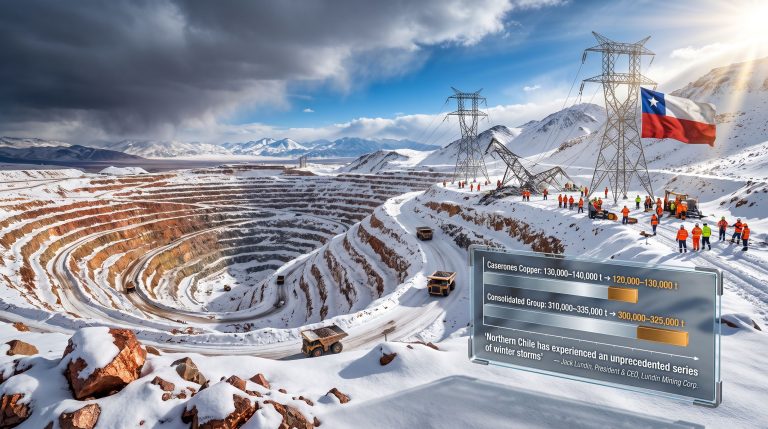
Caserones is a high-altitude porphyry copper-molybdenum operation sitting at elevations that place its surface infrastructure directly in the path of severe Andean weather systems. The mine had already been producing at scale as part of Lundin's diversified base metals portfolio following its acquisition, and its original 2026 copper production guidance of 130,000 to 140,000 metric tons reflected an expectation of stable, full-year operations.
Candelaria, located at a comparatively lower elevation in the Atacama coastal range, operates as a copper-gold-silver mine with a significantly different infrastructure exposure profile. Its processing facilities maintained mill operations through the first storm event by drawing on pre-built ore stockpiles, demonstrating that effective contingency planning can meaningfully buffer production continuity even when access and logistics are compromised.
The divergence between Caserones and Candelaria during the same weather events is not simply a matter of luck. It reflects the operational reality that elevation-adjusted contingency planning, including ore stockpiling strategies timed to seasonal storm risk windows, can be the difference between a manageable disruption and a full guidance revision.
A Chronological Breakdown of the Two Storm Events
Understanding why the Lundin Chile operations impacted by winter storm events required a guidance revision means examining the sequential and compounding nature of what unfolded between July and August 2026.
The July Storm: First Power Outage and Initial Damage
| Event | Date | Operational Impact |
|---|---|---|
| Caserones operations suspended | July 18, 2026 | Snowfall restricted site access; power supply disrupted |
| Candelaria mill maintained output | July 18 onwards | Operations sustained via ore stockpile drawdown |
| Power outage duration at Caserones | July 18 to July 30, 2026 | Two powerline transmission towers confirmed damaged |
| Restoration timeline issued | July 27, 2026 | Power and gradual restart projected within two to three weeks |
The July event established a challenging but apparently manageable recovery pathway. Two transmission towers had been damaged, repair crews were mobilised, and Lundin's initial assessment suggested the production impact would likely keep full-year output within the lower boundary of the original guidance range. Candelaria's ability to maintain throughput through stockpile management provided a degree of portfolio-level offset.
According to Lundin Mining's official update, the company confirmed the extent of damage to its Chilean transmission infrastructure following the July storm, with repair timelines issued to reassure investors of a structured recovery plan.
The August Storm: Re-Damage and the Compounding Effect
| Event | Date | Operational Impact |
|---|---|---|
| Second winter storm commences | August 13, 2026 | Heavy rainfall at lower elevations; severe snowfall and high winds at altitude |
| Second power outage at Caserones | August 14, 2026 | Previously repaired transmission tower re-damaged by severe winds and snowfall |
| Recovery timeline extended | August 19, 2026 | Full power restoration targeted by end of that week; phased ramp-up to follow |
| 2026 production guidance revised | August 19, 2026 | Caserones and consolidated group guidance both lowered |
The August storm introduced what risk analysts sometimes describe as a reset event — a secondary disruption that erases the recovery progress achieved following the initial incident and forces planners to restart their downtime clock from a position of greater cumulative loss. The fact that a partially repaired transmission tower was re-damaged by the second storm highlights a specific vulnerability in high-altitude infrastructure repair.
Crews working in remote, elevated terrain cannot always complete hardening works before the next weather system arrives, particularly during an active winter season. Backup generators were deployed to sustain critical site infrastructure during the second outage, confirming that Lundin's emergency systems performed as designed, but these systems were never intended to support full production throughput.
Revised Production Guidance: What the Numbers Mean
Caserones and Consolidated Group Guidance Comparison
| Metric | Original 2026 Guidance | Revised 2026 Guidance | Change |
|---|---|---|---|
| Caserones Copper Production | 130,000 to 140,000 mt | 120,000 to 130,000 mt | Approximately 10,000 mt reduction at midpoint |
| Consolidated Group Copper Production | Higher pre-revision range | 300,000 to 325,000 mt | Revised downward |
| Candelaria Copper Production | Full-year guidance maintained | Full-year guidance maintained | No change |
A reduction of approximately 10,000 metric tons at the Caserones midpoint may appear modest against a global copper market that produces roughly 22 to 23 million metric tons annually. However, for Lundin's earnings model, the implications extend beyond volume. Alongside the output reduction, cash-cost guidance for Caserones was also revised upward, creating a dual pressure on both production volume and unit economics.
This dynamic is well understood within the mining finance community but less visible to general investors. When a processing-intensive operation like Caserones runs below nameplate capacity, fixed costs — including maintenance, labour, energy contracts, and depreciation — are spread across fewer tonnes of copper produced. The result is a mechanically higher cost per pound of copper, even if no additional spending has occurred.
This fixed-cost dilution effect means that unplanned downtime is almost always more economically damaging than the simple volume loss suggests.
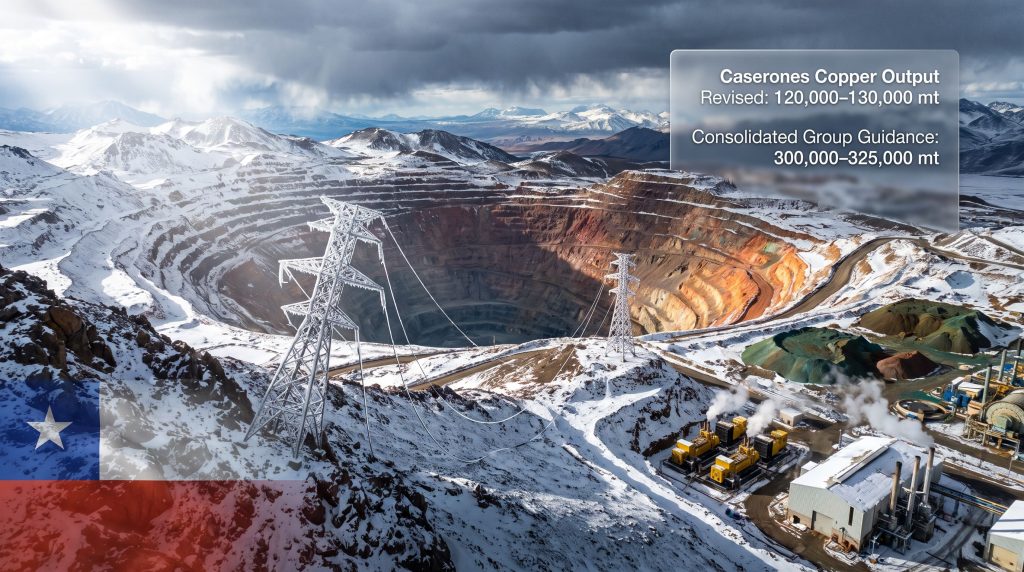
Featured Insight: Lundin's revised 2026 consolidated copper production guidance stands at 300,000 to 325,000 metric tons, with Caserones now targeted at 120,000 to 130,000 metric tons. Candelaria remains on track to meet its original full-year targets. The dual impact of lower volume and higher unit costs at Caserones represents a compounded earnings headwind beyond what the tonnage reduction alone implies.
What This Means for Copper Supply and Market Dynamics
Chile accounts for approximately 25 to 27 percent of global mined copper supply, a concentration that makes operational disruptions at major Chilean mines a relevant data point for commodity markets, even when the absolute tonnage impact appears modest in isolation. The Chile copper outlook for the coming years makes this structural exposure increasingly important for commodity investors to understand.
The more significant market observation from the 2026 Atacama winter storm season is not the Caserones guidance revision in isolation, but the pattern it represents. Severe weather events affecting multiple Chilean copper producers during the same seasonal window create a cumulative supply effect that no single guidance update fully captures. When several operations across the Andean copper belt experience simultaneous disruptions, the aggregate reduction in copper deliveries can begin to register in physical market tightness indicators and influence near-term price sentiment.
As mining.com reported, Chile's deadly 2026 winter storms added growing pressure to copper prices, reinforcing concerns about the broader supply implications of Andean weather disruption beyond any single producer's guidance revision.
Commodity analysts are increasingly building weather-adjusted production frameworks into their Chilean copper forecasting models. Rather than treating Andean winter disruptions as exceptional and unpredictable events, these frameworks apply a probabilistic downtime allowance to high-altitude producers during the July-to-September seasonal risk window. This analytical shift has meaningful implications for how production guidance from Andean copper miners is interpreted by institutional buyers and commodity trading desks.
For investors, the practical implication is that headline guidance figures from high-altitude Chilean copper producers may warrant a seasonal risk discount during the southern hemisphere winter months, particularly for operations where single-point transmission infrastructure represents a known vulnerability. Moreover, Chile's copper supply gap remains a persistent structural concern that weather-driven production disruptions only serve to amplify.
The next major ASX story will hit our subscribers first
Lundin's Operational Response: A Step-by-Step Recovery Framework
Infrastructure Repair and Power Restoration
Lundin's response to the second storm followed a structured emergency protocol:
- Immediate mobilisation of specialised repair crews following damage assessment on August 14
- Deployment of backup generators to sustain critical site monitoring, safety, and communications systems
- Targeted repair of the re-damaged transmission tower under difficult high-altitude conditions
- Full power restoration targeted by the end of the week of August 19, 2026
- A phased, safety-prioritised operational ramp-up commencing after power restoration was confirmed
What Does a Safe Restart Look Like in Practice?
Returning a large-scale copper processing operation to full throughput after an extended power outage is not a simple switch-on event. The standard restart sequence for a high-altitude porphyry copper operation typically involves:
- Full electrical systems verification and load testing following power restoration
- Mechanical and structural inspection of processing equipment, including mills, conveyors, and flotation cells
- Controlled restart of crushing circuits at reduced throughput rates
- Progressive ramp-up of semi-autogenous grinding and ball mill circuits
- Commissioning of flotation and concentrate handling systems
- Gradual throughput escalation toward nameplate capacity with continuous monitoring
- Stabilisation and performance verification before declaring full operational normalcy
Lundin's CEO Jack Lundin publicly acknowledged the efforts of employees, contractors, and emergency response teams throughout the disruption period, emphasising that a safe and controlled restart took priority over speed of recovery. This philosophy reflects the operational reality that rushing a restart at a complex processing facility following an unplanned outage creates meaningful risks of mechanical damage that could extend downtime far beyond what a careful ramp-up would require.
Risk Factors Investors Should Monitor
Near-Term Risks at Caserones
- The Andean winter season typically extends through August and into September, meaning additional weather events cannot be ruled out before seasonal risk abates
- Any mechanical issues identified during restart inspections could add incremental downtime beyond current guidance assumptions
- Further delays in power infrastructure repair would extend the production shortfall and potentially trigger a second guidance revision
Medium-Term Strategic Questions for Lundin's Chilean Portfolio
| Risk Mitigation Strategy | Applicability to High-Altitude Operations | Investment Horizon |
|---|---|---|
| Redundant or underground transmission routes | High, eliminates single-point-of-failure exposure | Medium to long term |
| Expanded on-site generation capacity | Medium, viable for critical systems, not full operations | Near to medium term |
| Seasonal ore stockpile pre-building | High, demonstrated effectively at Candelaria | Immediate to near term |
| Real-time meteorological monitoring integration | High, enables earlier pre-emptive shutdowns | Near term |
| Transmission tower structural hardening programs | High, reduces re-damage risk in sequential storms | Medium to long term |
The most pressing strategic question for Lundin's medium-term capital allocation is whether the 2026 experience accelerates investment in transmission infrastructure redundancy at Caserones. The cost of constructing a redundant power supply route or expanding on-site generation capacity is significant but finite. The cost of repeated unplanned downtime, in both lost production and elevated unit costs, is recurring and potentially larger over a multi-year operational horizon.
Candelaria's performance during the same weather events provides a useful internal benchmark. Its stockpile management approach, which effectively decoupled mill throughput from the short-term disruption of access route closures, represents a transferable contingency planning model that Caserones' operational team may look to replicate and expand ahead of future winter seasons. In addition, understanding the future of copper mining reveals how infrastructure resilience and adaptive planning are becoming as important as ore quality in determining long-term producer viability.
The broader copper price drivers that underpin investment theses for Chilean producers remain intact, however, consecutive weather-related disruptions of this kind serve as a reminder that operational execution risk in high-altitude environments deserves equal analytical attention alongside macroeconomic demand factors.
Frequently Asked Questions
Which Lundin Mining operations in Chile were affected by the 2026 winter storms?
Both Caserones and Candelaria were affected. Caserones experienced the most severe disruption, including two separate power outages and a full operational suspension. Candelaria's mill continued operating through the use of ore stockpiles and was only briefly impacted.
When did the second storm hit Caserones, and what damage did it cause?
The second winter storm commenced on August 13, 2026. By August 14, severe winds and heavy snowfall had re-damaged a transmission tower that had already been affected during the July storm, triggering a second power outage.
By how much has Lundin revised its 2026 copper production guidance for Caserones?
Caserones' 2026 copper production guidance was reduced from 130,000 to 140,000 metric tons to 120,000 to 130,000 metric tons, a reduction of approximately 10,000 metric tons at the midpoint.
Is Candelaria still on track to meet its 2026 production targets?
Yes. Lundin Mining confirmed that Candelaria remains on track to meet its original full-year 2026 production guidance.
What is Lundin's consolidated copper production guidance for 2026 after the revision?
Lundin's consolidated group copper production guidance for 2026 now stands at 300,000 to 325,000 metric tons.
What steps is Lundin taking to restore full operations at Caserones?
Repair crews have been mobilised to address the damaged transmission infrastructure. Backup generators are sustaining critical site systems in the interim. Full power restoration was targeted by the end of the week of August 19, 2026, followed by a phased, safety-prioritised ramp-up of processing operations.
Key Takeaways
- Sequential storm events create compounding operational risk that single-event contingency planning cannot fully absorb — the experience of Lundin Chile operations impacted by winter storm conditions in 2026 makes this structural vulnerability tangible and quantifiable
- Transmission infrastructure at high-altitude Andean mines represents a critical single point of failure that warrants dedicated capital investment in redundancy and hardening
- The fixed-cost dilution effect of unplanned downtime at capital-intensive processing operations means that volume-based guidance revisions understate the full earnings impact
- Stockpile management and operational flexibility, as demonstrated at Candelaria, are essential portfolio-level buffers for weather-exposed mining companies with high-altitude Andean exposure
- Institutional investors and commodity analysts are increasingly applying seasonal weather-risk frameworks to Andean copper producers, a trend that may gradually affect how production guidance from these operations is priced by the market
This article is intended for informational purposes only and does not constitute financial or investment advice. Production guidance figures, timelines, and operational details referenced herein are sourced from publicly available company announcements and industry reporting. Readers should conduct their own due diligence before making investment decisions. Forward-looking statements involve inherent uncertainty and actual outcomes may differ materially from those projected.
Want to Track the Next Major Copper Discovery Before the Market Moves?
Discovery Alert's proprietary Discovery IQ model scans ASX announcements in real time, instantly identifying significant mineral discoveries — including copper — and converting complex data into clear, actionable insights for both traders and long-term investors. Explore how historic mineral discoveries have generated substantial returns on Discovery Alert's dedicated discoveries page, and begin your 14-day free trial today to position yourself ahead of the broader market.