
August 19, 2026
When the Desert Gets Wet: Understanding Extreme Weather Risk in the World's Copper Heartland
Copper mining's greatest operational paradox lies in geography. The driest places on Earth often sit directly above the richest copper deposits ever discovered, and for decades, that aridity has been a feature rather than a bug for mine operators in northern Chile's Atacama region. Minimal rainfall meant predictable ground conditions, stable open-pit walls, and uninterrupted power infrastructure. However, the 2026 Chilean winter season has forced a fundamental reassessment of that assumption, with Lundin Mining severe weather in Chile emerging as one of the most consequential operational disruptions the Atacama copper belt has seen in recent memory.
The Atacama is not simply a mining district. It is the backbone of global copper supply forecast. Chile produces roughly 25% to 27% of the world's mined copper, with the Atacama region alone accounting for a disproportionate share of that output. Any disruption to major operations in this corridor carries supply-side implications that ripple through copper markets, concentrate logistics chains, and the downstream industries that depend on reliable cathode and concentrate flows.
When big ASX news breaks, our subscribers know first
The Atacama's Hidden Vulnerability: Altitude, Infrastructure, and the Physics of Power Delivery
What most market observers fail to appreciate is the engineering challenge of delivering electricity to high-altitude open-pit copper operations in the Andes. Mines like Caserones sit at elevations exceeding 4,000 metres above sea level, where above-ground transmission lines traverse exposed ridgelines and mountain passes subject to extreme wind loading, ice accumulation, and seismic activity.
Unlike underground mines, where power delivery infrastructure can be partially sheltered, large open-pit operations depend on long runs of exposed transmission towers to bring grid power to concentrators, crushers, mills, and water systems. This architecture creates a structural vulnerability that is easy to overlook during normal operating conditions but becomes acutely apparent the moment a severe weather system tracks across the region.
The consequences of this design reality played out in precise detail across two separate storm events during July and August 2026:
-
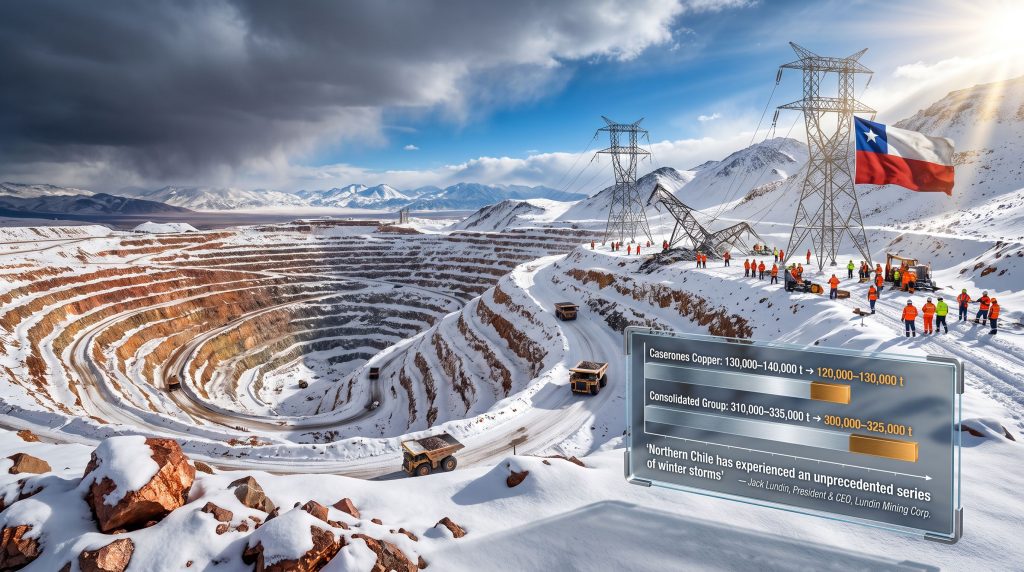
Storm One (July 18 to July 30): Extreme snowfall and associated structural loading caused direct damage to at least two powerline towers at Caserones, triggering a grid outage that lasted twelve days. At lower elevations, Candelaria experienced heavy rainfall but maintained processing continuity by drawing on existing ore stockpiles, with full mining operations resuming shortly after.
-
Storm Two (August 13 to 14 onward): A distinct weather system moved through the region with heavy precipitation at lower elevations combined with intense snowfall and high winds at altitude. An inspection following this second event confirmed that wind and snowfall had re-damaged a transmission tower already structurally compromised by the first storm, triggering a further power outage at Caserones on August 14.
According to Lundin Mining's official operations update, the compounding dynamic here is critical to understand. The second storm did not simply add its own damage to an otherwise intact system. It exploited the weakened state of infrastructure still undergoing active repair from the first event, multiplying the total downtime beyond what either storm would have caused independently.
Backup generators were deployed immediately to sustain critical site systems, and repair crews were mobilised to restore the damaged tower. Full power restoration was anticipated within days of the August 14 outage, with operations expected to follow a phased, safety-first ramp-up sequence.
The Caserones and Candelaria Asset Profiles: What Is Actually at Stake
To properly contextualise the production impact, it helps to understand what these two operations actually produce and how they differ operationally.
| Asset | Mining Method | Primary Products | Elevation Profile |
|---|---|---|---|
| Caserones | Large-scale open pit | Copper concentrate, copper cathode, molybdenum concentrate | High altitude, above 4,000m |
| Candelaria | Open pit + underground | Copper concentrate | Lower elevation, coastal Atacama |
Caserones is notable not just for its copper output but also for its molybdenum production, a byproduct that carries significant value in steel alloying applications. The operation is one of the higher-altitude copper mines in the Chilean system, which explains its particular vulnerability to the type of extreme snowfall and wind events that characterised the 2026 storm sequence.
Candelaria, by contrast, represents Lundin Mining's largest single operation and is positioned at a lower elevation in the Atacama coastal zone. Its ability to maintain mill throughput during the first storm by processing ore from existing stockpiles is a textbook example of operational buffer management, and its continued trajectory toward full-year guidance targets provides meaningful ballast to the company's consolidated outlook.
Revised Guidance: How the Numbers Changed and What They Mean
The cumulative downtime from both events forced a material revision to Lundin Mining's 2026 production and cost outlook for Caserones specifically, with a smaller flow-through effect at the consolidated group level.
| Metric | Previous 2026 Guidance | Revised 2026 Guidance | Change |
|---|---|---|---|
| Caserones Copper Production | 130,000 to 140,000 tonnes | 120,000 to 130,000 tonnes | Down 10,000t at each bound |
| Caserones Cash Cost | US$2.05 to US$2.25/lb | US$2.15 to US$2.35/lb | Up US$0.10/lb across range |
| Consolidated Production | 310,000 to 335,000 tonnes | 300,000 to 325,000 tonnes | Down 10,000t at each bound |
| Consolidated Cash Cost | US$1.90 to US$2.10/lb | US$1.95 to US$2.15/lb | Up US$0.05/lb across range |
The cash cost movement deserves specific attention. The US$0.10/lb increase at Caserones reflects a well-understood mining economics principle: fixed costs, including labour, maintenance, site services, and debt servicing, continue to accumulate during production downtime. When these fixed costs are subsequently spread across a lower volume of output, the per-unit cost rises mechanically. This is not an efficiency problem. It is a mathematical consequence of extended involuntary downtime.
At the consolidated group level, the US$0.05/lb increase in cash cost guidance is partially buffered by Candelaria's unaffected performance, demonstrating the value of multi-asset portfolio diversification even within a single country.
Force Majeure Versus Operational Failure: Why the Distinction Matters to Investors
Guidance revisions are rarely received neutrally by equity markets, but context determines their interpretive weight. Weather-driven production shortfalls sit in a categorically different analytical bucket from operational underperformance caused by grade disappointment, processing inefficiencies, labour disruptions, or management execution failures.
Markets appear to have recognised this distinction. Lundin Mining shares traded at $35.87 on the TSX on the day of the update, representing a gain of 0.96%, or $0.34, suggesting investors were either pricing in the weather-related downside ahead of the formal announcement or viewing the revised guidance as appropriately conservative relative to the actual disruption scale. The company's 52-week trading range of $14.88 to $45.64 reflects the broader sentiment cycle that mid-tier copper producers navigate as copper price drivers oscillate and single-jurisdiction concentration risk periodically reasserts itself in valuations.
For investors evaluating mid-tier copper producers, the key analytical question is not whether guidance was missed but why it was missed. External, uncontrollable disruptions that are properly disclosed and accurately quantified can actually reinforce management credibility rather than undermine it.
What This Event Reveals About Structural Risk in High-Altitude Copper Mining
The 2026 Atacama storm sequence is instructive beyond its immediate financial implications. It surfaces several structural vulnerabilities that are industry-wide rather than company-specific.
Transmission infrastructure design standards at altitude were developed during an era of more predictable precipitation patterns in the Atacama. The region's reputation as the world's driest non-polar desert has historically justified lighter infrastructure specifications compared to operations in wetter environments. If extreme precipitation events become more frequent or more intense at high elevations, those design standards may need revisiting across the entire Chilean copper industry.
Recovery sequencing risk is a concept that does not appear formally in most operational risk frameworks but has proven consequential in this case. When repair crews are mid-process on damaged infrastructure and a second event occurs before completion, the effective downtime is not additive. It is multiplicative, because the second event can undo completed repair work, re-damage partially restored systems, and reset restoration timelines from an already compromised baseline.
Stockpile management as a resilience tool was validated by Candelaria's response. Maintaining sufficient ore inventory to sustain mill throughput during surface mining interruptions is a capital-efficiency tradeoff that does not always look attractive on a quarter-by-quarter basis, but its value becomes evident precisely in scenarios like the 2026 storm sequence.
The structural vulnerabilities most exposed by this event can be summarised as follows:
-
Above-ground power transmission over high-altitude terrain represents a single point of failure with long repair timelines
-
Backup generator capacity at large concentrators is typically sized for critical systems preservation, not full production maintenance
-
Mountain road access routes, essential for delivering repair materials and personnel, are themselves vulnerable to the same weather systems that damage the primary infrastructure
-
Insurance and force majeure provisions differ across operator contracts and may not fully offset production value loss during extended outages
The next major ASX story will hit our subscribers first
The Broader Market Context: Chilean Supply Constraints in a Structurally Tight Copper Market
The timing of Lundin Mining severe weather in Chile matters not just at the company level but within the wider copper supply picture. Chile's copper supply gap has faced accumulating headwinds across recent years, including grade decline at maturing porphyry deposits, rising water access costs in arid regions, and increasing royalty and fiscal pressures following legislative changes. Against that backdrop, even temporary weather-related volume losses contribute to a supply environment that is already tighter than headline production figures suggest.
A 10,000-tonne reduction in consolidated guidance from a single producer is not, in isolation, a market-moving event for a global copper market measured in millions of tonnes annually. However, when that reduction sits alongside similar weather-related disruptions affecting other Atacama operators during the same winter season, the cumulative supply effect becomes directionally significant for near-term concentrate availability and treatment charge dynamics. Furthermore, the copper supply crunch building across the broader industry only amplifies the impact of events like this one.
The 2026 Chilean winter system was not an isolated Lundin Mining phenomenon. Multiple operations across the Atacama corridor reported disruptions from the same regional weather pattern, underscoring that this was a systemic event rather than a site-specific exposure. In addition, the Chile copper price outlook remains closely tied to how quickly and completely the region's operations can return to full capacity following disruptions of this scale.
As reported by Bloomberg, the mine restart timeline following the initial storm was expected to take two to three weeks, a projection that was ultimately complicated by the arrival of the second weather system before repairs were fully completed.
Frequently Asked Questions: Lundin Mining Severe Weather in Chile
What caused the Caserones production disruption in 2026?
Two sequential winter storms struck Chile's Atacama region. The first, beginning July 18, caused a twelve-day power outage by damaging transmission towers. A second storm beginning August 13 re-damaged a tower already under repair, triggering a further outage on August 14 and extending total downtime beyond initial recovery projections.
Why was Candelaria not affected as severely as Caserones?
Candelaria operates at a lower elevation in the coastal Atacama zone and maintained processing mill operations throughout the first storm by drawing on existing ore stockpiles. Its mining activities returned to full capacity without requiring a guidance revision for the full year.
How much did Lundin Mining's 2026 production guidance change?
Caserones guidance was reduced from 130,000 to 140,000 tonnes down to 120,000 to 130,000 tonnes. At the consolidated group level, guidance moved from 310,000 to 335,000 tonnes to 300,000 to 325,000 tonnes.
Why did cash costs increase alongside the production reduction?
Fixed operational costs continue to accumulate during downtime regardless of output volumes. When those fixed costs are distributed across fewer tonnes of copper produced, the per-pound cost rises mechanically. The US$0.10/lb increase at Caserones reflects this fixed-cost dilution effect.
Is extreme weather becoming a more common risk for Atacama copper producers?
The 2026 storm sequence was described as unprecedented in terms of its sequential nature and regional scale. However, the event highlights that high-altitude operations face structural exposure to transmission infrastructure damage that may warrant reassessment of design standards and contingency planning frameworks across the industry.
Key Takeaways: Operational Risk, Investor Framing, and the Road Ahead
-
Sequential storm events create non-linear risk because each subsequent event compounds rather than simply adds to prior damage, especially when repair work is already underway
-
Above-ground power transmission at high altitude is the critical infrastructure vulnerability for open-pit copper operations in the Andes, and it is largely unavoidable given terrain constraints
-
The force majeure versus underperformance distinction is analytically essential for investors assessing mid-tier copper producers after guidance revisions
-
Candelaria's performance during the disruption validates the operational and financial value of stockpile buffers and portfolio diversification across elevation profiles
-
Chile's cumulative supply constraints, spanning grade decline, fiscal pressures, and now climate-related infrastructure risk, are building a longer-term structural case for copper prices that individual company-level disruptions should be read within
This article is intended for informational purposes only and does not constitute financial or investment advice. Forecasts, guidance ranges, and scenario projections discussed herein are subject to material change and should not be relied upon as the basis for investment decisions. Readers should conduct their own due diligence and consult a qualified financial adviser before making any investment.
Want to Stay Ahead of the Next Major Copper Discovery on the ASX?
Discovery Alert's proprietary Discovery IQ model delivers real-time alerts on significant ASX mineral discoveries — cutting through complex data to surface actionable opportunities the moment they are announced — so begin your 14-day free trial today and explore how historic mineral discoveries have generated substantial returns for investors who positioned early.