June 11, 2026
Copper's Hidden Price Problem: Why African Producers Have Long Paid a Logistics Tax
For decades, the economics of Central African copper have been quietly distorted by a factor that rarely appears in analyst models: the cost of getting metal to water. While the DRC's Copperbelt sits atop some of the richest copper geology on the planet, ore grades and smelter efficiency have told only part of the story. The other chapter belongs to freight, and it has not been a flattering one.
The traditional export pathways threading south through Tanzania, Mozambique, and South Africa added four to six weeks of transit time between mine gate and ocean vessel. That delay is not simply an inconvenience. It translates directly into elevated working capital requirements, higher demurrage costs, reduced responsiveness to spot market pricing windows, and a structural competitive disadvantage against Chilean and Peruvian producers who enjoy far shorter journeys to Pacific or Atlantic loading ports. Central Africa's copper, in other words, has been carrying a logistics tax that its geology never deserved.
The completion of the first full Lobito Corridor copper shipment to Europe represents the most concrete evidence yet that this structural penalty is being dismantled. Furthermore, understanding what that means requires looking beyond the headline milestone and into the mechanics of what has actually changed.
When big ASX news breaks, our subscribers know first
The Corridor's Physical Architecture and What It Actually Compresses
Rail, Port, and Sea: The Three-Stage Logistics Chain
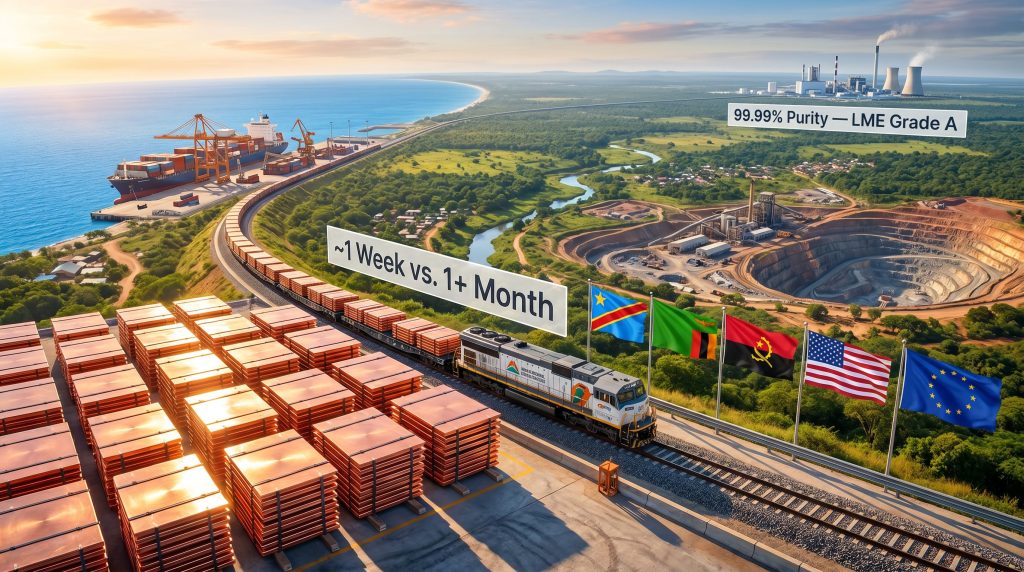
The Lobito Corridor functions as a rehabilitation and integration of existing rail infrastructure connecting the DRC's Copperbelt through Zambia to Angola's Port of Lobito on the Atlantic coast. The Lobito Atlantic Railway forms the backbone of this network, carrying mineral cargo westward to the ocean rather than funnelling it south through multiple border crossings and congested road networks.
The efficiency improvement this creates is substantial. European Union assessments have placed the transit time reduction at approximately 75 to 80 percent, compressing a journey that previously consumed more than a month down to roughly one week from mine to coast. From Lobito, Atlantic sea routes to northern European ports are comparatively direct, giving the corridor a total mine-to-refinery timeline that traditional southern African routes simply cannot match under current infrastructure conditions.
What this means in practical terms for a mining operator:
- Working capital cycles tighten because copper spends less time in transit between production and payment
- Demurrage exposure falls as vessel scheduling becomes more predictable with shorter, more reliable transit legs
- Spot market responsiveness improves because operators can react to pricing windows without being locked into weeks-long logistics commitments
- Insurance and freight cost structures shift favourably as transit distances and durations shrink
The Anode-to-Cathode Journey: A Technical Primer
One dimension of this shipment that is frequently misunderstood outside the metals industry is the distinction between copper anodes and the LME Grade A cathodes that ultimately arrived in Belgium. These are not the same product, and the difference matters enormously for pricing and market access.
Copper anodes are typically produced at smelters near the mine site, with purity levels commonly in the range of 99.5 to 99.7 percent. They represent an intermediate processing stage. LME Grade A copper cathodes, by contrast, must achieve a minimum purity of 99.99 percent and meet strict dimensional and surface quality specifications. This refined form is the global benchmark for physical copper pricing and the product against which futures contracts on the London Metal Exchange are settled.
The Kamoa-Kakula Copper Complex, which operates one of Africa's largest copper smelters, produced anodes of sufficient quality for intake at the Aurubis facility in Belgium. Aurubis, headquartered in Hamburg and one of Europe's largest copper refiners, then processed those anodes into LME Grade A cathodes exceeding the 99.99 percent purity threshold. The successful execution of this chain confirms technical compatibility between Central African anode quality and European refinery specifications, a question that had not previously been answered at commercial scale via this route.
Green Copper and the Carbon Premium: Why Purity Is Only Half the Story
Renewable Energy as a Competitive Differentiator
The Kamoa-Kakula supply chain draws predominantly on hydropower for its energy inputs, covering both the mining operation itself and the smelting process that produces export-ready anodes. This renewable energy foundation gives the resulting refined copper a carbon intensity profile that Ivanhoe Mines has described as among the lowest of any comparable copper product available in global markets.
That claim carries real commercial weight in the current European market environment. Consider what European industrial buyers are now navigating:
- The EU's Carbon Border Adjustment Mechanism (CBAM) is progressively applying carbon costs to imported goods, making the embedded emissions profile of raw material inputs a direct financial variable rather than an abstract sustainability metric
- Major European automotive manufacturers and renewable energy infrastructure developers have adopted Scope 3 emissions reduction commitments, which require accounting for the carbon intensity of purchased materials across supply chains
- Green copper premiums are an emerging pricing category in physical markets, with some European buyers willing to pay above the standard LME price for material with documented low-carbon provenance
| Supply Chain Variable | Kamoa-Kakula via Lobito | Conventional DRC Southern Corridor |
|---|---|---|
| Primary energy source | Predominantly hydropower | Mixed fossil fuel and grid |
| Transit time to Europe | ~1 week (rail + sea) | 4 to 6 weeks |
| Refined purity achieved | 99.99% (LME Grade A) | Varies by destination refinery |
| Carbon intensity classification | Among lowest globally | Higher due to transit length and energy mix |
| Working capital cycle | Compressed | Extended |
CBAM's Quiet Restructuring of Copper Sourcing Economics
The Carbon Border Adjustment Mechanism deserves specific attention because its implications for copper sourcing are not yet fully priced into mainstream investment narratives. Under CBAM, European importers of certain industrial goods are required to purchase carbon certificates corresponding to the carbon price that would have been paid under EU carbon pricing rules had the goods been produced domestically. As the mechanism matures and expands, the embedded carbon cost of copper sourced from high-emission supply chains will become a quantifiable cost disadvantage.
Low-carbon copper from a renewable-powered DRC supply chain, delivered via a short-transit Atlantic route, is structurally positioned to face lower CBAM-related cost burdens than copper from coal-heavy processing hubs. This is not a hypothetical future advantage; it is a mechanism already in transitional operation that will intensify through the remainder of the decade. In addition, shifting copper market trends further reinforce why European buyers are urgently reassessing their sourcing strategies.
The Commercial Validation Layer: Why Trafigura's Involvement Matters
The involvement of Trafigura, one of the world's largest commodity trading houses, in Lobito Corridor copper shipments to Europe provides a dimension of commercial credibility that transcends the operational milestone itself. Major trading houses do not commit their logistics networks and balance sheets to routes they regard as unreliable or commercially marginal. Trafigura's public confirmation that the Lobito Atlantic Railway has handled multiple copper shipments destined for both Europe and the Far East signals that the corridor has achieved repeatable commercial throughput, not a single demonstration event choreographed for press coverage.
This distinction is critical for investors evaluating the corridor's long-term relevance. A one-off shipment proves technical possibility. However, multiple commercial shipments through a trading house prove that the route has been stress-tested under real commercial conditions and found viable.
Comparing Africa's Copper Export Corridors: Where Lobito Stands
| Corridor | Key Route | Approximate Transit to Europe | Infrastructure Status | Primary Backers |
|---|---|---|---|---|
| Lobito Corridor | DRC/Zambia to Angola Atlantic | ~1 to 2 weeks | Active, under upgrade | US, EU, Angola, DRC, Zambia |
| TAZARA / Dar es Salaam | DRC/Zambia to Tanzania Indian Ocean | 4 to 6 weeks | Ageing, underfunded | Tanzania, Zambia |
| North-South Corridor | Zambia to South Africa Durban | 3 to 5 weeks | Operational, congested | SADC multilateral |
| Beira Corridor | Zambia to Mozambique Indian Ocean | 3 to 4 weeks | Operational, variable | Mozambique, Zambia |
The contrast in transit times is stark, but the more instructive comparison is infrastructure trajectory. The traditional corridors are operating at or near capacity in many segments, with maintenance backlogs and limited near-term investment commitments. The Lobito Corridor, by contrast, is receiving active capital infusion, including $753 million in financing secured by Angola from the United States and South Africa specifically for rail infrastructure development along the route. Consequently, the global copper supply gap makes this infrastructure investment even more strategically significant for European industrial planners.
What the DRC's Value Chain Position Actually Looks Like Now
From Concentrate Exporter to Refined Metal Producer
Historically, the DRC's position in the global copper value chain terminated early. The country exported ore concentrates and blister copper, with the higher-margin refining stages captured by Asian and European processing facilities. Each stage of processing that occurs outside the country of origin represents economic value that does not accrue to domestic workers, governments, or communities.
The delivery of LME Grade A cathodes from a DRC-origin supply chain marks a structural movement up this value ladder. The Kamoa-Kakula smelter, commissioned relatively recently and described as one of Africa's largest copper processing facilities, is the enabling infrastructure for this shift. Smelting near the mine site and exporting high-purity anodes for final refining, rather than shipping raw concentrates, captures meaningfully more economic value within the region.
The Multiplier Effect Beyond Copper
The Lobito Corridor's economic logic extends well beyond copper specifically. The rail infrastructure being built and rehabilitated along the corridor is commodity-agnostic. Cobalt, manganese, agricultural products, and general freight can all use the same rail backbone. For a region where transport cost has historically constrained the viability of entire industries, a functional low-cost rail link to an Atlantic port represents an economic multiplier with implications across sectors. Indeed, Africa's first copper shipment via this route signals a broader shift in how the continent positions itself within global commodity supply chains.
The next major ASX story will hit our subscribers first
Europe's Copper Supply Chain Strategy and the Diversification Imperative
The CRMA's 65 Percent Rule and What It Means for African Supply
The EU's Critical Raw Materials Act establishes a specific quantitative benchmark: no single non-EU country should supply more than 65 percent of any strategic raw material consumed by the EU. Copper is classified as a strategic raw material under this framework. The practical implication is that European industrial policy now creates structural demand for geographically diversified copper sources, regardless of purely commercial pricing considerations.
Central African copper delivered via the Lobito Corridor fits this diversification mandate precisely. It represents a supply origin that is neither Chile nor Peru, processed through a route that is neither Chinese-controlled nor reliant on the Suez Canal, and produced with a carbon intensity profile that aligns with European regulatory trajectories. Furthermore, the broader European raw materials strategy signals that this regulatory pressure will only intensify as the decade progresses.
Policy Context: The CRMA's diversification benchmarks are not aspirational targets; they carry implementation timelines and monitoring obligations. European buyers who fail to diversify sourcing face potential regulatory exposure as the framework matures. This creates institutional buying pressure for African copper that is structurally distinct from pure commercial demand.
Three Scenarios for the Corridor's Next Decade
Scenario 1: Accelerated Scale-Up
Sustained multi-sovereign investment, expanding DRC copper production, and growing European demand for low-carbon refined metal drive rapid throughput growth. The Lobito Corridor displaces southern corridor routes as the primary export pathway for Central African copper within five to seven years. Green copper premiums institutionalise as a pricing category, further rewarding renewable-powered supply chains.
Scenario 2: Steady Institutionalisation
The corridor achieves stable, growing utilisation but competition from upgraded southern routes and periodic geopolitical friction between corridor-state governments moderates growth. The route becomes one of several parallel options rather than a dominant artery, with market share building gradually over a longer timeframe.
Scenario 3: Structural Disruption Risk
Political instability in the DRC or Angola, infrastructure maintenance deficits following the initial investment phase, or shifts in great-power financing priorities slow corridor development below potential. The route remains technically functional but throughput fails to reach levels that justify the infrastructure investment narrative. Southern corridor operators capture volume that the Lobito route cannot consistently absorb.
Investors and analysts should note that these scenarios are not equally probable and carry asymmetric implications. The presence of multiple major commercial stakeholders, including Trafigura, Ivanhoe Mines, and Aurubis, alongside sovereign-level financing commitments, creates institutional momentum that is difficult to reverse in the short term even if political conditions deteriorate. For those exploring copper investment strategies in this evolving landscape, the corridor's trajectory deserves close attention.
Disclaimer: The scenario projections presented here are analytical constructs intended for informational purposes. They do not constitute investment advice, and actual outcomes will depend on factors including political developments, commodity price movements, infrastructure maintenance, and financing continuity that cannot be reliably predicted.
Key Data Summary: The Lobito Corridor Copper Shipment in Numbers
| Metric | Detail |
|---|---|
| Copper purity delivered to Europe | 99.99% (LME Grade A) |
| Origin operation | Kamoa-Kakula Copper Complex, DRC |
| European destination refinery | Aurubis AG, Belgium |
| Transit time reduction | ~1 week via Lobito vs. 1+ month via southern corridors |
| Angola rail financing secured | $753 million (US and South Africa) |
| Carbon intensity classification | Among world's lowest, renewable-powered supply chain |
| Corridor sovereign backers | US, EU, Angola, DRC, Zambia |
| Additional confirmed shipments | Multiple to Europe and Far East, per Trafigura |
| CRMA single-source cap threshold | 65% maximum from any one non-EU country |
What Would Confirm the Corridor's Permanence as a Major Copper Artery
For analysts and investors tracking the corridor's maturation, the following indicators would represent meaningful confirmation beyond the current milestone:
- Sustained quarterly throughput data showing consistent volume growth from multiple operators, not only Kamoa-Kakula
- Additional major DRC and Zambian mining companies formally routing export shipments through Lobito rather than southern corridors
- Long-term offtake agreements between European refiners and Central African producers that specify Lobito Corridor delivery terms
- Port of Lobito capacity expansion completions aligned with projected throughput growth
- Rail electrification milestones that further reduce the carbon intensity and operating cost of corridor transit
- Secondary commodity flows including cobalt and manganese that validate the corridor's utility beyond copper specifically
The first Lobito Corridor copper shipment to Europe is best understood not as a singular achievement but as a proof-of-concept that re-prices Central African copper's competitive position across multiple dimensions simultaneously: logistics efficiency, carbon intensity, value chain positioning, and European regulatory alignment. Underpinning all of this is the broader issue of critical minerals and energy security, which continues to shape how policymakers and investors assess routes like this one. The real question is not whether the corridor works, because this shipment confirms that it does, but how quickly the volumes will scale to match the strategic ambition that surrounds it.
Want to Track the Next Major Copper Discovery Before the Market Does?
Discovery Alert's proprietary Discovery IQ model delivers real-time alerts the moment significant ASX mineral discoveries are announced, turning complex commodity data into actionable insights for both short-term traders and long-term investors — begin your 14-day free trial today and see why historic discoveries have generated extraordinary returns for those who moved early.