
May 18, 2026
What Drives Copper M&A Activity at Major Mining Conventions?
Mining conventions represent critical inflection points where strategic consolidation accelerates across commodity markets. These gatherings transform from networking events into high-stakes dealmaking environments when fundamental supply-demand imbalances create acquisition urgency among major producers.
The copper sector exemplifies this dynamic, where projected supply deficits and electrification demand converge to reshape acquisition strategies at industry gatherings. Furthermore, copper dealmaking at PDAC convention has become particularly influential in shaping North American mining investment flows.
Global Supply Chain Pressures Creating Deal Urgency
Supply chain vulnerabilities in copper production have intensified acquisition competition among Tier-1 mining companies. Current market analysis indicates that global supply growth rates are declining, while demand from renewable energy infrastructure and electric vehicle manufacturing continues expanding exponentially.
Major mining corporations face a strategic imperative to secure copper resources through acquisitions rather than relying solely on organic growth. This pressure stems from several interconnected factors:
- Declining ore grades at existing operations requiring higher-grade replacement assets
- Extended permitting timelines making greenfield development increasingly challenging
- Infrastructure constraints limiting access to remote deposits without acquisition partnerships
- Geopolitical risks driving diversification away from concentrated supply regions
Strategic Asset Positioning in Critical Minerals Markets
The classification of copper as a critical mineral has fundamentally altered how mining companies evaluate acquisition targets. Strategic positioning now extends beyond traditional metrics of grade and tonnage to encompass broader supply chain security considerations.
Mining executives increasingly prioritize assets located in stable jurisdictions with established regulatory frameworks. This preference has created valuation premiums for North American copper projects, particularly those with advanced permitting status or existing infrastructure access.
The strategic value of copper assets has also been enhanced by their potential integration with other critical minerals. Projects containing copper alongside uranium command higher acquisition multiples due to their ability to serve multiple supply chains within a single operation.
Capital Allocation Trends Among Tier-1 Mining Companies
Large-scale mining companies have shifted capital allocation strategies toward copper-focused acquisitions over the past 24 months. This reallocation reflects long-term demand projections that indicate sustained price support above historical averages.
Capital deployment patterns reveal several emerging trends:
- Increased risk tolerance for earlier-stage development projects
- Premium pricing for assets with near-term production potential
- Partnership structures replacing outright acquisitions for larger deposits
- Technology integration requirements driving higher acquisition costs
Financial modelling by major producers now incorporates longer payback periods and higher discount rates to account for copper's strategic importance in energy transition portfolios.
When big ASX news breaks, our subscribers know first
How Do Mining Convention Dynamics Influence Dealmaking Outcomes?
Mining conventions create unique environments where information asymmetries temporarily decrease, enabling more efficient price discovery for potential acquisition targets. The concentrated presence of industry participants accelerates due diligence processes and facilitates rapid decision-making that would otherwise require months of separate negotiations.
PDAC's Role as North America's Premier Deal-Making Platform
The Prospectors & Developers Association of Canada convention has evolved into North America's most significant venue for copper dealmaking at PDAC convention. PDAC's timing in early March coincides with Q1 corporate development planning cycles, creating optimal conditions for transaction announcements and preliminary negotiations.
PDAC's unique structure facilitates copper dealmaking through several mechanisms:
- Concentrated executive presence enabling rapid senior-level decision making
- Technical presentation formats allowing detailed project evaluation
- Private meeting facilities supporting confidential negotiation processes
- Investment community participation providing financing solutions
The convention's reputation for copper project transactions has created self-reinforcing dynamics where companies specifically time major announcements to coincide with PDAC week. Moreover, copper M&A cycle activity reaches peak intensity during these gatherings.
Networking Infrastructure and Transaction Facilitation
Mining conventions provide structured networking infrastructure that reduces transaction costs and accelerates deal completion timelines. The ability to conduct multiple stakeholder meetings within a compressed timeframe enables complex multi-party transactions that would be logistically challenging in normal business environments.
Convention settings also facilitate information sharing between technical teams, reducing due diligence timelines and enabling more accurate asset valuations. This efficiency becomes particularly valuable for copper projects where geological complexity requires extensive technical review.
Timing Advantages for Q1 Corporate Development Strategies
First quarter mining conventions align with optimal timing for corporate development initiatives. Companies typically complete annual budget planning in December and January, positioning them to execute strategic acquisitions early in the calendar year.
This timing alignment creates several advantages:
- Fresh capital budgets enabling larger transaction sizes
- Annual guidance updates allowing acquisition impact integration
- Regulatory filing schedules supporting timely disclosure requirements
- Market sentiment patterns often favouring mining sector performance in Q1
Which Copper Project Categories Attract the Most Investment Interest?
Copper project investment interest varies significantly based on development stage, resource characteristics, and geographic location. Current market conditions favour advanced-stage projects with defined resources and clear development pathways over early-stage exploration targets.
Tier-One Asset Characteristics and Valuation Metrics
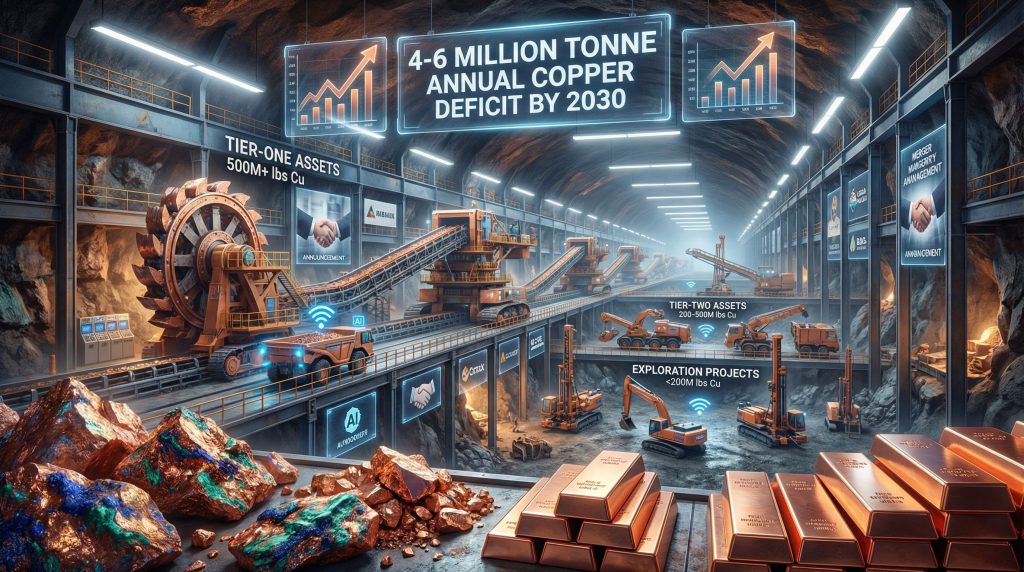
Tier-One copper assets command premium valuations due to their combination of scale, grade, and development certainty. These projects typically feature large-scale resources exceeding 500 million pounds of contained copper with grades above regional averages.
| Asset Tier | Minimum Resources | Infrastructure Access | Development Timeline | Risk Profile |
|---|---|---|---|---|
| Tier-One | 500M+ lbs Cu | Established | 3-5 years | Low-Medium |
| Tier-Two | 200-500M lbs Cu | Moderate | 5-8 years | Medium |
| Exploration | <200M lbs Cu | Variable | 8+ years | High |
Valuation metrics for Tier-One assets typically range from $0.08 to $0.15 per pound of contained copper, depending on jurisdiction and development stage. Projects with existing infrastructure or processing facilities command higher multiples due to reduced capital requirements.
Geographic Preference Patterns in Current Market Conditions
Geographic risk assessment has become increasingly sophisticated in copper project evaluation. Political stability, regulatory predictability, and infrastructure availability significantly influence acquisition interest and valuation multiples.
Current geographic preference patterns indicate:
- North American projects receiving 15-25% valuation premiums
- Australian assets maintaining strong institutional investor appeal
- Chilean operations benefiting from established mining infrastructure
- African developments requiring higher risk-adjusted return thresholds
Geopolitical considerations have particularly impacted valuation of projects in emerging markets. Additionally, projects in regions like Argentina are gaining attention due to their major copper systems and development potential.
Technology Integration and ESG Compliance Requirements
Modern copper projects increasingly require integration of advanced mining technologies and comprehensive ESG compliance frameworks. These requirements add complexity to acquisition evaluation but also create competitive advantages for well-positioned assets.
Technology integration requirements include:
- Autonomous haulage systems for improved operational efficiency
- AI-driven ore grade optimisation to maximise resource recovery
- Remote monitoring capabilities reducing operational risks
- Carbon capture integration for emissions reduction compliance
ESG compliance has become a mandatory consideration rather than an optional enhancement, particularly for projects seeking financing from major institutional investors or development banks. Furthermore, underground copper mining operations are increasingly adopting advanced analytical technologies.
What Are the Key Financial Drivers Behind 2026 Copper Consolidation?
Financial modelling for copper consolidation reflects fundamental shifts in long-term demand projections and supply availability constraints. Industry analysts project significant supply deficits emerging in the second half of this decade, creating compelling investment cases for strategic acquisition programmes.
Long-Term Demand Projections and Supply Gap Analysis
Industry analysts project a 4-6 million tonne annual copper deficit by 2030, driving aggressive acquisition strategies among major producers seeking to secure long-term supply chains.
This projected deficit stems from accelerating electrification trends across multiple sectors simultaneously. Electric vehicle adoption rates, renewable energy infrastructure development, and grid modernisation programmes all require substantial copper consumption increases that exceed current production capacity expansion plans.
Supply constraints result from several converging factors:
- Declining ore grades at existing major operations
- Extended development timelines for new mining projects
- Capital intensity increases for remote or complex deposits
- Environmental permitting complexity delaying project advancement
Capital Efficiency Metrics in Current Deal Structures
Copper acquisition deal structures increasingly emphasise capital efficiency metrics rather than traditional resource-based valuations. Buyers focus on projects offering the highest copper production per dollar of development capital rather than simply the largest resource bases.
Key capital efficiency metrics include:
- Capital intensity per annual copper pound produced
- Net present value per dollar of acquisition cost
- Payback period under conservative price assumptions
- Operating cost position on the global cost curve
These metrics reflect the reality that copper project development capital costs have increased substantially, making acquisition of advanced-stage assets more attractive than greenfield development.
Risk-Adjusted Return Calculations for Copper Investments
Risk-adjusted return calculations for copper investments now incorporate broader ranges of potential outcomes due to increased market volatility and regulatory uncertainty. Monte Carlo simulation models commonly include price volatility ranges of 40-60% around base case assumptions.
Standard risk adjustments include:
- Regulatory approval delays adding 12-18 months to development timelines
- Construction cost overruns ranging from 15-35% above initial estimates
- Commodity price volatility requiring sensitivity analysis across multiple scenarios
- Currency fluctuation impacts for projects in emerging market jurisdictions
How Do Major Mining Companies Evaluate Copper Acquisition Targets?
Major mining companies employ sophisticated evaluation frameworks that extend beyond traditional resource assessment to encompass strategic fit, operational integration potential, and long-term portfolio optimisation. These frameworks have evolved to address increasing complexity in copper project development and operation.
Due Diligence Frameworks for Resource Assessment
Contemporary due diligence frameworks for copper acquisitions integrate multiple technical and commercial evaluation streams. Resource assessment extends beyond historical drilling results to include modern geological modelling and metallurgical testing validation.
Evaluation Checklist:
- Resource grade and tonnage verification through independent geological review
- Metallurgical testing completeness ensuring processing pathway viability
- Environmental permitting status assessment of regulatory approval timeline
- Community relations evaluation measuring social licence sustainability
- Infrastructure development costs quantifying required capital investments
Technical evaluation teams now routinely employ artificial intelligence and machine learning tools to analyse geological data and identify optimisation opportunities that may not be apparent through traditional assessment methods.
Strategic Fit Analysis and Portfolio Optimisation
Strategic fit analysis evaluates how potential acquisitions enhance overall portfolio performance rather than standalone project economics. This approach recognises that copper assets may provide strategic value through geographic diversification, operational synergies, or supply chain integration.
Portfolio optimisation considerations include:
- Geographic risk distribution across multiple stable jurisdictions
- Production profile timing to maintain consistent cash flow generation
- Processing facility utilisation to maximise existing infrastructure value
- Shared services integration reducing consolidated operating costs
Companies increasingly model acquisition impacts on consolidated financial metrics rather than evaluating projects in isolation.
Geopolitical Risk Assessment in Asset Selection
Geopolitical risk assessment has become a primary filter in copper acquisition evaluation. Recent resource nationalism trends and regulatory changes have elevated political risk considerations to equal importance with technical and financial metrics.
Risk assessment frameworks evaluate:
- Political stability indicators including election cycles and policy continuity
- Mining law predictability and historical treatment of foreign investment
- Tax regime stability and likelihood of future fiscal changes
- Infrastructure reliability including power supply and transportation access
Major mining companies now maintain dedicated geopolitical risk teams to support acquisition evaluation and ongoing operational monitoring.
What Role Do Junior Mining Companies Play in the Copper Value Chain?
Junior mining companies serve as essential intermediaries in the copper value chain, advancing early-stage exploration targets through preliminary development stages before transfer to major producers. This model has become increasingly important as major mining companies focus capital allocation on advanced-stage assets rather than grassroots exploration.
Exploration-to-Development Pipeline Management
Junior companies provide specialised expertise in early-stage exploration and resource definition that complements major producers' operational capabilities. Their focused approach to individual projects enables more efficient capital deployment during high-risk exploration phases.
The exploration-to-development pipeline typically follows this progression:
- Grassroots exploration identifying prospective geological targets
- Preliminary resource definition through systematic drilling programmes
- Feasibility study completion establishing project economic viability
- Permitting advancement securing necessary regulatory approvals
Junior companies excel in the first two phases, while major producers typically acquire assets during feasibility or permitting stages when risk profiles align with their investment criteria.
Partnership Structures and Joint Venture Models
Partnership structures between junior and major mining companies have evolved to address changing risk tolerance and capital availability patterns. These arrangements enable risk sharing while preserving development optionality for both parties.
Common partnership models include:
- Earn-in agreements allowing majors to acquire increasing ownership through development funding
- Option arrangements providing acquisition rights at predetermined valuations
- Joint venture structures sharing development costs and production revenues
- Technical support agreements providing expertise while maintaining junior company control
These structures have become more sophisticated, incorporating milestone-based payments and performance incentives that align interests throughout development phases.
Exit Strategy Optimisation for Junior Developers
Junior mining companies increasingly design exit strategies from project inception, recognising that optimal exit timing requires careful coordination with market conditions and major producer acquisition cycles.
Successful exit strategies typically incorporate:
- Market timing coordination with commodity price cycles and investor sentiment
- Strategic buyer identification early in the development process
- Asset package optimisation to maximise attractiveness to potential acquirers
- Regulatory milestone achievement reducing acquisition risk for buyers
Convention environments like PDAC provide optimal venues for executing these exit strategies through concentrated buyer-seller interactions.
The next major ASX story will hit our subscribers first
Which Market Conditions Favour Copper M&A Activity?
Copper M&A activity demonstrates strong correlation with specific market condition combinations that create favourable environments for both buyers and sellers. These conditions extend beyond simple commodity price levels to encompass broader financial market dynamics and industry-specific factors.
Commodity Price Cycles and Transaction Timing
Copper M&A activity typically peaks during periods of price stability rather than extreme highs or lows. Sustained pricing above $8,000 per tonne provides sufficient cash flow visibility for acquisition financing while avoiding the valuation uncertainties associated with price volatility.
Market Timing Factors:
- Copper price stability above $8,000/tonne providing cash flow predictability
- Interest rate environment favouring capital deployment reducing financing costs
- Currency exchange rate advantages particularly for cross-border transactions
- Regulatory clarity in key jurisdictions reducing acquisition execution risk
Historical analysis indicates that copper M&A transaction volumes increase by 35-50% during periods when these four conditions align simultaneously. Indeed, copper dealmaking leads PDAC week activities when market conditions are optimal.
Credit Market Access and Financing Availability
Credit market conditions significantly influence copper M&A activity levels, particularly for transactions requiring substantial development capital or debt refinancing. Mining project financing requires specialised lenders with commodity market expertise and long-term capital availability.
Favourable credit conditions include:
- Project finance availability from development banks and commodity-focused lenders
- Corporate credit spreads below historical averages for investment-grade miners
- Equipment financing options supporting capital-intensive development projects
- Working capital facilities providing operational cash flow support
Copper projects typically require 5-7 year development financing arrangements, making lender appetite for long-term mining exposure a critical transaction enabler.
Shareholder Sentiment and Market Liquidity Conditions
Shareholder sentiment toward mining investments creates significant impacts on acquisition activity through its influence on equity valuations and transaction approval processes. Positive sentiment enables premium pricing for quality assets while negative sentiment can create acquisition opportunities for well-capitalised buyers.
Market liquidity conditions affect transaction execution through several mechanisms:
- Equity market valuations determining relative attractiveness of acquisition versus internal development
- Trading volume patterns influencing shareholder approval likelihood for complex transactions
- Institutional investor positioning affecting financing availability and terms
- Market volatility levels impacting transaction timing and structure decisions
How Are ESG Considerations Reshaping Copper Deal Structures?
Environmental, social, and governance considerations have transformed from peripheral concerns to core elements of copper acquisition evaluation and deal structuring. These factors now influence valuation, financing terms, and operational integration planning throughout the transaction lifecycle.
Environmental Compliance Standards in Asset Valuation
Environmental compliance requirements significantly impact copper asset valuations through their influence on development costs, operational restrictions, and long-term liability exposure. Projects with established environmental management systems and clean operational histories command premium valuations.
Key environmental valuation factors include:
- Baseline environmental conditions affecting permitting complexity and costs
- Water management requirements particularly critical for copper processing operations
- Waste storage arrangements including tailings facility design and monitoring
- Rehabilitation obligations influencing long-term cash flow projections
Advanced environmental management systems can reduce development timelines by 12-18 months through streamlined permitting processes, creating substantial net present value advantages.
Social Licence Requirements and Community Engagement
Social licence requirements have evolved from informal community relations to formal stakeholder engagement frameworks with measurable performance indicators. Successful community engagement significantly reduces operational risk and enhances long-term project sustainability.
Effective social licence programmes typically include:
- Community benefit sharing agreements providing ongoing economic participation
- Local employment and procurement commitments supporting regional economic development
- Cultural heritage protection protocols addressing indigenous rights and traditional land use
- Environmental impact mitigation measures addressing community concerns about operational effects
Projects with established community support demonstrate lower operational risk profiles and reduced likelihood of production disruptions.
Governance Framework Integration in M&A Planning
Corporate governance framework integration has become essential for cross-border copper acquisitions, particularly involving companies from different regulatory jurisdictions. Governance alignment affects transaction structure, post-acquisition integration complexity, and ongoing operational oversight requirements.
Governance integration considerations include:
- Board composition requirements balancing technical expertise with independence standards
- Executive compensation alignment ensuring performance incentives support long-term value creation
- Risk management system integration combining operational and financial risk oversight
- Stakeholder communication protocols maintaining transparency throughout integration processes
What Future Trends Will Shape Copper Dealmaking Beyond 2026?
Future copper dealmaking patterns will be shaped by technological advancement, regulatory evolution, and fundamental shifts in global supply chain architecture. These trends are already influencing current acquisition strategies and will intensify over the remainder of this decade.
Technology Integration and Automation Investment Requirements
Technology integration requirements are transforming copper project evaluation criteria and post-acquisition development planning. Advanced mining technologies enable higher productivity and improved safety performance but require substantial upfront capital investments and specialised technical expertise.
Emerging Technologies in Copper Mining:
- Autonomous haulage systems reducing labour costs and improving operational efficiency
- AI-driven ore grade optimisation maximising resource recovery and processing throughput
- Remote monitoring and predictive maintenance minimising unplanned equipment downtime
- Carbon capture integration supporting environmental compliance and cost reduction
These technologies require integration during project development rather than retrofit after production commencement, influencing acquisition target evaluation and development timeline planning.
Supply Chain Resilience and Strategic Stockpiling
Supply chain resilience has emerged as a strategic priority for copper consumers, particularly in renewable energy and electric vehicle manufacturing sectors. This trend is driving vertical integration strategies and long-term supply contract negotiations that influence mining company acquisition decisions.
Strategic stockpiling initiatives by major consuming nations are creating additional demand layers that extend beyond traditional industrial consumption patterns. These programmes provide price support during economic downturns while creating supply tightness during expansion periods.
Copper producers are responding through:
- Direct customer partnerships securing long-term off-take commitments
- Geographic diversification strategies reducing single-jurisdiction supply risks
- Processing capability expansion capturing additional value chain margins
- Recycling technology investments developing secondary supply sources
Critical Minerals Policy Impact on Investment Flows
Critical minerals policy frameworks are redirecting investment flows toward domestic and allied-nation copper production capacity. These policies create competitive advantages for projects located in preferred jurisdictions while potentially disadvantaging assets in non-aligned regions.
Policy impacts include:
- Accelerated permitting procedures for strategically important projects
- Financial incentive programmes reducing development capital requirements
- Research and development support advancing mining technology capabilities
- Trade policy coordination affecting competitive dynamics across jurisdictions
These policy frameworks are expected to intensify over the next decade as energy transition acceleration increases copper strategic importance.
Key Takeaways for Copper Investment Strategy Development
Copper investment strategy development requires integration of multiple complex and evolving factors that extend beyond traditional commodity investment considerations. Successful strategies must balance short-term market dynamics with long-term structural demand trends while maintaining flexibility to adapt to changing conditions.
Risk-Return Profile Optimisation in Current Market
Current market conditions favour copper investments with strong risk-adjusted return profiles rather than maximum absolute return potential. This preference reflects increased volatility and uncertainty across multiple risk dimensions including geopolitical, regulatory, and technological factors.
Optimal risk-return profiles typically feature:
- Geographic diversification across multiple stable jurisdictions
- Development stage distribution balancing near-term production with long-term growth options
- Scale optimisation focusing on projects capable of achieving cost curve advantages
- Operational flexibility enabling production adjustments based on market conditions
Portfolio Diversification Considerations
Copper portfolio diversification extends beyond traditional geographic and operational parameters to encompass ESG performance, technological capability, and stakeholder relationship quality. These additional diversification dimensions reduce various forms of operational and regulatory risk.
Effective diversification strategies incorporate:
- Jurisdiction risk distribution avoiding over-concentration in single regulatory environments
- Operational stage balance combining producing assets with development projects
- Technology integration levels ranging from conventional to highly automated operations
- Market exposure variety serving different customer segments and geographic markets
Long-Term Value Creation Through Strategic Positioning
Long-term value creation in copper investments requires strategic positioning that anticipates and capitalises on structural industry changes rather than simply riding commodity price cycles. This approach demands deeper understanding of technology trends, policy evolution, and supply chain transformation.
Strategic positioning considerations include positioning within established supply chains serving growth industries, developing technological capabilities that create competitive advantages, maintaining operational flexibility to adapt to changing market requirements, and building stakeholder relationships that support long-term operational sustainability.
The copper sector's role in global energy transition ensures continued strategic importance, but success will increasingly depend on operational excellence and stakeholder management rather than simply resource ownership. Companies and investors that adapt their strategies to these realities will be best positioned to capitalise on the sector's long-term growth prospects.
Further Exploration:
Readers interested in comprehensive mining industry analysis can explore additional educational resources covering global commodity markets and strategic investment frameworks in the natural resources sector.
Seeking Opportunities in ASX Copper Discoveries?
Discovery Alert's proprietary Discovery IQ model delivers real-time alerts on significant copper discoveries announced on the ASX, empowering investors to capitalise on actionable opportunities before the broader market reacts. With major mineral discoveries historically generating substantial returns, explore Discovery Alert's dedicated discoveries page to understand the potential impact and begin your 14-day free trial to secure your competitive advantage in today's rapidly evolving copper market.