May 16, 2026
The Copper Calculus: Why State-Backed Capital Keeps Flowing Into Africa's Most Hostile Mining Jurisdictions
Frontier mining investment has never followed a straight line. Across decades of African resource development, the pattern repeats: geological promise attracts capital, conflict disrupts it, and patient sovereign investors with long time horizons outlast the disruption to claim asymmetric returns. The decision by Qatar Mining to restart Sudan mining operations after a two-year civil war pause is not an anomaly. It is a precise expression of this logic, applied to one of northeastern Africa's most significant undeveloped copper systems.
Understanding why this matters requires moving past the headline figure and examining the geological, geopolitical, and structural forces converging in Red Sea State.
When big ASX news breaks, our subscribers know first
Sudan's Mineral Economy: Built on Gold, Now Pivoting to Copper
Sudan's relationship with its mineral sector deepened dramatically after South Sudan's secession in 2011 stripped Khartoum of the majority of its oil revenues. With petroleum income sharply reduced, gold extraction became the primary engine of foreign exchange earnings, with the country consistently ranking among Africa's top gold producers by volume.
However, gold dominance has always masked an underexplored base metals story. Sudan's geological formations, particularly in its northeastern corridor along the Red Sea Hills and into the Nubian Shield, host conditions associated with large-scale copper mineralisation. The Nubian Shield is a Precambrian geological province that extends across northeastern Africa and the Arabian Peninsula, and it has historically produced significant mineral deposits wherever modern exploration techniques have been applied systematically.
The civil war that erupted in April 2023 between the Sudanese Armed Forces and the Rapid Support Forces effectively froze this emerging story. Infrastructure was disrupted, foreign company personnel were evacuated, and concession activity ground to a halt across most of the country. The disruption was severe, but it was not permanent.
Jebel Ohier: The Geology Behind the $800 Million Commitment
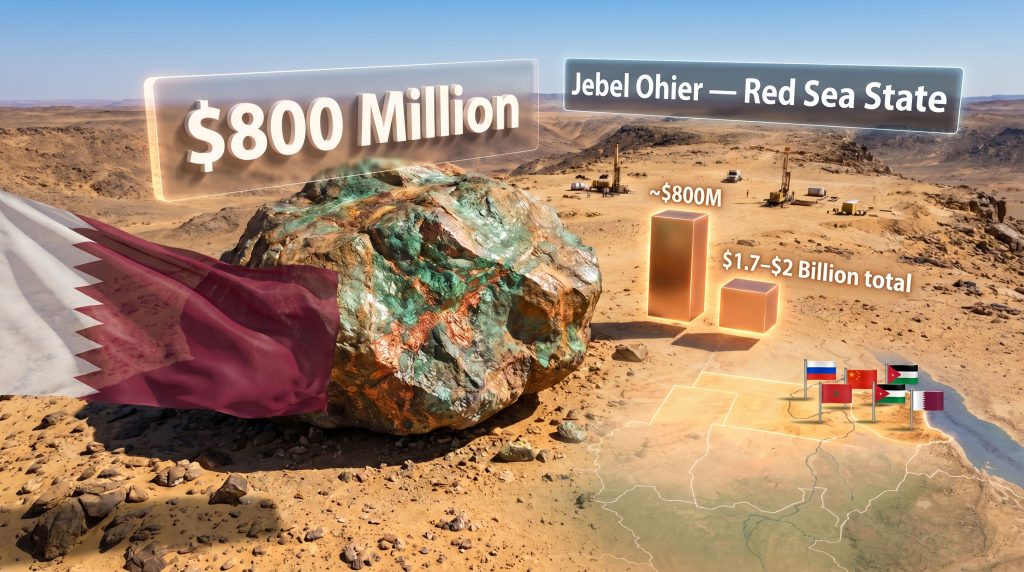
The centrepiece of Qatar restarts Sudan mining operations news is the Jebel Ohier deposit in Red Sea State, a copper-gold porphyry system that has been under investigation by Qatar Mining's Sudanese subsidiary, QMSD, since the company established its presence in Sudan in 2012.
Porphyry copper deposits deserve specific attention because they are the workhorses of global copper supply. They account for approximately 75% of the world's copper production and a significant share of global molybdenum and gold byproduct output. What distinguishes them from other deposit types is their scale and geometry: porphyry systems typically feature large, bulk-tonnage ore bodies with relatively consistent grade distribution, making them ideally suited for mechanised, large-scale open-pit or block-cave mining methods.
Furthermore, understanding the broader copper supply crunch helps contextualise why Qatar is committing such significant capital to a challenging jurisdiction. Key technical characteristics of porphyry systems relevant to Jebel Ohier include:
- Deposit size: Porphyry systems are typically measured in hundreds of millions to billions of tonnes of mineralised material, which justifies the capital intensity of development
- Grade profile: Copper grades in porphyry deposits typically range from 0.2% to 0.8% Cu, with higher-grade zones often enriched through supergene processes near the surface
- Byproduct economics: Gold and molybdenum credits from porphyry mines can substantially improve project economics, lowering the effective cost of copper production
- Mine life: Large porphyry operations routinely achieve 20 to 40-year mine lives, making short-term political disruption a manageable variable for investors with sovereign-scale patience
The $800 million investment figure attached to Jebel Ohier reflects these development realities. Building the processing infrastructure, tailings facilities, water management systems, and haul road networks required to extract value from a porphyry deposit at industrial scale requires capital measured in hundreds of millions, deployed over years rather than months.
Technical Note: Copper-gold porphyry deposits form through the intrusion of magmatic fluids into surrounding rock, with copper and gold precipitating as temperatures and pressures drop. The Red Sea Hills region of Sudan sits within a tectonic environment that has historically been associated with this type of mineralisation, making Jebel Ohier's geological setting credible for a large-scale system.
Qatar's Sudan Footprint: A Sovereign Investment Architecture
The copper project does not exist in isolation. Qatar's total investment exposure in Sudan is estimated at between $1.7 billion and $2 billion, distributed across approximately 60 projects spanning multiple economic sectors.
| Sector | Representative Initiative | Strategic Logic |
|---|---|---|
| Mining | Jebel Ohier copper-gold project (QMSD) | Upstream resource access and export revenue |
| Agriculture | Hassad Food | Gulf food security via Sudan's arable land reserves |
| Real Estate | Urban development projects | Capital deployment and infrastructure exposure |
| Banking and Finance | Financial sector participation | Trade facilitation and liquidity access |
Hassad Food is particularly instructive as a window into Qatari investment philosophy. Sudan holds some of the largest untapped arable land reserves in Africa, and Hassad's operations there reflect a dual-purpose calculus: generating commercial returns while simultaneously securing food supply chains for a Gulf state that imports the vast majority of its food requirements.
This mirrors the logic applied to mining. The investment is not purely financial — it is strategic resource positioning. For state-backed entities operating under this framework, the risk tolerance ceiling is structurally higher than it would be for a listed mining company accountable to quarterly earnings guidance. A sovereign vehicle can absorb years of deferred returns in exchange for the optionality of being positioned when conditions improve.
Who Is Still Operating in Sudan and Why It Matters
One of the less-discussed dimensions of Sudan's conflict-era mining landscape is the degree to which foreign operators from several nations have maintained continuous presence in the country's stable northern zones. Sudan's Ministry of Minerals has confirmed that international mining companies from Russia, China, Morocco, and Jordan have kept operations running throughout the conflict period, restricted to the River Nile, Northern, and Khartoum states.
This is not incidental. It reflects a deliberate calculus by each of these nations, as illustrated below:
| Country | Primary Investment Driver | Risk Management Mechanism |
|---|---|---|
| China | Long-term copper and gold supply security | State-backed capital, bilateral diplomatic frameworks |
| Russia | Geopolitical influence combined with resource access | Alignment with SAF-controlled government |
| Qatar | Sovereign wealth deployment plus diplomatic bilateral ties | Concession restrictions to secure northern zones |
| Morocco | Regional trade relationships and proximity | Selective operational continuity in stable areas |
| Jordan | Bilateral trade frameworks and geographic proximity | Targeted concession management |
The continued presence of these operators is itself a signal to international markets. It suggests that Sudan's northern mineral corridor has maintained sufficient stability to sustain operational continuity, even as catastrophic conflict has unfolded in other parts of the country. In addition, the mining geopolitical landscape across Africa more broadly is reshaping how sovereign investors evaluate risk and position capital.
Artisanal to Industrial: Sudan's Mining Sector Structural Reform Agenda
A frequently overlooked dimension of the Qatar restarts Sudan mining operations story is what it signals about Sudan's broader sectoral reform ambitions. The Ministry of Minerals has articulated a clear strategic objective: transition the sector away from artisanal and small-scale mining (ASM) toward formalised, large-scale industrial extraction.
This is a materially significant ambition. Sudan's artisanal gold mining sector has historically been enormous, involving hundreds of thousands of informal operators across multiple states. While it has provided livelihoods for a large population, the ASM sector has also created persistent structural problems:
- Revenue leakage through informal gold trading and smuggling channels that bypass official royalty and tax collection mechanisms
- Environmental degradation through unregulated use of mercury and other processing chemicals without rehabilitation obligations
- Investor deterrence as large mining companies are reluctant to develop concessions adjacent to active artisanal operations due to land access conflicts and reputational risk
- Data deficiency because informally mined areas are poorly documented in terms of resource estimation, making bankable feasibility studies difficult to construct
The Jebel Ohier copper project, if it advances to production, would represent precisely the kind of anchor investment that the Ministry of Minerals is seeking to demonstrate: a large-scale, formally structured operation generating measurable government revenue through transparent royalty and taxation frameworks.
Structural Insight: The transition from ASM-dominated to industrially-dominated mining is a well-documented development pathway in Africa. Countries including Ghana, Zambia, and Tanzania have navigated versions of this transition over multi-decade timelines, with mixed success. Sudan's challenge is that it is attempting this structural shift while simultaneously managing an active internal conflict, creating a dual execution risk that no comparable African precedent has faced at the same scale.
The next major ASX story will hit our subscribers first
Three Scenarios for Sudan's Mining Recovery Trajectory
The forward trajectory for Qatar's copper ambitions in Sudan is not binary. Investors and analysts should be thinking across a spectrum of outcomes.
Scenario A: Accelerated Stabilisation (Optimistic)
If peace negotiations between the Sudanese Armed Forces and the Rapid Support Forces produce a durable ceasefire within 12 to 18 months, the northern mining corridor could become a proving ground for post-war reconstruction investment. Qatar's copper project would function as a flagship demonstration of foreign capital's return, potentially catalysing additional investment inflows from operators who have been watching from the sidelines.
Scenario B: Protracted Conflict with Enclave Operations (Base Case)
Mining activity remains geographically confined to the stable northern states. Qatar, China, Russia, and others continue operating within their permitted concession zones. The Jebel Ohier project advances incrementally through later-stage exploration and early development phases, but broader FDI into Sudan's full mineral estate remains constrained. This is the most likely near-term outcome given current conflict dynamics.
Scenario C: Escalation and Capital Suspension (Downside)
Conflict expands northward into the River Nile and Northern states, destabilising the zones that have functioned as mining enclaves throughout the war. Under this scenario, even committed state-backed operators would face pressure to suspend or exit. Recovery timelines would extend significantly, potentially beyond a decade.
Disclaimer: These scenarios are analytical projections based on available information and historical precedents in conflict-affected mining jurisdictions. They do not constitute investment advice. Readers should conduct independent due diligence before making any investment decisions related to Sudan or its mining sector.
The Copper Demand Backdrop Shaping Qatar's Long-Duration Thesis
The decision to recommit to an $800 million copper project in a conflict-affected jurisdiction becomes more legible when viewed against the structural trajectory of global copper demand. The critical minerals demand surge driven by the energy transition has fundamentally altered copper's demand profile. Electric vehicles require approximately 2.5 to 4 times more copper than equivalent internal combustion engine vehicles.
Grid infrastructure upgrades needed to accommodate renewable energy integration are intensely copper-dependent. Heat pump systems, offshore wind turbines, and large-scale battery storage installations all carry significant copper content. Consequently, the challenge for the global copper industry is that the pipeline of new large-scale projects capable of meeting this demand growth is increasingly concentrated in jurisdictions characterised by complexity.
For a sovereign investor like Qatar, which does not face the same short-term earnings pressure as a listed mining company, this complexity is manageable. The long-duration asset thesis holds that a copper-gold porphyry deposit with a potential 25 to 30-year mine life will generate returns that dwarf the near-term costs of navigating political and operational risk. The key variable is not whether disruption occurs; it is whether the underlying geological asset justifies enduring through it. Exploring copper investment strategies of this nature reveals why sovereign patience consistently outperforms short-term capital in frontier markets.
What Qatar's Return Reveals About Gulf Resource Strategy in Africa
The resumption of Qatar restarts Sudan mining operations activity is not an isolated bilateral event. It sits within a broader pattern of Gulf state capital targeting African critical minerals with a patience and strategic focus that differs markedly from Western mining majors, which have largely avoided Sudan entirely.
According to recent reporting, Qatar's ambassador attending mining discussions in Port Sudan alongside company officials signals that this engagement carries the formal weight of state-to-state relations, not merely commercial negotiation. This diplomatic dimension provides a layer of political risk insurance that pure commercial investors cannot replicate.
When a bilateral relationship between states underpins a mining concession, the concession holder has recourse mechanisms and communication channels that go beyond what a standard mining licence provides. Sudan's position at the intersection of the Red Sea corridor, the Horn of Africa, and the broader Sahel region makes it geopolitically significant well beyond its mineral endowment. For Qatar, maintaining an active and growing investment presence in Sudan is a tool of regional diplomatic influence as much as it is a resource acquisition strategy.
How Does Jebel Ohier Compare to the World's Largest Operations?
Contextualising the scale of Jebel Ohier against the largest copper mines globally underscores why porphyry systems command such sustained sovereign interest. The world's top-producing copper operations — concentrated in Chile, Peru, and the DRC — are overwhelmingly porphyry deposits, and they generate returns over decades that justify even the most challenging development environments. Analysis from Sudan Horizon confirms that discussions between Sudan and Qatar have specifically focused on accelerating the return of these mining investments, reflecting the strategic urgency both parties attach to the project.
Frequently Asked Questions: Qatar Restarts Sudan Mining Operations
Why did Qatar Mining pause operations in Sudan?
Qatar Mining suspended Sudanese operations in April 2023 following the outbreak of conflict between the Sudanese Armed Forces and the Rapid Support Forces. The security environment created operational and safety risks that made continued activity impractical at the time.
What type of deposit is Jebel Ohier?
Jebel Ohier is classified as a copper-gold porphyry deposit located in Sudan's Red Sea State. Porphyry systems of this type are globally significant because they account for the majority of the world's copper production and are typically characterised by large, bulk-tonnage ore bodies suited to industrial-scale extraction.
How large is Qatar's total investment exposure in Sudan?
Qatar's cumulative investment across Sudan is estimated at between $1.7 billion and $2 billion, spread across approximately 60 projects covering mining, agriculture through Hassad Food, real estate, and banking and financial services.
Which regions of Sudan are currently open for mining operations?
Sudan's Ministry of Minerals has designated the River Nile, Northern, and Khartoum states as the primary zones where foreign mining concessions are permitted to operate, based on their relative stability compared to conflict-affected areas in western and southern Sudan.
Is the Jebel Ohier copper project a new announcement?
No. Qatar Mining has maintained a presence in Sudan since 2012 through its subsidiary QMSD. The $800 million copper project at Jebel Ohier represents the resumption and potential acceleration of a long-running strategic asset that was interrupted by conflict, not a new market entry.
What other countries maintain mining operations in Sudan during the conflict?
Russia, China, Morocco, and Jordan are among the countries whose companies have maintained active mining operations within Sudan's secure northern zones throughout the conflict period, according to Sudan's Ministry of Minerals.
Want To Track The Next Major Copper Discovery Before The Market Moves?
Discovery Alert's proprietary Discovery IQ model delivers real-time alerts the moment significant ASX mineral discoveries are announced, transforming complex geological data into actionable investment insights for both short-term traders and long-term investors — explore historic discovery returns to understand the scale of opportunity, then begin your 14-day free trial at Discovery Alert to position yourself ahead of the next major find.