May 8, 2026
The global copper market enters 2026 with structural imbalances reshaping investment flows toward established mining jurisdictions. Decades of underinvestment in new copper development, combined with accelerating electrification demands, have created compelling fundamentals for projects with advanced permitting and engineering completion. Against this backdrop, strategic capital deployment toward mine-ready assets in premier copper regions represents a calculated response to supply-demand dynamics favouring near-term production capabilities. Furthermore, understanding the global copper supply forecast provides crucial context for such strategic positioning in the Power Metal investment in Comahue copper project.
What Makes the Power Metal-Next Minerals Partnership Strategically Significant?
Cross-Border Investment Structure and Equity Positioning
The Power Metal investment in Comahue copper project exemplifies sophisticated risk-adjusted capital allocation in the current mining investment environment. The transaction structure combines immediate equity participation with future optionality through warrant components, creating a tiered investment approach aligned with project development milestones.
Power Metal Resources committed US$1 million for 65,142 shares plus an equivalent warrant allocation, securing a 2.6% equity position in Next Minerals. The warrant structure extends over three years with a 1:1 exercise ratio, providing strategic flexibility for additional capital deployment based on project advancement and market conditions.
The partnership includes Swift Mining Services as a co-investor, bringing combined commitments to US$3 million for a total 7.9% stake in the Chilean copper developer. This collaborative approach distributes due diligence costs whilst maintaining sufficient equity concentration for meaningful corporate governance participation. Moreover, this strategic alliance represents one of several emerging copper investment opportunities across Latin American mining jurisdictions.
Key Investment Mechanics:
- Initial subscription: 65,142 shares at US$1 million valuation
- Warrant allocation: 65,142 warrants with three-year validity
- Exercise terms: 1:1 ratio enabling doubled equity position
- Strategic timing: March 2026 positioning ahead of production ramp
Due Diligence Framework for Mine-Ready Assets
The Power Metal investment in Comahue copper project targets assets with completed engineering and secured environmental approvals, significantly reducing execution risk compared to early-stage exploration ventures. Mine-ready classification represents a premium asset category requiring comprehensive feasibility studies, detailed engineering designs, and regulatory completion. Additionally, this approach aligns with broader trends in mineral exploration in copper where investors increasingly favour advanced-stage projects.
Comahue's advanced development status includes finalised environmental permits, completed detailed engineering, and established metallurgical processing parameters. This positioning eliminates major development uncertainties whilst providing accelerated pathways to copper cathode production.
The coastal belt location within Antofagasta region leverages established mining infrastructure, skilled labour markets, and logistics networks developed over decades of large-scale copper operations. Regional infrastructure advantages reduce capital requirements for standalone development whilst ensuring operational efficiency benchmarks.
Due Diligence Advantages:
- Environmental compliance: All necessary approvals secured
- Engineering completion: Detailed design reducing construction risk
- Regional infrastructure: Established power, transport, and supply chains
- Jurisdictional stability: Chile's established mining regulatory framework
When big ASX news breaks, our subscribers know first
How Does the Comahue Project Economics Stack Against Industry Benchmarks?
Phase 1 Production Metrics and Financial Projections
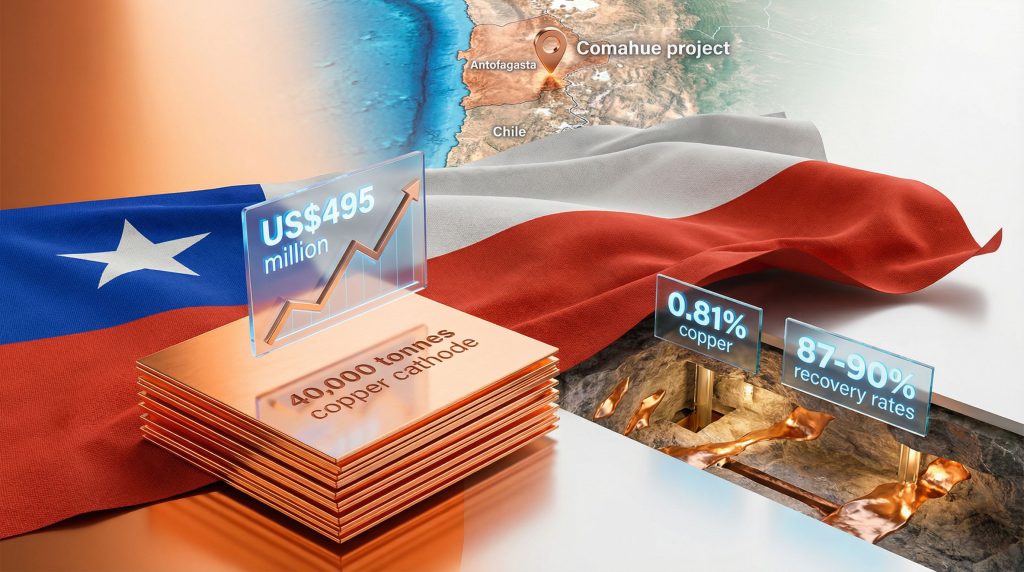
Comahue's economic profile positions the project within mid-tier copper production with above-average profitability metrics for underground operations. The project targets 40,000 tonnes of annual copper cathode production over a seven-year initial phase, generating projected revenues of US$495 million with US$140 million in EBITDA.
The 28% EBITDA margin (US$140M ÷ US$495M) represents premium profitability for underground copper extraction, reflecting efficient processing design and favourable ore characteristics. At current production targets, the project generates approximately US$3,500 EBITDA per tonne of refined copper cathode, indicating robust operational economics. Furthermore, according to strategic Chilean copper investment insights, such profitability metrics position Comahue favourably within the regional competitive landscape.
| Economic Indicator | Comahue Phase 1 | Industry Context |
|---|---|---|
| Annual Production | 40,000 tonnes copper cathode | Mid-tier producer scale |
| Life of Mine Revenue | US$495 million | 7-year production horizon |
| EBITDA Margin | 28% (US$140M) | Above-average for underground |
| Resource Grade | 0.81% copper | Premium for underground operation |
| Metallurgical Recovery | 87-90% | Industry-standard efficiency |
| Revenue per Tonne | US$12,375 | Based on LOM projections |
Resource Classification and Expansion Potential
The mineral resource base of 9.91 million tonnes at 0.81% copper grade provides substantial ore inventory for sustained production. Critically, 70% of resources fall within Measured and Indicated categories, representing high-confidence geological classification based on extensive drilling and modelling.
Resource classification significance extends beyond tonnage figures to encompass geological certainty and mine planning reliability. Measured and Indicated resources enable detailed reserve calculations, production scheduling, and financial modelling with reduced geological risk compared to projects relying primarily on Inferred resource categories.
Metallurgical recovery rates between 87-90% align with industry standards for conventional copper processing circuits, indicating no unusual technical challenges for ore treatment. The recovery range suggests compatibility with standard leaching, solvent extraction, and electrowinning (SX-EW) processing technology.
Resource Expansion Opportunities:
- Brownfield exploration: Five additional prospects across 3,000 hectares
- Regional land package: 10,000 hectares of unexplored adjacent licences
- Life extension potential: Possible 15+ year operation with resource additions
- Production scaling: Target 100,000 tonnes total copper cathode over extended mine life
What Investment Thesis Drives International Capital into Chilean Copper?
Market Fundamentals Supporting Mid-Tier Copper Development
Global copper market dynamics in 2026 reflect structural supply constraints coinciding with accelerating demand from electrification infrastructure. Years of limited exploration investment and mine depletion have created a supply deficit environment favouring new production capacity, particularly from permitted projects in established mining jurisdictions.
Chile's position as the world's largest copper producer provides distinct advantages for international investors seeking exposure to premium copper assets. The country's mining expertise, regulatory frameworks, and infrastructure development offer reduced execution risk compared to emerging mining jurisdictions with limited operational history.
Currency dynamics create additional investment appeal through USD-denominated copper revenues offsetting peso-based operating costs. This natural hedge provides protection against local currency volatility whilst maintaining exposure to global copper price appreciation. Additionally, these dynamics complement broader copper and uranium investment strategies across developed mining jurisdictions.
Investment Drivers for Chilean Copper:
- Supply deficit projections: Global copper shortage through 2030
- Infrastructure advantages: Established mining supply chains and logistics
- Regulatory stability: Mature permitting processes and mining code
- Currency benefits: USD revenue streams with peso cost structures
Portfolio Diversification Strategy for Resource Investors
International resource investors increasingly prioritise geographic diversification within established mining jurisdictions rather than concentration in single regions. Chilean copper exposure complements portfolio construction across multiple mining-friendly countries whilst maintaining focus on premier copper districts. Moreover, investors often compare these opportunities with Argentina copper insights when evaluating regional Latin American exposure.
The Power Metal investment in Comahue copper project represents strategic commodity positioning toward base metals with strong electrification demand fundamentals. Copper exposure provides portfolio balance against precious metals or energy commodities whilst leveraging infrastructure transition trends.
Mid-tier copper projects offer optimal risk-return characteristics for international investors seeking meaningful exposure without the capital requirements of major mining developments. Projects producing 40,000 tonnes annually provide substantial cash generation potential whilst maintaining manageable operational complexity.
How Do Underground Copper Operations Compare to Open-Pit Alternatives?
Technical Advantages of Subterranean Mining Methods
Underground copper mining offers distinct operational and environmental advantages over open-pit alternatives, particularly for high-grade ore bodies in established mining districts. The Comahue project's underground design enables selective extraction of 0.81% copper grade ore whilst minimising surface disturbance and environmental impact.
Weather independence represents a significant operational advantage for underground operations, enabling consistent production schedules regardless of surface conditions. This reliability factor becomes increasingly important for meeting copper cathode delivery commitments to industrial customers requiring predictable supply streams.
Underground Mining Advantages:
- Environmental footprint: Reduced surface disturbance and waste generation
- Weather independence: Year-round production capability
- Grade selectivity: Targeted extraction of high-value ore zones
- Community impact: Lower visual and noise disruption
- Extended mine life: Deeper ore access enabling longer production horizons
Economic Considerations for Underground Development
Underground operations typically require higher initial capital expenditure for decline development, ventilation systems, and material handling infrastructure compared to open-pit alternatives. However, these investments enable access to higher-grade ore bodies with potentially superior long-term economics.
The capital-intensive nature of underground development creates barriers to entry whilst providing operational advantages once production begins. Established underground operations benefit from economies of scale in specialised equipment, skilled labour, and technical expertise.
Labour requirements for underground mining favour skilled technical workers rather than large-scale earth-moving operations typical of open-pit mining. This employment profile aligns well with Chile's established mining workforce and technical education infrastructure.
What Role Does Next Minerals Play in Chile's Copper Landscape?
Regional Context Within Antofagasta's Mining District
Antofagasta region contains some of Chile's most significant copper operations, including major mines operated by Codelco, BHP, and other international producers. Next Minerals' positioning within this established mining district provides access to developed infrastructure whilst targeting mid-tier production scale complementary to existing operations.
The coastal copper belt geological setting offers proven mineralisation patterns with historical production success. Regional geological understanding, combined with established supply chains and technical services, reduces development risk for new entrants compared to greenfield mining districts. This positioning also leverages insights from Chile's expanding copper development sector, which continues attracting international investment capital.
District-Level Advantages:
- Infrastructure access: Established power, water, and transportation networks
- Skilled workforce: Regional mining expertise and technical capabilities
- Supply chain networks: Equipment, services, and logistics providers
- Regulatory familiarity: Local permitting expertise and government relationships
Corporate Development Strategy and Growth Pipeline
Next Minerals has assembled a land package extending beyond the immediate Comahue project area, encompassing 10,000 hectares of exploration licences adjacent to known mineralisation. This regional consolidation strategy enables systematic exploration of brownfield targets with established geological context.
The company's approach emphasises advanced-stage asset development rather than early exploration, aligning with current market preferences for near-term production assets. This strategy reduces capital requirements whilst accelerating pathways to cash generation from copper cathode sales.
Brownfield exploration across five additional prospects spanning 3,000 hectares provides organic growth potential beyond the initial seven-year mine plan. Systematic exploration of these targets could extend mine life significantly whilst leveraging existing infrastructure and processing capabilities.
How Should Investors Evaluate Cross-Border Mining Investments?
Due Diligence Checklist for International Mining Partnerships
International mining investments require comprehensive evaluation frameworks addressing technical, regulatory, and operational risks specific to cross-border transactions. The Power Metal investment in Comahue copper project demonstrates systematic assessment of asset quality, jurisdictional stability, and partnership structure.
Critical Assessment Areas:
Technical Validation:
- Independent resource estimation verification
- Metallurgical testing and processing route confirmation
- Engineering design review and capital cost validation
- Infrastructure assessment and logistics evaluation
Regulatory Compliance:
- Mining law and tax structure understanding
- Environmental permit status and compliance requirements
- Labour regulations and workforce availability
- Foreign investment protection and repatriation rights
Operational Assessment:
- Local partnership benefits and operational support
- Supply chain access and equipment availability
- Power and water supply security and costs
- Transportation and export logistics evaluation
Risk Mitigation Strategies for Emerging Market Exposure
Currency risk management becomes essential for international mining investments with local cost structures and USD commodity revenues. Natural hedging through USD copper sales offsetting peso operating expenses provides inherent protection, though additional hedging instruments may enhance stability.
Political risk considerations include regulatory stability, tax policy consistency, and foreign investment protection frameworks. Chile's established mining sector and international investment treaties provide structural protection, though ongoing monitoring remains essential.
Local partnership structures offer operational advantages through regulatory expertise, community relationships, and technical capabilities. The Next Minerals partnership model demonstrates effective risk distribution whilst maintaining strategic control over key development decisions.
The next major ASX story will hit our subscribers first
What Market Signals Support Copper Investment Timing in 2026?
Demand Drivers and Supply Constraints Analysis
Electrification trends accelerate copper demand through electric vehicle adoption, renewable energy infrastructure, and grid modernisation projects globally. Each electric vehicle requires approximately 180-400 pounds of copper compared to 50 pounds in conventional internal combustion vehicles, creating multiplicative demand effects.
Supply-side constraints reflect decades of underinvestment in new mine development, combined with natural depletion at existing operations. The average copper mine requires 10-20 years from discovery to production, creating structural supply gaps as current mines approach end-of-life whilst replacement capacity remains limited.
Global copper inventories have declined significantly from historical averages, reducing buffer capacity for supply disruptions. This inventory tightness amplifies price volatility whilst supporting sustained higher price levels for copper producers with operational mines.
Market Dynamics Supporting Copper Investment:
- EV adoption acceleration: Multiplicative copper demand per vehicle
- Grid infrastructure expansion: Renewable energy transmission requirements
- Supply pipeline constraints: Limited new mine development completions
- Inventory depletion: Reduced global stockpiles increasing price sensitivity
Investment Climate for Mid-Tier Copper Developers
Capital availability for permitted copper projects has improved significantly as institutional investors recognise supply-demand imbalances and seek inflation-protected commodity exposure. Mid-tier projects offer optimal scale for development financing whilst avoiding the complexity of major mining ventures.
Environmental, social, and governance (ESG) considerations increasingly favour underground operations with completed environmental approvals over greenfield projects requiring extensive permitting. The Comahue project's advanced permit status aligns with institutional investment criteria emphasising operational certainty.
Merger and acquisition activity in the copper sector reflects strategic consolidation as major producers seek to replace depleting reserves. Well-positioned development projects become acquisition targets as larger companies prioritise reserve replacement over exploration risk.
Strategic Positioning for Copper Market Evolution
The Power Metal investment in Comahue copper project represents sophisticated resource investment strategy combining geographic diversification with advanced-stage asset acquisition. Underground operations with completed permitting offer superior risk-adjusted returns compared to early-stage exploration projects, whilst Chile's established mining jurisdiction provides operational certainty for international capital deployment.
Mid-tier copper projects producing 40,000 tonnes annually occupy an optimal position within the global copper supply chain, providing meaningful production scale without the complexity of major mining operations. The seven-year initial mine plan, supported by potential 15+ year extensions through brownfield exploration, creates substantial value creation opportunities for equity participants.
Current copper market fundamentals, driven by electrification trends and supply constraints, support premium valuations for permitted projects with near-term production capability. The Comahue project's mine-ready status, combined with 28% EBITDA margins and regional infrastructure advantages, positions the investment for favourable returns under multiple copper price scenarios.
For investors evaluating similar international mining opportunities, this transaction demonstrates the premium placed on advanced permitting, completed engineering, and established jurisdictional frameworks. The warrant component provides additional optionality aligned with project development milestones whilst the brownfield exploration potential offers long-term value creation beyond initial production targets.
Disclaimer: This analysis is based on publicly available information and industry data. Mining investments carry inherent risks including commodity price volatility, operational challenges, and regulatory changes. Prospective investors should conduct independent due diligence and consult qualified advisors before making investment decisions. Past performance does not guarantee future results, and all forward-looking statements involve uncertainty and assumption.
Ready to Capitalise on the Next Copper Discovery?
Discovery Alert's proprietary Discovery IQ model delivers real-time alerts on significant ASX mineral discoveries, instantly empowering subscribers to identify actionable opportunities ahead of the broader market. Understand why historic discoveries can generate substantial returns by exploring Discovery Alert's dedicated discoveries page showcasing exceptional market outcomes, then begin your 14-day free trial to position yourself ahead of the market.