June 5, 2026
The Hidden Cost of Processing Everything: Why Grinding Circuits Need a Smarter Approach to Pebbles
Across the global mining industry, a quiet inefficiency has persisted for decades inside grinding circuits. Not a dramatic equipment failure, not a geological surprise, but a slow and compounding drain embedded within the normal operating logic of SAG and AG mills. The assumption has long been that all material entering the pebble recirculation stream carries enough value to justify reprocessing. Sensor-based sorting of pebble streams in mining is now fundamentally challenging that assumption, and the financial implications for operations that continue to ignore it are substantial.
The shift begins not with new equipment, but with a more honest analysis of what pebble streams actually contain at the individual particle level. When that analysis is applied rigorously, the case for blanket recirculation collapses under its own logic.
When big ASX news breaks, our subscribers know first
Why Grinding Circuits Lose More Than Operators Realise
In hard-rock mining operations, particularly those processing competent copper sulphide or orogenic gold ore bodies, a portion of the mill feed stubbornly resists comminution. These particles, commonly referred to as pebbles, accumulate at what engineers call "critical size" — a threshold where the material is too large to exit the mill through its discharge aperture but too hard to break efficiently under prevailing grinding conditions.
The scale of this problem is larger than most plant managers account for. Depending on ore type and circuit configuration, between 5% and 30% of total mill feed can report back as recirculating pebbles, according to documented analysis from SRK Consulting and TOMRA Mining published in Global Mining Review in May 2026. Furthermore, the article documents that for every tonne of pebbles returned to the mill, between 0.4 and 0.7 tonnes of fresh ore feed may effectively be displaced from available mill volume.
This displacement ratio reveals the compounding nature of the problem. Pebbles do not simply occupy space passively; they actively compete with economic feed for processing capacity every hour the mill is running. The result is a persistent throughput ceiling that operators often attribute to other causes — including ore variability, liner wear, or feed preparation issues — when the root cause is the volume of low-value material cycling endlessly through the circuit.
The operational costs extend beyond throughput loss alone:
- Elevated energy consumption as the mill expends effort on already-processed, hard material rather than fresh feed
- Increased water usage to maintain appropriate slurry density within a circuit carrying excess recirculating load
- Accelerated mechanical wear across grinding mill liners, discharge grates, and pebble crusher components
- Higher maintenance frequency for pebble crushers, particularly in circuits where grinding media occasionally enters the crusher feed stream, creating severe mechanical stress events
These costs do not appear as line items labelled "pebble inefficiency" in operational reports. They are absorbed across energy budgets, maintenance schedules, and throughput shortfalls, making them systematically underestimated.
What Pebbles Are, and Why Certain Ores Generate Them in Large Volumes
Pebble formation is not a circuit malfunction. It is a predictable material response to the mechanical forces applied during grinding, and its intensity depends heavily on the mineralogical and structural characteristics of the ore being processed.
The Physics of Critical-Size Particle Accumulation
When ore enters a SAG or AG mill, particles experience impact from the mill shell, grinding media, and other ore fragments. Softer, weaker particles fracture progressively and eventually reach a size small enough to discharge. However, particles composed of hard, interlocked mineral assemblages — dense silicate gangue matrices, competent sulphide veinlet networks, or structurally intact quartz-hosted rock — resist this fracture sequence. They persist at a size that the mill cannot efficiently reduce, circulating until external intervention is applied.
Ore Types Most Prone to High Pebble Generation
The following table summarises pebble generation characteristics by ore type, based on industry-documented operational experience:
| Ore Type | Typical Pebble Rate (% of Mill Feed) | Primary Circuit Impact | Common Downstream Equipment |
|---|---|---|---|
| Hard copper sulphide (porphyry) | 15 – 30% | High throughput suppression | Pebble crushers, secondary mills |
| Competent gold ore (orogenic, quartz-hosted) | 10 – 25% | Grade dilution + energy loss | Pebble crushers, AG circuits |
| Multi-metal hard rock | 5 – 20% | Variable, circuit-dependent | Recirculation conveyors |
Porphyry copper deposits are particularly susceptible because the ore matrix typically combines hard silicate minerals with disseminated chalcopyrite and bornite, creating a mechanically resistant composite. Orogenic gold deposits, where gold is hosted within structurally competent quartz veins, present comparable challenges. As SRK Consulting's Adrian Dance explains in Global Mining Review, the accumulation of these particles at critical size directly interferes with grinding efficiency and limits the circuit's ability to process fresh material. Understanding cut-off grade economics is therefore essential when evaluating which pebble fractions genuinely justify reprocessing.
The Pebble Crusher Paradox
Pebble crushers are the conventional response to recirculating pebbles. They reduce particle size below the critical threshold, allowing material to re-enter the grinding circuit at a processable size. However, they introduce their own operational burden: high mechanical stress from repeatedly crushing competent material, significant liner wear, frequent maintenance interventions, and serious equipment damage risk when steel grinding media enters the crusher feed. The crusher does not resolve the underlying problem. It manages it, at cost.
Not All Pebbles Carry the Same Value — And This Changes Everything
The conventional logic applied to pebble streams treats them as homogeneous, essentially assuming that because average pebble grade approximates a meaningful fraction of feed grade, all pebbles justify reprocessing. This assumption, while operationally convenient, is analytically incorrect.
The 80/50 Metal Distribution Reality
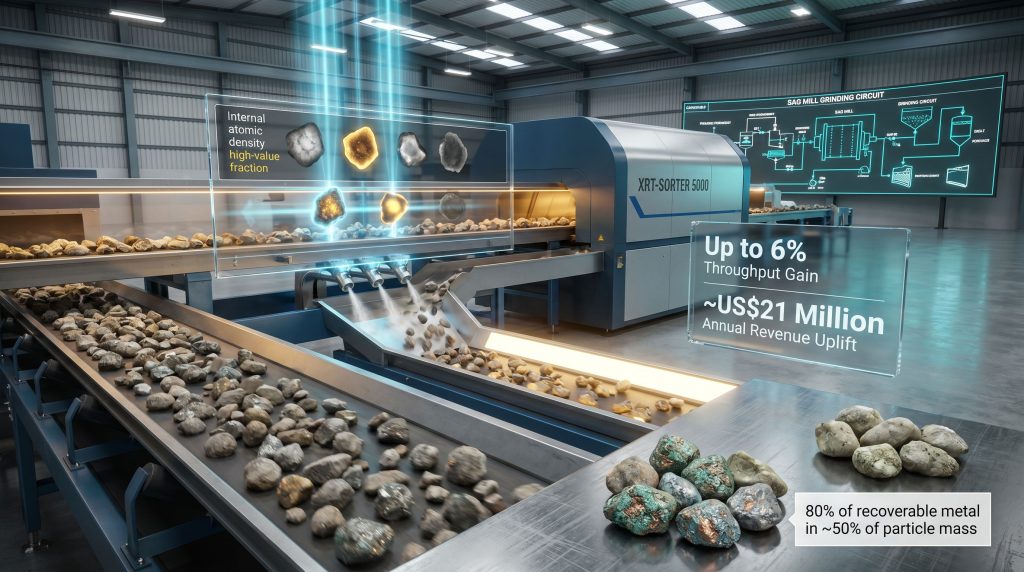
Detailed particle-level analysis reviewed by SRK Consulting reveals a striking degree of metal concentration within pebble streams. According to Adrian Dance, as cited in Global Mining Review (2026), up to 80% of the recoverable metal content within a pebble stream can be concentrated within approximately 50% of the total particle mass. The remaining half of the material contains only around 20% of the recoverable metal — placing a substantial portion of any given pebble stream below economic cut-off grade.
This distribution creates a clear economic argument for selective processing. The high-value fraction carries metal at a concentration roughly 3.2 times the stream average, while the low-value fraction carries metal at only a fraction of that average. Reprocessing both fractions identically means consuming the same energy, wear, and circuit capacity on material with fundamentally different economic contributions.
Why Particle Size Cannot Separate Value from Waste
A logical expectation might be that larger pebbles contain more mineralisation, and that conventional screening could therefore separate the high-value fraction. However, the same particle-level analysis demonstrates no meaningful relationship between particle size and metal content. A 100 mm pebble and a 50 mm pebble drawn from the same stream can have completely different metal grades.
This finding makes screening an ineffective upgrading tool for pebble streams. Size-based separation cannot discriminate between economic and sub-economic particles when size and grade are uncorrelated.
Pebbles are typically reported at around 60% of feed grade when evaluated as a bulk stream. This average masks enormous particle-level variability — and it is that variability, not the average, that defines the true economic opportunity in selective pebble sorting. (Global Mining Review, Dodgson, 2026)
The Energy Cost of Processing What Adds No Value
Every particle that has passed through the grinding circuit once has already consumed energy. Returning it to the mill for a second pass consumes more. When that particle carries no meaningful metal content, the energy investment yields no recovery benefit — it simply adds cost. As the Global Mining Review article frames it, every tonne of reprocessed low-grade pebble material represents an unjustifiable energy expenditure when a selective alternative exists. Consequently, the resource development economics case for selective rejection strengthens considerably when these compounding energy costs are fully accounted for.
How Sensor-Based Sorting of Pebble Streams Works in Practice
The emergence of sensor-based sorting of pebble streams in mining as an operational solution directly addresses the heterogeneity problem. Rather than treating the pebble stream as a bulk flow to be crushed and recirculated, sorting technology analyses individual particles in real time and makes particle-level reject or retain decisions before material re-enters the grinding circuit.
X-Ray Transmission Technology: The Core Detection Mechanism
XRT sorting benefits are rooted in the technology's ability to transmit X-rays through each particle as it travels along a conveyor, measuring differential attenuation based on internal atomic density. High-density minerals — including sulphides, oxides, and other economically valuable mineral species — absorb X-rays at measurably different rates than low-density gangue minerals. This density contrast allows the system to classify each particle's economic potential within milliseconds. For further detail on how XRT technology performs in practice, the TOMRA Mining platform documents a range of operational outcomes across ore types.
Step-by-Step: How a Pebble Sorting System Processes Material
- The pebble stream exits the SAG or AG mill and is transported to the sorting system via existing conveyors
- Material is presented to the sorting conveyor at a controlled, consistent feed rate to ensure reliable scan coverage
- XRT scanners analyse every individual particle as it passes, measuring internal atomic density in real time
- A classification algorithm assigns each particle to either a high-value or low-grade/barren category within milliseconds of scanning
- An air-jet or mechanical deflection system physically separates the two streams at the conveyor discharge point
- High-value pebbles continue downstream for re-entry into the grinding circuit
- Rejected low-grade material is diverted to a dedicated stockpile or waste destination, permanently removed from the recirculating load
As Fernando Romero-Lage, Area Sales Manager at TOMRA Mining, explains in Global Mining Review (2026), this particle-by-particle approach directly addresses the variability inherent in pebble streams. Rather than managing the material as a bulk flow, it enables operations to retain value while removing the fraction that would otherwise add cost without contributing to recovery.
Why Pebble Streams Are Ideal Candidates for Sorting Technology Deployment
Not all mining streams are equally suited to sensor-based sorting. Pebble streams possess a particularly favourable set of characteristics:
- They are typically already screened to remove fine material, presenting a clean, sized feed to the sorting system
- They are generally washed during circuit operation, reducing clay coating and surface contamination that can compromise sensor readings
- They travel on existing conveyors, minimising infrastructure additions required for integration
- Their relatively consistent size range allows sorting equipment to operate within designed particle dimension parameters
These characteristics mean that pebble streams can accept sorting technology integration with relatively modest capital additions compared to applying the same technology to run-of-mine ore.
Laser-Based Sorting: Applications in Quartz-Hosted Gold Deposits
For orogenic gold deposits where mineralisation is spatially associated with quartz veins and distinct lithological contrasts, laser-based sorting systems offer an alternative detection pathway. These systems analyse surface reflectance and texture rather than internal atomic density, making them effective where visual or structural contrast exists between ore and waste. TOMRA's PRO LASER platform represents one application of this approach in mineral sorting contexts.
Technology Comparison: Choosing the Right Sensor for Pebble Stream Applications
| Technology | Detection Principle | Best-Suited Ore Type | Key Advantage | Primary Limitation |
|---|---|---|---|---|
| X-Ray Transmission (XRT) | Internal atomic density | Copper sulphide, dense minerals | Millisecond particle analysis | Less effective at ppm-level gold |
| Laser-Based Sorting | Surface reflectance / texture | Orogenic quartz-hosted gold | Effective for lithological contrast | Requires mineralisation surface exposure |
| Combined XRT + Laser | Dual-sensor fusion | Complex multi-mineral ores | Highest classification accuracy | Higher capital cost |
Documented Economic Outcomes: What Selective Pebble Rejection Delivers
The transition from theoretical argument to operational proof is essential for industry adoption. In the case of sensor-based sorting applied to pebble streams, documented outcomes from copper mining circuits are compelling.
The Canadian Copper Operation: 6% Throughput Gain and US$21 Million Annual Revenue Impact
In a large-scale copper operation in Canada, selective rejection of lower-grade pebbles from the recirculating stream delivered a throughput increase of up to 6% without any modification to the primary mill configuration. This improvement translated into an estimated US$21 million in additional annual revenue, as reported in Global Mining Review (Dodgson, 2026). The gain resulted directly from removing low-value material from the recirculating load, freeing mill capacity for economic feed. Given the prevailing copper market trends and tightening supply dynamics, such throughput improvements carry even greater strategic weight for operations seeking to maximise output.
The Peruvian Copper Operation: Combined Grade and Throughput Improvement
A second documented case from a copper operation in Peru demonstrated simultaneous improvements in both feed grade and throughput following selective pebble sorting implementation. The combined effect generated multi-million-dollar annual gains, according to the same source. The grade improvement component reflects the concentration effect of removing below-cut-off particles from the mill feed, while the throughput improvement reflects the reduced circulating load releasing capacity for fresh ore.
Documented Economic Outcomes Summary
| Operation | Location | Ore Type | Throughput Gain | Estimated Annual Revenue Impact |
|---|---|---|---|---|
| Large-scale copper operation | Canada | Copper sulphide | Up to 6% | ~US$21 million |
| Integrated copper circuit | Peru | Copper sulphide | Throughput + grade uplift | Multi-million dollar improvement |
Downstream Equipment Relief: The Often-Overlooked Secondary Benefit
Beyond throughput and grade improvements, reducing the volume of hard, competent material cycling through the circuit produces measurable downstream benefits:
- Pebble crusher load reduction, extending liner life and reducing frequency of maintenance shutdowns
- Lower circulating load mass, improving mill stability and reducing process control challenges
- Reduced grinding media consumption in SAG circuits, as fewer abrasive pebble particles cycle through the mill shell
- Improved slurry stability, reducing the frequency of density excursions that can destabilise downstream flotation or leach circuits
These secondary gains compound the direct revenue impact, contributing to a more robust economic case for investment.
The next major ASX story will hit our subscribers first
Technical Challenges That Operators Must Overcome
The benefits of sensor-based sorting of pebble streams in mining are well-documented in copper applications. However, the technology is not universally ready for all ore types or all operational scales without careful qualification.
Gold Ore Detection at Parts-Per-Million Grades
XRT technology operates on the principle of atomic density contrast. Gold itself is an exceptionally dense element, but the grades at which it occurs in economic deposits — typically measured in grams per tonne — may be insufficient to generate detectable density contrast at the individual particle level. A pebble carrying 2 g/t gold in a quartz matrix presents only a marginally elevated average atomic density compared to barren quartz, potentially falling within the noise threshold of current XRT systems. This represents the most significant technical barrier to broader gold ore adoption.
Laser-based systems offer a partial alternative where gold is visually associated with sulphide minerals or distinctive lithological markers, but this relationship is deposit-specific and cannot be assumed across all orogenic gold systems.
Ore Characterisation and Calibration Requirements
Sorting systems must be calibrated to the specific mineralogical characteristics of the ore being processed. This requires representative sample collection, detailed geometallurgical characterisation, XRT test work, and iterative calibration before deployment. Operations with high ore variability must establish that sorting performance remains consistent across the range of ore types the plant will process over its operating life.
High-Tonnage Operations: Capital Intensity at Scale
Processing plants operating above approximately 1,200 tonnes per hour may require multiple parallel sorting units to handle pebble stream volumes within the equipment's designed throughput range. This parallel configuration multiplies capital expenditure and integration complexity, raising the minimum economic justification threshold for deployment. At very high tonnage operations, the capital cost of sorting infrastructure can require careful payback analysis before investment is committed.
At high-capacity operations, the capital case for pebble sorting requires robust site-specific economic modelling rather than direct extrapolation from smaller-scale case studies. The 6% throughput gain documented in Canada remains an achievable benchmark, but the investment required to replicate it at greater scale is proportionally higher. (Global Mining Review, Dodgson, 2026)
The Data Transparency Gap
Independent, peer-reviewed operational benchmarks for sensor-based pebble sorting remain limited in publicly available literature. Most documented results are presented by technology vendors or consulting firms involved in project delivery. For instance, peer-reviewed analysis of sensor-based sorting across diverse ore types would substantially strengthen the investment case and accelerate industry-wide adoption.
Integrating Pebble Sorting Into Broader Circuit Optimisation Strategy
Sensor-based sorting of pebble streams is not a standalone fix applied in isolation. Its maximum value is realised when integrated into a holistic rethinking of grinding circuit design philosophy.
From Process Everything to Process What Adds Value
Traditional grinding circuit design operates on a fundamentally inclusive philosophy: all material entering the mill is processed until it reaches product specification size. Pebbles are an accepted by-product of this approach, managed through crushing and recirculation rather than selective rejection. Sensor-based sorting introduces a selective philosophy: material is evaluated before re-entry into the circuit, and only the fraction that justifies reprocessing continues through.
This represents a conceptual shift with implications beyond pebble management. It positions preconcentration and selective processing as mainstream operational strategies rather than niche applications. In addition, the mining decarbonisation benefits of removing low-value material before it consumes further grinding energy align directly with the emissions reduction targets that large-scale operations are increasingly required to meet.
Pebble Crushing vs. Sensor-Based Sorting: A Comparative Framework
| Operational Dimension | Traditional Pebble Crushing | Sensor-Based Pebble Sorting |
|---|---|---|
| Material selectivity | None — all pebbles processed | Particle-level — value vs. waste separated |
| Energy consumption | High — all material re-ground | Reduced — low-grade material rejected pre-grinding |
| Crusher maintenance burden | High — frequent mechanical stress | Reduced — lower recirculating load |
| Throughput impact | Neutral to negative | Positive — up to 6% documented improvement |
| Capital investment | Moderate | Moderate-to-high |
| Grade improvement | Minimal | Measurable — higher-value fraction retained |
Integration Points With Existing Infrastructure
Because pebble streams are already conveyed, screened, and often washed as part of existing circuit design, sorting system integration typically connects at the pebble conveyor discharge point prior to crusher feed. This minimises civil works and avoids disruption to primary mill operation during installation. Remote monitoring platforms, such as TOMRA Insight, can provide ongoing process performance data, enabling continuous optimisation of sorting thresholds as ore characteristics evolve over mine life.
Which Mining Sectors Are Leading Adoption
Adoption of sensor-based sorting technology across mining sectors follows a readiness gradient shaped by ore characteristics, economic incentives, and existing technology familiarity.
Copper mining presents the highest readiness profile. The density contrast between copper sulphide minerals and silicate gangue is well-suited to XRT detection, pebble generation rates in porphyry systems are high (15–30%), and the economic scale of large copper operations provides the revenue base to justify sorting investment and generate compelling payback periods.
Gold mining is at an earlier adoption stage. Pilot programmes and sulphide ore applications are progressing, but the parts-per-million grade detection challenge limits broader deployment until technology capabilities advance or deposit-specific mineralogical solutions are identified.
Diamond mining has demonstrated proven XRT application for decades, providing an important confidence-building precedent. Diamond's density contrast with host rock is unambiguous for XRT systems, and this established track record reduces the technology risk perception in other sectors considering adoption.
Tungsten and multi-metal operations represent an emerging frontier, particularly in preconcentration circuit applications where the density contrast between tungsten minerals and gangue provides favourable XRT detection conditions.
Frequently Asked Questions: Sensor-Based Sorting of Pebble Streams
What is sensor-based sorting in the context of mining pebble streams?
It is the application of real-time particle analysis technology — primarily XRT or laser-based systems — to classify individual particles within a pebble stream before they re-enter the grinding circuit. Particles assessed as low-grade or barren are physically removed from the stream; high-value particles continue downstream for reprocessing.
How does XRT technology identify valuable particles within a pebble stream?
XRT scanners transmit X-rays through each particle and measure the degree of attenuation based on internal atomic density. Economically valuable minerals (copper sulphides, dense oxides) absorb X-rays more strongly than gangue minerals (quartz, feldspar), creating a measurable density signal that allows classification within milliseconds.
What percentage of pebbles in a typical grinding circuit carry below-cut-off-grade material?
Particle-level analysis indicates that approximately half the particle mass in a pebble stream may carry only around 20% of the total recoverable metal content, suggesting that a substantial portion of any pebble stream sits below economic cut-off grade at the individual particle level.
Can pebble sorting technology be retrofitted into existing grinding circuit infrastructure?
Yes. Because pebble streams are already conveyed, screened, and managed within existing infrastructure, integration typically requires connection at the pebble conveyor prior to crusher feed. The incremental civil works requirement is generally modest compared to greenfield installations.
What is the typical payback period for a pebble sorting installation in a copper operation?
Payback periods are site-specific and depend on pebble generation rate, copper price, plant throughput, and capital cost of installation. The documented US$21 million annual revenue uplift in a Canadian copper operation suggests payback periods measurable in months to a few years for large-scale operations, though this should not be assumed without independent site-specific economic modelling.
Does pebble sorting reduce carbon emissions and energy consumption?
By removing low-grade material from the recirculating load before it consumes grinding energy, pebble sorting reduces the specific energy consumption per tonne of metal recovered. Lower energy per unit of metal output translates directly to reduced carbon intensity per tonne produced, supporting operational decarbonisation targets.
Is sensor-based sorting of pebbles proven technology or still in pilot phase?
For copper sulphide applications, documented operational results from commercial-scale installations confirm that the technology is proven beyond pilot stage. Gold ore applications at ppm grades retain technical challenges that are still being resolved at the deposit-specific level.
The Future Direction of Pebble Stream Sorting Technology
The trajectory of sensor-based sorting of pebble streams in mining points toward increasing capability, broader ore type coverage, and closer integration with real-time circuit optimisation systems.
Artificial intelligence-driven classification algorithms are progressively improving sorting accuracy by learning from operational data accumulated across multiple ore domains. Rather than relying on static calibration thresholds, adaptive systems can adjust classification boundaries in response to real-time changes in ore characteristics, maintaining consistent separation performance across variable feed.
The most significant near-term technical frontier is extending reliable detection capability to low-grade gold applications. Advances in multi-sensor fusion — combining XRT with laser, near-infrared, or prompt gamma neutron activation analysis — may ultimately close the gap between the detection limits of current technology and the grade thresholds relevant to gold ore sorting.
Environmental performance requirements are also becoming a material driver of technology adoption. As mining operations face increasing pressure to reduce energy consumption and carbon intensity per unit of production, the ability to demonstrate measurable reductions in specific energy consumption through selective pebble rejection provides an independently quantifiable contribution to sustainability reporting metrics.
Geographically, the next wave of deployment is likely concentrated in Latin America and Central Asia, where large-scale porphyry copper operations processing high-competence ore at significant throughput rates present the most favourable conditions for technology justification.
Key Takeaways: Pebble Sorting as a Strategic Operational Lever
-
Pebble streams in SAG and AG grinding circuits are not homogeneous — individual particle metal content varies enormously, with up to 80% of recoverable metal concentrated in approximately half the particle mass
-
Blanket recirculation of all pebbles imposes measurable throughput penalties, energy inefficiencies, and equipment wear costs that compound across every operating hour
-
XRT-based sensor sorting enables millisecond particle-level classification, allowing low-grade material to be rejected before it re-enters the grinding circuit and consumes further energy without contributing to recovery
-
Documented operational results demonstrate throughput gains of up to 6% and revenue uplifts exceeding US$21 million annually in copper circuit applications, establishing a commercial-scale proof of concept
-
Technical barriers remain for gold ore applications at ppm detection thresholds, and high-tonnage operations face elevated capital deployment costs that require site-specific economic modelling before investment commitment
-
The technology represents a fundamental shift in grinding circuit philosophy: from processing all material to selectively processing only what generates economic return, turning a long-accepted operational inefficiency into a measurable competitive advantage
Disclaimer: Financial projections, throughput improvement estimates, and revenue uplift figures referenced in this article are drawn from documented case studies reported in Global Mining Review (May 2026) and reflect specific operational contexts. They should not be interpreted as indicative of outcomes achievable across all operations. Investors and mine operators should conduct independent technical and economic assessment before making capital deployment decisions based on this information.
Want to Know Which ASX Mining Companies Are Unlocking Hidden Value in Their Operations?
Discovery Alert's proprietary Discovery IQ model scans ASX announcements in real time, instantly identifying the mineral discovery opportunities that matter most — whether in copper, gold, or emerging multi-metal sectors — so investors can act before the broader market catches on. Explore historic discoveries and their remarkable returns, then begin your 14-day free trial to position yourself ahead of the next major find.