
July 28, 2026
When the World's Biggest Mines Stop Delivering: Copper's Structural Supply Crisis Enters a New Phase
There are moments in commodity markets when several independent risk factors converge simultaneously, producing price dynamics that no single variable can explain. The global copper market in 2026 is living through exactly such a moment. Mine output is contracting across three of the world's most productive copper regions at the same time. A processing reagent critical to roughly 15% of global production has been cut off by a policy decision in China. Consequently, the copper market deficit and Section 232 tariff risk are combining to push prices toward historic levels, requiring us to pull apart each thread individually before examining what happens when they intertwine.
When big ASX news breaks, our subscribers know first
The Anatomy of a Multi-Year Supply Failure
Most commodity supply disruptions are transient. A weather event delays a shipment, a labour dispute pauses production for weeks, and the market rebalances within a quarter. What is unfolding across copper-producing regions in 2026, however, is categorically different. The disruptions are structural, geographically dispersed, and extending over multi-year timelines that are actively being pushed further out rather than pulled forward.
Chile: Broad-Based Output Contraction Across Major Operations
Chile produces more copper than any other country on earth, which makes the depth of its 2026 output decline particularly significant for global balances. According to Cochilco, the country's national copper production fell 9.04% year-on-year in March 2026, with total output reaching 434,314 tonnes. The decline was not concentrated in a single operation.
Codelco, the state-owned giant, saw output fall approximately 10%, while BHP's Escondida recorded a decline of 15.75% and the Glencore-Anglo American Collahuasi joint venture contracted by 10.80%. Furthermore, simultaneous weakness across multiple major operations eliminates the possibility of cross-compensation, meaning Chile cannot offset losses at one mine with gains at another. For more context on the Chile copper outlook, the pressures there are both structural and long-term.
Indonesia and the DRC: Extended Recovery Timelines Adding to the Shortfall
The supply picture outside Chile compounds the problem further:
-
Grasberg, Indonesia: Freeport-McMoRan delayed the full production restart at Grasberg from 2027 to 2028 following a September 2025 mudslide, while CNBC reported in March 2026 that the company reduced its 2026 production guidance by approximately 35%. Grasberg is one of the world's largest copper and gold deposits by reserve base, so a two-year delay to full restart carries material consequences for global supply calculations.
-
Kamoa-Kakula, DRC: Ivanhoe Mines' flagship operation is recovering from 2025 flooding but faces an additional operational constraint in the form of acute sulfuric acid shortages. J.P. Morgan Global Research estimates the DRC imports approximately 80% of its sulfur supply through Middle East trade routes, meaning the Strait of Hormuz disruption is directly suppressing processing throughput at one of the world's fastest-growing copper operations.
Wood Mackenzie has revised its copper supply disruption assumptions for the 2026-2028 period upward, reflecting declining confidence that major mine recovery timelines will be met. This ongoing copper supply crunch is reshaping how analysts and investors assess medium-term availability.
TC/RC Compression: The Smelter Signal Markets Are Overlooking
One of the most technically informative signals in the copper market is the behaviour of treatment and refining charges, commonly referred to as TC/RCs. These are the fees smelters earn for processing copper concentrates into refined metal. When concentrate supply is abundant, smelters can demand higher TC/RCs from miners.
When concentrate supply is tight relative to smelting capacity, TC/RCs compress toward zero or turn negative, meaning smelters effectively pay to secure feed material. TC/RCs have compressed toward zero or negative territory in 2026, simultaneously telling investors that mine-level concentrate output is insufficient to fill global smelting capacity and that the refined copper deficit is being approached from the production side before it even reaches consumers.
The Sulfuric Acid Dimension: A Secondary Shock That Markets Initially Underestimated
Sulfuric acid is the dominant variable operating cost for oxide leach copper projects and a significant input for a wide range of copper processing operations. The convergence of two separate supply shocks for this reagent has created a cost and availability crisis that is amplifying the primary mine supply deficit.
China's May 2026 suspension of sulfuric acid exports delivered the first shock. J.P. Morgan Global Research estimates this decision directly affected approximately 15% of global copper production that relies on acid-based processing techniques. The second shock came through the Strait of Hormuz, where disruptions to Middle East shipping have interrupted sulfur trade routes that the DRC uses for roughly 80% of its sulfur supply.
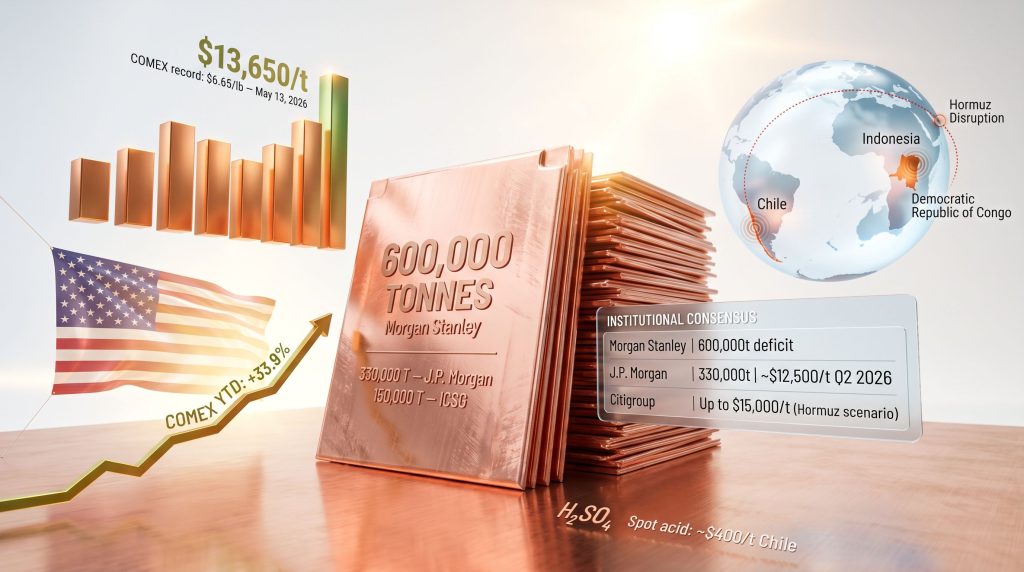
The combined effect on spot pricing has been severe. Spot sulfuric acid in Chile has risen to approximately $400 per tonne, compared to integrated self-production costs that can sit below $250 per tonne for operators with their own acid supply arrangements. This $150 per tonne differential represents a meaningful operating cost disadvantage for producers relying on third-party spot market purchases.
"The acid pricing dynamic is creating a new and previously underappreciated valuation criterion in copper project assessment: whether a developer controls its own reagent supply. Projects with access to integrated acid infrastructure or joint-venture arrangements with acid producers now carry a measurable cost advantage that can materially affect project-level economics and financing attractiveness."
Marimaca Copper's May 2026 non-binding MOU to evaluate a joint-venture sulfuric acid supply agreement using the Dos Amigos Acid Plant near Mejillones illustrates how construction-stage developers are moving to address this cost exposure directly. Marimaca's 2025 Definitive Feasibility Study valued the Marimaca Oxide Deposit at a pre-tax NPV8 of $1.1 billion using a $5 per pound copper price assumption and planned annual production of 50,000 tonnes of copper cathode, with an Environmental Approval secured in November 2025.
2026 Copper Deficit Forecasts: What the Major Institutions Are Projecting
The breadth of institutional agreement on a 2026 copper supply deficit is itself an unusual market signal. Financial institutions rarely converge on the same directional call with this degree of consistency.
| Institution | 2026 Refined Copper Deficit Forecast | Price Outlook |
|---|---|---|
| Morgan Stanley | 600,000 tonnes | Above historical average |
| J.P. Morgan | 330,000 tonnes | Avg. Q2 2026: ~$12,500/t |
| International Copper Study Group | 150,000 tonnes (revised from +209,000t surplus) | Not specified |
| Citigroup | Not specified | Up to $15,000/t (Hormuz resolution scenario) |
| Goldman Sachs | More conservative | $10,000–$11,000/t (H1 2026) |
The revision by the International Copper Study Group deserves particular attention. Within a single six-month forecast cycle, the ICSG moved from projecting a 209,000-tonne surplus in October 2025 to projecting a 150,000-tonne deficit by May 2026. That is a directional swing of nearly 360,000 tonnes and reflects how quickly simultaneous mine disruptions, acid shortages, and smelter margin compression shifted the global balance picture.
COMEX three-month copper reached a record $6.65 per pound on May 13, 2026, equivalent to approximately $13,650 per tonne on the LME, before consolidating to a range of approximately $13,100 to $13,400 per tonne as traders repositioned ahead of the Section 232 tariff decision. Year-to-date, COMEX copper is up approximately 33.9% versus the equivalent period in 2025.
Section 232 Tariff Risk: Understanding the Legal and Market Mechanics
What the Trade Expansion Act of 1962 Actually Enables
Section 232 of the Trade Expansion Act of 1962 grants the US President authority to impose tariffs on imports determined to threaten national security. The mechanism has previously been applied to steel and aluminium, creating precedent for its use across metals critical to defence manufacturing and industrial infrastructure. The current Section 232 investigation into copper is examining whether US dependence on imported refined copper constitutes a strategic vulnerability.
A critical technical development in recent 2026 rulemaking is that some Section 232 frameworks have shifted toward applying duties on the full customs value of covered imports rather than solely on the metal content value. This structural change materially increases the effective tariff burden on downstream users and importers, broadening the financial impact beyond what a simple percentage rate calculation might suggest. The copper tariff impacts on global trade flows are already being felt in pre-tariff inventory repositioning. According to the White House fact sheet, these actions are framed explicitly as a national security measure.
Goldman Sachs' Probability Assessment and Spread Impact Modelling
Goldman Sachs Research has assigned a high probability to a US refined copper tariff of at least 25% being implemented before mid-June 2026. The bank estimates that a tariff at this level would widen the CME-to-LME copper price spread by $0.30 to $0.80 per pound, effectively bifurcating the global copper market into a higher-cost US domestic price and a tighter international availability picture.
This spread dynamic creates a real-time market signal that investors can monitor. Under normal market conditions, the difference between COMEX copper futures and LME three-month copper reflects little more than shipping costs, currency effects, and minor regional supply variations. When tariff risk is elevated, the CME-LME spread widens as traders front-run the anticipated policy change. According to Sprott's analysis of copper fundamentals, underlying supply-demand dynamics remain intact even amid tariff-driven volatility.
ING analysis confirms that tariff uncertainty has already distorted trade flows and contributed to keeping global benchmark prices elevated, independent of the underlying fundamental deficit. Pre-tariff inventory hoarding by US importers has temporarily drawn down international inventories while inflating US stockpiles, creating regional imbalances that could take several quarters to normalise.
Three Strategic Scenarios for Copper Through Late 2026
Scenario 1: Maximum Stress Case
In this scenario, a 25%+ Section 232 tariff is confirmed before mid-June 2026, the Strait of Hormuz disruption persists, and Grasberg and Kamoa-Kakula recovery timelines extend further. Sulfuric acid prices remain elevated above $400 per tonne, smelter TC/RCs stay negative, and Chilean output declines into H2 2026.
- Price implication: Citigroup's path to $15,000 per tonne becomes achievable; the CME-LME spread widens toward the upper end of Goldman Sachs' range
- Investor implication: Maximum premium for construction-ready North American developers, projects with integrated acid supply, and brownfield infrastructure owners
Scenario 2: Moderate Resolution Base Case
A Section 232 tariff at approximately 25% is implemented but trade negotiations limit scope or duration. Partial Strait of Hormuz resolution reduces acid price pressure in H2 2026. Chilean output stabilises without recovering to pre-2026 levels.
- Price implication: LME copper consolidates in the $12,000 to $13,500 per tonne range, consistent with J.P. Morgan's Q2 average target
- Investor implication: Selective premium for developers with near-term permitting milestones and stable jurisdiction exposure
Scenario 3: Bear Case Resolution
The Section 232 decision is delayed or implemented below the 25% threshold. Chinese industrial activity contracts, and partial Grasberg and Kamoa-Kakula recovery adds more supply than anticipated in H2 2026.
- Price implication: Goldman Sachs' $10,000 to $11,000 per tonne range becomes a ceiling rather than a floor
- Investor implication: Developers with strong balance sheets and low-cost project economics retain relative value; early-stage explorers face re-rating risk
The next major ASX story will hit our subscribers first
Demand Fundamentals That Prevent a Bearish Resolution
AI Infrastructure and the Rack Power Density Effect
S&P Global Market Intelligence reported in April 2026 that the shift toward higher rack power density in AI data centre construction is materially increasing the copper content per facility. Denser electrical infrastructure requires proportionally more wiring, busbars, and cooling systems per unit of computing capacity than earlier-generation designs. This demand vector is structurally different from traditional industrial copper consumption because it is driven by technology sector capital expenditure cycles rather than GDP-linked manufacturing activity.
Energy Transition and Defence: Policy-Driven Demand That Persists Through GDP Weakness
The World Bank maintained its energy-transition copper demand outlook through 2030 despite reducing near-term global GDP growth forecasts, treating electrification demand as policy-driven and therefore less cyclically sensitive. Defence spending increases across NATO member states are adding a geopolitically driven demand layer for copper in weapons systems, communications infrastructure, and military electrification programmes.
Copper prices have remained near record levels despite elevated US interest rates and a stronger US dollar, a historically unusual combination. Under normal market conditions, both factors exert downward pressure on commodity prices denominated in dollars. Their failure to do so in 2026 underscores the severity of the underlying supply-demand imbalance and reinforces the relevance of understanding copper price drivers in the current environment.
How Investors Are Repositioning Across Copper Equity Tiers
Investors are not treating all copper equities uniformly. In addition, a tiered valuation framework has emerged based on project stage, jurisdiction quality, and operational risk profile:
| Tier | Project Stage | Key Valuation Drivers | Primary Risks |
|---|---|---|---|
| Tier 1 | Construction-ready developers | Financing completion, permitting status, acid supply strategy | Capital cost inflation, permit delays |
| Tier 2 | Resource-conversion explorers | Drill results, resource upgrades, PEA milestones | Geological risk, study timeline |
| Tier 3 | Early-stage / maiden resource | Discovery potential, jurisdiction quality | Exploration risk, market sentiment |
North American Projects Attract Capital as Tariff Reshapes Strategic Value
A confirmed US copper tariff creates a structural incentive for US manufacturers and government agencies to prioritise domestically sourced or allied-nation copper supply, increasing the strategic premium attached to projects in Canada, Australia, and select Latin American jurisdictions. For investors evaluating exposure, well-considered copper investment strategies increasingly favour jurisdiction-quality and project-stage discipline.
In Quebec, Abitibi Metals' B26 Copper-Gold Project hosts 25 million tonnes grading 2.1% copper equivalent, with Phase 4 drilling returning a 150-metre step-out intercept grading 2.71% copper equivalent over 7 metres. The company closed a C$30.75 million financing in May 2026, with Discovery Silver taking a 9.9% stake, leaving Abitibi with more than C$45 million in cash to fund over 80,000 metres of drilling.
In Yukon, Selkirk Copper is advancing the Minto Project with a 2025 Mineral Resource Estimate covering 12.59 million tonnes of Indicated resources grading 1.20% copper and 23.66 million tonnes of Inferred resources grading 1.05% copper. Phase 1 drilling intersected copper-gold-silver mineralisation in 87% of holes, including the discovery of a new lens beneath the historic Area 2 open pit. A Phase 2 programme targeting up to 50,000 metres by November 2026 is underway.
Chilean Mid-Tier Developers Benefiting From Majors' Output Weakness
The output declines at Codelco, Escondida, and Collahuasi are redirecting investor attention toward mid-tier Chilean copper developers capable of advancing projects independently. Fitzroy Minerals is advancing its Buen Retiro Copper Project near Copiapó, where 39 drill holes totalling 6,885 metres since February 2026 support a maiden resource estimate.
Drill hole BRT-DDH059 returned 78 metres grading 1.70% copper, including a high-grade interval of 40 metres grading 3.02% copper, a result that demonstrates the deposit's potential to host mineralisation at grades meaningfully above the industry average for open-pit copper operations. Fitzroy's partnership with Pucobre targets a heap leach joint-venture structure that could generate early cash flow without requiring a standalone mine build, lowering capital intensity significantly.
South Australia and the Rare Earth Adjacency
The copper supply narrative intersects with a broader critical mineral supply concern in South Australia. China controls more than 90% of global dysprosium and terbium supply according to Shanghai Metals Market data, creating a Western strategic interest in non-Chinese critical mineral supply chains that benefits Australian project developers.
Cobra Resources is advancing projects in South Australia that span both commodity categories. At the Boland Rare Earth Project, in-situ recovery testing achieved 66% heavy rare earth recovery with the lowest acid consumption among six peer projects benchmarked, while the mixed rare earth carbonate basket value of $65.22 per kilogram was the highest among 10 benchmarked ionic rare earth projects. The company's Manna Hill Copper Project adds copper exposure to its portfolio, with a combined market capitalisation of approximately £50 million.
Frequently Asked Questions: Copper Market Deficit and Section 232 Tariff Risk
What is the copper deficit forecast for 2026?
The 2026 refined copper deficit is projected at between 150,000 and 600,000 tonnes depending on the institution. Morgan Stanley holds the most bearish supply view at 600,000 tonnes, J.P. Morgan projects 330,000 tonnes, and the International Copper Study Group now projects a 150,000-tonne deficit having reversed a prior surplus forecast within a single six-month period. The wide range reflects genuine uncertainty around mine recovery timelines, the Section 232 tariff outcome, and the pace of demand growth from electrification and AI infrastructure.
How does Section 232 tariff risk affect copper prices?
Section 232 tariffs on US refined copper imports would widen the price differential between COMEX and LME copper, accelerate pre-tariff inventory hoarding, and increase investor interest in North American copper supply projects. Goldman Sachs Research estimates a 25% tariff would widen the CME-LME spread by $0.30 to $0.80 per pound. Consequently, the copper market deficit and Section 232 tariff risk together represent the most significant near-term policy catalyst for copper prices and mining equities.
Why is sulfuric acid scarcity important for copper investors?
Sulfuric acid is the primary reagent for oxide leach copper operations and a significant cost input across multiple processing methods. China's May 2026 export suspension and Strait of Hormuz disruptions have jointly elevated Chilean spot acid prices above $400 per tonne, materially increasing operating costs for producers relying on third-party supply. Developers with integrated acid supply arrangements carry a measurable cost advantage that is increasingly reflected in project valuations and financing terms.
This article contains forward-looking statements, projections, and analyst forecasts that are subject to material uncertainty. Commodity price forecasts, deficit estimates, and tariff probability assessments represent the views of the referenced institutions at the time of publication and should not be construed as investment advice. All investment decisions should be made with reference to independently verified information and appropriate professional guidance.
Want to Know When the Next Major Copper Discovery Hits the ASX?
Discovery Alert's proprietary Discovery IQ model scans ASX announcements in real time, instantly identifying significant mineral discoveries — including copper — and delivering actionable insights before the broader market has time to react. Explore historic examples of major mineral discoveries and their market returns on Discovery Alert's dedicated discoveries page, and begin your 14-day free trial today to position yourself ahead of the next major find.