May 23, 2026

Understanding the Structural Forces Behind Copper Market Transformation
The global mining industry confronts an unprecedented convergence of technological revolution and supply chain vulnerabilities that threatens to reshape commodity markets fundamentally. Meeting copper demand amid global disruption has become the primary challenge for mining executives and operations managers who find themselves at the epicenter of a structural transformation where artificial intelligence infrastructure demands intersect with electrification imperatives against a backdrop of constrained production capacity and geopolitical supply risks. This market recalibration extends beyond cyclical commodity price movements, representing a potential multi-decade shift in how copper markets function and where value accrues across the supply chain.
Modern hyperscale data centers supporting AI computational workloads require approximately 50,000 tons of copper per facility—a figure that dwarfs conventional data center requirements by an order of magnitude. BloombergNEF projects that annual AI-related copper demand could reach 572,000 tons by 2028, representing roughly 2% of current global copper consumption but establishing a trajectory for sustained demand acceleration. This structural shift occurs simultaneously with electric vehicle adoption, where each EV requires 2-3 times more copper than internal combustion engines, creating compounding pressure on mining operations worldwide.
The International Copper Study Group forecasts total copper demand expanding from 27 million tons in 2024 to 37 million tons by 2050, representing a 37% increase over 26 years. However, this demand growth trajectory occurs precisely as mining industry evolution has decelerated to just 1.4% in 2026—approximately 500,000 tons below initial projections. For mining companies, this structural imbalance creates potential leverage opportunities that could fundamentally alter contract negotiations and commercial relationships across the copper value chain.
When big ASX news breaks, our subscribers know first
What Economic Factors Drive the Current Copper Supply-Demand Imbalance?
The Technology Infrastructure Boom
Artificial intelligence infrastructure development represents a qualitatively different copper consumption pattern compared to traditional industrial applications. Each AI hyperscale data center requires extensive copper cabling for power distribution, advanced cooling systems, and high-density networking infrastructure designed to support computational workloads that generate substantially more heat and require more reliable power delivery than conventional data processing facilities. This copper intensity reflects the fundamental physics of AI operations: higher computational density generates more heat, requiring more sophisticated thermal management systems that rely heavily on copper heat exchangers and cooling distribution networks.
The 572,000-ton annual AI demand projection by 2028 represents just the beginning of infrastructure buildout. Technology corporations including Meta, Google, Amazon Web Services, and Microsoft have announced capital expenditure commitments exceeding $200 billion collectively for AI infrastructure development through 2030. These investments translate directly into copper procurement for data center construction, though detailed copper demand outstrips supply breakdowns are rarely disclosed by operators themselves.
Wind turbine installations demonstrate similar copper intensity characteristics. A single 2-megawatt wind turbine typically incorporates 1-1.2 tons of copper in generator windings, electrical systems, and power electronics. Global wind capacity expansion projections suggest approximately 2,000 gigawatts of new installations by 2040, representing potential copper demand of 1-1.5 million tons dedicated solely to wind turbine manufacturing and installation.
Electrification as a Macro-Economic Driver
Electric vehicle powertrain systems require copper primarily in battery thermal management, electric motor windings, and power electronics that convert stored battery energy into mechanical motion. The aggregate copper content varies by vehicle class and battery chemistry, but industry estimates suggest 50-60 kilograms of copper per electric vehicle. If electric vehicle adoption reaches 50% of new vehicle sales by 2040—a commonly cited scenario in industry projections—the aggregate copper demand for EV powertrains alone would account for approximately 1.5-2 million tons annually.
Solar photovoltaic installations require approximately 50-80 kilograms of copper per megawatt of installed capacity in electrical interconnection systems and inverters that convert direct current electricity from panels into alternating current for grid distribution. Solar capacity expansion to meet renewable energy targets would incorporate an additional 0.3-0.5 million tons of copper demand through 2040.
Furthermore, meeting copper demand amid global disruption requires understanding these structural consumption drivers operate independently of traditional industrial copper applications. Unlike cyclical demand from construction or manufacturing, electrification and AI infrastructure represent sustained multi-decade consumption patterns that mining operations must accommodate through expanded production capacity or improved extraction efficiency.
The Smelting Capacity Paradox
Between 2014 and 2024, smelting capacity expansion, led by Chinese industrial development policies, outpaced mining output growth substantially. This strategic capacity buildup created a fundamental structural imbalance where more smelting facilities exist than available copper concentrate can support. Chinese smelting operations now possess installed capacity exceeding 10 million tons annually, though concentrate supply constraints mean actual processing rates fall below nameplate capacity.
This overcapacity reverses traditional supply chain leverage structures. Treatment and refining charges—fees paid by mining companies to smelters for concentrate processing—have declined sharply as smelters compete aggressively for limited feedstock. Chinese smelters now accept reduced margins rather than idle expensive processing facilities, creating what industry analysts describe as a "margin compression cascade" that benefits mining operations while pressuring midstream processors.
How Are Mining Operations Responding to Supply Chain Disruptions?
Production Capacity Constraints
Mining sector output growth has experienced significant deceleration, with 2026 mine supply growth estimates falling to just 1.4%—representing approximately 500,000 tons below projections made at the beginning of the year. Gregory Shearer, Head of Base and Precious Metals Strategy at JP Morgan, characterises this supply tightening as occurring just as downstream capacity and demand expectations continue climbing, creating a fundamental structural stress point.
The 500,000-ton shortfall represents approximately 1.8% of current global copper mine production, indicating that global copper supply forecast expectations have been revised downward by material amounts within a single planning cycle. This revision reflects operational disruptions at major mine sites, permitting delays, and capital expenditure constraints that limit mining companies' ability to expand production quickly.
Operational disruptions demonstrate the vulnerability of global copper supply chains to site-level incidents. At Grasberg in Indonesia, the world's second-largest copper mine, a mudslide halted the Grasberg Block Cave section that accounts for approximately 70% of previously expected production from that facility. Restart projections extending to Q2 2026 indicate multi-quarter production interruption from a single facility that normally contributes approximately 1-1.5% of global copper mine production.
Operational Risk Assessment
| Risk Factor | Production Impact | Timeline | Global Supply Effect |
|---|---|---|---|
| Indonesian mine disruptions | 525,000-591,000 tons | Through 2026 | 2.6% of global production |
| Chilean operational issues | Variable | Ongoing | Additional capacity reduction |
| Permitting delays | 200,000-300,000 tons | Multi-year | Delayed capacity additions |
| Infrastructure constraints | Regional variation | Site-specific | Localised supply impacts |
Chilean mining operations have experienced additional operational problems, with production guidance cuts at facilities including Quebrada Blanca mine forcing further concentrate supply reductions. Chile accounts for approximately 25% of global copper mine production, meaning operational issues in this jurisdiction amplify global supply impacts compared to equivalent disruptions at more geographically dispersed mines.
In addition, meeting copper demand amid global disruption requires mining operations to reassess risk management strategies and operational resilience planning. Single-point failures at major facilities can disrupt global supply chains for extended periods, suggesting that operational excellence and infrastructure redundancy have become critical competitive advantages.
Strategic Investment Priorities
Elevated copper prices improve project economics for previously marginal deposits, enabling mining companies to evaluate accelerated development timelines and secondary deposit exploitation. Projects that appeared economically questionable at copper prices below $8,000 per ton become attractive at current price levels exceeding $10,000 per ton. This price environment supports investment in challenging deposits that require advanced extraction technologies or operate in remote locations with limited infrastructure.
Mining companies must also consider operational investments that might previously have appeared marginal. Equipment upgrades, processing efficiency improvements, and automation systems that generate incremental production gains yield significant commercial returns when concentrate commands premium pricing from desperate smelters. Even modest production increases of 1-2% from existing operations can generate substantial additional revenue in current market conditions.
Resource allocation decisions take on heightened significance when downstream demand shows no signs of softening. Mine life planning, expansion project timing, and exploration expenditure must account for sustained tight supply conditions rather than cyclical commodity price movements. The structural nature of demand growth from AI infrastructure and electrification suggests that current supply constraints may persist for multiple years.
What Market Dynamics Emerge from Supply Scarcity?
Pricing Power Redistribution
The traditional balance between miners and processors has shifted dramatically as smelters compete aggressively for limited concentrate supplies. Treatment and refining charges have declined sharply, with Chinese smelters accepting weaker economics to secure material and maintain facility utilisation rates. This margin erosion enhances mining companies' negotiating leverage over offtake agreements and contract structures.
Gregory Shearer at JP Morgan indicates that more acute supply disruptions are likely to persist for multiple quarters, limiting China's ability to wait out higher prices. He projects potential for Chinese smelters to experience raw material shortages that could drive a reversal in refined copper production growth—a development that would further strengthen miners' commercial positioning.
The widening gap between mining supply capacity and smelting capacity creates sustained pressure on concentrate availability. Mining operations now hold greater influence over contract structures and pricing mechanisms, as downstream processors face increasing pressure to secure feedstock regardless of commercial terms. This leverage shift enables mining companies to negotiate more favourable long-term agreements and potentially capture greater value from copper price appreciation.
Regional Price Dislocations
Currency fluctuations and trade policy considerations create arbitrage opportunities across global copper markets. US copper prices maintain premiums over London Metal Exchange benchmarks due to potential Section 232 tariff implementations, while inventory accumulation patterns vary significantly between regions. The United States front-loaded copper imports in early 2026, resulting in elevated refined metal inventories, yet price dislocations prevent inventory redistribution to regions experiencing shortages.
This geographical pricing disparity influences mining companies' decisions regarding offtake destinations and contract structures. Understanding where refined metal accumulates versus where concentrate shortages are most acute can inform commercial strategies and revenue optimisation. Mining operations that maintain flexibility in product destination can potentially capture additional value from regional price differentials.
Phil Flynn, Senior Market Analyst at Price Futures Group, emphasises copper's critical importance to the artificial intelligence revolution, noting that "without copper, AI infrastructure development becomes impossible". He observes increasing investment attention from market participants who previously overlooked copper, indicating a fundamental reassessment of the commodity's strategic importance across multiple investor classes.
How Do Inventory Dynamics Affect Global Copper Markets?
Strategic Stockpiling Patterns
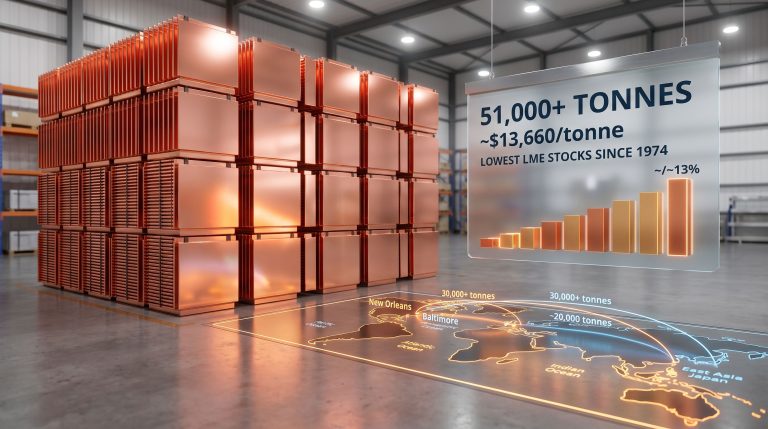
The United States implemented front-loaded copper import strategies in early 2026, resulting in refined metal inventories exceeding 1 million tons—the highest levels since 2003. However, potential Section 232 tariff implementations maintain US copper prices above London Metal Exchange benchmarks, creating open arbitrage conditions that effectively lock excess inventory within US markets rather than allowing redistribution to regions experiencing shortages.
This inventory accumulation pattern demonstrates how trade policy uncertainties can distort normal commodity distribution mechanisms. While the US holds substantial refined copper stocks, Chinese smelters compete aggressively for concentrate feedstock, creating a disconnect between refined metal availability and concentrate scarcity across different geographical markets.
Chinese consumption patterns continue absorbing approximately 60% of global copper supply despite broader economic headwinds. The combination of infrastructure spending mandates, manufacturing demand, and strategic stockpiling sustains Chinese copper consumption even as other economic indicators suggest industrial activity moderation. This consumption persistence limits the ability of other regions to access copper supplies during periods of global tightness.
Supply Chain Buffer Management
Mining companies must consider how inventory dynamics across different supply chain stages affect commercial relationships and pricing power. When refined metal accumulates in certain regions while concentrate remains scarce globally, mining operations maintain leverage over smelters regardless of downstream inventory positions.
The temporal mismatch between concentrate availability and refined metal distribution creates opportunities for mining companies to negotiate contract structures that capture value from supply chain inefficiencies. Long-term offtake agreements that guarantee concentrate delivery become increasingly valuable to smelters facing feedstock uncertainty.
Moreover, implementing effective copper investment strategies requires understanding that inventory positions at different supply chain stages can diverge significantly during periods of market stress. Mining operations that recognise these dynamics can structure commercial relationships to benefit from supply chain complexity rather than being constrained by it.
What Long-Term Supply Solutions Address Structural Deficits?
Resource Availability Assessment
Global copper reserves total approximately 870 million tons, with total identified resources exceeding 5,000 million tons. At current consumption rates of 28 million tons annually, proven reserves provide approximately 31 years of supply, while total resources extend availability beyond 180 years when considering both proven reserves and identified resources that require additional investment to become economically extractable.
However, accessing these resources requires significant capital investment, technological advancement, and regulatory approvals that can extend development timelines substantially. Major greenfield copper projects typically require 7-15 years from discovery to production, meaning supply responses to current market tightness may not materialise until the early 2030s at the earliest.
The grade decline phenomenon affects most major copper mining districts globally. Average ore grades at existing operations continue declining as higher-grade deposits become depleted, requiring processing of larger quantities of ore to maintain equivalent copper production levels. This grade decline increases energy consumption, water usage, and waste generation per unit of copper produced, adding to operational complexity and environmental compliance requirements.
Secondary Supply Development
Recycling currently meets approximately 30% of global copper demand, representing the most immediate pathway for supply expansion without new mining development. Copper exhibits excellent recycling characteristics, maintaining nearly full metallic properties through multiple recycling cycles without degradation. Infrastructure investments in collection systems, sorting technologies, and processing facilities could substantially increase secondary copper availability.
Urban mining initiatives focus on recovering copper from end-of-life infrastructure, electronic equipment, and building materials. Cities contain significant copper stocks in electrical wiring, plumbing systems, and telecommunications infrastructure that will become available for recycling as buildings and equipment reach end-of-service life. Systematic urban mining programmes could recover substantial copper quantities whilst reducing pressure on primary mining operations.
Advanced recycling technologies including hydrometallurgical processing and automated sorting systems can improve recovery rates and reduce processing costs for secondary copper production. These technological improvements make previously uneconomical recycling operations commercially viable, particularly when primary copper prices remain elevated and gold-copper exploration insights support resource optimisation strategies.
The next major ASX story will hit our subscribers first
How Will Market Forces Shape Future Copper Pricing?
Price Trajectory Analysis
JP Morgan forecasts copper prices reaching $12,500 per ton in Q2 2026, with annual averages around $12,075. These projections reflect structural supply deficits rather than speculative price movements, suggesting sustained price support from fundamental market imbalances. However, copper price volatility demonstrates sensitivity to geopolitical events, energy cost fluctuations, and economic growth concerns that can generate short-term price swings around longer-term trends.
Some industry analysts project copper prices could reach $15,000 per ton if supply constraints persist and demand growth from AI infrastructure and electrification accelerates beyond current projections. These scenarios assume continued operational disruptions at major mine sites and limited success in accelerating new mine development timelines.
Consequently, understanding how mining operations fare amid disruption at elevated price levels creates both opportunities and risks for market participants. Mining companies benefit from improved project economics and enhanced cash flow generation, while downstream consumers face input cost pressures that may accelerate substitution efforts or demand reduction initiatives.
Substitution Risk Evaluation
Higher copper prices incentivise substitution with alternative materials, particularly aluminium in electrical transmission applications. Aluminium exhibits approximately 60% of copper's electrical conductivity by weight but offers cost advantages when copper prices exceed certain thresholds. The substitution potential creates natural resistance to sustained copper price increases above $12,000-$15,000 per ton.
However, substitution limitations exist in applications requiring copper's unique properties including thermal conductivity, corrosion resistance, and electrical performance characteristics. High-performance applications in aerospace, medical equipment, and precision electronics typically cannot substitute alternative materials without significant performance compromises.
The substitution timeline varies substantially across different applications. Electrical transmission systems may require 5-10 years to implement aluminium substitution due to infrastructure replacement cycles and regulatory approval requirements. Consumer electronics and automotive applications can potentially substitute materials more rapidly through design modifications in new product generations.
What Strategic Implications Emerge for Global Supply Chains?
Mining Investment Priorities
Elevated copper prices improve project economics for previously marginal deposits throughout the global mining sector. Projects in remote locations, those requiring advanced extraction technologies, or deposits with complex metallurgy become economically attractive when copper prices exceed $10,000 per ton sustainably. This price environment supports expanded exploration programmes and accelerated development timelines for projects in various stages of advancement.
Mining companies must evaluate whether current price levels justify substantial capital commitments for long-term development projects. The structural nature of demand growth from electrification and AI infrastructure suggests price support may persist, but commodity markets remain inherently cyclical and subject to economic downturns that can rapidly change project economics.
Operational efficiency investments gain heightened importance when concentrate commands premium pricing. Automation systems, processing improvements, and maintenance programmes that generate incremental production increases yield disproportionate returns in tight supply markets. Even modest efficiency gains of 1-3% can generate substantial additional revenue when applied across large-scale mining operations.
Downstream Adaptation Strategies
Processors and manufacturers face pressure to secure long-term copper supplies through strategic partnerships, vertical integration, or alternative material adoption. The shift in negotiating power toward miners requires downstream players to reconsider supply chain strategies and accept less favourable contract structures to guarantee feedstock availability.
Vertical integration initiatives may become more attractive as downstream companies seek to secure copper supplies independently of competitive spot markets. Investments in mining operations, processing facilities, or recycling capabilities could provide supply chain security whilst potentially capturing additional value from copper price appreciation.
Long-term partnership agreements between miners and downstream consumers may replace shorter-term contracting structures as both parties seek certainty in volatile markets. These arrangements might include price-sharing mechanisms, volume commitments, or joint investment in capacity expansion projects that benefit both mining operations and end-users. Additionally, incorporating copper-uranium investment insights can enhance strategic positioning for companies seeking diversified commodity portfolios.
Investment Disclosure: This analysis is for informational purposes only and does not constitute investment advice. Commodity markets are inherently volatile and subject to numerous risk factors including operational disruptions, regulatory changes, economic conditions, and geopolitical events. Potential investors should conduct independent research and consult qualified financial advisors before making investment decisions. Past performance does not guarantee future results, and copper mining investments carry substantial risks including operational, environmental, regulatory, and market risks that could result in significant losses.
Looking to Capitalise on the Copper Supply Deficit?
Discovery Alert's proprietary Discovery IQ model delivers instant notifications on significant ASX mineral discoveries, empowering subscribers to identify copper and commodity opportunities ahead of broader markets during this unprecedented supply-demand imbalance. Explore Discovery Alert's dedicated discoveries page to understand why historic mineral discoveries can generate substantial returns, then begin your 14-day free trial today to position yourself strategically as copper market fundamentals continue strengthening.