
May 16, 2026
Macro Forces Shaping Future Copper Markets: Unpacking Zambia's Supply Surge
Copper's strategic status in the global economy has never been more pronounced. The material stands at the intersection of worldwide trends including clean energy deployment, surging electric vehicle adoption, and expanding AI infrastructure. Investment managers seeking to ride the structural shift towards resource security are focused on jurisdictions with both geological potential and operational reliability. Zambia, long a stalwart in global copper supply, is now witnessing a modern renaissance, with Canadian mining giants lead Zambia's copper expansion and rewriting investment models across Africa's mining landscape.
When big ASX news breaks, our subscribers know first
Why Is Zambia Becoming a Global Copper Powerhouse?
Economic Fundamentals Driving the Copper Boom
The Zambian copper sector forms the country's economic core, generating roughly 70% to 75% of total export earnings. Record output in 2025 reached 890,346 tonnes with projections to surpass 1 million tonnes in 2026, signalling a pivotal moment for the market. These gains are directly linked to expansions at major Canadian-owned operations such as Kansanshi (First Quantum Minerals) and Lumwana (Barrick Gold).
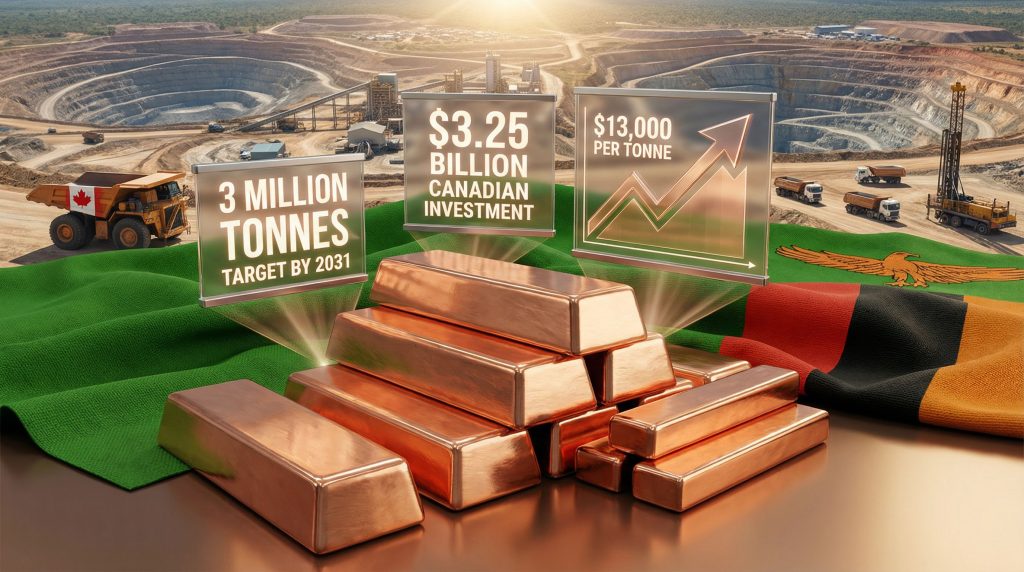
Furthermore, record copper prices surged nearly 50% in 2025, breaching the $13,000 per tonne barrier for the first time. This price action dramatically recalibrated risk-reward profiles for capital allocation, fuelling renewed confidence in Zambian ventures.
While GDP growth projections of 5.2% for 2025 and 5.8% for 2026 are cited (subject to IMF and Zambian Ministry of Finance confirmation), economic optimism is tightly interwoven with mining sector performance. Moreover, our global copper supply forecast indicates Zambia's growing importance in meeting worldwide demand.
Copper's expanding role in the energy transition is unmistakable:
- Electric vehicles demand around four times more copper than conventional cars
- Renewable energy systems may require five to six times more copper per megawatt compared to traditional sources
- Rapid buildouts of AI data centres necessitate robust copper infrastructure for power management and cooling, introducing fresh channels of demand
These dynamics combine to create a feedback loop of heightened demand, rising prices, and escalated investment in Zambia. Additionally, understanding energy transition dynamics provides crucial context for this copper boom.
Comparative positioning (2025): Zambia's output placed it among the world's top copper producers and cemented its standing as Africa's second largest, trailing only the Democratic Republic of Congo.
Strategic Geographic Advantages
Zambia's geological wealth is anchored in two core mining regions: the traditional Copperbelt Province and the rapidly rising North-Western Province. This distribution supports operational diversity and mitigates exposure to regional risks. Beyond geology, established infrastructure and upcoming corridors like the Lobito Railway are beginning to reshape Zambia's logistical landscape.
- The Lobito Railway, connecting Copperbelt operations to Atlantic ports, offers access to European and North American buyers, reducing reliance on conventional routes and potentially lowering transport costs
Such diversification enhances Zambia's attractiveness in a world focused on supply chain resilience, especially as Western economies seek reliable sources beyond their historic Asian and South American suppliers.
What Makes Canadian Mining Companies Dominant in Zambia?
Capital Deployment Strategies
Recent years have witnessed Canadian mining giants lead Zambia's copper expansion through disciplined, high-impact investment. Over $3.25 billion has been allocated to brownfield expansions between 2024 and 2026—a capital deployment approach that prioritises:
- Building upon proven deposits and infrastructure
- Lowering execution risk (compared to untapped greenfield sites)
- Accelerating return on invested capital
Key Canadian Investments in Zambian Copper (2024-2026):
| Company | Mine | Investment | Expected Output | Timeline |
|---|---|---|---|---|
| First Quantum Minerals | Kansanshi S3 Expansion | $1.25 billion | 250,000 tonnes/year | Through 2044 |
| Barrick Gold | Lumwana Super Pit | $2.0 billion | 240,000 tonnes/year | 2026-2028 |
| Total | $3.25B | 490,000 tonnes/year |
The investment philosophy centres on unlocking processing bottlenecks rather than simply boosting raw output. At Kansanshi, for instance, First Quantum commissioned a near $1.25 billion reinvestment in processing systems to notably increase throughput.
Operational Excellence Framework
Canadian operators have established formidable operational standards in the Zambian mining arena by emphasising vertical integration and environmental leadership.
Key features distinguishing Canadian-led projects:
- Integrated smelting capabilities at Kansanshi, which extend value capture beyond ore mining and reduce exposure to third-party processors
- Advanced ore processing and automation, which improve metal recoveries and decrease unit costs
- Comprehensive environmental management, including Barrick's 300,000-hectare forest conservation initiative—the largest of its kind among Zambian miners
- Tier One mine standards at Lumwana, signifying over 250,000 tonnes/year output, low-cost positioning, and long reserve life
- Dedicated workforce training facilities to enhance productivity and safety
This operational sophistication is hard for smaller or less capitalised players to replicate, offering Canadian firms resilient competitive advantages. In addition, exploring copper and uranium insights reveals broader strategic considerations for Canadian mining investments.
Estimated value chain impact: Integrated smelting and margin capture at Kansanshi can account for an added 15%–25% of value versus producers limited to raw concentrate sales, especially during times of global processing pinch points.
How Will Zambia Achieve Its 3 Million Tonne Production Target?
The National Mining Strategy Framework
The National Three Million Tonnes Copper Production Strategy and Mining and Minerals 2031 policy set an ambitious mandate: triple output to 3 million tonnes by the early 2030s—a 3.4-fold jump from 2025's base.
Pillars of the expansion strategy:
- Brownfield Expansions: Scaling up processing at mines like Kansanshi and Lumwana
- Greenfield Projects: Bringing new deposits, especially in underexplored territories, into production
- Artisanal Mining Formalisation: Structured support and regulation for small-scale miners, unlocking additional output while improving safety and tax compliance
- Infrastructure Modernisation: Upgrading rail, road, and power networks—vital for expanded mine operations
Reaching these targets will require $15–20 billion in cumulative investment. Currently committed funds account for approximately 20% of that figure, emphasising the need for new FDI flows and innovative public-private partnerships.
Zambia's copper expansion is seen as one of Africa's premier resource investment opportunities, blending established reserves, political progress, and robust long-term demand.
Disclaimer: Future production and investment goals remain subject to macroeconomic volatility, project delivery risks, and market pricing swings.
What Are the Competitive Dynamics in Zambian Copper Mining?
Market Share Analysis by Ownership Structure
Ownership and production in Zambia's copper sector reflect a tapestry of global interests, with Canadian mining giants lead Zambia's copper expansion as the dominant theme.
| Ownership Category | Annual Production | Market Share | Key Players |
|---|---|---|---|
| Canadian Companies | 420,000 tonnes | 47% | First Quantum, Barrick |
| Indian Companies | 180,000 tonnes | 20% | Vedanta Resources |
| Chinese Companies | 150,000 tonnes | 17% | JCHX Mining |
| Other International | 140,000 tonnes | 16% | Various |
Canadian firms have achieved this dominance through vertical integration and high-value processing, whereas Indian and Chinese operators tend to focus on either brownfield rehabilitation or cost-driven production models.
Strategic Positioning of Major Players
- First Quantum's integrated model shields earnings and guarantees throughput even when regional processing infrastructure is constrained
- Barrick Gold's Lumwana prioritises ESG standards, turning environmental and community initiatives into investor-friendly differentiators that strengthen long-term operating stability
- Indian and Chinese ventures often target lower-grade, higher-tonnage projects or recovery of legacy assets, producing at larger scale but with distinct capital deployment and risk strategies
How Do Global Copper Demand Trends Impact Zambian Operations?
Technology-Driven Demand Acceleration
Copper's role in new technologies means that demand curves are steepening across several key market slices:
- Electric vehicles (EVs) and grid-scale batteries: A single EV can require 80–100kg of copper, as compared to 20–25kg for conventional vehicles
- Wind and solar farms: Next-generation renewables use extensive copper wiring, cabling, and grounding, often 5–6 times the metal intensity of fossil alternatives
- AI and cloud data centres: Each hyperscale facility incorporates tens of thousands of kilometres of copper-wound power distribution and cooling infrastructure
Supply Chain Resilience Considerations
With Western economies seeking to lessen dependence on geographically concentrated supply chains, Zambia's distancing from the uncertainties faced by some Latin American and Asian copper exporters plays directly into buyer priorities. Infrastructure enhancements—especially the Atlantic-bound Lobito Railway—are further opening access, reducing transport times, and unlocking new market segments.
However, insights from gold-copper exploration insights suggest that diversified mineral portfolios may provide additional stability for Zambian operations.
The next major ASX story will hit our subscribers first
What Are the Infrastructure and Regulatory Enablers?
Power Generation and Transportation Networks
For Zambia's copper boom to reach its full potential, continued infrastructure improvements are essential:
- Rail Upgrades: New corridors, notably the Lobito line, set benchmarks for export efficiency
- Electrical Grid Expansion: Increased power reliability is essential to prevent costly mine shutdowns
- Road Improvements: Heavier and more frequent ore and concentrate shipments put pressure on existing roadways, demanding upgrades
- Telecom Enhancements: Connectivity enables operational analytics and safety systems, particularly in remote sites
Regulatory Framework Evolution
Regulatory clarity and modernisation are integral to attracting fresh investment. Recent initiatives aim to streamline permitting and bolster environmental oversight, including:
- Simplified project permitting for major investments
- Transparent taxation and royalty structures for large-scale miners
- Enhanced environmental performance criteria, helping operators secure local support and global financing
- Improved dispute resolution systems to protect foreign investors' interests
What Investment Risks and Opportunities Exist?
Risk Assessment Framework
| Risk Category | Impact Level | Mitigation Strategies |
|---|---|---|
| Political/Regulatory | Medium | Broad-based stakeholder engagement; compliance systems |
| Operational | Medium-High | Tech upgrades; workforce training |
| Market/Pricing | Medium | Long-term contracts; hedging flexibility |
| Infrastructure | Low-Medium | Public-private projects; system redundancy |
Proactive risk management and strong local partnerships underpin the business models of successful Canadian operators.
Opportunity Analysis
Where structural challenges exist, so do investment opportunities:
- Capital expansion at proven operations—brownfield development remains lowest risk and highest return
- Implementation of cutting-edge processing technology—automation, data analytics, and IoT in mining
- Infrastructure co-investment—rail and grid expansion unlock bottlenecked capacity
- Early-stage exploration in underexplored geology—potential to establish the next generation of Tier One deposits
Frequently Asked Questions
What makes Zambian copper operations attractive to Canadian companies?
Zambia's unique combination of established ore reserves, supportive regulatory reforms, and significant scale potential provides Canadian mining firms with a platform for sustainable, large-scale investment. The operational parallels between Zambian geology and successful Canadian ventures also foster confidence and encourage technology transfer.
How does Zambia's copper expansion compare to other African mining jurisdictions?
Among African peers, Zambia stands out for its investment-friendly regulatory posture, entrenched industrial infrastructure, and political stability. This reduces operational friction, attracts lower cost capital, and allows firms to plan with confidence far into the future.
What role does environmental sustainability play in Zambian copper mining?
As ESG priorities shape global capital flows, environmental stewardship is now essential rather than optional. Large-scale Canadian operators in Zambia are leading with comprehensive conservation programs, proactive community engagement, and transparent sustainability reporting—practices that secure social licence, funding, and long-term market access.
Disclaimer: This analysis draws on publicly available data and industry sources as of early 2026. Financial forecasts, production targets, and regulatory environments may evolve over time. Prospective investors should conduct detailed due diligence and review official policy documents before making capital allocation decisions.
For further exploration: Those seeking deeper insights into African mining dynamics can reference educational resources and industry reports from mining-focused institutions, commodity market observers, and regional policy think tanks.
Looking for Opportunities in Emerging Copper Markets?
Discovery Alert's proprietary Discovery IQ model delivers real-time alerts on significant copper discoveries across the ASX, instantly empowering subscribers to identify actionable opportunities ahead of the broader market. With copper's pivotal role in the energy transition creating unprecedented demand, begin your 14-day free trial today and secure your market-leading advantage in this rapidly evolving sector.