August 14, 2026
The Cost Revolution Quietly Reshaping How Copper Gets Out of the Ground
Every decade or so, a single operational model emerges that makes everything before it look economically obsolete. In hard rock mining, those moments have been rare. The shift from underground to open pit extraction reshaped global copper economics in the early twentieth century. The introduction of heap leach processing in the 1970s unlocked billions of tonnes of low-grade oxide material that conventional mills could never justify treating. Today, a third inflection point may be forming, not in geology or chemistry, but in the software layer that sits above every machine, every process, and every capital decision on a mine site.
The Mariana Minerals Copper One autonomous copper mine in Utah is the most visible current expression of this thesis. Located in San Juan County in southeastern Utah, on a land package near Moab that carries a long and well-documented production history, the project represents something genuinely new: a copper operation designed from the ground up as a software deployment, not a mining project with automation bolted on afterward.
Understanding why that distinction matters requires stepping back from the project itself and examining the structural forces that made such an approach not just technically interesting, but economically necessary.
When big ASX news breaks, our subscribers know first
Why Conventional Copper Economics Are Under Structural Pressure
The global copper industry faces a compounding problem that no single mine, technology, or policy intervention can resolve in isolation. On the demand side, electrification is placing sustained upward pressure on copper consumption across multiple sectors simultaneously. Electric vehicles require roughly 2.5 to 4 times more copper per unit than internal combustion engine equivalents, according to data from the International Copper Association. Grid-scale battery storage systems, transmission infrastructure upgrades, and defence manufacturing are all competing for the same finite supply of refined copper.
On the supply side, the economics of building new copper mines have deteriorated significantly over the past two decades. Average ore grades at operating copper mines have declined from approximately 1.0% copper in the early 2000s to below 0.6% at many major operations today, according to the USGS Mineral Commodity Summaries. Lower grades mean more rock moved per tonne of metal produced, which means higher costs, higher energy consumption, and larger environmental footprints per unit of output. Furthermore, this ongoing grade decline sits at the heart of today's copper supply crunch, making alternative operational models increasingly attractive to producers worldwide.
Greenfield copper development in the United States faces additional headwinds specific to the domestic regulatory environment. Permitting timelines for new mines can extend beyond a decade in some jurisdictions, and capital intensity for large conventional open pit operations routinely exceeds several billion dollars before first production. Against a backdrop of rising interest rates and cautious institutional capital, the business case for conventional greenfield copper has become genuinely difficult to construct.
The result is a structural gap between what domestic U.S. production can supply and what a rapidly electrifying economy will require. This gap is what creates the context for understanding Copper One.
From Lisbon Valley to Copper One: What Changed and Why It Matters
The site at the centre of this story is not new. The Lisbon Valley Mine in San Juan County has a documented production history that predates many of the technology companies now backing its successor operation. The deposit is a copper oxide system well suited to heap bioleach and hydrometallurgical processing, which is significant because, as discussed below, these metallurgical characteristics are precisely what makes full-stack automation technically achievable at this type of asset.
Mariana Minerals resumed copper operations in April 2026, following a production suspension at the site in late 2024. The restart was structured around a principle that distinguishes this operation from nearly every other automation story in the mining industry: autonomous systems were integrated before production resumed, not added to an already operating mine.
This sequencing matters more than it might initially appear. Retrofitting autonomous equipment into an existing operation requires working around established workflows, existing infrastructure, legacy equipment fleets, and entrenched operational cultures. The productivity gains achievable through retrofit automation are real but constrained. Building an autonomous-first operation from a standing start removes all of those constraints simultaneously, allowing software systems, physical infrastructure, and operational procedures to be co-designed rather than reconciled.
The Silicon Valley Operational Philosophy
The leadership profile of Mariana Minerals reflects this philosophy directly. CEO Turner Caldwell brings a background from Tesla, where software-defined manufacturing and continuous over-the-air improvement of operational systems became central to how vehicles were built, delivered, and updated. Applied to a copper mine, this mindset produces a fundamentally different set of questions. Instead of asking how many people are needed to operate each piece of equipment, the first question becomes: what decisions actually require human judgment, and how should software handle everything else?
The company has attracted technology-sector investors rather than drawing primarily from traditional mining finance. This capital source matters because technology investors evaluate assets differently — they expect software systems to improve iteratively, they understand recurring investment in platform development, and they are comfortable with operational models that look unfamiliar to conventional mining analysts.
How MarianaOS Integrates Extraction, Refining, and Capital Management
The operational architecture at Copper One is built around a proprietary platform called MarianaOS, which functions as a unified intelligence layer across three distinct operational domains.
| Subsystem | Operational Domain | Primary Function |
|---|---|---|
| MineOS | Open pit extraction | Autonomous drilling, robotic haulage, and distributed sensing |
| PlantOS | Hydrometallurgical refining | Process control across the full SX-EW circuit |
| CapitalProjectOS | Project execution | Autonomous coordination of capital deployment decisions |
The architecture deliberately avoids the point-solution approach that characterises most current mining automation deployments, where autonomous trucks might be operating alongside manually driven drills, or where process control systems operate independently from extraction scheduling. At Copper One, the stated intent is a single decision-making environment that spans all three domains.
Open Pit Automation: Drilling, Haulage, and Sensing
Within the MineOS domain, autonomous drilling systems eliminate the manual positioning errors that affect conventional drill operations. In traditional open pit copper mining, drilling accuracy directly influences blast fragmentation quality, which in turn affects shovel productivity, crusher throughput, and ultimately the consistency of material fed into the heap leach pad. Autonomous drill systems use machine-directed positioning protocols to maintain tighter tolerances than manual operation allows, with downstream benefits that compound across the entire processing chain.
Robotic haul truck fleets operate under coordinated dispatch algorithms that optimise route selection, queuing at loading points, and cycle times across the entire fleet simultaneously. Unlike a human-operated fleet, where individual driver decisions introduce variance into the system, a coordinated autonomous fleet behaves as a single optimised unit. Collision avoidance architecture manages interactions between machines, and the absence of shift changes means production continuity that a labour-dependent operation structurally cannot replicate. In addition, advances in sensor-based copper mining are increasingly complementing these autonomous fleets by providing real-time grade data that improves material sorting decisions at the pit face.
Distributed sensor networks replace the manual inspection and grade control functions that in conventional mines require geologists and technicians to physically sample, log, and interpret material across the pit face. Automated sensing provides continuous, real-time grade data that feeds directly into production scheduling decisions within MineOS.
Heap Bioleaching and the SX-EW Circuit: Why This Metallurgy Suits Full Automation
One of the less commonly discussed reasons why Copper One is technically suited to full-stack automation lies in its metallurgy. The copper leaching process followed by solvent extraction and electrowinning is a sequential, process-intensive refining pathway that differs fundamentally from the batch-oriented, highly variable processing required at conventional concentrator and smelter operations.
In heap bioleaching, acid solutions are distributed across crushed copper oxide ore stacked on lined pads. Bacteria accelerate the oxidation of copper minerals, dissolving copper into a solution called the pregnant leach solution (PLS). This PLS is then fed into the SX-EW circuit, where solvent extraction selectively separates copper from impurities, and electrowinning plates high-purity copper cathode directly from the purified electrolyte.
The critical characteristic for automation purposes is that this process is fundamentally continuous and parameter-driven. Flow rates, acid concentrations, pH levels, current densities in the electrowinning cells, and reagent addition rates can all be managed by software-controlled systems with a precision that exceeds manual intervention. PlantOS manages this entire circuit autonomously, with Mariana Minerals reporting a 30% reduction in refining costs attributable to this automated process management.
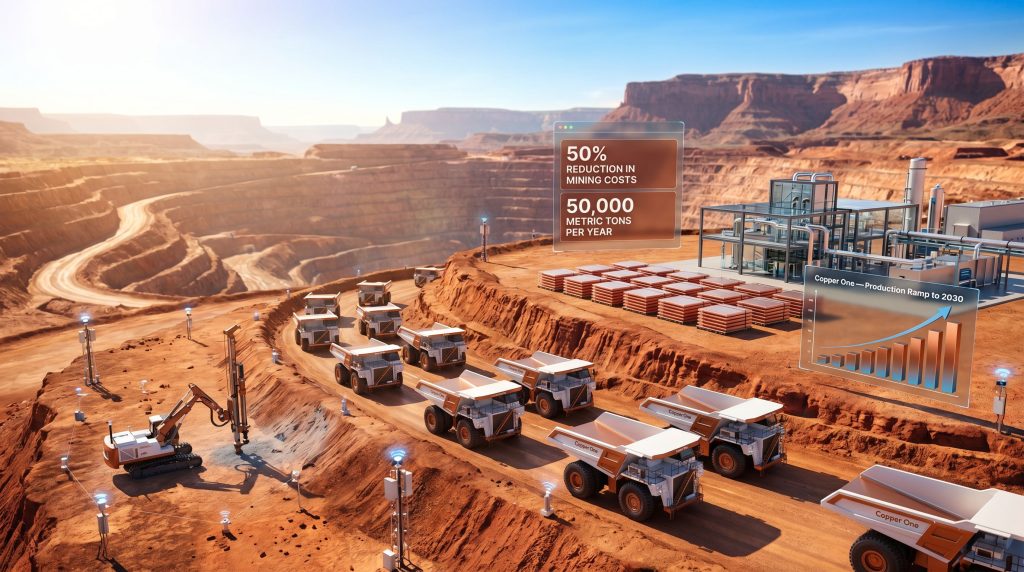
Mariana Minerals has stated that autonomous system deployment across extraction and processing has produced a 50% reduction in mining costs and a 30% reduction in refining costs relative to conventional operational benchmarks. These figures are company-reported and have not been independently audited at the time of writing. Investors and industry observers should treat these claims as indicative of the company's internal performance assessment rather than independently verified operational data.
Production Targets and the Path to Scale
The production architecture at Copper One is structured around a growth trajectory that runs from the April 2026 restart through to a target of 50,000 metric tons per year of high-purity copper cathode by 2030. The near-term operational phase involves doubling current output while simultaneously integrating a copper scrap processing stream to access domestic secondary supply.
The scrap integration element deserves attention as a strategic decision, not just an operational one. Domestic copper scrap represents an available, already-refined secondary feedstock that bypasses the extraction and comminution stages entirely. By processing scrap through the existing hydrometallurgical infrastructure, Copper One can supplement primary production from the heap leach operation with lower-cost secondary material, improving blended cost metrics without requiring proportional increases in mining activity.
The Permitted Land Package as a Strategic Asset
The Copper One project sits within a 10,000-acre permitted land package in southeastern Utah. In the current U.S. permitting environment, this attribute carries a value that is difficult to quantify but impossible to ignore. The existing permitted footprint encompasses proven additional deposits beyond the current operating area, creating optionality for future expansion phases without requiring new environmental impact assessments or the decade-long permitting sequences that constrain greenfield development.
For any company targeting 50,000 metric tons per year by 2030, the ability to expand within an already-permitted boundary fundamentally changes the capital risk profile of the growth plan.
Autonomous Mining Economics: What the Numbers Suggest
The cost structure implications of autonomous-first copper production are significant enough to warrant detailed examination, even with the caveat that Copper One's reported figures are early-stage and not yet independently verified.
| Cost Category | Conventional Operation | Copper One Model | Reported Difference |
|---|---|---|---|
| Mining cost per tonne | Industry baseline | Autonomous-optimised | Approximately 50% reduction |
| Refining cost per tonne | Industry baseline | Autonomous-optimised | Approximately 30% reduction |
| Labour dependency | High, shift-constrained | Minimal supervisory oversight | Significant structural reduction |
| Operational continuity | Shift change dependent | Continuous 24/7 machine operation | No shift interruption |
| Maintenance scheduling | Reactive and planned | Predictive via sensor data | Reduced unplanned downtime |
The labour cost reduction, while significant, is actually the least interesting component of this equation from an economic modelling perspective. The more durable competitive advantages lie in three other areas:
-
Operational continuity: A fully autonomous operation runs continuously without the productivity losses associated with shift changes, crew mobilisation, and the natural variability in human performance across different times of day.
-
Predictive maintenance: Sensor networks across autonomous equipment generate continuous condition data that enables maintenance interventions before failures occur, reducing unplanned downtime that represents one of the largest hidden costs in conventional mining.
-
Consistent throughput: Automated systems maintain process parameters at optimal levels with a consistency that human operators cannot sustain across long operating periods, reducing the grade and volume variability that inflates processing costs at conventional operations.
Where Autonomous-First Models Work and Where They Do Not
It is worth being direct about the conditions under which the Copper One model is replicable, because the autonomous-first thesis should not be overstated as a universal solution.
Heap bioleach and SX-EW operations are among the most automation-compatible processing routes in the copper industry. The process is continuous, the chemistry is well understood, and the control variables are measurable in real time. Underground operations with complex geotechnical conditions, polymetallic deposits requiring variable metallurgical treatment, and high-altitude or remote operations with infrastructure constraints present different challenges that point-solution automation addresses only partially.
The Copper One model works at Copper One, in significant part, because the metallurgy, geometry, and infrastructure of the Lisbon Valley deposit are well matched to the specific automation architecture being deployed. The broader industry will be watching whether the reported cost reductions hold as production scales, and whether the model can be replicated at assets with less favourable technical characteristics.
The next major ASX story will hit our subscribers first
Copper One's Place in the Domestic Supply Picture
The United States currently produces approximately 1.2 million metric tons of copper per year according to USGS data, while domestic consumption runs at levels that create meaningful import dependency for refined copper products. As EV manufacturing, transmission grid upgrades, and industrial electrification drive consumption higher through the late 2020s, that dependency is projected to widen rather than narrow without new domestic production coming online.
The Mariana Minerals Copper One autonomous copper mine in Utah represents a meaningful but not transformative addition to U.S. copper supply at its stated production target. Its significance lies less in volume and more in what it demonstrates about the economic viability of domestic production using autonomous-first operating models. If Copper One sustains its reported cost reductions at scale, it will provide the first genuine proof-of-concept data for software-defined copper mining as a replicable approach to closing the domestic supply gap.
The Investor Implication: A New Asset Category
Traditional mining company valuation frameworks, which centre on ore reserve quality, capital intensity per tonne of nameplate capacity, and long-term metal price assumptions, may not capture the full value proposition of an operation where the software platform is itself a scalable asset. If MarianaOS can be deployed at other copper or base metal assets beyond Copper One, the company's valuation story extends beyond a single Utah mine into something closer to a mining technology platform with a production asset attached. Consequently, those exploring copper investment strategies may find it worthwhile to consider how software-defined operations alter conventional risk and return assumptions.
This is speculative at this stage. Copper One has been operating for weeks, not years, and the performance claims require sustained validation across multiple production cycles before they should be treated as bankable data. However, the structural logic of the software-first mining thesis is coherent, and the conditions that motivated it — declining grades, rising permitting barriers, and tightening labour markets in resource regions — are not going away.
Disclaimer: This article contains forward-looking statements and references to production targets, cost reduction claims, and market projections that involve material uncertainty. The financial and operational figures attributed to Mariana Minerals are company-reported and have not been independently audited at the time of publication. Nothing in this article constitutes investment advice. Readers should conduct their own due diligence before making any investment decisions related to companies or assets discussed herein.
Frequently Asked Questions About Mariana Minerals and Copper One
What is Copper One and where is it located?
Copper One is an open pit copper mine in San Juan County, southeastern Utah, near Moab. Formerly operated as the Lisbon Valley Mine, it was acquired by Mariana Minerals in late 2025 and restarted in April 2026 as a fully autonomous copper producer.
What is MarianaOS?
MarianaOS is a proprietary AI operating platform developed by Mariana Minerals that integrates three subsystems: MineOS for open pit extraction, PlantOS for hydrometallurgical refining, and CapitalProjectOS for capital project coordination. The platform is designed to manage all operational domains through a single unified decision-making environment.
What production targets has Mariana Minerals set for Copper One?
The company is targeting 50,000 metric tons per year of high-purity copper cathode by 2030, with near-term plans to double current output from the April 2026 restart baseline and to integrate copper scrap processing into the operation.
What cost reductions has the autonomous model achieved?
Mariana Minerals has reported a 50% reduction in mining costs and a 30% reduction in refining costs relative to conventional operational benchmarks. These are company-reported figures and have not been independently verified at the time of writing.
What refining process does Copper One use?
The Mariana Minerals Copper One autonomous copper mine in Utah uses heap bioleaching followed by a hydrometallurgical circuit based on solvent extraction and electrowinning, producing high-purity copper cathode as its primary output.
Who is Turner Caldwell?
Turner Caldwell leads Mariana Minerals as CEO, bringing professional experience from Tesla, where software-driven approaches to manufacturing and operational management were central to the company's production model. His appointment signals a deliberate decision to apply technology-sector thinking to mine operations management.
Why does the permitted land package matter?
The 10,000-acre permitted footprint in southeastern Utah provides expansion optionality within an already-approved boundary, reducing the regulatory risk associated with growing production toward the 2030 target. Given U.S. mine permitting timelines, operating within an existing permitted area represents a significant practical advantage over greenfield alternatives.
Want to Know Which ASX Copper Discoveries Could Deliver the Next Major Return?
As autonomous mining models reshape the economics of copper production and demand continues to surge from electrification, Discovery Alert's proprietary Discovery IQ model scans ASX announcements in real time, instantly alerting subscribers to significant copper and mineral discoveries before the broader market reacts. Explore historic discoveries and the returns they generated, then begin your 14-day free trial to position yourself ahead of the market.