June 18, 2026
The Widening Gap Between Copper Supply and a World Being Rewired
The global economy is undergoing a fundamental rewiring. Not metaphorically, but literally. Every electric vehicle produced, every offshore wind turbine installed, every hyperscale data centre brought online, and every kilometre of upgraded transmission grid requires copper in quantities that would have seemed implausible a generation ago. Copper and the next phase of mining growth is a story shaped by simultaneous, self-reinforcing demand forces that have no clear historical parallel. This convergence is reshaping how miners, investors, and governments think about one of the oldest industrial metals on earth.
When big ASX news breaks, our subscribers know first
Copper and the Next Phase of Mining Growth: Understanding the Structural Demand Shift
Previous commodity cycles were typically driven by a dominant theme. The industrialisation of China through the 2000s powered a broad metals boom, but it was concentrated in construction and basic manufacturing. The current cycle is, however, different in architecture. Electrification, decarbonisation, and digital infrastructure are not sequential trends. They are concurrent, self-reinforcing, and each is highly copper-intensive.
An electric vehicle contains roughly three to four times more copper than a conventional internal combustion engine vehicle, with estimates ranging from 60 kg to over 80 kg per EV depending on the platform. Offshore wind installations require approximately 9.5 tonnes of copper per megawatt of generating capacity. Grid-scale battery storage and transmission upgrades compound this further.
Meanwhile, AI data centres, which are proliferating at a rate that would have been considered speculative just five years ago, rely on copper for power distribution, cooling systems, and signal transmission infrastructure. The role of critical minerals in energy transition planning has consequently elevated copper to the top of strategic resource agendas worldwide.
From Industrial Commodity to Strategic Resource
One of the most consequential shifts in the copper landscape over recent years is the formal reclassification of copper as a critical mineral by governments across North America, Europe, and the Asia-Pacific region. The United States, European Union, Australia, Japan, and South Korea have all included copper in their critical minerals frameworks, reflecting its irreplaceable role in power transmission, national defence electronics, and the broader energy transition.
This reclassification carries practical consequences beyond symbolism. It changes the financing environment for copper projects, creates pathways for strategic offtake arrangements, and elevates copper development within national industrial policy frameworks. Projects previously evaluated purely on commercial terms are now being assessed through the lens of supply chain security, introducing a new category of strategic investor into the sector.
"The shift from industrial commodity to strategic resource does not simply change how copper is perceived. It changes who funds copper development, how quickly projects can access capital, and which jurisdictions attract the most investment activity."
The Supply-Demand Arithmetic: What the Numbers Actually Mean
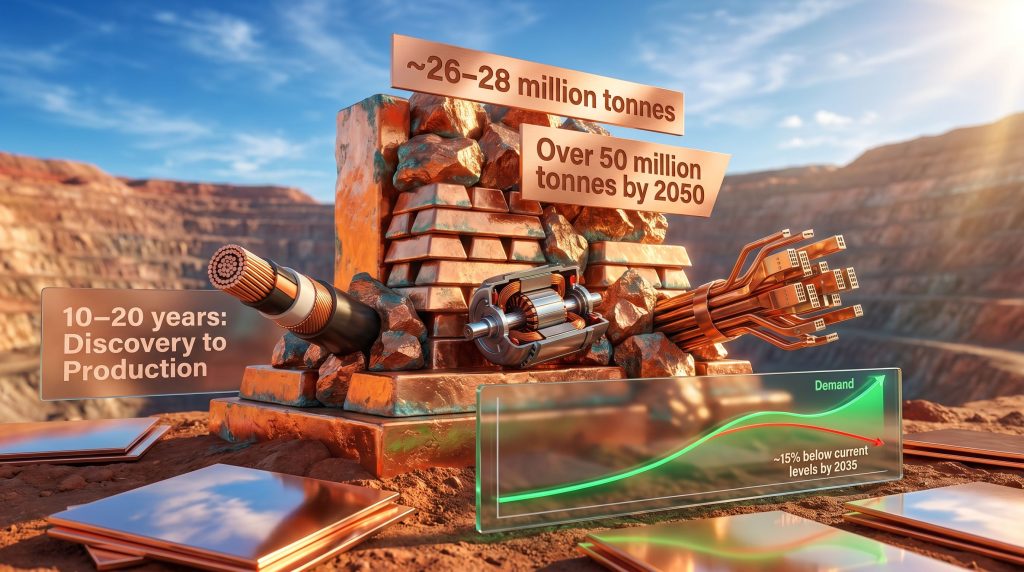
Global copper consumption currently sits in the range of 26 to 28 million tonnes per year. Copper demand is projected to exceed 50 million tonnes per year by 2050, representing a near-doubling of current consumption. The following table summarises the key metrics shaping the supply-demand outlook:
| Metric | Current Estimate | Projected by 2050 |
|---|---|---|
| Global copper demand | ~26–28 Mt/year | Over 50 Mt/year |
| New mined supply needed (next decade) | — | ~10 Mt/year additional |
| Output decline from existing mines by 2035 | — | ~15% below current levels |
| Recycled copper share of annual supply | ~30% | Growing, but insufficient alone |
| Average project development timeline | 16–20 years | Not improving meaningfully |
The most critical window in this trajectory is the period between 2028 and 2035. This is where the gap between projected demand and confirmed supply is widest, and where the consequences of underinvestment in project development over the prior decade will be most acutely felt. Furthermore, the copper supply crunch is being compounded by mine development timelines of 16 to 20 years, meaning decisions made today will barely produce metal in time to address a 2035 deficit.
Why Declining Ore Grades Are a Hidden Crisis
One of the less-discussed dimensions of the copper supply problem is ore grade deterioration. Across the world's major copper-producing regions, the average grade of ore being processed has declined steadily over decades. Ore that once yielded 1.5% to 2% copper per tonne of rock is being replaced in production profiles by material running at 0.5% or below.
This means miners must move significantly more material per tonne of refined copper produced, driving up energy consumption, water usage, and operating costs per unit of output. For investors, understanding the difference between a mine maintaining production and a mine maintaining profitable production at declining grades is an important analytical distinction.
The Project Development Bottleneck: Why New Mines Take So Long
"The average time from copper discovery to first commercial production now spans 16 to 20 years, a figure that has lengthened progressively as regulatory requirements, community consultation obligations, and technical complexity have all increased."
The factors contributing to extended development timelines can be grouped into four distinct categories:
-
Technical complexity — Many of the world's remaining large undeveloped copper deposits are located in geologically challenging environments. Porphyry copper systems at altitude, high-arsenic ore bodies, and deposits with complex sulphide mineralogy all require specialised processing solutions that extend engineering and feasibility timelines. Completing a robust definitive feasibility study has consequently become one of the most capital-intensive stages of project development.
-
Regulatory friction — Environmental impact assessments in major copper jurisdictions now routinely take three to five years to complete. Water use approvals, indigenous land rights processes, and biodiversity offset requirements have each added time and cost to the permitting pathway.
-
Financial barriers — Large-scale greenfield copper projects require capital commitments in the billions of dollars. Securing this capital without a defined offtake structure, strategic partnership, or sovereign backing has become increasingly difficult, particularly for junior and mid-tier developers.
-
Sovereign and political risk — Several of the world's highest-potential copper jurisdictions carry meaningful sovereign risk profiles. Royalty renegotiation, resource nationalism policies, and fiscal instability in parts of Latin America and Africa have caused developers to reassign risk premiums, raising the cost of capital for affected projects.
The Recycling Ceiling: Why Secondary Supply Has Limits
Recycled copper currently contributes approximately 30% of annual global supply, and this share is expected to grow modestly as collection infrastructure improves and urban mining programmes mature. However, there is a structural ceiling on how much recycled copper can realistically contribute in the timeframe that matters most.
The volume of copper available for recycling is constrained by the existing installed base of copper-containing products. As demand from new applications — particularly EVs, offshore wind, and grid storage — grows faster than the end-of-life cycle of earlier copper-containing products, the recycling pool cannot keep pace. This means primary mined supply must carry the bulk of the demand increment for at least the next two decades.
Regional Supply Outlook: Where New Copper Will Come From
| Region | Key Characteristics | Primary Challenges |
|---|---|---|
| Latin America (Chile, Peru, Ecuador) | World's largest copper reserves; established infrastructure | Water scarcity, community opposition, regulatory complexity |
| Central Africa (DRC, Zambia) | High-grade deposits; growing investment interest | Infrastructure deficits, political risk, logistics costs |
| Asia-Pacific (Mongolia, PNG, Indonesia) | Large undeveloped deposits; greenfield potential | Remote locations, sovereign risk, environmental approvals |
| North America (USA, Canada) | Strategic supply chain importance; stable jurisdictions | High capital costs, lengthy permitting timelines |
Brownfield expansions at or adjacent to existing operations are widely regarded as the fastest path to meaningful new supply, with estimates suggesting these projects could contribute up to 30% of total copper supply by 2035. The Democratic Republic of Congo's Kamoa-Kakula complex is among the most significant brownfield-adjacent developments globally, and the Central African Copperbelt is attracting renewed capital interest given its high-grade ore bodies.
North America has, in addition, gained particular strategic importance as domestic supply chain considerations increasingly influence capital allocation decisions among both private and state-aligned investors.
Technology's Role in Unlocking the Next Generation of Deposits
The future of copper mining will not resemble the operations built during the last expansion cycle. Lower grades, greater depths, and more complex mineralogy are the defining characteristics of the resource base available for development. This reality places technology investment at the centre of economic viability, rather than at the periphery.
Several processing advances are materially changing the economics of previously marginal deposits:
- Heap leaching and SX-EW (solvent extraction-electrowinning) technologies have been refined to economically process oxide and transitional ore bodies at grades that conventional flotation circuits cannot handle profitably.
- Atmospheric leaching innovations are extending the economic life of deposits with complex sulphide mineralogy, particularly in regions where water availability limits conventional wet processing.
- Bioleaching is emerging as a viable processing pathway for low-grade secondary sulphide ores, with advances in bacterial consortia and reactor design improving recovery rates.
- Autonomous haulage and AI-driven ore sorting are reducing unit costs at operations where grade decline would otherwise compress margins to unprofitable levels.
- Digital twin technology enables mine planners to model extraction sequences in real time, optimising ore blending and reducing dilution from waste rock.
"The ability to process lower-grade, more complex ores economically is becoming a genuine competitive differentiator between copper projects that will attract capital and those that will not. Technology investment is no longer an efficiency measure; it is a threshold requirement for project viability."
The next major ASX story will hit our subscribers first
Capital Allocation and Investment Strategy: What the Numbers Demand
The scale of capital required to close the projected supply gap is significant by any measure. Meeting a demand trajectory that requires roughly 10 million additional tonnes of mined copper per year within the next decade implies hundreds of billions of dollars in new project capital, infrastructure, and processing investment globally.
Major diversified miners including BHP and Rio Tinto have publicly repositioned copper as a core growth commodity within their long-term capital frameworks. For those evaluating copper investment strategies, the margin profile of copper relative to legacy iron ore and coal businesses makes it an increasingly compelling allocation target.
| Investment Type | Risk Profile | Return Timeline | Strategic Rationale |
|---|---|---|---|
| Brownfield expansion | Lower | 3–7 years | Fastest path to production; established infrastructure |
| Greenfield in Tier 1 jurisdictions | Medium | 8–15 years | Large-scale reserves; long mine life |
| Greenfield in emerging regions | Higher | 10–20 years | High grades; requires sovereign risk premium |
| Processing technology | Medium | 5–10 years | Enables lower-grade economics; scalable |
| Recycling and urban mining | Lower–Medium | 3–8 years | ESG-aligned; complements primary supply |
Streaming and royalty financing structures are, furthermore, becoming more prominent as mechanisms for funding development without equity dilution at the operating company level. These instruments allow projects to access capital earlier in the development cycle than traditional project finance permits, which is particularly relevant given the capital intensity of modern copper projects.
Three Scenarios for the 2035 Copper Market
Scenario 1: Accelerated Development involves meaningful permitting reform, government-backed project financing in key jurisdictions, and processing technology breakthroughs compressing development timelines. Under this outcome, brownfield expansions and a cohort of mid-tier greenfield projects partially close the supply gap by 2033 to 2035, and copper prices remain elevated but stable enough to sustain continued investment.
Scenario 2: Structural Deficit (Base Case) assumes development timelines remain extended and brownfield expansions provide only partial relief. A persistent supply shortfall of four to eight million tonnes per year emerges in the early 2030s, entrenching elevated copper prices and triggering demand-side substitution in some applications while incentivising higher-cost production in others.
Scenario 3: Demand Moderation contemplates slower-than-projected EV adoption, delayed grid investment, and softer-than-expected AI infrastructure spending. Consequently, copper demand growth moderates to the lower end of forecast ranges, and some of the investment made at peak optimism faces margin pressure.
"The base case structural deficit scenario carries the broadest consensus among major industry participants and analytical frameworks. The central uncertainty is not demand, which is underpinned by durable policy and technology drivers, but the pace at which new supply can realistically be mobilised given the structural constraints on project development timelines."
Frequently Asked Questions: Copper and the Next Phase of Mining Growth
Why is copper so difficult to substitute in clean energy applications?
Copper's combination of electrical conductivity, thermal performance, ductility, and corrosion resistance makes it uniquely suited to power transmission and electrical motor applications. Aluminium is used as a partial substitute in overhead transmission lines but performs poorly in applications requiring flexibility, compact design, or high-frequency signal transmission. For most clean energy end-uses, no material currently replicates copper's performance profile at comparable cost. BHP's analysis of copper's role in the energy future underscores this point clearly.
What is SX-EW and why does it matter for future copper supply?
Solvent extraction-electrowinning is a hydrometallurgical process that recovers copper from leach solutions without requiring smelting. It is particularly effective for oxide ore bodies and certain secondary sulphide deposits. Its importance for future supply lies in its ability to process lower-grade, near-surface ore that conventional concentrators cannot handle economically, extending the resource base available to the industry without requiring the capital intensity of a full concentrator-smelter circuit.
Which companies are leading capital allocation toward copper growth?
BHP has described copper as central to its long-term growth strategy, with the proposed acquisition of Anglo American in 2024 partly motivated by a desire to increase copper exposure. Rio Tinto's Oyu Tolgoi expansion in Mongolia and its interest in the Winu project in Australia reflect similar strategic positioning. Beyond the majors, mid-tier developers in Chile, Peru, and the DRC-Zambia belt are the focus of growing strategic investor interest.
Is the social licence challenge getting harder for copper projects?
Evidence from recent project developments suggests the social licence environment has become more complex, particularly in Latin America. Community opposition contributed to the suspension or cancellation of several large copper projects in Peru and Chile over the past decade. Developers that integrate community engagement, shared economic benefit frameworks, and environmental management early in the project cycle are increasingly demonstrating shorter permitting timelines and lower execution risk than those treating social licence as a compliance obligation.
Want to Position Yourself Ahead of the Next Major Copper Discovery?
Discovery Alert's proprietary Discovery IQ model scans ASX announcements in real time, instantly identifying significant mineral discoveries — including copper — and turning complex data into actionable investment insights for subscribers at every experience level. Explore historic discoveries and their returns or start your 14-day free trial today to gain a market-leading edge as the structural copper deficit deepens.