June 18, 2026
The Hidden Infrastructure Bottleneck Holding Back Peru's Copper Ambitions
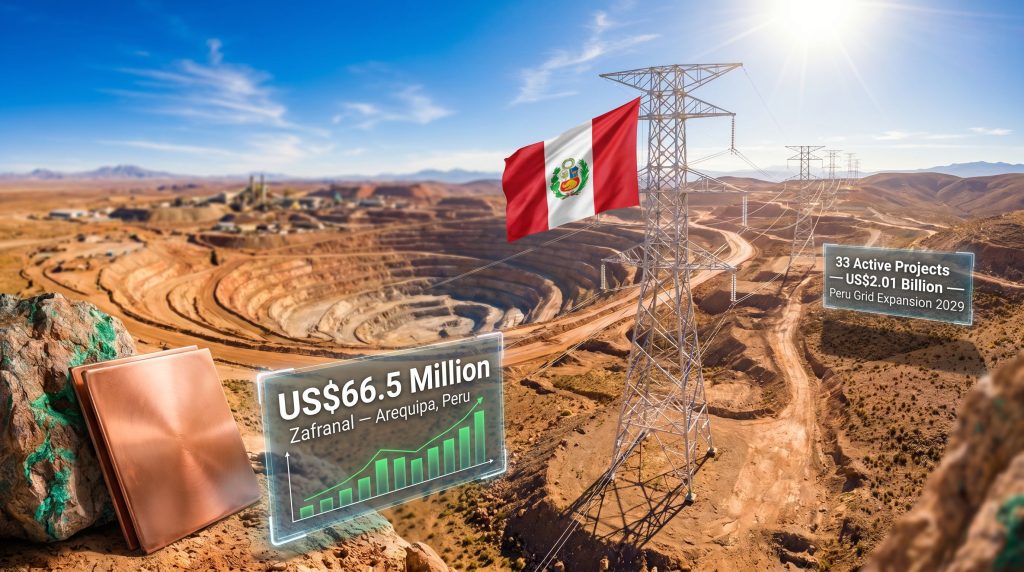
Before a single tonne of copper cathode leaves a processing facility in southern Peru, long before the first blast is detonated or the first conveyor belt turns, a far less glamorous problem must be solved: where does the power come from? For large-scale open-pit copper operations in Peru's Arequipa region, grid access is not a given. Transmission infrastructure in remote southern corridors lags well behind both the ambition of mining developers and the appetite of global copper markets hungry for new supply. This is the structural reality that makes the Teck power line in Peru one of the more consequential infrastructure moves in Latin American copper development right now, with a commitment of US$66.5 million to a dedicated transmission solution.
When big ASX news breaks, our subscribers know first
Why Mining Companies Are Becoming Energy Infrastructure Developers
The shift toward vertically integrated energy infrastructure is one of the most understated trends reshaping the economics of large-scale mining in Latin America. Historically, mines relied on national grid concessions for power access, accepting whatever tariff structures and reliability levels those arrangements offered. That model works adequately in well-served industrial corridors. It fails predictably in the remote, high-altitude, and geographically isolated zones where much of Peru's remaining copper endowment sits.
The economic logic behind self-financed transmission infrastructure becomes compelling over a mine's full operating life. A dedicated line eliminates recurring grid access fees, removes exposure to spot electricity price volatility through Peru's COES-SINAC market, and provides the operational reliability that sustained copper cathode production demands. When a large open-pit copper operation runs solvent extraction and electrowinning (SX-EW) circuits around the clock, power interruptions directly compromise cathode quality, production continuity, and ultimately the terms of offtake agreements with downstream buyers.
Across Latin America, the precedent for privately financed mining power corridors is well established. Mining operators in Chile copper outlook, in northern Argentina, and across parts of Brazil have long treated transmission infrastructure as a capital item to be owned rather than a service to be purchased. Peru is catching up, and the Teck power line in Peru is among the clearest expressions of that shift to date.
Breaking Down the US$66.5 Million Commitment: What It Means in Practice
The US$66.5 million figure represents the total value of the dedicated electrical transmission line being developed by Teck to serve its copper operations in Peru's Arequipa region. The project is currently in its land acquisition phase, which is precisely where the complexity begins.
Why Land Acquisition Is the Most Underestimated Phase
Transmission line development for mining projects involves a category of land access challenge that is qualitatively different from acquiring surface rights for mine infrastructure. A processing plant or tailings facility occupies a defined footprint. A power line is a linear asset, meaning it must negotiate access across dozens of separate land parcels, each potentially involving different legal ownership structures, land use classifications, and community stakeholder groups.
In Peru's southern regions, this challenge is compounded by several layers of legal complexity:
- The distinction between formal legal title and actual occupancy rights, which frequently diverge in rural Arequipa
- Easement negotiations that must satisfy both private landowners and rural communities simultaneously
- The applicability of Peru's Law of Prior Consultation (Law 29785) to transmission corridor access where indigenous or campesino communities hold territorial rights
- The requirement to coordinate land access timelines with environmental impact assessment (EIA) approval processes through Peru's Ministry of Energy and Mines (MINEM)
The financial cost of underestimating this phase is well documented in Peruvian mining history. Unresolved land tenure disputes have contributed to delays measured in years, not months, at several major infrastructure projects across Arequipa and the neighbouring Moquegua region. Each month of uncertainty at this stage compounds NPV erosion at the project level.
"The land acquisition phase of a transmission corridor project in Peru is often where project timelines are made or broken. Legal title and social licence are two separate conditions, and both must be satisfied before construction machinery can move."
The Zafranal Connection: Power as a Gating Item
The Teck power line in Peru is understood to be a critical enabling piece of infrastructure for the Zafranal copper project, a long-life open-pit copper development in the Arequipa region. Zafranal is a porphyry copper deposit, a geological category that typically features large tonnage at moderate grades and is particularly well suited to the SX-EW processing route that produces copper cathode directly on site.
The SX-EW process is highly power-intensive. Electrowinning, the electrolytic stage that strips copper from solution and deposits it as refined cathode, requires sustained and stable electricity supply at significant load. For a copper operation of Zafranal's projected scale, annual power demand runs into the hundreds of gigawatt-hours. This is not a load that can be reliably met through grid connections that are themselves subject to transmission congestion or infrastructure gaps in the southern corridor.
Importantly, transmission infrastructure is a long-lead-time item. Construction of a line of this scale typically requires 18 to 36 months after all approvals and land rights are secured. That means the land acquisition work being done now is directly connected to production timelines several years hence. Investors and analysts tracking Zafranal's advancement should treat progress on the power line as a meaningful leading indicator of project confidence.
Navigating Peru's Regulatory and Social Licence Environment
Peru's regulatory framework for private transmission infrastructure linked to mining operations involves overlapping jurisdictions that developers must navigate simultaneously rather than sequentially.
| Risk Factor | Timeline Impact | Primary Mitigation Pathway |
|---|---|---|
| Unresolved land easements | 6 to 24 months | Early title verification and community engagement |
| EIA approval from MINEM | 12 to 18 months | Parallel processing with land access work |
| Prior consultation requirements | Variable, potentially indefinite | Compliance with Law 29785 and benefit-sharing |
| COES grid interconnection approval | 6 to 12 months | Pre-coordination with Peru's grid operator |
| Community opposition | Project suspension risk | Social licence investment beyond legal minimums |
Peru's Law of Prior Consultation requires that indigenous and campesino communities be consulted in good faith before projects affecting their territories proceed. This is a legal obligation distinct from environmental permitting, and it requires genuine dialogue rather than notification. Projects that treat prior consultation as a box-ticking exercise have faced injunctions and work stoppages in Peru's southern regions at significant cost.
Teck's community engagement track record in Peru, built across years of operating in the country, is a relevant variable here. Companies with established relationships in host communities tend to move through consultation processes more efficiently than those arriving without prior presence. That said, transmission corridors cross new ground almost by definition, and each new community along the route represents a fresh negotiation.
Peru's National Grid Expansion: The Bigger Picture
Peru's Ministry of Energy and Mines has committed to an ambitious electricity transmission expansion programme encompassing 33 active projects valued at approximately US$2.01 billion through 2029. Furthermore, key components of this programme include a 300-kilometre, 220 kV line in southern Peru and a 900-kilometre, 500 kV corridor linking multiple substations across the country.
This national investment programme improves the overall reliability and capacity of Peru's transmission network. However, it does not necessarily resolve the specific corridor requirements of remote copper projects in Arequipa. National grid planning prioritises connections between population centres, industrial hubs, and renewable energy generation zones. Remote mining corridors in the early stages of development rarely appear on near-term public infrastructure schedules.
This gap between national grid expansion timelines and the specific needs of emerging mining projects is precisely what creates the strategic imperative for dedicated private transmission investment. The Teck power line in Peru is not a substitute for public grid development. It is a complement to it, filling a geography that national planning has not yet reached.
The Energy Economics Behind a US$66.5 Million Power Line
Evaluating whether a US$66.5 million upfront capex commitment is economically justified requires thinking across a 25 to 30-year mine life. Over that period, the avoided cost of grid tariffs, connection fees, and exposure to electricity spot price volatility in the COES-SINAC market can substantially exceed the initial capital outlay. The net present value calculation depends on assumptions about copper production volumes, power consumption intensity, and long-term electricity price trajectories in Peru.
For context on the scale of power demand involved:
- Open-pit copper mines typically consume between 20 and 50 megawatt-hours per tonne of refined copper produced, depending on ore grade and processing method
- SX-EW operations have higher direct power intensity than concentrate-producing operations because the electrowinning circuit runs continuously
- A mid-scale copper cathode operation producing 50,000 to 100,000 tonnes per year could require peak power loads of 60 to 120 megawatts, a load that demands transmission infrastructure sized specifically for mining-grade reliability
Benchmarking the Teck investment against comparable Latin American mining power infrastructure reinforces its scale and seriousness. In addition, understanding the broader copper supply crunch context helps frame why such infrastructure decisions carry long-term strategic weight.
| Project | Location | Transmission Cost | Commodity | Current Status |
|---|---|---|---|---|
| Teck Peru Power Line | Arequipa, Peru | US$66.5 million | Copper | Land acquisition phase |
| Southern Peru 220 kV Line | Southern Peru | ~US$120 million (est.) | Regional grid | Under development |
| 500 kV Southern Corridor | Peru (national) | Part of US$2.01B programme | National grid | Multi-project pipeline |
The next major ASX story will hit our subscribers first
What This Signals for the Global Copper Supply Chain
Peru consistently ranks among the world's top five copper-producing nations, contributing roughly 10 to 12 percent of global mined copper supply in recent years. That position depends on a continuous pipeline of new projects advancing from development to production, and infrastructure investment is the rate-limiting step for most of them. Consequently, understanding the global copper supply gap helps contextualise why transmission milestones like this carry outsized importance.
Global copper demand forecasts through 2035 paint a consistent picture of accelerating consumption driven by electric vehicle manufacturing, grid-scale energy storage, and the buildout of renewable energy systems. Copper is irreplaceable in these applications at anything approaching current technology trajectories, and new supply is not keeping pace. Existing mines are ageing, grades are declining at several major operations, and the average timeline from discovery to first production for large copper deposits now exceeds 16 years.
"In this environment, infrastructure milestones at projects like Zafranal carry disproportionate strategic significance. A US$66.5 million power line commitment is not a sunk cost. It is an indicator of project conviction at a time when the copper market has limited tolerance for further supply-side delays."
Teck's corporate trajectory reinforces this reading. Following its exit from steelmaking coal assets, copper has become the central axis of Teck's base metals growth strategy. Furthermore, for those evaluating copper investment strategies in the current climate, advancing power infrastructure at Zafranal while simultaneously progressing land acquisition signals a developer that is moving from optionality preservation toward genuine execution mode. For those watching the copper supply pipeline, that distinction matters considerably.
Teck's approach also mirrors that of other major copper project development programmes globally, where infrastructure investment is increasingly treated as a prerequisite rather than a late-stage consideration. Developers who front-load this commitment tend to compress overall delivery timelines and reduce the risk of late-stage disruption. Reviewing top transmission line projects in Peru further illustrates how Teck's commitment compares to broader infrastructure trends across the country.
Frequently Asked Questions: Teck Power Line in Peru
What exactly is the Teck power line in Peru?
It is a US$66.5 million dedicated electrical transmission line being developed by Teck to supply power to its copper mining operations in the Arequipa region of southern Peru. As of mid-2026, the project is in the land rights and easement acquisition phase.
Why build a private line rather than connect to Peru's national grid?
Remote open-pit copper operations in Arequipa require sustained, high-load power supply that the existing national grid cannot reliably deliver in that corridor. A dedicated line provides energy security, eliminates long-term tariff exposure, and ensures the operational continuity that copper cathode production requires.
What are the primary risks at this stage?
The key risks include delays in securing land easements across multiple parcels, prior consultation obligations under Law 29785, EIA approval timelines from MINEM, and the broader social licence environment in southern Peru's mining regions. Each of these can extend timelines independently.
How does the US$66.5 million figure relate to overall project costs?
Power infrastructure of this scale represents a meaningful but proportionate share of total development capex for a large copper operation. It is often underweighted in early feasibility assessments, which is why its explicit commitment at this stage is a noteworthy signal of project advancement.
Does Peru's national grid expansion programme affect this project?
Peru's 33-project, US$2.01 billion transmission expansion programme improves overall grid reliability but does not resolve the specific corridor requirements for Zafranal's location. The private Teck power line addresses a gap that public planning has not yet reached.
Disclaimer: This article is intended for informational purposes only and does not constitute financial or investment advice. Statements regarding project timelines, copper demand forecasts, and economic projections involve forward-looking assumptions that may differ materially from actual outcomes. Readers should conduct independent due diligence before making any investment decisions.
Want to Track the Next Major Copper Infrastructure Milestone Before the Market Does?
Discovery Alert's proprietary Discovery IQ model scans ASX announcements in real time, instantly identifying significant mineral discoveries and actionable opportunities in copper and beyond — explore historic discoveries and their returns to understand the scale of what early positioning can deliver, then begin your 14-day free trial at Discovery Alert to ensure you're never caught flat-footed when the next major development lands.