June 17, 2026
Argentina's RIGI Framework: The Architecture Behind Long-Cycle Mining Capital
Few policy instruments in Latin American resource history have been designed as deliberately as Argentina's Régimen de Incentivo para Grandes Inversiones, known as RIGI. The RIGI for Vicuña Lundin copper Argentina and Chile represents a landmark convergence of policy design and geological opportunity, one that has attracted the attention of the world's largest mining capital allocators. Rather than offering ad hoc concessions negotiated project by project, RIGI codifies a structured fiscal compact between the Argentine state and large-scale investors.
The framework explicitly targets industries where capital cycles span decades and where sovereign risk has historically been the single greatest deterrent to commitment. This design logic is not accidental — it reflects a deliberate response to Argentina's long-standing challenge in converting geological endowment into production.
The framework emerged from a clear-eyed diagnosis of Argentina's competitiveness deficit relative to neighbouring mining jurisdictions. Chile and Peru had long attracted the majority of Andean copper investment, partly due to institutional predictability. RIGI was engineered to address that gap by locking in fiscal conditions at the moment of project approval, insulating investors from the policy volatility that has periodically disrupted Argentine business environments.
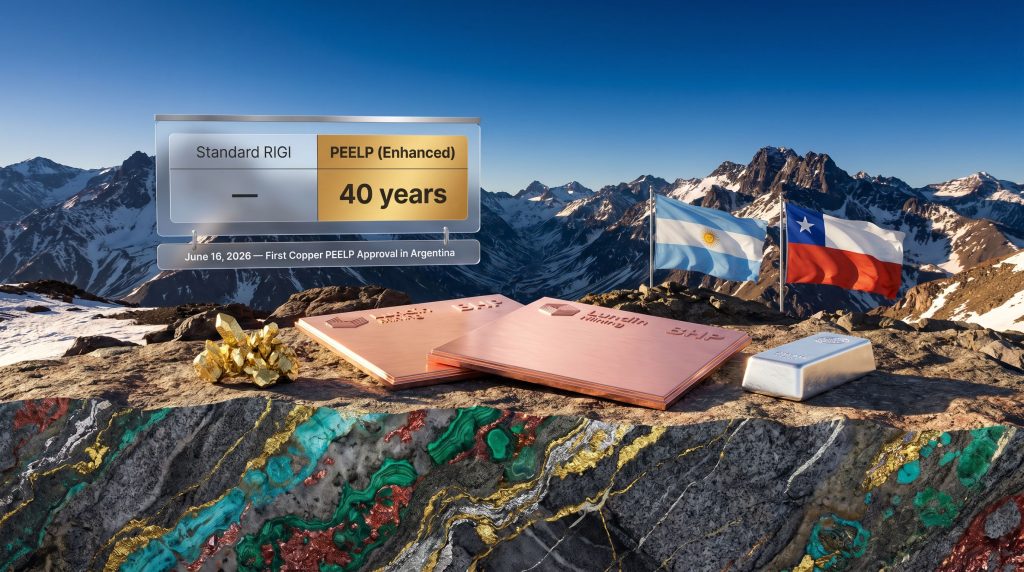
Within RIGI's architecture, two tiers exist. Standard RIGI projects receive a 30-year fiscal stability window, encompassing export duty treatment, accelerated depreciation mechanisms, and defined revenue repatriation pathways. The enhanced designation, known as PEELP (Projeto Estratégico de Exportação de Largo Prazo), extends those protections to 40 years while adding full export duty exemptions and an accelerated repatriation framework. PEELP approval is not routine. It requires a project to meet elevated thresholds of capital commitment and strategic relevance, and it is granted selectively.
When big ASX news breaks, our subscribers know first
PEELP vs. Standard RIGI: Understanding the Two-Tier Structure
The distinction between these two designations is more than administrative. For project finance purposes, a 40-year fiscal stability guarantee versus a 30-year one represents a materially different risk profile, particularly for copper projects where mine life commonly extends beyond three decades.
| Feature | Standard RIGI | PEELP (Enhanced) |
|---|---|---|
| Benefit Duration | 30 years | 40 years |
| Export Duty Treatment | Partial exemption | Full exemption |
| Revenue Repatriation | Standard timeline | Accelerated pathway |
| Eligibility Threshold | Lower capital commitment | Higher capital commitment / strategic designation |
| Precedent in Copper Mining | Multiple projects | First copper project: Vicuña (June 2026) |
PEELP designation requires a project to clear elevated strategic and capital thresholds. This means the approval is not a formality but a substantive assessment of long-term economic contribution, making each successful application a meaningful signal to the broader investment community.
The practical significance for debt capital markets is considerable. Lenders pricing sovereign risk into project finance structures can apply lower risk premiums when the host government has legally committed to fiscal stability for a period that exceeds the project's anticipated debt tenor. This compression of the risk premium translates directly into improved project economics and reduced financing costs.
The Vicuña District: Geology, Geography, and Cross-Border Complexity
A Porphyry System Straddling Two Nations
The Vicuña district occupies a high-altitude corridor along the Chile-Argentina border in the central Andes, a geological setting that has produced some of the world's most significant copper-gold porphyry systems. The district encompasses two core deposits: Josemaría, located entirely within Argentina, and Filo del Sol, a deposit whose orebody physically extends across the international border, with portions falling under Argentine jurisdiction and others under Chilean mining law.
Porphyry copper systems of this type are characterised by large tonnages at moderate grades, with economic viability driven by scale rather than high-grade selectivity. Furthermore, the polymetallic profile of Vicuña, combining copper with meaningful gold and silver credits, is geologically significant. Gold and silver revenues function as natural hedges within project economics, lowering the effective copper breakeven cost and improving the project's resilience across commodity price cycles.
What makes Vicuña particularly notable within the Andean copper belt is the integrated development thesis. The economic case for Josemaría and Filo del Sol is strongest when both deposits are developed as a unified system, sharing infrastructure, processing facilities, and logistics rather than being treated as independent operations. This integration logic underpins the joint venture structure and is central to the RIGI PEELP application. For context on what makes this a major copper system in Argentina, the district's scale and polymetallic credentials place it among the most strategically significant Andean discoveries in recent decades.
Ownership and Strategic Rationale of Vicuña Corp
The project is held through Vicuña Corp, a 50/50 joint venture between Lundin Mining and BHP. This equal-partnership structure reflects a deliberate capital-sharing and risk-distribution logic. BHP brings the balance sheet depth and operational experience of the world's largest mining company, alongside a clearly articulated strategic priority around copper growth in South America.
Lundin Mining, however, contributes technical expertise developed across a portfolio of operating copper mines and positions itself as a mid-tier producer with ambitions toward Tier 1 asset ownership. The mining joint ventures structure also creates a governance dynamic worth noting: decisions require alignment between two major mining entities with distinct corporate cultures and investor bases.
While this can introduce decision-making complexity, it also provides a natural internal discipline against capital misallocation, as both partners must independently validate the project's investment thesis before committing further resources.
June 16, 2026: The Landmark PEELP Approval and What It Means
On June 16, 2026, the Vicuña project received PEELP approval under Argentina's RIGI framework, becoming the first copper mining project in Argentina to achieve this designation. The scope of the approval covers the integrated development of both Josemaría and Filo del Sol on the Argentine side of the border.
The approval milestone serves multiple functions simultaneously:
- It provides regulatory certainty over fiscal conditions for the project's full 40-year benefit period
- It enables the joint venture to engage debt capital markets with a materially de-risked sovereign risk profile
- It signals to other large copper and lithium projects considering Argentine development that the PEELP pathway is functional and available
- It advances the project toward a formal Final Investment Decision (FID), though FID itself remains a separate and subsequent milestone
RIGI PEELP approval establishes the regulatory and fiscal foundation upon which project financing can be advanced. It does not guarantee construction commencement or represent a final investment commitment by either partner.
Regulatory Divergence: Argentina's RIGI vs. Chile's Mining Framework
Two Jurisdictions, One Orebody
The cross-border nature of Filo del Sol creates a regulatory complexity that has few direct precedents in global mining. The Argentine components of the project fall under RIGI's structured fiscal framework, while the Chilean portions of the deposit remain subject to Chile's own mining and environmental permitting processes, which operate entirely independently.
| Dimension | Argentina (RIGI/PEELP) | Chile (Standard Mining Law) |
|---|---|---|
| Fiscal Stability Period | 40 years (PEELP) | No equivalent long-term lock-in |
| Royalty Regime | Defined under RIGI terms | Subject to ongoing legislative debate |
| Export Duty Exemptions | Embedded in PEELP approval | Not applicable in same form |
| Permitting Complexity | Centralised RIGI process | Multi-agency environmental review |
| Cross-Border Coordination | Required for Filo del Sol | Required for Filo del Sol |
Chile's environmental review process, while institutionally robust, involves multiple regulatory agencies and community consultation processes that can extend timelines significantly. The Filo del Sol deposit's Chilean component will require its own permitting pathway, which proceeds independently of and in parallel with the Argentine RIGI approval.
This creates a sequencing risk: the integrated development thesis depends on both jurisdictions reaching permitting alignment, and delays on the Chilean side could affect the overall project timeline regardless of the Argentine regulatory position. Understanding permitting in mining is therefore essential context for evaluating the realistic timeline to production for a cross-border asset of this complexity.
High-Altitude Operational Realities
Beyond the regulatory complexity, the Vicuña district presents genuine operational challenges rooted in its physical geography. Operating at high altitude in the Andean corridor introduces constraints around:
- Worker productivity and health: Altitude affects both human performance and equipment efficiency
- Concentrate transport logistics: Options include routing product westward through Chilean Pacific ports or eastward through Argentine Atlantic corridors, each with distinct infrastructure requirements and cost profiles
- Power supply: The remote location necessitates significant energy infrastructure investment, with renewable integration representing both a cost opportunity and a technical challenge at altitude
- Water management: Arid high-altitude environments impose strict limitations on water consumption, with regulatory scrutiny around sourcing and tailings management intensifying across the Andean mining jurisdictions
Vicuña's Role in the Global Copper Supply Equation
Why Tier 1 Copper Assets Are Becoming Scarcer
The structural backdrop against which the RIGI for Vicuña Lundin copper Argentina and Chile approval should be understood is a global copper industry facing a compounding supply challenge. Existing major copper operations are experiencing declining ore grades as higher-grade zones are progressively depleted, whilst the discovery rate of genuinely large, long-life copper deposits has fallen significantly over the past two decades despite sustained exploration spending.
Energy transition demand is simultaneously reshaping the demand curve. Electric vehicles require approximately four times the copper content of a conventional internal combustion vehicle. Grid infrastructure expansion for renewable energy integration is intensely copper-dependent. Consequently, the combined effect of rising demand and constrained supply growth is widely expected to produce structural copper deficits across the coming decade, according to multiple independent commodity research organisations. The global copper supply crunch is, in many respects, the macro force that elevates Vicuña's strategic importance beyond its standalone economics.
Vicuña's significance within this context is its potential scale. A successfully developed integrated Josemaría and Filo del Sol system would represent a multi-decade production centre capable of contributing meaningfully to global copper supply from a district that, while geologically established, remains relatively early in its development lifecycle.
Polymetallic Economics and Project Finance Attractiveness
The gold and silver credits embedded in Vicuña's mineral profile are not incidental. In project finance modelling, byproduct revenues are typically applied as offsets against operating costs, reducing the reported cash cost per pound of copper produced. A robust gold credit can shift a project's position on the global cost curve by a material amount, improving its economic resilience during copper price downturns.
For streaming and royalty financiers, polymetallic systems offer the additional appeal of multiple revenue streams that can be structured as separate instruments, allowing more sophisticated capital stack construction than single-metal projects permit. The technical report filed for Vicuña provides detailed mineralogical and economic modelling that underpins these project finance considerations.
The next major ASX story will hit our subscribers first
Argentina's Repositioning as a Copper Investment Destination
Closing the Competitiveness Gap with Andean Neighbours
Argentina's mining sector has historically operated in the shadow of Chile and Peru, both of which established deeper institutional frameworks for large-scale mining investment earlier. The country possesses substantial geological endowment, including significant copper, lithium, and gold resources, but translating that endowment into production has been complicated by periods of macroeconomic instability, currency controls, and regulatory uncertainty.
RIGI represents a structural attempt to recalibrate that competitive position by offering fiscal certainty that, on paper, extends further than what either Chile or Peru currently provides through equivalent mechanisms. The Vicuña PEELP approval is the first concrete test of whether that framework can attract and retain Tier 1 mining capital at scale.
The risks that remain are real and should not be minimised. Argentina's macroeconomic environment, whilst stabilising under recent policy shifts, carries historical precedents that institutional investors are not quick to discount. Currency control frameworks, even when loosened under RIGI's repatriation provisions, can be subject to future reinterpretation. Political cycle exposure remains a consideration for any investment horizon measured in decades rather than years.
What Investors and Industry Observers Should Monitor Next
| Milestone | Detail |
|---|---|
| RIGI PEELP Approval Date | June 16, 2026 |
| Project Scope | Integrated Josemaría + Filo del Sol |
| Ownership | 50% Lundin Mining / 50% BHP (Vicuña Corp) |
| PEELP Benefit Duration | 40 years |
| First Copper PEELP in Argentina | Yes, precedent-setting |
| Geographic Scope | Argentina-Chile border district |
| Metals | Copper, gold, silver |
Several developments merit close attention in the months following the PEELP approval:
- Final Investment Decision triggers: BHP and Lundin Mining's respective quarterly reporting cycles will offer the first signals around FID timelines, capex estimates, and phasing strategies
- Chilean permitting progression: The Filo del Sol Chilean component represents the critical parallel regulatory track, and any updates from Chile's environmental review agencies will directly affect integrated development sequencing
- Project finance market engagement: Indications of lender interest, export credit agency involvement, or streaming agreement negotiations would confirm that the RIGI approval is translating into tangible capital mobilisation
- Broader RIGI pipeline signals: Whether other large copper and lithium projects in Argentina submit RIGI or PEELP applications following the Vicuña precedent will indicate how effectively the framework is functioning as a policy tool
- Argentina's macroeconomic trajectory: Exchange rate stability, inflation management, and the continuity of investor-friendly policy settings will remain background variables that institutional capital monitors continuously
The RIGI for Vicuña Lundin copper Argentina and Chile approval represents a genuine policy and regulatory milestone for copper development across both nations. Whether it becomes a transformative moment for Argentine mining investment depends on the convergence of geological execution, cross-border regulatory alignment, capital market conditions, and the sustained credibility of Argentina's fiscal framework over a 40-year horizon. For investors considering copper investment strategies, the Vicuña precedent offers a compelling, if complex, case study in how sovereign policy design can unlock capital at scale. That is, by any measure, a long bet — and one that two of the world's most sophisticated mining companies have now formally placed.
This article contains forward-looking analysis and references to project timelines, regulatory frameworks, and commodity market dynamics. All such content is subject to material uncertainty and should not be construed as financial or investment advice. Readers should conduct their own due diligence before making investment decisions.
Want To Stay Ahead of the Next Major Copper Discovery on the ASX?
Discovery Alert's proprietary Discovery IQ model delivers real-time alerts on significant ASX mineral discoveries, turning complex mineral data into actionable insights for both short-term traders and long-term investors — begin your 14-day free trial today and position yourself ahead of the broader market, or explore historic discovery returns to understand just how transformative major mineral finds can be.