
June 17, 2026
The Hidden Economics Driving China's Copper Smelter Coalition
Most commodity markets operate on the assumption that price discovery is a neutral, bilateral process. In reality, the structure of who sits at the negotiating table determines the outcome long before any figures are discussed. Nowhere is this dynamic more visible right now than in the global copper concentrate market, where China copper smelters talks with miners are engineering a fundamental shift in collective bargaining power through the deliberate expansion of an industry pricing body that has existed for years but never wielded its full potential weight.
Understanding why this matters requires looking beneath the surface of standard commodity reporting and into the plumbing of how raw copper actually moves from mine to market. Furthermore, the copper supply crunch underpinning these negotiations has created conditions that few industry participants anticipated even two years ago.
When big ASX news breaks, our subscribers know first
Treatment and Refining Charges: The Fee System That Underpins Copper's Value Chain
Most investors track the copper spot price without ever considering the intermediate layer that sits between a mine and a refined metal bar. That layer is the smelting and refining complex, and its economics are governed by a specialised fee structure known as treatment and refining charges, commonly abbreviated as TC/RCs.
When a mining company extracts copper ore, the resulting concentrate typically contains between 25% and 35% copper by weight, alongside sulphur, iron, and various trace elements. This material cannot be sold directly into industrial supply chains. It must first be processed by a smelter, which converts it into blister copper, and then refined into cathode copper at approximately 99.99% purity.
How Does the TC/RC Framework Actually Work?
The TC/RC framework works as follows:
- Treatment charges (TCs) are paid per dry metric tonne of concentrate delivered to the smelter, compensating for the cost of smelting.
- Refining charges (RCs) are paid per pound of finished copper produced, covering the electrolytic refining stage.
- Both charges are negotiated annually between major miners and major smelters, with the benchmark settlement cascading across most other supply agreements globally.
When concentrate supply is abundant, smelters hold leverage and TC/RCs rise. When mines underperform or new supply fails to materialise, the dynamic reverses entirely, and miners can dictate progressively lower fees. In extreme conditions, those fees can turn negative, meaning smelters must effectively subsidise the processing of a third party's ore simply to keep their furnaces running.
That extreme condition is precisely where the market finds itself today.
Historic Lows and the Collapse of Smelter Economics
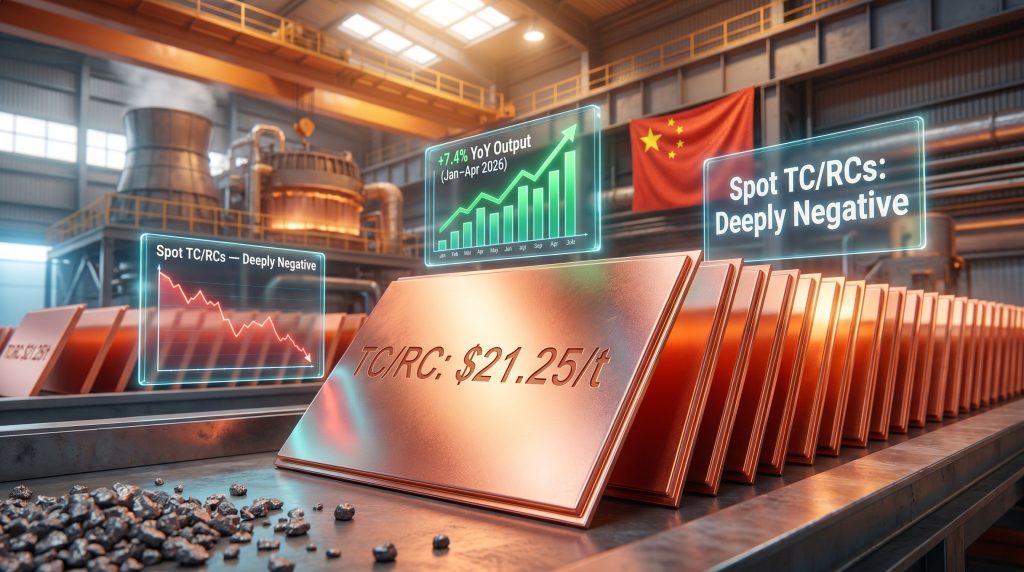
The 2025 annual benchmark negotiations, which set the pricing reference for 2025 concentrate supply contracts, concluded at $21.25 per dry metric tonne for treatment charges and 2.125 cents per pound for refining charges. At the time, these figures represented a historically compressed settlement that alarmed smelter operators across China.
By mid-2026, the situation has deteriorated further. Spot TC/RCs, which reflect real-time market conditions outside annual contracts, have moved deeply into negative territory. This is not a marginal technical anomaly. It is a systemic inversion of the traditional smelter business model.
| Metric | Value | Context |
|---|---|---|
| 2025 Annual TC Benchmark | $21.25 per tonne | Historically compressed settlement |
| 2025 Annual RC Benchmark | 2.125 cents per pound | Corresponding refining charge |
| Spot TC/RC Status (mid-2026) | Deeply negative | Smelters effectively paying to process |
| China Refined Copper Output Growth (Jan-Apr 2026) | +7.4% year-on-year | Contradicts stated production cuts |
| CSPT Quarterly Guidance Issued | None (6th consecutive quarter) | Persistent inability to set floor prices |
The inability of the China Smelters Purchase Team to issue quarterly TC/RC floor guidance for six consecutive quarters is itself a remarkable admission of institutional paralysis. The CSPT was designed precisely to prevent this kind of sustained margin erosion. Its failure to function as intended has accelerated the push for structural reform within the group. Consequently, understanding the broader copper price drivers at play is essential context for appreciating why smelters are under such extreme pressure.
What Sulphuric Acid Has to Do With Copper Smelting Survival
A detail that rarely surfaces in mainstream copper market coverage is the growing dependence of Chinese smelters on sulphuric acid revenue as a margin lifeline. When copper concentrate is smelted, sulphur dioxide gas is captured and converted into sulphuric acid as a byproduct. Historically, this revenue stream was a secondary consideration — a useful supplement to the core processing fee income.
Under current conditions, however, that relationship has been inverted. With TC/RCs in negative territory, sulphuric acid sales have become the primary source of operating margin for many Chinese smelters. China's agricultural sector is a major consumer of sulphuric acid, which is used in the production of phosphate fertilisers, meaning smelter economics are now partially tethered to agricultural commodity cycles in ways that industry analysts rarely model explicitly.
This structural dependency raises a question that few market participants are asking: what happens to smelter viability if sulphuric acid prices weaken at the same time as TC/RCs remain negative? The margin buffer that is currently keeping Chinese smelters operational could narrow rapidly under a scenario where fertiliser demand softens or sulphuric acid supply increases from alternative industrial sources.
The CSPT Expansion: Logic, Membership, and What It Could Achieve
The China Smelters Purchase Team currently comprises 16 major copper producers. Its original function was to coordinate quarterly spot TC/RC floor prices, providing the collective negotiating weight of China's dominant smelting industry to counterbalance the leverage of large miners during concentrate purchases.
The decision to expand that membership, evidenced by the invitation of at least six additional producers to the CSPT's quarterly meeting in Yantai, Shandong province, reflects a calculated escalation in negotiating strategy. The companies reportedly invited include:
- Guangxi Nanguo
- Chizhou Guanhua
- Xinjiang Wuxin
- Bayannur Feishang
- Chifeng Fubang
- Yanggu Xiangguang, a 400,000 metric tonne per year smelter controlled by C&D Inc.
Formal admission of these producers is not guaranteed. The CSPT operates through a structured incorporation process, and attendance at a quarterly meeting does not automatically confer membership. Nevertheless, the direction of travel is clear: China's smelting industry is attempting to consolidate a broader coalition to face miners with a more unified front.
The strategic logic mirrors China's increasingly assertive posture in iron ore negotiations, where the scale of domestic consumption has been used as a bargaining instrument to pressure major exporters. The copper smelting expansion dynamic presents a different set of variables, however, because the supply shortage that has produced negative TC/RCs is a genuine physical constraint, not a policy-manufactured condition.
The Antofagasta Deadlock and What Benchmark Negotiations Actually Determine
Ongoing negotiations between Chinese smelters and Chilean mining major Antofagasta have stalled, with Tongling Nonferrous Metals reportedly acting as the lead negotiating counterpart on the Chinese side. According to reporting on the deadlock, the dispute centres on where to set annual TC/RC benchmarks for the next supply period, with the two sides appearing far apart on acceptable terms.
The significance of these talks extends well beyond the bilateral relationship. Annual benchmark settlements between major Chinese smelters and major mining companies function as pricing anchors for the broader global concentrate market. Whatever figure emerges from Antofagasta-led negotiations tends to cascade through most other supply contracts, making the outcome a de facto global pricing reference.
A settlement at or near zero would represent an unprecedented shift in how the economics of copper processing are shared between producers and refiners. For miners, it would represent the capture of virtually all processing margin. For smelters, it would codify an operating model that depends entirely on byproduct revenues for profitability — a fundamentally unstable foundation for long-term capital allocation.
The next major ASX story will hit our subscribers first
China's Production Cut Commitment: Promise vs. Reality
In 2025, China's copper smelting industry committed to reduce refined copper output by 10% in 2026, a pledge framed as a collective response to the unsustainable economics of negative TC/RC processing. The stated intention was to tighten concentrate demand sufficiently to rebalance TC/RCs toward positive territory.
The data through April 2026 tells a different story entirely. China's refined copper output expanded by 7.4% year-on-year during the January-to-April period, according to figures from China's National Bureau of Statistics. Rather than contracting, the industry is producing more refined metal than it was at the same point last year.
Why Are Production Cuts Failing to Materialise?
Several structural factors explain this divergence between stated policy and actual behaviour:
- Individual smelter incentives conflict with collective goals. Each smelter that reduces output creates a benefit shared across the entire industry through tighter concentrate demand, but bears the full cost of lost production alone. This classic collective action problem makes voluntary output restraint economically irrational at the firm level.
- Capacity expansions already in progress cannot be easily paused. Several Chinese smelters have commissioned new capacity in recent years, and operators face financial pressure to utilise those facilities regardless of broader industry commitments.
- Sulphuric acid revenues provide a partial but sufficient incentive to keep operating. As long as byproduct sales cover marginal costs, individual smelters have limited financial urgency to curtail output.
- The CSPT lacks binding enforcement mechanisms. Quarterly guidance is advisory in nature, and the group has no legal or contractual authority to compel member behaviour.
In addition, analysts at Mercuria have noted that smelters are not yet at peak pain, suggesting further deterioration may be required before genuine output discipline emerges across the industry.
Oyu Tolgoi, G7 Diversification, and the Broader Supply Picture
The concentrate supply squeeze driving this entire dynamic has been compounded by developments outside China's direct control. Protesters halted copper concentrate exports from Rio Tinto's Oyu Tolgoi mine in Mongolia in mid-June 2026, adding further disruption to an already strained global supply picture. Oyu Tolgoi is one of the world's largest copper mines and a significant contributor to concentrate supply in Asian markets.
Simultaneously, G7 nations have been advancing frameworks to reduce concentration risk in critical mineral supply chains, with copper increasingly recognised as a strategic material given its centrality to electrification and defence manufacturing. These dynamics have also intensified scrutiny of China copper supply chains and the degree to which geopolitical pressures are reshaping long-established trading relationships. Furthermore, the Codelco copper strategy for navigating these conditions will play a meaningful role in how the broader concentrate market evolves through the remainder of 2026.
Scenario Analysis: Three Paths Forward for China Copper Smelter Negotiations
| Scenario | Probability Driver | Impact on Miners | Impact on Smelters | Market Signal |
|---|---|---|---|---|
| Zero TC/RC Settlement | Concentrate scarcity persists | Captures maximum processing margin | Operating model remains byproduct-dependent | Bearish for smelter equities |
| Prolonged Deadlock | CSPT expansion talks stall | Pricing uncertainty persists | Operational and financial stress deepens | Volatile spot market conditions |
| CSPT Leverage Restored | Broad membership achieved, output discipline improves | Pricing power moderates | Margin recovery pathway opens | Positive signal for smelter sector valuations |
This scenario analysis represents a forward-looking framework based on current market conditions and should not be construed as financial advice. Commodity markets are subject to rapid and unpredictable change.
Frequently Asked Questions
What Does It Mean When Copper TC/RCs Go Negative?
Negative TC/RCs occur when concentrate supply is so tight that smelters must effectively pay miners above the value of the metal recovered in order to secure raw material. Rather than being compensated for their processing service, smelters absorb a cost on each tonne processed, relying on byproduct revenues such as sulphuric acid sales to remain viable.
Why Are Chinese Smelters Expanding the CSPT Now?
The expansion is a direct response to sustained margin erosion from negative TC/RCs. By broadening the coalition to represent a larger share of China's total smelting capacity, the group aims to present a more credible and unified negotiating position during China copper smelters talks with miners at the annual benchmark stage.
Does a Larger CSPT Guarantee Better TC/RC Outcomes for Smelters?
Not necessarily. The CSPT's track record on collective output discipline has been inconsistent. A larger membership increases representational weight but does not resolve the underlying collective action problem that has prevented meaningful production cuts from materialising.
How Does Concentrate Tightness Affect the Copper Price?
Reduced smelter throughput from constrained concentrate supply can limit refined copper output over time, which is supportive of copper prices in physical markets. However, the relationship is complex and subject to inventory levels, demand conditions, and the degree to which smelters can substitute concentrate sources.
What Is the Significance of the Antofagasta Negotiation for the Broader Market?
An annual benchmark settlement between Tongling Nonferrous and Antofagasta effectively sets the pricing reference point for most other global concentrate supply contracts. The outcome of these talks will therefore influence smelter economics well beyond China's domestic industry, making China copper smelters talks with miners one of the most closely watched negotiations in the global commodities calendar.
Want to Know When Copper Discoveries Hit the ASX Before the Market Moves?
Discovery Alert's proprietary Discovery IQ model scans ASX announcements in real time, instantly identifying significant copper and base metal discoveries and translating complex concentrate and supply data into actionable investment insights — explore historic mineral discovery returns to understand the scale of opportunity, and begin a 14-day free trial at Discovery Alert to position yourself ahead of the next major find.