
June 17, 2026
When the Road Goes Silent: What Copper Supply Disruptions Reveal About the Modern Mining Paradox
The global copper market is entering one of its most structurally constrained periods in decades. Decades of underinvestment in new large-scale deposits, combined with exponentially rising demand from electrification infrastructure, have narrowed the pipeline of tier-one copper projects to a handful of operations worldwide. When any one of those operations faces disruption, the consequences reverberate far beyond the mine gate. The Rio Tinto Mongolia copper mine protests that unfolded at Oyu Tolgoi on June 17, 2026 are a case study in exactly this dynamic, exposing vulnerabilities that the critical minerals sector has not yet found a durable answer to.
When big ASX news breaks, our subscribers know first
The Copper Chokepoint No One Talks About
Mongolia occupies a landlocked position in Central Asia, wedged between Russia to the north and China to the south. For bulk mineral exports, that geography is not merely inconvenient; it is a structural constraint that has no short-term remedy. There is, in practical terms, a single viable corridor for copper concentrate to travel from Oyu Tolgoi to its primary market: overland by truck to the Chinese border crossing.
This is not a quirk of logistics planning. It is the physical reality of operating a massive mining complex in the South Gobi Desert, hundreds of kilometres from any seaport or alternative export gateway. Chinese smelters that rely on Mongolian concentrate as a feedstock input receive deliveries through this corridor alone. When that road is blocked, the entire chain stops.
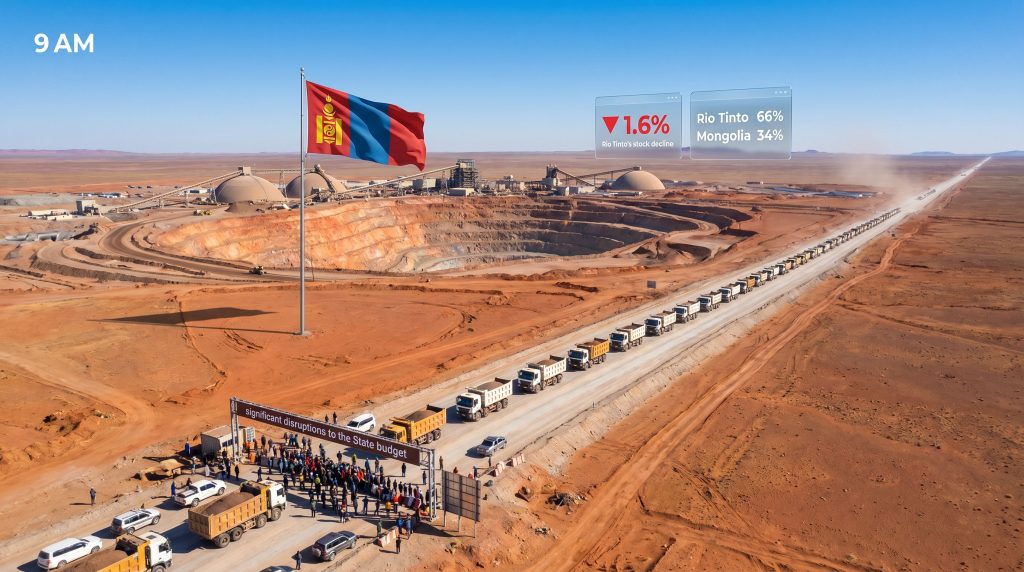
On the morning of June 17, 2026, protesters established a blockade on the primary haulage road connecting Oyu Tolgoi to the Chinese border at 9:00 AM local time. Concentrate trucks were halted, contractual delivery timelines were immediately placed at risk, and Rio Tinto's Mongolian subsidiary published a statement acknowledging the disruption and flagging the potential for contract non-fulfilment. The statement also warned that the blockade could cause significant harm to Mongolia's state budget and damage the country's standing in international mining markets. Rio Tinto's London-listed shares declined 1.6% within the first trading hours following the news.
Short-duration blockades at critical single-corridor export operations can trigger disproportionate spot market reactions, particularly when the affected mine is in a production ramp-up phase where delivery reliability is closely monitored by offtake counterparties.
Oyu Tolgoi's Place in the Global Copper Hierarchy
To understand why this matters at a macro level, it is worth establishing precisely what Oyu Tolgoi represents in the global copper supply picture. The operation is currently ramping up its underground expansion, and once it reaches full production capacity, it is projected to become the fourth-largest copper-producing mine in the world by nameplate capacity. That is not a minor footnote; that is a top-tier asset in a mineral category where new large-scale discoveries are becoming increasingly rare. For context on scale, it sits alongside some of the largest copper mines globally in terms of projected output.
Rio Tinto holds a 66% operating stake in the project, with the remaining 34% held by the Mongolian government. Copper concentrate exports from the mine represent a disproportionately large share of Mongolia's total export earnings and, by extension, a meaningful contribution to the country's GDP and sovereign revenue base. In a resource-dependent economy like Mongolia's, this concentration creates systemic exposure: the fortunes of a single mining operation are closely tied to national fiscal health.
For Rio Tinto, Oyu Tolgoi sits at the centre of its energy transition growth strategy. The Rio Tinto copper strategy publicly identifies copper as a core strategic metal, and Oyu Tolgoi is one of the few remaining confirmed large-scale underground copper reserves globally with a defined production ramp-up trajectory. Sustained social disruption at this operation does not just affect quarterly production numbers; it threatens the reliability of Rio Tinto's copper growth narrative to investors.
A Grievance Architecture Built Over a Decade
The specific motivations behind the June 2026 blockade had not been officially confirmed at the time of reporting. However, understanding the protest history at Oyu Tolgoi provides essential context. This is not an operation experiencing its first community conflict. Three distinct categories of grievance have cycled through the site over more than a decade.
The Herder Dispute: Land, Water, and Implementation Failures
The most deeply rooted grievances involve herder communities whose traditional pastoral lands and water sources have been affected by mine development activities, including river diversions associated with construction. Formal complaints were lodged through international lender accountability mechanisms, leading to a 2017 agreement that committed the operator to specific mitigation measures covering pastureland access and groundwater quality.
What makes this history particularly significant is what happened next. By 2022, Mongolian herders were raising concerns that the mine had not complied with its community council charter and had failed to implement the agreed remedies. By 2024, documented assessments indicated that a substantial portion of the 2017 commitments remained unimplemented. This is not an isolated operational failure. It is a pattern of governance breakdown that has persisted across multiple review cycles.
Timeline of Major Community and Labour Disputes
| Year | Protest Category | Core Grievance | Documented Outcome |
|---|---|---|---|
| 2017 | Herder community | Pasture degradation, water access, livelihood impacts | Formal mitigation agreement reached |
| 2022 | Herder community | Non-compliance with community council charter | Lender and operator pressure sought |
| 2024 | Labour | Wage disputes among mine workers | Weeklong work stoppage recorded |
| 2024 | Community | Unimplemented 2017 water and pasture commitments | Ongoing complaints documented |
| 2026 | Road blockade | Concentrate haulage disrupted | Active disruption at time of reporting |
The Revenue-Sharing Fault Line
Separate from community grievances is a structural financial tension baked into the ownership model itself. The Mongolian government's 34% equity stake in Oyu Tolgoi was not acquired with upfront capital. Instead, the government's development costs were financed by Rio Tinto under an arrangement requiring loan repayment before the government begins receiving substantial dividend distributions. This loan-before-dividend structure has generated persistent political friction across successive Mongolian administrations, each of which has sought to renegotiate terms to accelerate cash flows back to the state.
The distinction between nominal equity ownership and practical cash return is a critically important one that is often overlooked in headline coverage of the project. The Mongolian government is a 34% owner on paper, but its ability to translate that ownership into meaningful revenue has been structurally deferred. This creates a political environment in which resource nationalism sentiment finds fertile ground regardless of which party holds government.
Labour Unrest: A Compounding Variable
The 2024 weeklong worker stoppage over wage disputes demonstrated that operational disruption risk at Oyu Tolgoi is not confined to community grievances. Labour unrest represents a separate but compounding exposure layer. When community tensions and labour dissatisfaction coincide, as they have at various points in the mine's history, the reputational and contractual risks to the operator multiply considerably.
The Social Licence Problem Is Structural, Not Situational
One of the least-discussed dimensions of repeat protest cycles at large mining operations is the difference between a social licence failure as an isolated event versus a systemic governance breakdown. At Oyu Tolgoi, the evidence increasingly points to the latter.
A formal community agreement was reached in 2017. That agreement was not fully implemented by 2024. That implementation failure contributed to renewed unrest in 2024 and likely forms part of the backdrop to the 2026 disruption. The pattern suggests that the governance architecture for community relations at this operation has not kept pace with the complexity of the stakeholder environment. Furthermore, broader mining geopolitical risks of this kind are increasingly common across the sector globally.
There is also an inherent structural tension in the Mongolian government's dual role. As a 34% co-owner of the mine, the government is a direct financial beneficiary of continued production. As the representative body for Mongolian citizens, including herder communities directly affected by the operation, it is also theoretically the primary advocate for those harmed. These two roles create conflicts of interest that have historically complicated the speed and sincerity of grievance resolution.
The gap between formal community agreements and on-the-ground implementation is not unique to Mongolia. It is a recurring pattern across large-scale extractive operations in resource-dependent economies, and it consistently undermines the social licence framework that operators rely on to justify continued development.
What This Means for Copper Markets and the Energy Transition
The broader context for this disruption is worth examining carefully. Electric vehicles require roughly 2.5 to 4 times more copper per unit than conventional internal combustion engine vehicles. Grid-scale battery storage systems, offshore wind turbines, and utility-scale solar installations all have substantially higher copper intensity than the fossil fuel infrastructure they are replacing. This demand trajectory is not speculative; it is embedded in the capital expenditure plans of energy transition developers globally.
Against this backdrop, the global copper supply gap the industry faces is structural rather than cyclical. The pipeline of large-scale, high-grade copper projects that can be developed within the next decade is genuinely thin. Projects like Oyu Tolgoi are not interchangeable with smaller operations; their scale and grade profile make them irreplaceable components of the forward supply picture.
This is the energy transition paradox that the June 2026 blockade crystallises: the metals most needed to build a lower-carbon global economy are extracted under conditions that carry significant social, governance, and geopolitical risk. The communities most directly affected by that extraction do not automatically benefit from the green energy narrative that makes those metals strategically valuable.
Key Risk Factors: A Structured Assessment
| Risk Category | Specific Factor | Severity Assessment |
|---|---|---|
| Supply Chain | Single-corridor export route vulnerable to blockade | High: no viable short-term alternative |
| Community Relations | Multi-year unresolved herder grievances | High: systemic pattern, not isolated event |
| Revenue Governance | Loan-before-dividend ownership structure | Medium-High: persistent political flashpoint |
| Labour Relations | Wage disputes with history of work stoppages | Medium: separate from community layer |
| Geopolitical | Mongolia-China trade corridor dependency | High: structural geographic vulnerability |
| Market Impact | Rio Tinto stock -1.6% on disruption news | Moderate: immediate investor sensitivity |
The next major ASX story will hit our subscribers first
Resource Nationalism and the Critical Minerals Tension
The dynamics playing out at Oyu Tolgoi are not unique to Mongolia. Across copper-producing jurisdictions in sub-Saharan Africa, South America, and Southeast Asia, a similar tension is emerging: resource-rich nations with significant mineral endowments are increasingly asserting stronger revenue claims over projects that were structured under earlier investment frameworks.
This trend is being accelerated, somewhat ironically, by the same energy transition demand pressure that makes copper so strategically valuable. As the metal's importance to decarbonisation infrastructure becomes more widely recognised, the political calculus for host governments shifts. Accepting the terms of a legacy financing arrangement becomes harder to defend domestically when the commodity in question is described globally as critical to the future of energy.
For mining operators and institutional investors, this dynamic introduces a new analytical framework requirement. Evaluating a copper asset's value is no longer simply a function of grade, tonnage, and processing costs. It increasingly requires rigorous assessment of social licence durability, governance accountability mechanisms, revenue-sharing structure fairness, and community implementation track records. The copper supply crunch facing the market only amplifies the strategic importance of resolving these tensions.
At Oyu Tolgoi, all four of those variables carry documented risk flags. The Rio Tinto Mongolia copper mine protests of June 2026 are a reminder that those flags are not theoretical. They translate into halted trucks, broken delivery contracts, and declining share prices.
Frequently Asked Questions: Rio Tinto Mongolia Copper Mine Protests
What is Oyu Tolgoi and why is it strategically significant?
Oyu Tolgoi is a large-scale copper and gold mining operation located in the South Gobi Desert of Mongolia. Operated by Rio Tinto with a 66% stake, alongside the Mongolian government's 34% interest, the project is currently in an underground expansion phase. Once fully ramped up, it is projected to rank among the four largest copper-producing mines globally by output capacity, making it one of a very small number of tier-one copper assets in the world.
Why has Oyu Tolgoi experienced repeated protests?
Grievances at the mine span multiple categories. Herder communities have raised sustained concerns about pastureland degradation, water access, and the incomplete implementation of mitigation commitments agreed in 2017. Mine workers staged a weeklong stoppage in 2024 over wage disputes. Revenue-sharing tensions between the Mongolian government and Rio Tinto have generated persistent political pressure regarding the loan-before-dividend ownership structure.
How does a road blockade affect copper exports?
Because Mongolia is landlocked, copper concentrate from Oyu Tolgoi has no viable alternative export route beyond overland trucking to the Chinese border. A blockade of the primary haulage road immediately halts concentrate deliveries to Chinese smelters, placing the operator at risk of breaching contractual delivery obligations and disrupting downstream processing supply chains.
What does the Mongolian government's ownership stake actually mean in practice?
The government holds a 34% equity interest in Oyu Tolgoi, but its development costs were financed by Rio Tinto. Under the financing structure, those loans must be substantially repaid before the government begins receiving meaningful dividend distributions. This creates a gap between nominal equity ownership and practical revenue access, which has been a persistent source of political friction domestically.
What are the broader implications for copper supply?
With global copper demand projected to rise substantially through the 2030s driven by electrification and energy transition infrastructure, disruptions at a top-four producing mine carry significance well beyond Rio Tinto's balance sheet. Every tonne of concentrate that fails to reach a Chinese smelter during a ramp-up phase tightens an already constrained forward supply picture and increases spot market sensitivity to further disruption events.
Disclaimer: This article is intended for informational purposes only and does not constitute financial or investment advice. Projections regarding copper production capacity, demand growth, and market impacts are based on publicly available data and industry analysis and involve inherent uncertainty. Readers should conduct independent research before making any investment decisions.
Want to Stay Ahead of ASX Mineral Discoveries Before the Market Moves?
Discovery Alert's proprietary Discovery IQ model delivers real-time alerts on significant ASX mineral discoveries — including copper — instantly translating complex data into actionable opportunities for both short-term traders and long-term investors. Explore Discovery Alert's discoveries page to see the historic returns major mineral discoveries have generated, and begin your 14-day free trial today to secure a market-leading edge.