June 17, 2026
Why District-Scale Copper Consolidation Is the Hardest Thing to Pull Off in Mining
In large-scale resource development, the most valuable strategic moves are rarely the flashiest. While the industry obsesses over drill results and resource upgrades, the quieter discipline of district consolidation — bringing fragmented geological systems under unified control — consistently generates the most durable long-term value. It is also extraordinarily rare. Competing land tenure, legacy ownership structures, and misaligned corporate timelines mean that adjacent deposits frequently remain separated for decades, forcing duplicated infrastructure, competing permitting queues, and suboptimal copper capital allocation across what should be a single integrated system.
That is precisely why the proposed Faraday Copper San Manuel acquisition by BHP subsidiary stands out as one of the most structurally significant copper transactions in the United States in years. It is not simply an asset purchase. It is the first step toward consolidating an entire copper mining district under a single development vision, with two world-class deposits, pre-existing infrastructure, private land tenure, and two blue-chip cornerstone investors all converging at once.
When big ASX news breaks, our subscribers know first
Understanding the Transaction: Structure, Terms, and Timeline
As of mid-2025, Faraday Copper has executed a non-binding letter of intent with a BHP subsidiary to acquire the San Manuel copper property in Arizona. This transaction has not yet closed and remains conditional on a definitive agreement, shareholder approval, and regulatory clearances.
The deal structure is unconventional by junior mining standards, and deliberately so.
| Deal Component | Detail |
|---|---|
| Transaction Type | Non-binding Letter of Intent (LOI) |
| Consideration | Newly issued Faraday shares equal to 30% of the company (fully diluted) |
| Environmental Liability | Faraday assumes San Manuel's environmental and closure obligations |
| BHP Future Participation Rights | Up to US$20 million in future Faraday financings over 24 months |
| Expected Closing | End of Q3 2025 |
| Shareholder Vote | Anticipated July to August 2025 |
Rather than accepting cash, BHP will receive a 30% equity stake in Faraday. This structure converts what was a dormant legacy asset on BHP's books into meaningful forward exposure to a district-scale US copper development story, without BHP having to carry the execution risk of an early-stage project. It also aligns the two parties' long-term interests in a way that a straightforward cash sale never could.
The participation rights attached to the deal — giving BHP the ability to invest up to US$20 million in future Faraday financings — reinforce the point. This is a relationship structure, not a one-time divestment.
Furthermore, the global mining industry consolidation trend has been accelerating, making this transaction a timely example of how major miners are repositioning dormant assets into active development stories through creative deal structures.
The Two Assets at the Core of the District Thesis
Copper Creek: A Growing Resource With Significant Exploration Upside
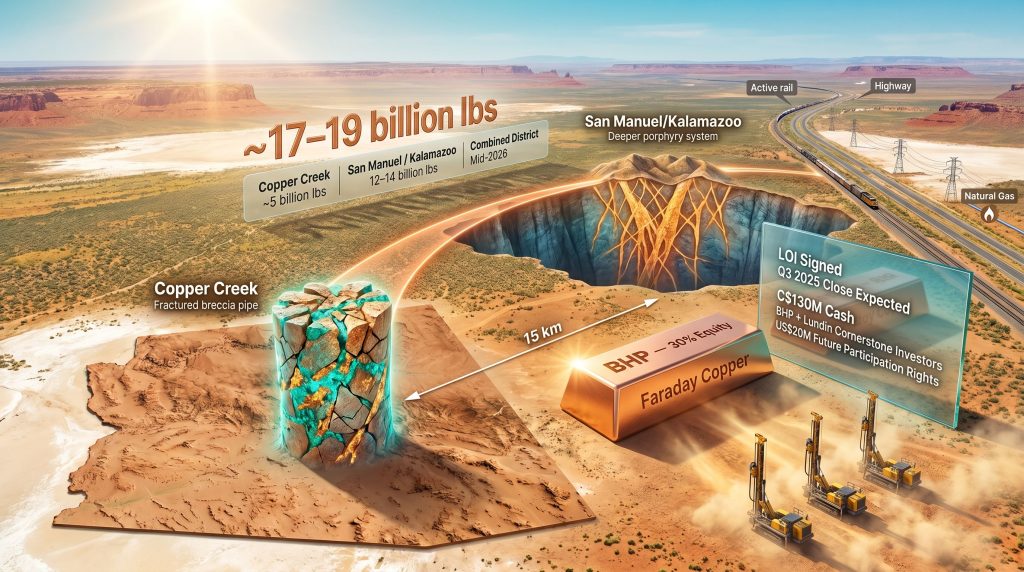
Copper Creek has been Faraday's flagship asset since the company took operational control roughly five years ago. The 2023 resource estimate placed 4.2 billion pounds of copper in the measured and indicated categories, with just over 5 billion pounds across all resource categories. Since that estimate was published, the company has completed between 60,000 and 70,000 metres of additional drilling, with a materially expanded combined resource estimate targeting publication by mid-2026.
Three drill rigs are currently active at Copper Creek. Drilling is paused seasonally during Arizona's monsoon period, typically July through September, due to the risk of flash flooding that can affect drill access and site safety in that region of the US Southwest. For a full overview of the Copper Creek project, including maps and technical details, Faraday's project page provides further context.
Two Mineralisation Styles, One Integrated Strategy
What makes Copper Creek geologically distinctive is the coexistence of two separate but related mineralisation types within a single land package.
| Mineralisation Style | Characteristics | Mining Method |
|---|---|---|
| Breccia Pipes | Broken rock fragments re-cemented by copper mineralisation; outcrop at surface | Open pit |
| Porphyry Systems | Classic stockwork vein mineralisation at depth, transitioning downward from breccias | Underground |
More than 300 breccia pipes have been mapped at surface across the Copper Creek land package. Critically, only 15% of those pipes have been drill-tested to date. That figure represents one of the most underappreciated aspects of the Copper Creek story: the exploration pipeline of near-surface open-pittable targets remains largely untouched.
The property contains two major structural corridors. The Holy Joe Fault runs along the eastern portion of the property and is the primary geological conduit responsible for the mineralisation associated with the current resource. Numerous breccia pipes and porphyry systems with surface copper mineralisation are exposed along this structure, providing a continuous pipeline of near-term drill targets.
A western belt of breccias and porphyries has received no drill testing to date. The geometric position of this belt within the mineralising system suggests it sits at a higher elevation in the hydrothermal column, which is theorised to represent deeper underground-style bulk mining targets rather than shallow open-pittable material. Current drilling strategy deliberately prioritises the near-surface open pit resource to maximise early mine value before transitioning to underground development.
San Manuel: A Dormant Giant With Exceptional Infrastructure
The San Manuel mine has a production history that most modern copper projects simply cannot match. Originally developed by Magma Copper in the mid-1950s, it operated for nearly 50 years using block cave mining technology — a method that only became industry-standard globally decades after San Manuel first employed it. At its operational peak, San Manuel was the largest underground mine in the world.
Over its operational life, the mine produced approximately 4,500 kilotonnes of copper. BHP acquired Magma Copper in the mid-1990s but closed San Manuel in the late 1990s, not because the resource was exhausted, but because copper prices collapsed. At the time of closure, an estimated 12 to 14 billion pounds of copper remained in the ground.
It is worth pausing on this figure. The resource that remains at San Manuel was never fully extracted, never fully drilled out, and was last formally calculated when copper was priced at approximately US$0.80 per pound. At current copper prices, the economics of that resource are entirely different.
One of the final drill holes completed at depth before closure returned 0.9% copper, indicating the system remains open and mineralised at depth. The mineral system has never been drilled to its full extent.
During the early 2000s, BHP deconstructed surface infrastructure and completed environmental rehabilitation of the site. Critically, while the physical drill core was discarded during reclamation, the digital drill hole data, assay certificates, and mine reconciliation records are fully preserved. SRK Consulting has been engaged to assess confirmation drilling requirements ahead of a NI 43-101 compliant resource estimate. For additional reporting on the letter of intent between the two parties, Global Mining Review's coverage of the agreement provides useful background.
The Infrastructure Advantage: Private Land and Pre-Existing Utilities
One of the most underappreciated elements of the Faraday Copper San Manuel acquisition by BHP is the 27,000 acres of private land that comes with the property. In the US regulatory context, private land ownership removes a substantial layer of federal permitting complexity that typically applies to mining projects on public land. It gives the operator direct control over infrastructure development timelines without requiring federal land use authorisations for surface disturbance.
Beyond the land tenure advantage, the site retains a remarkable set of pre-existing utilities:
- A highway passes directly adjacent to the property boundary
- An electrical transformer remains on-site
- New high-voltage electrical installations have been connected to serve Arizona's expanding power grid needs
- Natural gas pipelines from the US national grid pass through the property
- An active rail line terminates at the San Manuel site
This combination of private land and functional utility infrastructure compresses both the capital requirement and the timeline to early-stage production relative to a comparable greenfield project starting from scratch. In addition, the favourable regulatory environment for US mining permits under recent executive actions further supports the project's development trajectory.
Mining Optionality Beyond the Underground Narrative
A common assumption about San Manuel is that it will be exclusively an underground operation, given its block cave history. That assumption is incorrect. The property contains a significant near-surface oxide copper resource that creates an additional production pathway.
Oxide copper resources are amenable to heap leach and SX-EW (solvent extraction-electrowinning) processing, which produces copper cathode directly and requires lower initial capital than sulphide concentrating circuits. This creates the potential for an early-stage cash-generating production scenario before the larger bulk underground development at the Kalamazoo deposit is commissioned. Kalamazoo is the offset portion of the original San Manuel orebody and represents the primary bulk underground target within the combined district.
Combined District Scale: A Comparative Resource Overview
| Asset | Estimated Contained Copper | Resource Status |
|---|---|---|
| Copper Creek (2023 estimate) | ~5 billion lbs (all categories) | Active drilling; updated estimate pending |
| San Manuel / Kalamazoo | 12 to 14 billion lbs (historical, at closure) | Pre-NI 43-101; confirmation drilling required |
| Combined District (indicative) | ~17 to 19 billion lbs | Combined estimate targeted mid-2026 |
The combined resource would position the San Manuel mining district among the top four undeveloped copper resources in the United States. A combined NI 43-101 compliant resource estimate is targeted for mid-2026, forming the foundation for a Phase 1 project study expected by the end of 2026.
Disclaimer: The combined resource figures cited above include historical estimates for San Manuel that have not yet been verified under NI 43-101 standards. Investors should not place undue reliance on historical resource figures pending completion of confirmation drilling and a compliant resource estimate.
Capital Structure and Financial Position
What Two Blue-Chip Cornerstone Investors Actually Means
Prior to the San Manuel transaction, Lundin was Faraday's sole major strategic shareholder. Following completion of the acquisition, both Lundin and BHP will sit on the register as cornerstone investors. That combination is not merely a marketing point. These two names represent some of the deepest institutional knowledge and capital networks in global copper development and production.
The practical benefits of this dual cornerstone structure include:
- Long-term capital access through committed participation rights on future financings
- Credibility with institutional investors who follow the copper sector closely
- A shareholder base that signals seriousness to regulators, permitting agencies, and potential project partners
Funded Through to 2028
Faraday recently closed a C$100 million financing round, with both Lundin and BHP participating. Combined with existing cash, the company holds approximately C$130 million on its balance sheet, providing a funded runway that extends into 2028 without requiring additional equity raises.
This capital base is specifically sized to:
- Complete the San Manuel acquisition, including assumption of environmental liabilities
- Fund confirmation drilling at San Manuel to support a NI 43-101 compliant resource estimate
- Deliver the combined Copper Creek and San Manuel resource estimate by mid-2026
- Progress a Phase 1 project study by the end of 2026
Trading liquidity has improved substantially alongside the company's rising profile. Daily share volume has grown from approximately 200,000 shares per day twelve months prior to over 2 million shares per day, with single-day trading volumes reaching as high as C$17 million.
A US Exchange Listing Under Consideration
Faraday currently trades on the Toronto Stock Exchange (TSX). Management has publicly flagged a potential listing on the Nasdaq or NYSE as a strategic consideration, given the company's exclusive US project focus. Very few pure-play copper developers with 100% US-based assets are currently listed on US exchanges, creating a potential differentiation and liquidity opportunity if such a move is pursued.
The M&A Landscape: Where Faraday Fits in the US Copper Consolidation Wave
The copper M&A cycle has evolved in a meaningful way over the past several years. Early transactions prioritised producing assets with immediate cash flow. More recently, the emphasis has shifted toward acquiring development-stage projects in favourable jurisdictions, before permitting risk is fully resolved and before resources are fully defined. This shift reflects both the growing copper supply crunch globally and the strategic urgency amongst major miners to secure future production pipelines.
| Transaction | Acquirer | Target | Stage |
|---|---|---|---|
| Foran Mining acquisition | Eldorado Gold | Foran Mining | Production-stage asset |
| Arizona Sonora acquisition | Hudbay Minerals | Arizona Sonora Copper | Development-stage US project |
| San Manuel LOI | Faraday Copper | BHP (San Manuel property) | District-scale consolidation |
With the discovery pipeline for new large-scale copper deposits running thin globally, and quality development-stage projects in favourable jurisdictions increasingly scarce, Faraday's combined district position creates a compelling strategic profile. When considering large US-based copper development projects still held by junior companies, the field is remarkably narrow — a scarcity dynamic that has historically preceded corporate activity in other commodity sectors.
The presence of Lundin and BHP on the register adds a further dimension to this analysis. These shareholders provide both a degree of protection against opportunistic low-ball approaches and a visible signal to the broader market of the district's perceived long-term value. Investors assessing how to approach this space may also benefit from reviewing copper investment strategies tailored to the current market environment.
The next major ASX story will hit our subscribers first
Key Milestones and Upcoming Catalysts
| Expected Catalyst | Anticipated Timing |
|---|---|
| Shareholder vote on 30% equity issuance | July to August 2025 |
| San Manuel acquisition close | End of Q3 2025 |
| Mobilisation of drill rigs at San Manuel | September to October 2025 |
| Ongoing Copper Creek drill results | Near-term (continuous) |
| Combined resource estimate (Copper Creek + San Manuel) | Mid-2026 |
| Phase 1 project study | End of 2026 |
Frequently Asked Questions
Has the Faraday Copper San Manuel Acquisition by BHP Closed?
Not yet. As of mid-2025, Faraday has signed a non-binding letter of intent with a BHP subsidiary. The transaction remains subject to a definitive agreement, shareholder approval, and regulatory clearances, with closing expected by the end of Q3 2025.
What Is Faraday Paying for San Manuel?
No cash is changing hands. BHP will receive newly issued Faraday shares representing 30% of the company on a fully diluted basis. Faraday also assumes the property's environmental and closure liabilities as part of the consideration.
Why Was San Manuel Closed If Copper Was Still in the Ground?
San Manuel was closed by BHP in the late 1990s due to a collapse in copper prices, not resource depletion. The last resource calculation was conducted when copper was priced at approximately US$0.80 per pound. An estimated 12 to 14 billion pounds of copper remained in the ground at closure, and the mineralised system was never fully drilled to its limits.
What Is the Kalamazoo Deposit?
Kalamazoo is the offset portion of the original San Manuel orebody and sits within the San Manuel property boundary. It is considered the primary bulk underground mining target within the combined district and would likely form the basis of large-scale block cave operations in future mine planning.
Why Does Private Land Ownership Matter So Much?
Private land in the US context eliminates the need for federal land use approvals that apply to mining on public land, giving the operator substantially greater control over infrastructure construction timelines. Combined with pre-existing utility connections at San Manuel, this represents a meaningful compression of both capital requirements and development lead times relative to comparable greenfield projects.
How Does Breccia Pipe Mineralisation Differ From Porphyry?
Breccia pipes form when existing rock is fractured and subsequently re-cemented by mineralising fluids. At Copper Creek, copper itself serves as the cementing agent. These structures outcrop at surface and are amenable to open pit extraction. Porphyry systems develop deeper in the hydrothermal column as copper-bearing fluids migrate through stockwork fracture networks, forming classic disseminated and vein-hosted mineralisation that typically requires underground bulk mining methods.
A Rare Convergence of District Scale, Infrastructure, and Capital
The proposed Faraday Copper San Manuel acquisition by BHP represents something genuinely uncommon in the junior mining sector: a district-scale consolidation of two world-class copper assets, underpinned by private land tenure, pre-existing utility infrastructure, preserved historical data, blue-chip shareholder support, and a fully funded balance sheet — all arriving simultaneously.
The combination of a dormant historic giant with unverified but compelling historical resources, a growing exploration-stage flagship with documented near-surface upside, and a management team that has been deliberately working toward this exact outcome for five years creates a development story with multiple independent value drivers. With a combined resource estimate and a Phase 1 project study both targeted within the next 18 months, the cadence of value-defining news flow is set to accelerate meaningfully.
This article is for informational purposes only and does not constitute financial advice. Investors should conduct their own due diligence and consult a qualified financial adviser before making investment decisions. Forward-looking statements regarding resource estimates, timelines, and project studies are subject to material risks and uncertainties.
Want to Track the Next Major Copper Discovery Before the Market Catches On?
Discovery Alert's proprietary Discovery IQ model delivers real-time alerts on significant ASX mineral discoveries, instantly translating complex mineral data into actionable opportunities — explore the historic returns major discoveries have generated to understand what's at stake, then begin your 14-day free trial at Discovery Alert to position yourself ahead of the broader market.