June 17, 2026
The Hidden Economics Behind a Copper Market in Crisis
When a raw materials processing industry begins paying to receive the very material it exists to process, something structurally significant has broken down. That is precisely the situation confronting China copper smelters talks with miners in 2026, where spot treatment and refining charges have turned deeply negative, byproduct revenues have become the primary income stream for many facilities, and the world's largest copper-consuming nation is scrambling to reorganise its purchasing architecture before conditions deteriorate further.
Understanding why this matters requires unpacking a corner of commodity markets that rarely receives mainstream attention: the mechanics of copper concentrate processing economics, and the shifting power dynamics between the miners who dig ore out of the ground and the smelters who transform it into refined metal.
When big ASX news breaks, our subscribers know first
Treatment and Refining Charges: The Barometer of Supply Chain Health
Copper does not travel in a straight line from mine to market. Between extraction and refined metal production sits a critical intermediate stage: the processing of copper concentrate, a partially refined slurry typically containing between 20% and 30% copper content alongside various impurities. Smelters convert this concentrate into cathode copper through a combination of high-temperature smelting and electrorefining.
How Are TC/RCs Structured?
Historically, miners compensated smelters for this service through treatment and refining charges, referred to throughout the industry as TC/RCs. Treatment charges are denominated in US dollars per dry metric tonne of concentrate, while refining charges are expressed in US cents per pound of copper recovered. Together, they form the core margin for smelting operations.
What makes TC/RCs such a sensitive market indicator is that they respond directly to the balance of concentrate supply. When miners are producing abundantly and smelter capacity is ample, smelters can negotiate from a position of strength and TC/RCs rise. However, when concentrate supply tightens relative to installed smelting capacity, the calculus inverts entirely: smelters compete for limited ore, miners extract better terms, and TC/RCs compress.
The table below illustrates how dramatically this dynamic has shifted over recent years:
| Year | Annual Benchmark TC (USD/tonne) | Annual Benchmark RC (cents/lb) | Market Condition |
|---|---|---|---|
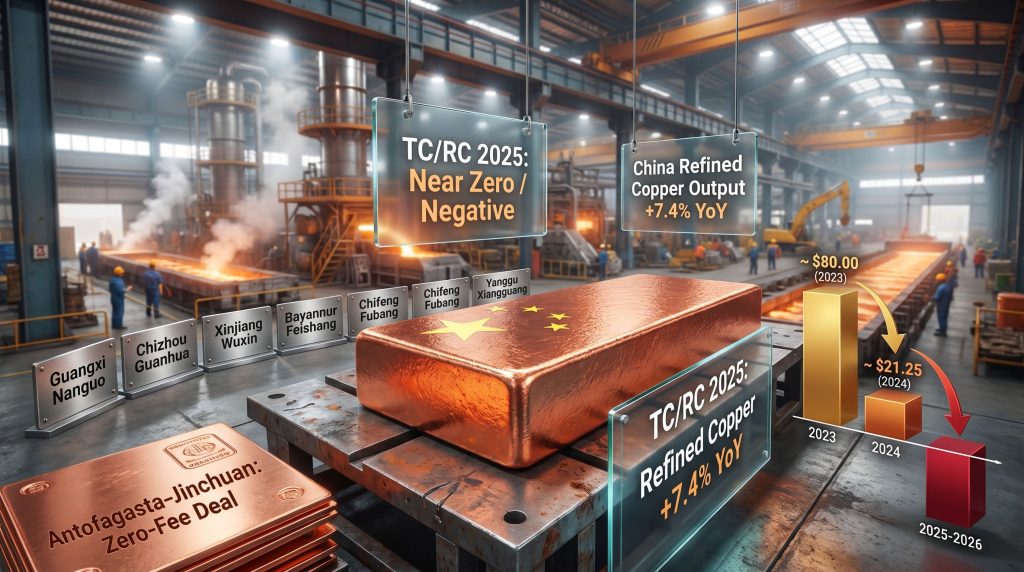
| 2023 | ~$80.00 | ~8.0 | Balanced supply |
| 2024 | ~$21.25 | ~2.125 | Tight concentrate |
| 2025 | Near zero / negative (spot) | Near zero / negative (spot) | Severe shortage |
| 2026 | Negative spot; zero-fee deals emerging | Negative | Crisis-level squeeze |
The collapse from $80 per tonne to negative territory in roughly three years represents one of the most compressed pricing cycles in modern copper processing history. For context, a negative TC/RC means smelters are not merely earning less for processing concentrate; they are effectively subsidising the miner to take their ore. The traditional value chain relationship has been inverted entirely. Furthermore, this inversion is deeply connected to the broader copper supply crunch that has been building across global markets.
This inversion reflects something deeper than a short-term supply disruption. It signals that global copper mining output has failed to keep pace with the smelting capacity China has built over the past decade, creating a structural mismatch that no quarterly negotiation can easily resolve.
The Zero-Fee Deal: A Historic Precedent That Changes Negotiating Floors
Nowhere is this supply stress more visible than in the 2026 negotiations between Chilean mining giant Antofagasta and Chinese smelter Jinchuan, where reports indicate that a portion of concentrate supply has been agreed on a zero-fee basis. In practical terms, this means no TC/RC payment changes hands: the smelter receives the concentrate and accepts that its margin must come entirely from byproduct recovery, particularly sulphuric acid produced as a co-product of the smelting process.
This development carries enormous symbolic weight beyond its immediate commercial implications. Once a zero-fee deal is struck and acknowledged within the industry, it establishes a reference point that weakens the negotiating floor for all subsequent discussions. Miners can credibly argue that at least one major smelter found zero-fee arrangements commercially acceptable, which makes it harder for others to hold out for positive TC/RCs.
The broader 2026 annual benchmark negotiations between Chinese smelters and Antofagasta remain unresolved as of mid-2026, a state of affairs that itself reflects how dysfunctional the traditional annual benchmark-setting process has become under current market conditions. According to reporting on the ongoing deadlock, both sides remain entrenched in what has become one of the most prolonged standoffs in recent memory.
China's Collective Response: Expanding the CSPT Coalition
The China Smelters Purchase Team, known as the CSPT, was established as a coordination mechanism among China's largest copper producers to present a unified front in concentrate purchasing negotiations. Historically composed of 16 major producers, the group sets floor prices for spot concentrate processing deals and attempts to synchronise the industry's negotiating posture.
In mid-2026, the CSPT held its quarterly meeting in Yantai, Shandong province, with a notable expansion agenda: at least six prospective new members were invited to attend, representing a deliberate attempt to broaden the coalition and amplify its collective leverage.
Who Are the Prospective New CSPT Members?
The companies invited to participate include the following:
| Company | Region | Notable Ownership / Affiliation |
|---|---|---|
| Guangxi Nanguo | Guangxi Province | Not confirmed |
| Chizhou Guanhua | Anhui Province | Not confirmed |
| Xinjiang Wuxin | Xinjiang | Xinjiang Nonferrous Metal Group |
| Bayannur Feishang | Inner Mongolia | Not confirmed |
| Chifeng Fubang | Inner Mongolia | Not confirmed |
| Yanggu Xiangguang | Shandong Province | C&D Inc. (400,000 t/yr capacity) |
Formal admission for these companies is not yet finalised, as CSPT membership requires incorporation through an established governance process. Nevertheless, the signal is clear: China's smelting sector is attempting to consolidate its purchasing power at a moment when individual smelters lack the leverage to negotiate meaningful improvements on their own.
The strategic logic mirrors China's increasingly assertive posture in iron ore negotiations. However, the iron ore experience offers a cautionary lesson rather than a clear success template: consumption-side coordination frequently fractures along competitive lines, particularly when participants have divergent cost structures, utilisation rates, and byproduct revenue profiles. Consequently, the copper smelting expansion of recent years has, paradoxically, weakened rather than strengthened the sector's collective hand.
The Credibility Problem: What the Output Data Reveals
For the sixth consecutive quarter, the CSPT declined to issue quarterly TC/RC guidance at its Yantai meeting. This pattern of sustained silence from the group's guidance function is itself revealing. Issuing guidance that the market immediately invalidates through actual trading activity does reputational damage to the body's authority.
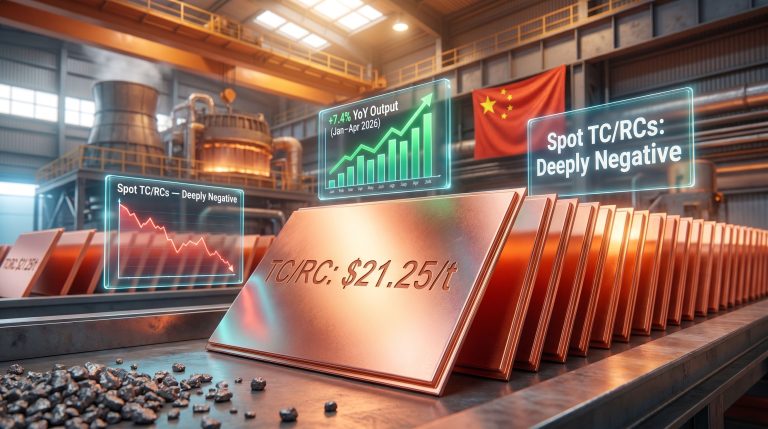
The output data makes this credibility challenge stark. Despite a formal CSPT commitment to reduce China's 2026 refined copper production by 10% compared to the prior year, data from China's National Bureau of Statistics showed that refined copper output grew 7.4% year-on-year between January and April 2026. The gap between the stated commitment and the actual result is not marginal; it represents a complete reversal of direction.
Why Does Coordination Fail So Reliably in Copper Smelting?
Several structural incentives work against discipline:
- Capacity utilisation pressure: Smelters with high fixed-cost infrastructure have a strong incentive to keep furnaces running regardless of processing margins, as idle capacity still incurs costs.
- Byproduct revenue dependency: Facilities generating substantial sulphuric acid income may calculate that negative TC/RCs are offset by acid sales, making output reductions economically irrational at the individual level.
- Competitive information asymmetry: Without robust verification mechanisms, each smelter suspects others are defecting from agreed cuts, which justifies its own defection as a self-protective response.
- Local government pressure: Many Chinese smelters operate in regions where they are significant employers, and local government stakeholders often pressure management to maintain production for economic stability reasons.
Surviving on Sulphuric Acid: The Byproduct Revenue Model
Perhaps the most underappreciated dimension of the current crisis is how Chinese copper smelters are remaining commercially viable at all. The answer lies in sulphuric acid.
Copper smelting generates large quantities of sulphur dioxide as a byproduct of processing sulphide-based concentrates. Modern smelters capture this gas and convert it into sulphuric acid, which is sold primarily to the fertiliser and chemical industries. In the current environment, it has effectively become the primary economic rationale for continued operations at many facilities.
This dependency creates its own vulnerability. Sulphuric acid pricing is subject to its own supply and demand dynamics, and a meaningful decline in acid prices could simultaneously eliminate the last remaining margin buffer for smelters already earning nothing from concentrate processing. As analysts at Mercuria have noted, smelters have not yet reached peak pain, but the trajectory remains deeply concerning.
If sulphuric acid markets weaken at the same time concentrate supply remains tight, a number of Chinese copper smelters would face genuine viability questions, which could paradoxically accelerate the supply rationalisation that voluntary output cuts have failed to achieve.
The next major ASX story will hit our subscribers first
Scenario Analysis: Three Paths Forward for Copper Markets
How the CSPT expansion resolves, combined with the trajectory of concentrate supply from global miners, will meaningfully influence copper pricing and refining economics through the remainder of the decade. In addition, the ongoing copper price rally driven by broader macro forces adds further complexity to any forecasting exercise. Three broad scenarios frame the range of plausible outcomes:
| Scenario | Probability | TC/RC Direction | Copper Price Impact | Key Risk |
|---|---|---|---|---|
| Unified CSPT discipline achieved | Low to Moderate | Rising gradually | Neutral to modest downward | Internal defection by smaller smelters |
| Coordination fails, margins erode further | Moderate to High | Flat to negative | Neutral to upward | Smelter closures tighten refined supply |
| Beijing imposes formal capacity controls | Moderate | Rising | Upward pressure on copper price | Execution risk and political economy |
The third scenario deserves particular attention. If voluntary coordination through the CSPT continues to fail, central policy intervention to enforce capacity rationalisation becomes more probable. Such a move would be consistent with patterns observed across other Chinese industrial sectors, where voluntary industry commitments give way to regulatory enforcement when market discipline proves insufficient.
What This Means for Investors Watching Copper
The dynamics playing out in China's copper smelting sector have direct implications for investors tracking base metals markets. Furthermore, these pressures compound existing structural challenges such as Chile's copper supply gap and ongoing Codelco production decline, which continue to constrain the concentrate volumes available to processors globally. Several observations are worth synthesising:
- The persistent negative TC/RC environment is structurally bullish for copper miners with long-term contract exposure, as they are effectively receiving concentrate processing services at no cost or at a net benefit.
- Smelters reliant on spot concentrate purchasing face compounding margin pressure and represent elevated operational risk until supply conditions normalise.
- If Chinese smelter capacity eventually undergoes meaningful rationalisation, the resulting tightening of refined copper supply could exert upward pressure on copper cathode prices at a time when demand from electrification and grid infrastructure remains structurally elevated.
- The failure of CSPT output cut pledges suggests that bottom-up price signals have not yet crossed the threshold required to force genuine capacity discipline, implying that further deterioration may be necessary before the market self-corrects.
Disclaimer: This article is intended for informational purposes only and does not constitute financial advice. Commodity markets involve significant uncertainty and risk. Past pricing trends and scenario projections are not guarantees of future outcomes. Investors should conduct their own due diligence before making any investment decisions.
Frequently Asked Questions: China Copper Smelters and Miner Negotiations
What is the CSPT and why does it exist?
The China Smelters Purchase Team is a coordinating body comprising China's major copper producers. It was formed to give Chinese smelters collective negotiating power in concentrate supply discussions with global miners, setting floor prices for spot processing deals and attempting to synchronise the industry's commercial positions.
Why are spot TC/RCs currently negative?
Global copper concentrate supply has not kept pace with the smelting capacity China has built over the past decade. When concentrate is scarce relative to processing capacity, smelters compete for available ore, driving processing fees down and ultimately into negative territory.
What does a zero-fee copper deal mean operationally?
A zero-fee arrangement means the smelter receives no processing payment from the miner. Its revenue must come entirely from the value of refined copper output and byproduct sales, principally sulphuric acid. Such deals are historically anomalous and signal extreme supply-side leverage held by miners.
Can the CSPT realistically force better terms from global miners?
The CSPT's track record suggests significant limitations. Despite formal commitments, China's refined copper output grew rather than contracted in early 2026. Without enforcement mechanisms and given competing individual incentives among smelters, collective discipline has repeatedly failed to materialise in practice.
What is the significance of the Yantai meeting for 2026 supply negotiations?
The Yantai gathering marked the CSPT's attempt to expand its membership base and consolidate negotiating power ahead of ongoing China copper smelters talks with miners including Antofagasta. The meeting also confirmed the group's sixth consecutive quarter without issuing TC/RC guidance, underlining the prolonged dysfunction in concentrate pricing benchmarks.
Want to Know When the Next Major Copper Discovery Hits the ASX?
Discovery Alert's proprietary Discovery IQ model scans ASX announcements in real time, instantly identifying significant mineral discoveries — including copper — and delivering actionable insights before the broader market reacts. Explore historic discoveries and their exceptional returns, then begin your 14-day free trial at Discovery Alert to position yourself ahead of the next major find.