August 14, 2026
Global copper supply constraints are tightening across established mining regions while energy transition demands create unprecedented mineral consumption requirements. This structural imbalance emerges as traditional ore grades decline by 0.5-1% annually across major deposits, forcing operations to process larger tonnages for equivalent metal recovery. Meanwhile, renewable energy infrastructure development requires copper intensities 3-5 times higher than conventional power generation, fundamentally altering demand patterns through 2035.
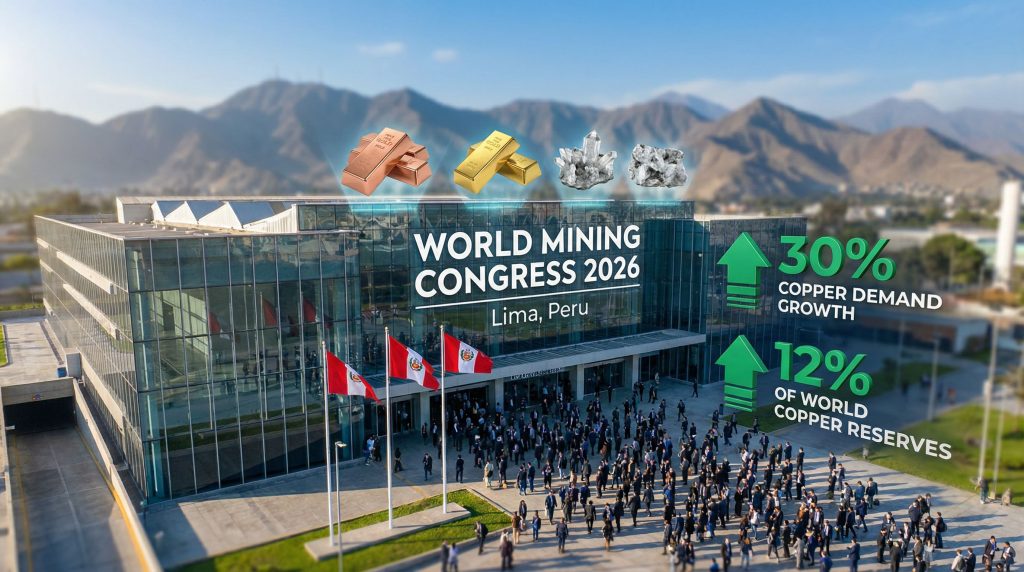
The mining industry faces a convergence of technical challenges, regulatory evolution, and stakeholder expectations that demands systematic transformation across operational frameworks. Against this backdrop, Peru's hosting of the world mining congress 2026 represents more than ceremonial recognition of the nation's 13% share of global copper reserves. The gathering positions Lima as a strategic forum for addressing extraction economics, community stakeholder management, and technological integration challenges that transcend individual jurisdictions.
Strategic Positioning Factors Driving Peru's Mining Leadership Role
Peru's emergence as the global mining capital for June 2026 reflects multiple convergent advantages that extend beyond simple resource endowment. The nation's mineral wealth includes approximately 77 million tonnes of contained copper reserves, representing the world's second-largest concentration after Chile. However, Peru's strategic positioning encompasses broader factors that make Lima an authentic venue for addressing industry-wide transformation challenges.
Critical Mineral Reserve Distribution:
| Mineral | Peru's Global Share | Strategic Importance |
|---|---|---|
| Copper | 13% of reserves | Essential for electrification |
| Silver | 3.4% of reserves | Industrial applications growth |
| Gold | 5.4% of reserves | Portfolio diversification |
| Zinc | 5.9% of reserves | Infrastructure development |
The geographic positioning offers Pacific Basin market access advantages, creating supply chain optimisation opportunities for Asian consumption markets. Peru's regulatory framework modernisation efforts, including revised mining code discussions and strengthened indigenous consultation protocols, mirror challenges across emerging mining jurisdictions globally. Furthermore, this development parallels trends observed in the Argentina copper system where similar governance evolution initiatives are underway.
Infrastructure capacity at Lima's Convention Center supports the expected 3,000+ delegates from 60+ countries, with programming designed around multi-track sessions spanning June 24-26, 2026. The timing aligns strategically with Inti Raymi celebrations, symbolically reinforcing renewal themes relevant to industry transformation imperatives.
Peru's mining sector contributes approximately 10.5% of national GDP and 60% of export revenues, making mining governance decisions critical to macroeconomic stability. However, the country faces infrastructure gaps and regulatory compliance challenges, with informal mining operations accounting for 15-20% of national copper production, creating authentic discussion contexts for governance modernisation.
When big ASX news breaks, our subscribers know first
Architectural Framework Addressing Systematic Industry Evolution
The world mining congress 2026 structures discussions around three interdependent transformation pillars that acknowledge mining's systematic evolution requirements. This framework recognises that operational excellence demands simultaneous advancement across human capital development, financial optimisation, and technological integration dimensions. Consequently, these pillars reflect the broader mining industry evolution taking place across global markets.
Traditional mining metrics focused on production tonnage and unit costs no longer capture full value equations in an ESG-conscious investment landscape. Approximately 73% of institutional investment decisions in mining companies now incorporate environmental, social, and governance considerations as material financial factors rather than peripheral concerns.
Day 1: Leadership Paradigm Transformation Under Market Volatility
Opening sessions examine decision-making frameworks under uncertainty, featuring behavioural economics insights and project management methodologies. The programming addresses cognitive biases in major project approval processes, where optimism bias accounts for approximately 25-35% of cost overruns in extractive industries.
Beau Lotto, CEO of Lab of Misfits Studio, delivers the opening keynote on navigating uncertainty and transforming decision-making processes. His behavioural economics framework addresses systematic cognitive distortions in risk processing and probability assessment, particularly relevant for multi-billion-dollar capital commitments with decade-long asset lifecycles.
Oxford University Professor Bent Flyvbjerg presents research on major project success factors, drawing from analysis of 2,700+ infrastructure and resource projects. His findings reveal that mining projects exceed budget forecasts by 40-60% on average, with schedule overruns exceeding timeline projections by 30-45%. Large-scale mining projects fail at disproportionately high rates relative to other major capital undertakings.
Industry perspectives come from Juan Luis Kruger of Minsur, Iván Arriagada from Antofagasta Minerals, and Marna Cloete of Ivanhoe Mines, providing operational insights on responding to growing global mineral demand while managing stakeholder complexities.
Day 2: Asset Value Optimisation and Strategic Positioning
Mid-congress sessions focus on generating enhanced value from existing assets, addressing capital efficiency challenges where mining capital intensity increased 45% over the past decade while project delivery timelines expanded by 30-40%. In addition, brownfield expansion initiatives at existing operations typically yield 8-12% productivity gains without proportional capital expenditure requirements.
Mark Cutifani of Odin Partnership leads discussions on performance and competitiveness, joined by Mikael Staffas from Boliden and Roque Benavides of Buenaventura. The programming examines brownfield expansion versus greenfield development economics, strategic partnership models for risk sharing, and talent pipeline development in technical specialisations.
A featured dialogue between Mark Cutifani and Robert Friedland, moderated by Rohitesh Dhawan from the International Council on Mining and Metals, examines strategic direction considerations for global mining. Additional perspectives come from Julia Torreblanca of Peru's mining industry association SNMPE, Luis Miguel Castilla from Videnza Institute, and Eva Arias of Poderosa.
Stanford Professor Jef Caers addresses long-term talent challenges, particularly relevant as approximately 55% of mining operations still utilise legacy systems for operational planning. The sessions explore workforce transition management as roles shift from purely operational to operational-analytical hybrid positions.
Day 3: Technology-Driven Transformation and Organisational Capabilities
Concluding sessions examine systematic efficiency improvements and capability building, emphasising artificial intelligence applications in mineral discovery, automation impact on workforce planning, and digital twin technologies for operational optimisation.
Contributors include Jef Caers on AI applications, Flavia Tata Nardini from Fleet Space Technologies, Tim O'Connor from BHP, and Michelle Ash from SIMULIA. The programming addresses technology integration challenges, including retrofitting new systems into 30-50 year-old operational infrastructure and managing change across geographically dispersed, multinational workforces.
The Congress concludes with a high-level session featuring Iván Arriagada, Mark Cutifani, Marek Cala, and Liang Yuan from Anhui University, followed by a closing keynote from Beau Lotto on thriving amid uncertainty.
Critical Supply Chain Vulnerabilities in Energy Transition Metals
The Congress timing coincides with heightened awareness of supply chain dependencies for battery metals essential to electrification goals. Global copper demand is projected to increase by 25-30% by 2035 due to renewable energy infrastructure requirements, rising from 22 million tonnes in 2020 to approximately 30 million tonnes by 2035. This trend directly connects to the broader critical minerals energy transition requirements that will shape mining investments throughout the decade.
Geographic concentration risks in critical mineral production create strategic vulnerabilities for consuming nations. Latin America produces approximately 40% of global copper, with Peru accounting for 13% of global production at roughly 2.3 million tonnes annually. However, processing capacity remains concentrated in traditional hubs, creating bottlenecks throughout the value chain.
Discussion frameworks will examine alternative sourcing strategies for strategic materials, processing capacity development outside established centres, and recycling technology advancement for circular economy models. Water stress affects 30% of global mining sites, rising to 45% in Latin America specifically, adding operational complexity to expansion planning.
The Congress addresses resource nationalism trends across emerging markets, characterised by revised tax and royalty structures, mandatory local content requirements, expanded regulatory oversight, and community consultation mandates with quasi-veto powers. For instance, Peru's evolving mining tax code provides a case study for balancing fiscal revenue requirements with investment climate competitiveness, whilst the Chile copper market outlook offers comparative insights for regional policy development.
Stakeholder Ecosystem Convergence for Strategic Outcomes
The 3,000+ expected participants represent diverse stakeholder groups, each bringing specific priorities that create opportunities for cross-sector dialogue and strategic alignment. Mining executives seek operational efficiency insights and strategic partnership opportunities, while government officials focus on regulatory framework development and investment attraction strategies.
Technology providers view the gathering as market penetration opportunities and innovation showcasing platforms. Financial institutions prioritise risk assessment methodologies and project financing structure development. Furthermore, academic researchers contribute knowledge transfer and collaborative research initiatives, whilst industry professionals explore copper investment strategies for positioning portfolios ahead of the energy transition.
Organisations implementing structured leadership development programs demonstrate 25% faster project execution and 18% better community stakeholder outcomes, highlighting the value of systematic capability building approaches discussed throughout the Congress programming.
Mining projects incorporating external advisory oversight show 35% lower overrun rates than internally-managed equivalents, emphasising the importance of governance frameworks and independent review processes in major capital deployment decisions.
Implementation Pathways for Post-Congress Strategic Integration
The true value of the world mining congress 2026 emerges through subsequent implementation of discussed strategies and partnerships formed during the Lima gathering. Successful participants typically develop action plans based on insights gained across multiple sessions, establish follow-up protocols with new professional connections, and integrate learnings into existing strategic planning processes.
Pre-Congress Preparation Framework:
- Review preliminary programme topics aligned with organisational priorities
- Identify key speakers relevant to specific operational challenges
- Schedule targeted networking sessions with industry counterparts
- Prepare discussion points for interactive session participation
During-Congress Engagement Strategy:
- Attend sessions outside immediate expertise areas for broader perspective
- Participate actively in Q&A segments to establish thought leadership positioning
- Document innovative approaches and methodologies for post-event analysis
- Build relationships across the complete mining value chain ecosystem
Knowledge sharing across organisational teams maximises institutional benefit from Congress participation. However, organisations implementing decision-making protocols incorporating scenario analysis and pre-mortem evaluation reduce major decision reversal rates by approximately 40%.
How Will Attendees Maximise Value from the Lima Gathering?
Effective participation requires strategic preparation and structured follow-up processes. Attendees should align session attendance with specific organisational objectives, whilst preparing targeted questions for speaker interactions. Post-congress implementation planning ensures insights translate into operational improvements and strategic initiatives.
The World Mining Congress 2026 official platform provides comprehensive programme details and registration information for industry professionals seeking participation. Additionally, the Global Mining Review coverage offers detailed analysis of expected outcomes and industry impact assessments.
The next major ASX story will hit our subscribers first
Transformation Imperatives Shaping Mining's Next Decade
The convergence of technological advancement, environmental pressures, and geopolitical complexity creates unprecedented context for mining industry evolution. Environmental, social, and governance considerations now influence investment decisions as material financial risks, requiring operational frameworks that integrate sustainability metrics into performance dashboards.
Technology adoption in mining lags other industrial sectors, creating opportunities for productivity enhancement through systematic digital transformation. Consequently, legacy system integration challenges require careful management of workforce transition as roles evolve toward operational-analytical hybrid positions requiring new skillset development.
The Lima gathering's significance extends beyond information sharing to encompass relationship building, strategic partnership formation, and collaborative approach development for challenges that individual organisations cannot address independently. The world mining congress 2026 represents a critical forum for collective problem-solving and strategic alignment across traditional industry boundaries.
Resource governance modernisation, community stakeholder engagement best practices, and regulatory compliance in evolving legal frameworks remain central themes requiring continued industry collaboration. Moreover, Peru's hosting provides authentic context for these discussions, given the nation's position as both major commodity producer and jurisdiction navigating mining governance evolution.
Disclaimer: This article contains forward-looking statements and industry projections based on current market conditions and available data. Mining investments carry inherent risks including commodity price volatility, operational challenges, regulatory changes, and environmental factors. Readers should conduct independent research and consult qualified professionals before making investment or business decisions related to mining sector opportunities.
Ready to Invest in the Next Major Mineral Discovery?
Discovery Alert instantly alerts investors to significant ASX mineral discoveries using its proprietary Discovery IQ model, turning complex mineral data into actionable insights. Understand why major mineral discoveries can lead to significant market returns by exploring Discovery Alert's dedicated discoveries page, showcasing historic examples of exceptional outcomes, and begin your 14-day free trial today to position yourself ahead of the market.