August 25, 2026
The Grade Decline Crisis Forcing a Technological Reckoning in Copper Mining
Few structural challenges in resource extraction are as quietly consequential as the long-run deterioration of copper ore grades. Over the past five decades, the average grade of copper ore mined globally has fallen from roughly 1.5–2% copper to below 0.5% at many major operations. That means producers are moving, crushing, and processing two to four times more material today to generate the same quantity of refined metal as their predecessors did a generation ago.
When you layer rising energy costs, tightening environmental regulation, water scarcity, and increasingly complex ore mineralogy on top of that grade compression, the economics of copper production face a structural squeeze that new mine development alone cannot resolve.
This is the underlying pressure making the technologies transforming copper mining not merely attractive, but operationally essential. The industry's technology adoption curve is no longer driven by competitive ambition in isolation. It is being driven by the hard arithmetic of deposit depletion and the rising cost of extracting value from what remains.
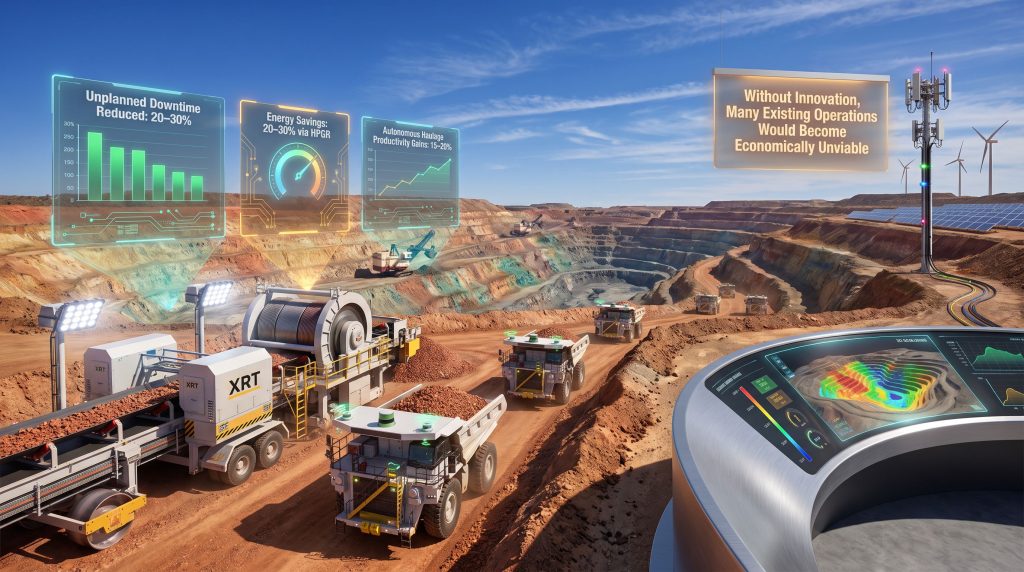
Key Insight: The copper mining industry is not simply adopting technology for efficiency gains. It is doing so out of structural necessity. Without innovation, many existing operations would become economically unviable as ore complexity increases and grades continue their multi-decade decline.
When big ASX news breaks, our subscribers know first
A Framework for Understanding Innovation Across the Copper Value Chain
Understanding where technology creates value in copper mining requires mapping it across the operational domains where the economic pain is greatest. The table below provides a structured overview of the primary innovation categories and their intended outcomes.
| Domain | Technology Category | Primary Outcome |
|---|---|---|
| Asset and Equipment Management | AI-driven predictive and prescriptive maintenance | Reduced unplanned downtime |
| Processing and Recovery | Advanced leaching, ore sorting, HPGR comminution | Higher metal recovery from complex ore |
| Data and Decision Intelligence | Real-time analytics, digital twins, IoT connectivity | Faster, better-informed operational decisions |
| Exploration and Resource Definition | Hyperspectral imaging, 3D geological modelling, drones | Improved targeting and resource confidence |
| Sustainability and Energy | Low-carbon power integration, dry stack tailings, water recycling | Lower emissions and environmental footprint |
No single category dominates. The greatest operational gains consistently emerge from the integration of multiple technologies across these domains, rather than from any standalone solution. Understanding the broader copper supply trends further highlights why this integrated approach is becoming increasingly urgent.
From Reactive to Prescriptive: The AI Maintenance Revolution
Why Scheduled Servicing Is No Longer Adequate
The traditional maintenance model in mining was built around scheduled servicing intervals. Equipment was inspected, components replaced, and systems serviced according to predetermined time cycles. This approach was predictable, but expensive. It led to the routine replacement of components that still had usable life remaining, while simultaneously failing to catch the unpredictable failure modes that caused the most costly unplanned shutdowns.
Condition monitoring improved on this by introducing sensor-based visibility over equipment health. However, condition monitoring alone generates data, not decisions. An alarm telling a maintenance team that a bearing temperature is elevated is useful. A system that diagnoses why that bearing is overheating, estimates the remaining operational window before failure, and recommends the specific corrective action is fundamentally more valuable.
This is the distinction between predictive and prescriptive maintenance, and it represents the frontier where AI mining optimisation platforms are having their most measurable impact. Industry experience indicates that where AI-driven maintenance systems are fully implemented, unplanned downtime reductions of between 20% and 30% are achievable. These are not theoretical projections. They reflect documented operational outcomes at mining and industrial facilities that have moved beyond alert generation to decision support.
The principle underlying this shift is straightforward: the value of a maintenance technology is not measured by how many alerts it produces, but by the quality of the decisions it enables maintenance teams to make before failures cascade into production losses.
Slurry Pump Monitoring and Remote Adjustment Systems
Among the most operationally critical and wear-intensive assets in any copper processing circuit are slurry pumps. These systems move abrasive, high-density mineral slurries at high velocity through flotation and leaching circuits. Component wear is continuous, and unexpected failure can shut down entire processing trains.
Sensor-integrated monitoring platforms now allow maintenance teams to track pump condition in real time, generating far more precise estimates of remaining component life than visual inspection or time-based cycles can provide. When combined with remote adjustment capabilities, these systems reduce the frequency of manual intervention, improve both equipment availability and safe working conditions, and enable a shift from time-based servicing schedules to condition-triggered intervention.
The operational philosophy change this enables is significant: maintenance resources are deployed where and when they are actually needed, rather than uniformly across all assets regardless of their condition.
How Real-Time Process Analytics Is Redefining Copper Recovery
The Cost of Acting on Outdated Information
Conventional processing plant management relied on periodic laboratory sampling. Ore samples would be collected, sent to an onsite or offsite laboratory, and results returned hours later. By that point, the ore characteristics the sample represented had already moved through the plant. Reagent dosing decisions, pH adjustments, and flotation circuit optimisation were all being made on the basis of historical information rather than current conditions.
In a processing environment where ore characteristics can shift meaningfully over a single shift, this lag carries a measurable recovery cost. Excess reagent consumption, suboptimal flotation performance, and plant instability all have direct economic consequences. As ore bodies become more mineralogically complex, containing mixed sulphide and oxide zones, fine-grained mineralisation, or elevated concentrations of penalty elements, the cost of acting on outdated analytical data increases proportionally.
Continuous online analytical technologies address this by enabling operators to monitor ore characteristics, process chemistry, and reagent performance in real time. The ability to adjust flotation reagent dosing dynamically, for instance, has been shown to improve copper recovery while simultaneously reducing chemical consumption.
### What Is Real-Time Process Monitoring in Copper Mining?
Real-time process monitoring uses continuous analytical sensors and online measurement systems to track ore characteristics, chemical conditions, and equipment performance throughout the processing circuit. Unlike laboratory analysis, which introduces time delays, real-time systems allow operators to adjust process parameters immediately, improving metal recovery, reducing reagent consumption, and maintaining plant stability.
Data Quality as the Foundation of Decision Quality
A principle that experienced mining operations practitioners understand, but that often goes unstated in technology discussions, is this: the quality of operational decisions is directly constrained by the quality of the data underpinning them. Poor analytical data generates expensive operational errors, whether in processing optimisation, resource estimation, or environmental compliance reporting.
This is why independent testing, inspection, and assurance services remain foundational to copper mine operations even as internal data systems become more sophisticated. Third-party analytical frameworks validate the operational data that critical decisions are based on, providing a check against systematic measurement error, equipment drift, and sample contamination. In an environment where a single percentage point improvement in copper recovery can be worth millions of dollars annually at a major operation, the value of trusted analytical assurance is substantial.
Advanced Ore Processing Technologies: Unlocking Value from Low-Grade and Complex Deposits
Ore Sorting: Rejecting Waste Before It Enters the Mill
One of the less widely understood opportunities in copper processing is the concept of rejecting waste material before it ever reaches the comminution circuit. XRT ore sorting and near-infrared (NIR) sorting technologies can identify and physically separate barren waste rock from mineralised ore on conveyor belts at throughput rates commercially viable for large operations.
The economic logic is straightforward. Every tonne of waste rock that enters the grinding circuit consumes energy, water, grinding media, and processing time without contributing to copper production. Reducing mill feed volume by removing waste upstream lowers the cost per tonne of copper produced and extends the operational life of processing equipment. Furthermore, for lower-grade ore bodies where conventional processing economics are marginal, pre-sorting can be the difference between a viable and an unviable operation.
Next-Generation Leaching Methods for Refractory Copper Ores
Conventional heap leaching, the industry's workhorse for treating oxide copper ores, is largely ineffective against the sulphide mineralogy that dominates many of the copper deposits now being developed. This mineralogical reality has driven significant investment in alternative hydrometallurgical pathways. For instance, advanced copper leaching techniques are now enabling producers to treat ore types that were previously considered uneconomic.
-
Bioleaching employs naturally occurring microorganisms, primarily Acidithiobacillus ferrooxidans and related species, to oxidise sulphide minerals and liberate copper into solution. Its strategic significance is that it enables economically viable recovery from ore grades as low as 0.1–0.2% Cu that conventional sulphide processing cannot treat at acceptable cost.
-
Chloride leaching uses chloride chemistry to accelerate the dissolution of copper sulphide minerals, offering faster leach kinetics than conventional acid leaching in specific ore types.
-
Pressure oxidation subjects sulphide concentrates to elevated temperature and pressure in an autoclave environment, destroying sulphide mineral structures and liberating copper for subsequent leaching.
-
Electrochemical reductive leaching represents an emerging approach targeting specific mineralogical challenges in complex ore systems, and while not yet widely deployed commercially, active development programmes are advancing its applicability.
The collective significance of these methods is that they effectively expand the economically recoverable copper resource base without requiring greenfield mine development. That is a strategically important outcome given the decade-plus timelines and multi-billion dollar capital requirements associated with bringing new copper mines into production.
High-Pressure Grinding Rolls and Energy-Efficient Comminution
Comminution, the process of crushing and grinding ore to liberate copper minerals, typically accounts for 30–50% of a concentrator's total energy consumption. This makes it the single largest energy cost centre in most copper processing operations. High-Pressure Grinding Roll (HPGR) technology reduces specific energy consumption compared to conventional Semi-Autogenous Grinding (SAG) and ball mill circuits by applying intense inter-particle compression rather than impact grinding.
Energy consumption reductions of 20–30% are documented in applicable ore types, with secondary benefits including improved copper mineral liberation at coarser grind sizes, potential throughput advantages, and reduced grinding media consumption. At operations where energy costs represent a significant proportion of total cash costs, HPGR deployment can materially improve cost-per-pound of copper economics.
Digital Infrastructure: The Connected Mine as a Competitive Differentiator
IoT Networks, Digital Twins, and Unified Operational Visibility
The physical infrastructure of a modern copper mine, haul trucks, drills, loaders, crushers, flotation cells, and tailings systems, generates enormous volumes of operational data. The value of that data is directly proportional to how quickly and coherently it can be transformed into operational decisions. Private LTE and 5G networks now enable low-latency telemetry across both open-pit and underground environments, linking disparate assets into unified visibility platforms.
Digital twins extend this capability by creating dynamic virtual replicas of physical mine and processing infrastructure. Rather than testing the impact of a process change on live production, operators can simulate the effect of ore variability on plant performance, test alternative maintenance scheduling scenarios, and model equipment degradation trajectories. The value of reducing operational risk while preserving the ability to test and optimise is particularly high in copper operations where processing circuits are tightly interdependent.
Remote Operations Centres and the Decentralisation of Mine Control
Centralised remote operations centres are enabling experienced operators to monitor and control multiple assets across large, geographically dispersed copper operations from a single location. This model reduces the number of personnel required in physically hazardous environments while maintaining, or in some cases improving, the quality of operational control.
The integration challenge is non-trivial. Equipment from multiple original equipment manufacturers generates data in incompatible formats, and legacy infrastructure at many copper operations was not designed to accommodate unified digital systems. Consequently, addressing this interoperability gap requires deliberate data architecture investment that many operations have historically underbudgeted.
The next major ASX story will hit our subscribers first
Automation and Autonomous Equipment in Large-Scale Copper Operations
Autonomous haulage systems are now operating at several of the world's largest copper operations, with documented productivity improvements of 15–20% compared to conventionally operated truck fleets. The gains come from multiple sources: consistent cycle times unaffected by operator fatigue, optimised speed profiles, reduced tyre wear from smoother acceleration and braking, and the ability to operate continuously across shift changes.
Autonomous drilling systems improve drill pattern accuracy and reduce collar deviation, enabling more precise blast design and better fragmentation. This translates downstream into improved crusher and mill performance, a linkage that is often underappreciated when evaluating the economics of autonomous drilling investment.
In underground copper mining, robotics and remote operations are being applied to mucking, development drilling, and infrastructure inspection in environments where geotechnical risk, atmospheric hazard, or proximity to heavy equipment creates elevated safety exposure. The long-term workforce transition this enables moves personnel from direct equipment operation toward remote supervision, data analysis, and system management roles. According to research on copper mining innovation, this shift is also closely intertwined with broader sustainability outcomes across the sector.
Exploration Technology: Accelerating the Discovery of Next-Generation Copper Resources
Hyperspectral imaging is changing the speed and precision of geological interpretation by identifying mineralogical signatures across drill core, surface exposures, and airborne datasets. The technology can distinguish between different copper-bearing mineral species, alteration assemblages, and gangue mineralogy in ways that support more targeted resource definition drilling.
Machine learning algorithms are being applied to multi-dataset geoscientific inputs, combining geophysical surveys, geochemical sampling, structural mapping, and remote sensing data to generate exploration targets with measurably higher geological confidence than conventional sequential interpretation. The practical outcome is a reduction in the volume of resource definition drilling required before committing to development feasibility studies.
In addition, 3D geological modelling is being integrated directly into digital twin infrastructure. When geological models feed dynamically into mine planning and scheduling systems, changes in resource interpretation can be propagated through to production planning in near-real-time rather than through periodic manual model updates.
Sustainability Technologies and the Environmental Footprint of Copper Production
Water Management in Water-Scarce Operating Environments
Water scarcity is an acute operational constraint for copper producers in regions including Chile's Atacama Desert and inland Western Australia. Advanced filtration and water recycling systems are reducing freshwater consumption per tonne of copper produced, while dry stack tailings technology is eliminating the need for conventional wet tailings storage facilities at new developments.
Dry stack tailings filter-press the tailings material to a low moisture content before stacking and compacting it, recovering process water for reuse and removing the risk of catastrophic tailings dam failure. Given that several of the mining industry's most significant environmental incidents in recent decades have involved wet tailings facility failures, this technology shift carries safety and social licence implications that extend well beyond water savings.
Decarbonising the Energy Supply of Remote Copper Operations
Hybrid renewable energy systems combining solar photovoltaic generation, wind power, and battery storage are reducing diesel dependency at remote copper operations where grid connection is impractical. Microgrid management systems optimise energy dispatch across multiple generation sources to minimise both cost and emissions simultaneously.
The economic case for renewable integration has strengthened substantially as solar and battery costs have fallen. At many remote copper operations, hybrid renewable systems now offer lower long-run energy costs than diesel-only supply, making decarbonisation simultaneously an environmental and financial priority. A detailed overview of how technology drives efficiency across these operational dimensions illustrates just how interconnected these sustainability and productivity gains have become.
Comparison: Conventional vs. Technology-Enabled Copper Operations
| Operational Dimension | Conventional Approach | Technology-Enabled Approach |
|---|---|---|
| Maintenance | Scheduled, time-based servicing | AI-driven condition and prescriptive maintenance |
| Process monitoring | Periodic laboratory sampling | Continuous real-time online analysis |
| Ore processing | Bulk milling of all feed material | Pre-sorted feed with upstream waste rejection |
| Leaching | Conventional heap leach for oxide ores | Bioleaching, chloride leach, pressure oxidation |
| Energy supply | Diesel-dependent or grid power | Hybrid renewable microgrid systems |
| Exploration | Sequential drilling programmes | AI-assisted multi-dataset target generation |
| Tailings management | Wet tailings storage facilities | Dry stack tailings with water recovery |
The Measurable Economics of Technology Adoption in Copper Mining
The economic case for the technologies transforming copper mining is no longer theoretical. Across maintenance, processing, energy, and exploration, documented performance improvements are delivering measurable reductions in cost per pound of copper produced:
-
Autonomous haulage systems have delivered productivity improvements of 15–20% at large-scale copper operations, with proportional reductions in tyre and maintenance costs.
-
AI-driven maintenance platforms have demonstrated unplanned downtime reductions of 20–30% where fully implemented.
-
Advanced ore sorting has the potential to reduce mill feed volumes by 20–40% depending on ore variability, with proportional energy and water savings.
-
HPGR comminution delivers energy consumption reductions of 20–30% compared to conventional grinding circuits in applicable ore types.
-
Bioleaching and related advanced leaching methods enable copper recovery from ore grades as low as 0.1–0.2% Cu that conventional processing cannot treat economically.
These figures represent the aggregate value opportunity across a copper operation's technology adoption journey. No single technology delivers all of these gains simultaneously, but the cumulative impact of integration across multiple domains is substantial.
The Barriers Slowing Technology Adoption
Despite a compelling economic case, technology adoption in copper mining faces real implementation barriers:
-
Integration complexity: Legacy infrastructure at mature operations was not designed to accommodate digital systems, creating retrofitting costs that compete with sustaining capital requirements.
-
Data interoperability: Equipment from multiple OEMs generates data in incompatible formats, complicating the creation of unified operational visibility.
-
Workforce capability gaps: Transitioning from conventional operational roles to data-literate, technology-enabled positions requires sustained investment in training and organisational change management.
-
Capital allocation tension: Technology investment competes with near-term sustaining capital priorities, particularly during periods of copper price volatility when operational cash flows are under pressure.
-
Cybersecurity exposure: Increased connectivity across operational technology networks introduces vulnerabilities that require dedicated risk management frameworks, an area where the mining industry's maturity still lags behind other industrial sectors.
Frequently Asked Questions: Technologies Transforming Copper Mining
What Is the Most Impactful Technology Currently Used in Copper Mining?
No single technology dominates. The greatest operational gains emerge from integrating multiple innovations. AI-driven maintenance, real-time process analytics, and advanced leaching technologies are among the highest-impact applications currently deployed at scale.
How Does AI Improve Copper Mining Operations?
AI is applied across maintenance prediction, process optimisation, geological modelling, and autonomous equipment control. In maintenance applications, AI systems diagnose probable failure causes and recommend corrective actions, moving beyond simple alert generation to genuine decision support.
What Is Bioleaching and Why Is It Significant for Copper Supply?
Bioleaching uses naturally occurring microorganisms to oxidise sulphide minerals, releasing copper into solution for recovery. Its significance lies in its ability to process low-grade and refractory sulphide ores that conventional heap leaching cannot treat economically, effectively expanding the accessible copper resource base.
How Are Digital Twins Used in Copper Mining?
Digital twins create dynamic virtual models of physical mining and processing infrastructure. They are used to simulate the impact of operational changes, test maintenance scenarios, optimise blending strategies, and model equipment degradation, all without disrupting live production.
What Role Does Automation Play in Improving Copper Mine Safety?
Autonomous haulage, drilling, and inspection systems remove workers from high-risk environments, including areas with elevated geotechnical hazard, poor air quality, or proximity to heavy equipment. This reduces exposure to the primary causes of serious injury in mining operations.
Are New Copper Leaching Technologies Commercially Proven?
Several advanced leaching methods, including bioleaching and chloride leaching, have moved beyond pilot scale and are operating commercially at select copper operations globally. Others, such as electrochemical reductive leaching, remain in advanced development and demonstration phases.
The Strategic Outlook: Where Technology Is Taking Copper Mining
The trajectory of innovation in copper mining points toward a fundamental restructuring of what a copper operation looks like, rather than an incremental refinement of the existing model. The convergence of AI, connectivity, advanced processing chemistry, and renewable energy is creating operating conditions where the economic viability of a deposit is determined not solely by its grade, but by the operational capability to extract value from complex mineralogy at acceptable cost and environmental impact.
By the early 2030s, leading copper operations are projected to function with significantly higher levels of operational autonomy, treating ore grades that would be uneconomic under today's conventional processing methods, powered predominantly by renewable energy, and managed by smaller, more technically specialised workforces operating from remote control centres. This is not a distant aspiration. The technology foundations enabling that future are being deployed and refined across active copper operations today.
The industry's own transformation is inseparable from the broader energy transition it serves. Copper is the material underpinning electrification at scale. The sector's ability to meet accelerating demand depends directly on its willingness to deploy, refine, and integrate the technologies transforming copper mining to make production from increasingly challenging ore bodies economically and environmentally viable.
This article is intended for informational purposes only and does not constitute financial advice. Forward-looking statements and projected performance improvements are based on documented industry benchmarks and publicly available research. Actual outcomes at individual operations will vary based on ore characteristics, operational context, and technology implementation quality. Readers should conduct independent research before making investment or operational decisions.
For further reading on operational innovation and copper sector developments, visit Australian Mining, which regularly publishes technology profiles, operational insights, and sector analysis relevant to copper production.
Want to Identify the Next Major Copper Discovery Before the Market Does?
Discovery Alert's proprietary Discovery IQ model scans ASX announcements in real time, instantly alerting subscribers to significant mineral discoveries — including in the copper sector where grade decline and technological disruption are reshaping which deposits become the next major finds. Start your 14-day free trial at Discovery Alert today, or explore the historic returns major discoveries have generated to understand what early positioning can mean for your portfolio.