August 24, 2026
The Hidden Copper Deficit Reshaping American Industrial Strategy
For decades, the assumption underpinning U.S. industrial planning was that copper could always be sourced from somewhere else. Chile, Peru, and the Democratic Republic of Congo supplied the bulk of global refined copper output, and domestic production was treated as a supplementary rather than strategic concern. That calculation is now being fundamentally reassessed. The convergence of electrification mandates, artificial intelligence infrastructure build-out, and advanced manufacturing reshoring has created a structural copper demand curve that import reliance can no longer comfortably satisfy. Against this backdrop, the Ivanhoe Santa Cruz copper project loan has emerged as one of the most consequential financing developments in U.S. mining in nearly two decades.
When big ASX news breaks, our subscribers know first
America's Copper Problem Is Both Structural and Urgent
The United States has not commissioned a significant new copper mine in close to twenty years. That gap in domestic capacity has compounded quietly, masked by relatively stable demand during the post-2008 period. What has changed is the demand profile itself. Copper is not simply a construction material or an industrial commodity anymore. It is the foundational conductor enabling every major technology transition underway simultaneously.
Furthermore, understanding the broader copper supply crunch helps contextualise why domestic projects like Santa Cruz have become so strategically vital. Consider the demand vectors now pulling on copper supply simultaneously:
- Electric vehicles require roughly three to four times more copper per unit than internal combustion engine vehicles
- Utility-scale wind turbines consume approximately 3.6 tonnes of copper per megawatt of installed capacity
- Large-scale AI data centres, which are being constructed at an accelerating pace across the United States, require hundreds of tonnes of copper per facility for power distribution busbars, cooling infrastructure, and high-density cabling
- Advanced manufacturing reshoring programmes are driving factory construction that is itself copper-intensive
Each of these demand categories is growing independently. Their simultaneous expansion creates a compounding effect on copper consumption that most supply forecasts from five years ago did not adequately capture. The United States currently imports a significant share of its refined copper needs, making domestic supply development not merely economically attractive but strategically important from a supply chain security perspective.
What Makes the Santa Cruz Project Technically Distinctive
Located approximately 65 kilometres southeast of Phoenix in Arizona, the Santa Cruz copper project is not a conventional open-pit operation. It is an underground mine designed around a hydrometallurgical processing circuit that eliminates the need for a smelter entirely. This distinction matters enormously from both an environmental and commercial standpoint.
The SX-EW Processing Advantage
The processing method employed at Santa Cruz is leach-solvent extraction-electrowinning, commonly abbreviated as SX-EW. In this approach, the copper leaching process involves leaching ore with a dilute acid solution, concentrating the resulting copper-bearing solution through solvent extraction, and then electrochemically plating it onto cathode blanks to produce 99.9% pure copper cathode directly on-site.
The significance of this for U.S. manufacturers cannot be overstated. Copper cathode at this purity grade is immediately usable in fabrication without further refining steps. Because the United States has very limited domestic smelting capacity for copper concentrates, a project that delivers finished cathode bypasses a critical bottleneck in the domestic supply chain. It is a genuinely supply chain-ready product in a way that concentrate-producing mines are not.
| Metric | Santa Cruz (Projected) | Typical U.S. Copper Mine Benchmark |
|---|---|---|
| Annual Production (Peak) | 72,000 tonnes Cu | 30,000 to 60,000 tonnes Cu |
| Mine Life | 23 years | 15 to 20 years |
| Processing Method | Hydromet SX-EW (no smelting) | Conventional smelting |
| Copper Purity Output | 99.9% cathode | Varies |
| Capital Cost | $1.24 billion | $500M to $2B+ |
Underground Access via Tunnel Boring Machine
One of the less widely discussed but technically significant aspects of Santa Cruz's development methodology is its planned use of a tunnel boring machine (TBM) for decline access rather than conventional drill-and-blast development. TBM-driven tunnels offer several advantages in this context: faster advance rates, reduced ground disturbance, more consistent tunnel geometry, and lower dilution risk for ore recovered near the decline.
The TBM is expected to arrive and be assembled during the first half of 2027, with decline driving commencing around mid-2027. An updated Preliminary Feasibility Study incorporating the TBM methodology is expected to be released in September 2026. Investors should watch this document carefully because revised capital cost estimates and schedule assumptions may materially shift the project's NPV and IRR figures relative to the 2025 PFS numbers.
Breaking Down the Ivanhoe Santa Cruz Copper Project Loan Structure
The financing architecture assembled for Santa Cruz is multi-layered and worth examining in detail, because it illustrates how large-scale greenfield mining projects navigate the gap between initial capital commitment and long-term debt facility completion.
The U.S. Export-Import Bank's Evolving Commitment
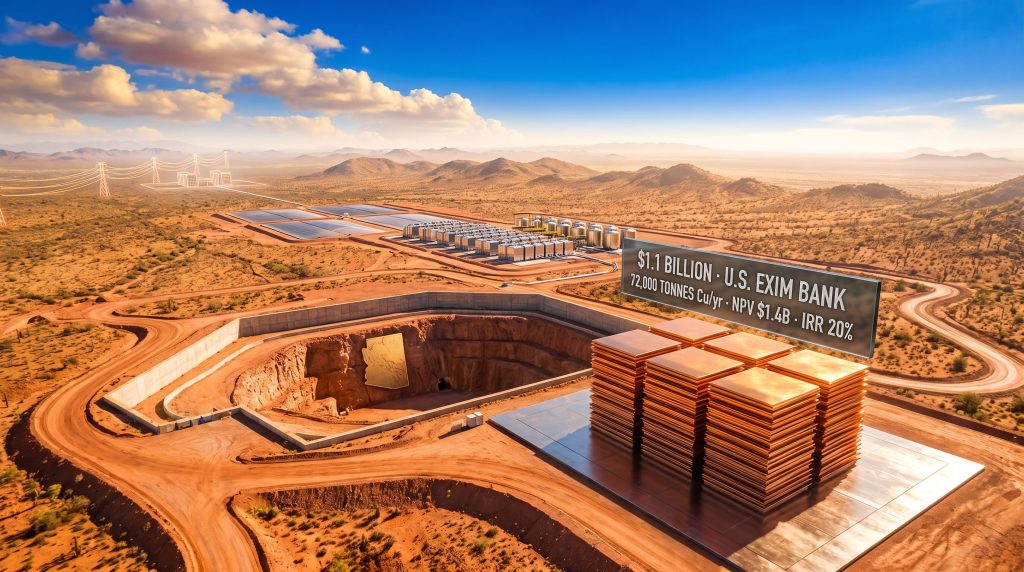
The U.S. Export-Import Bank (EXIM) issued a letter in August 2026 indicating potential debt financing of up to $1.1 billion for the Santa Cruz project. This represented a 33% increase from the earlier April 2025 letter of interest, which had outlined up to $825 million. The upgrade is significant because it reflects the completion of EXIM's preliminary due diligence phase, meaning the bank has moved beyond an initial expression of interest into a more substantive credit assessment process.
It is critical to understand what this letter is and what it is not. A letter indicating potential financing is not a binding loan commitment. Final EXIM approval requires completion of full due diligence, environmental review, and satisfaction of all credit conditions.
Investors should carefully distinguish between indicative financing letters and executed debt facilities. The $1.1 billion figure represents an important milestone in the financing process, but it does not constitute a guarantee that this amount will ultimately be drawn or approved in its entirety.
The $200 Million Bridge Facility
To bridge the gap between current construction activity and the eventual closing of the long-term EXIM-led facility, Ivanhoe Electric's subsidiary Mesa Cobre Holding Corporation closed a $200 million senior secured multi-draw bridge facility. The syndicate behind this facility was led by National Bank of Canada, BMO Capital Markets, and Société Générale, with a two-year maturity term. The facility is secured against project-related assets and is designed specifically to fund major construction milestones in 2026 while the broader debt package is finalised.
This bridge-to-permanent financing structure is a well-established pattern in large-scale project finance. It allows construction activity to commence and de-risk the project operationally, which in turn strengthens the borrower's negotiating position when finalising the long-term facility terms.
Financing Timeline Summary
| Milestone | Date | Amount | Institution |
|---|---|---|---|
| Initial EXIM Letter of Interest | April 2025 | Up to $825M | U.S. Export-Import Bank |
| Bridge Facility Closed | 2026 | $200M | National Bank of Canada, BMO, Société Générale |
| Updated EXIM Letter (Post-Due Diligence) | August 2026 | Up to $1.1B | U.S. Export-Import Bank |
| Full Debt Facility (Target) | TBD | ~$1.1B | U.S. EXIM + Syndicate |
Project Economics: What the Numbers Actually Mean
The 2025 Preliminary Feasibility Study produced the following headline economics for Santa Cruz:
- After-tax NPV: $1.4 billion at a $4.25 per pound copper price assumption
- Internal Rate of Return (IRR): 20%
- Cash Operating Costs: $1.32 per pound of copper
- Initial Capital Expenditure: $1.24 billion
- Projected Annual Output: 72,000 tonnes of copper during the first 15 years
- Total Mine Life: 23 years
A 20% after-tax IRR at $4.25 per pound copper is considered attractive for large-scale greenfield development, where hurdle rates in the mining sector typically sit between 15% and 20% depending on jurisdiction and commodity risk. The cash operating cost of $1.32 per pound positions Santa Cruz in the lower half of the global copper cost curve, which provides meaningful downside protection in weaker price environments.
What is particularly worth noting is the operating cost structure relative to the copper price assumption. At $4.25 per pound, the project generates substantial operating margins. If copper prices sustain above $4.50 per pound, the fixed-cost nature of the operation means incremental revenue flows almost entirely to free cash flow generation. Consequently, the relatively high initial capital cost means that project viability is sensitive to financing terms, which is precisely why the Ivanhoe Santa Cruz copper project loan structure and its associated tenor and interest rate profile are so important to the ultimate economics.
Export credit agency financing, such as the EXIM Bank's support for Santa Cruz, typically carries lower interest rates, extended repayment tenors, and more flexible covenant structures than commercial project finance alone. For a greenfield copper project of this scale, such financing can reduce the weighted average cost of capital by several hundred basis points, materially improving NPV outcomes and making the project bankable in circumstances where pure commercial financing might prove insufficient.
Construction Progress and Development Roadmap
Physical site activity at Santa Cruz is already underway. Crews have commenced road clearing, perimeter fencing installation, and portal excavation preparation. Box-cut construction is expected to follow shortly, setting the stage for underground access development.
Projected Development Schedule
| Phase | Target Date |
|---|---|
| TBM Arrival and Assembly | H1 2027 |
| Decline Drive Commencement | Mid-2027 |
| Copper Reserve Reached Underground | Mid-2028 |
| First Ore on Leach Pads | H2 2028 |
| First Copper Cathode Production | H1 2029 |
| Peak Annual Production (72,000t Cu) | Within first 15 years of operation |
Surface infrastructure development, including the crushing plant, leaching facilities, and cathode plant, will proceed in parallel with underground development rather than sequentially, which compresses the overall construction timeline.
Permitting Status
Permits Already Secured:
- Mine-land reclamation
- Air quality
- Dust control
- Aquifer protection
- Land-use permits for initial works
Permits Still Required:
- Surface construction approvals
- Full production operating permits
The permitting risk profile at Santa Cruz is partially de-risked by the permits already in hand, which allow current site preparation activities to proceed legally. However, surface construction permits and production operating approvals remain outstanding and represent a genuine execution risk that investors should monitor as the project advances.
The next major ASX story will hit our subscribers first
Key Risks Worth Understanding Before Assessing This Project
No large-scale greenfield mining project is without meaningful risk, and Santa Cruz is no exception. Several risk categories deserve specific attention:
Permitting Timeline Risk: While initial permits are secured, production-level approvals remain pending. Delays in obtaining these could push back first production beyond the H1 2029 target.
EXIM Loan Finalisation Risk: The $1.1 billion is an indicated amount from a preliminary due diligence letter, not a signed loan agreement. Full credit approval involves additional environmental review, legal documentation, and credit committee processes that could take considerable time.
TBM Execution Risk: Using a tunnel boring machine for mine access is not universal practice in underground copper mining. TBM operations require specialised expertise, and ground conditions can affect machine performance and advance rates in ways that alter cost and schedule assumptions.
Copper Price Sensitivity: The project's after-tax NPV of $1.4 billion is calculated at $4.25 per pound. Copper is a cyclical commodity, and sustained price weakness below the project's cost assumptions would erode returns and potentially affect the debt facility's financial covenants.
Capital Cost Overrun Risk: The September 2026 PFS update incorporating TBM methodology may revise the $1.24 billion capital estimate. Historical mining project development suggests that capital costs commonly exceed initial feasibility estimates, particularly for technically novel approaches.
What Santa Cruz Signals for U.S. Mining Finance More Broadly
The Ivanhoe Santa Cruz copper project loan process is being watched closely across the mining finance community because of the precedent it sets. If EXIM successfully closes a facility of this scale for a domestic greenfield copper mine, it would demonstrate a viable template for financing other critical mineral projects that have historically struggled to attract competitive long-term debt.
In addition, the U.S. copper supply landscape is shifting significantly, with tariff pressures further reinforcing the strategic case for projects like Santa Cruz that can deliver finished cathode without reliance on foreign smelting infrastructure. The underlying demand drivers — electrification, AI infrastructure, and advanced manufacturing — are structural rather than cyclical in nature.
For investors exploring the broader opportunity set, a range of copper investment strategies are worth considering alongside project-specific exposure, particularly as the domestic production landscape evolves. Furthermore, the future of copper mining points increasingly toward technologically advanced, hydrometallurgical operations of precisely the kind Santa Cruz represents.
For context on where Santa Cruz sits within the U.S. copper landscape, Canadian Mining Journal has been tracking the financing and development developments closely, and their reporting at canadianminingjournal.com offers additional industry perspective for readers seeking complementary analysis of U.S. mining finance trends and critical minerals development activity.
This article contains forward-looking statements regarding project timelines, financial metrics, and financing outcomes. All economic figures cited are drawn from the 2025 Preliminary Feasibility Study and are subject to revision. The EXIM Bank financing remains indicative and subject to full credit approval. This article does not constitute financial or investment advice.
Want to Capitalise on Major Mineral Discoveries Before the Broader Market Does?
Discovery Alert's proprietary Discovery IQ model delivers real-time alerts on significant ASX mineral discoveries, transforming complex mineral data into actionable insights for investors at every experience level — explore the historic returns major discoveries have generated and begin your 14-day free trial today to secure a genuine market-leading edge.