August 21, 2026
When One Mine Can Move Markets: Understanding Copper's Supply Fragility
The global copper market has long operated under a quiet but growing tension: demand is accelerating at a pace that existing supply infrastructure was never designed to meet, while the concentration of high-grade production capacity in a handful of geologically exceptional deposits means that a single operational failure can ripple across industries worldwide. That tension has sharpened considerably in 2026, as flooding at one of the planet's most important copper operations forces a reassessment of just how resilient the global supply chain actually is.
The situation at the Kamoa-Kakula copper complex in the Democratic Republic of Congo offers a rare and instructive case study in how underground mining risk, equatorial hydrology, and macro commodity dynamics intersect. For investors and industrial buyers tracking the Zijin copper target under pressure after Congo mine flood, the implications extend well beyond one company's annual production figures.
When big ASX news breaks, our subscribers know first
What Makes Kamoa-Kakula Structurally Irreplaceable
Not all copper mines are created equal. The global copper industry distinguishes between deposits on the basis of grade, scale, and metallurgical complexity, and by most measures Kamoa-Kakula sits in a category shared by very few operations on Earth. Indeed, when considering the largest copper mines globally, this complex stands apart in terms of both grade and strategic importance.
The deposit is hosted within the Central African Copperbelt, a geological formation that extends across the DRC and Zambia and contains some of the highest copper concentrations found anywhere in the world. What separates Kamoa-Kakula from most other large-scale copper operations is the combination of exceptional ore grade and enormous reserve base. High-grade copper deposits of this scale are exceptionally rare; most of the world's copper comes from large, low-grade porphyry deposits, particularly in South America, where ore grades of 0.5% to 0.8% copper are considered commercially viable.
The Copperbelt's sediment-hosted stratiform copper deposits, by contrast, can carry grades several multiples higher than porphyry systems. This grade advantage translates directly into lower unit production costs, higher concentrator recoveries, and more predictable metallurgical performance. It also means that disruptions at Kamoa-Kakula cannot easily be offset by ramping up production elsewhere, because comparable grade and scale simply do not exist in available spare capacity globally.
"The concentration of irreplaceable, high-grade copper production capacity in a single equatorial region creates a structural vulnerability that the industry has not yet adequately priced into long-term supply planning."
The Mechanics Behind the Flooding Event
How Underground Dewatering Systems Work and Why They Fail
Underground copper mines in high-rainfall regions depend on sophisticated dewatering infrastructure to manage groundwater ingress and surface water infiltration. In equatorial environments like the DRC, annual rainfall can exceed 1,500 millimetres in some zones, creating persistent hydrological pressure on underground workings.
Dewatering systems typically involve a network of sump pumps, drainage channels, and electrical distribution infrastructure that operates continuously to keep mine voids dry enough for safe working. The critical dependency here is electrical power: without functioning electrical systems, pumps cannot operate, and water accumulates rapidly in underground excavations.
At Kamoa-Kakula, damage to underground electrical and pumping infrastructure appears to have been the initiating failure that allowed water ingress to overwhelm the mine's dewatering capacity. This type of cascading failure — where electrical damage disables pumping, which then enables flooding, which then causes further electrical damage — is one of the most technically challenging scenarios an underground mine operator can face. Each phase of the cascade compounds the difficulty of the next recovery step.
The situation was further complicated by the fact that flooding followed earlier seismic activity, meaning that underground infrastructure was already stressed before water became the primary operational challenge.
Timeline of Compounding Disruptions
| Event | Period | Operational Impact |
|---|---|---|
| Seismic activity disruption | 2025 | Initial production suspension |
| Flooding of underground workings | 2025 to 2026 | Extended ramp-down and guidance cuts |
| Dewatering and restart phase | Ongoing (2026) | Partial recovery, output still constrained |
The sequential nature of these events is significant. A single isolated disruption might allow for a relatively straightforward recovery trajectory. Sequential disruptions, however, prevent the operational and logistical reset that mines depend on to rebuild momentum. Equipment that was being rehabilitated after seismic damage was then exposed to flooding conditions, effectively resetting recovery timelines.
Quantifying the Production Shortfall
From Guidance to Reality: The Output Gap at Mine Level
The scale of the production loss at Kamoa-Kakula is substantial by any measure. When expressed in absolute tonnage terms and compared against global annual copper supply of approximately 22 to 23 million tons, the figures become even more telling. Furthermore, the global copper supply gap was already a concern before this disruption emerged.
| Metric | Original Guidance | Revised Guidance | Implied Loss |
|---|---|---|---|
| Kamoa-Kakula 2025 production | 520,000 to 580,000 t | 370,000 to 420,000 t | ~100,000 to 210,000 t |
| Kamoa-Kakula 2026 production | 380,000 to 420,000 t | 290,000 to 330,000 t | ~50,000 to 130,000 t |
| Zijin attributable loss (2026) | N/A | Up to 57,000 t | Meaningful consolidated impact |
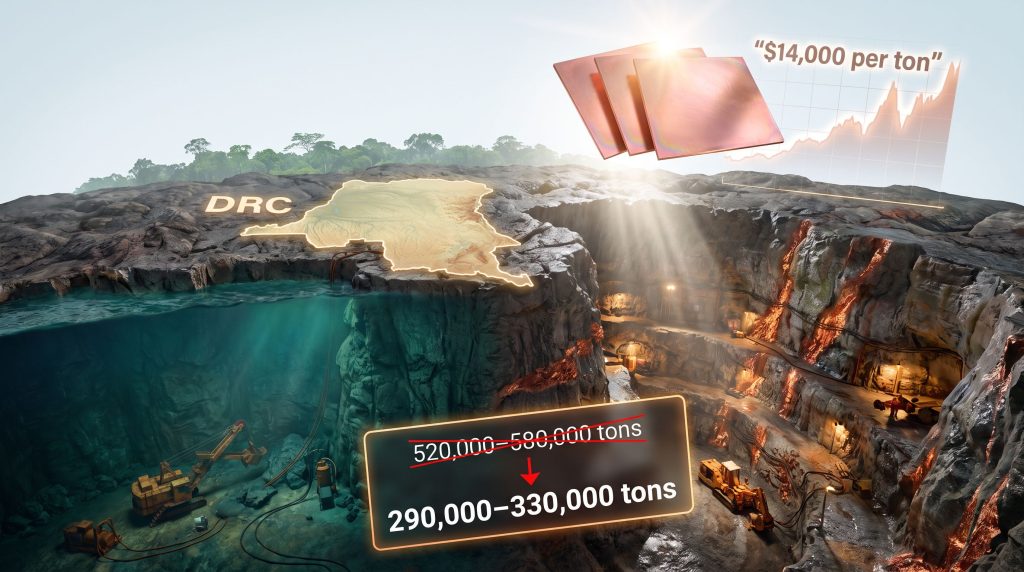
Ivanhoe Mines, one of the project's key partners, revised its 2026 production guidance for the complex down to a range of 290,000 to 330,000 tons from the earlier forecast of 380,000 to 420,000 tons. Zijin Mining, holding just over 44% of the Kamoa-Kakula complex, disclosed an attributable output reduction of up to 57,000 tons in 2026, with earlier disclosures indicating attributable losses of 44,000 to 93,000 tons across the 2025 disruption period.
Zijin has set a full-year mined copper production target of 1.2 million tons across all its global operations for 2026. The Kamoa-Kakula shortfall, while partially absorbed by its broader portfolio spanning China, Serbia, and other DRC assets, nonetheless places measurable pressure on achieving that consolidated figure.
"Even at the lower bound of disclosed attributable losses, the Kamoa-Kakula disruption represents a non-trivial drag on Zijin's global copper output at a moment when copper prices are approaching record territory."
Why Copper Markets Are So Sensitive to This Disruption
Price Structure and the Supply Risk Premium
Copper's return above $14,000 per ton in 2026, near record highs reached earlier in the year, reflects a market that has been pricing in both a structural demand upgrade and heightened supply uncertainty. These two forces are now operating simultaneously, creating a pricing environment that is acutely responsive to news flow from major producing operations. The copper supply crunch that analysts have long forecast is, consequently, no longer a distant scenario.
The dual demand drivers amplifying this sensitivity are well understood but worth restating in terms of their scale:
- Electrification programmes across North America, Europe, and Asia are generating sustained multi-decade demand for copper wire, cable, and transformers as power grids are expanded and modernised.
- AI data centre infrastructure is emerging as a significant incremental copper demand source, given the copper intensity of power distribution systems, cooling infrastructure, and high-density cabling within large-scale computing facilities.
- Electric vehicle manufacturing continues to consume copper at rates several multiples higher per unit than conventional internal combustion vehicles.
When demand growth of this magnitude meets supply disruptions at tier-one operations, markets price in a risk premium that can persist well beyond the immediate operational recovery period, because the structural deficit thesis does not disappear with a single mine restart.
The Lead Time Problem and Why Existing Mines Cannot Be Replaced
A critical but often underappreciated dimension of the Zijin copper target under pressure after Congo mine flood is what it reveals about the replaceability of existing world-class copper operations. The development timeline for a new copper mine — from discovery through feasibility, permitting, construction, and commissioning to full production — typically spans 10 to 20 years. In some jurisdictions and geological settings, that timeline extends further.
This means that no new greenfield copper project currently in the pipeline can compensate for multi-year production losses at an operating tier-one asset. For instance, even a major new copper project of the scale being developed in Pakistan remains years away from meaningful production volumes. The global copper supply balance through the late 2020s and into the 2030s depends critically on existing operations performing at or near their design capacity.
Comparing This Disruption to Historical Supply Shocks
A Framework for Evaluating Mine-Level Risk
Not all mine disruptions carry the same market implications. The relevant variables for assessing impact include:
- Magnitude: How much of global annual supply does the affected asset represent?
- Duration: Is this a weeks-long event or a multi-year ramp-down scenario?
- Replaceability: Can other producers absorb the shortfall through inventory drawdowns or idle capacity activation?
- Price transmission speed: How quickly do mine-level disruptions flow through to spot and futures markets?
| Disruption Type | Typical Duration | Market Price Impact | Recovery Complexity |
|---|---|---|---|
| Labour strike (single mine) | Weeks to months | Moderate | Low |
| Natural disaster or flooding | Months to years | High | High |
| Seismic event | Variable | Moderate to high | Medium to high |
| Geopolitical suspension | Indefinite | Very high | Very high |
The Kamoa-Kakula situation most closely resembles the natural disaster and flooding category, but with an additional layer of complexity arising from the prior seismic event. Sequential disruptions of different types are considerably more difficult to recover from than isolated single-cause events, because each phase damages the infrastructure being relied upon for the next phase of recovery.
The next major ASX story will hit our subscribers first
Downstream Consequences for Copper-Dependent Industries
Industrial Buyers and the Inventory Management Challenge
Copper fabricators, cable manufacturers, and industrial buyers rely on a combination of long-term supply contracts, spot purchases, and London Metal Exchange inventory drawdowns to manage input price volatility and availability risk. The LME copper inventory system functions as a global buffer during supply disruptions, but that buffer has limits.
When a mine of Kamoa-Kakula's scale suffers a multi-year ramp-down, the cumulative production loss can exceed the absorptive capacity of exchange inventories, particularly when global demand is simultaneously growing. In this environment, industrial buyers face a difficult choice between accepting higher spot prices and forward contracting at elevated rates, either of which increases input costs and compresses margins across downstream manufacturing sectors.
Renewable energy project developers and grid infrastructure contractors are particularly exposed, given that copper is a primary bill-of-materials component in transformers, underground cabling, and generation equipment. Extended periods of elevated copper pricing can alter project economics in ways that introduce delays or scope reductions, creating second-order consequences for electrification timelines.
The DRC's Dual Identity: Indispensable Resource, Complex Environment
Geophysical and Operational Risk in an Equatorial Mining Jurisdiction
The DRC occupies a contradictory position in global mining: it holds some of the world's most valuable mineral resources, yet the operating environment presents challenges that are genuinely difficult to mitigate. Infrastructure deficits in power grid reliability, road and rail logistics, and water management systems create compounding operational dependencies that do not exist to the same degree in more developed mining jurisdictions.
The interaction between equatorial climate patterns and underground mining is a particularly underappreciated risk factor. Annual rainfall variability in the DRC's Copperbelt region can be significant, and the volume of water management required to keep large-scale underground operations viable during wet seasons is substantial. When pumping infrastructure is compromised — whether through seismic damage, electrical failure, or equipment failure — the speed at which underground workings can flood far exceeds the capacity to respond.
For Zijin Mining, Zijin's global strategy spans multiple assets across the DRC in addition to its Kamoa-Kakula interest, meaning the concentration of exposure to this single operating environment represents a risk factor that investors and analysts are increasingly scrutinising. Its broader geographic diversification across Serbia and China provides some counterweight, but the DRC remains a central pillar of the company's copper production ambitions.
Restart Scenarios and What to Watch
Dewatering as the Critical Path Variable
The engineering process of dewatering a flooded underground copper mine involves systematically pumping accumulated water from the lowest accessible levels upward through the mine workings. This process is not simply a matter of running pumps; it requires staging temporary pumping infrastructure as permanent systems are assessed and repaired, managing the structural integrity of mine voids that may have been compromised by prolonged water exposure, and rehabilitating electrical distribution systems that often sustain damage both from initial events and from extended submersion.
Underground electrical system rehabilitation is typically the longest-lead-time element of mine restarts following flooding events, because high-voltage infrastructure requires methodical testing and certification before it can be safely energised. This creates a sequential constraint on the recovery timeline that cannot easily be accelerated.
Analysts are currently working across three broad scenarios for production recovery at Kamoa-Kakula:
- Base case: Partial restart achieved in the second half of 2026, with a gradual production ramp through 2027 as underground sections are progressively returned to operation.
- Upside case: Faster-than-expected dewatering and electrical rehabilitation enable earlier output recovery, partially offsetting 2026 guidance losses and bringing 2027 production closer to originally planned trajectories.
- Downside case: Ongoing infrastructure rehabilitation challenges, potentially compounded by additional rainfall events during the wet season, push meaningful production recovery into 2027 or 2028.
"The pace of electrical infrastructure reinstatement will be the most important determinant of whether 2026 production losses settle at the lower or upper end of the disclosed guidance range. Additional wet season rainfall represents the principal downside risk to the base case timeline."
Frequently Asked Questions: Kamoa-Kakula Flood and Copper Supply Impact
What caused the flooding at Kamoa-Kakula?
Damage to underground electrical and pumping infrastructure compromised the mine's dewatering capacity, allowing water ingress to flood underground workings. This followed an earlier period of operational disruption caused by seismic activity, creating a compounding sequence of events.
How much copper production has been lost?
At the mine level, 2025 guidance was reduced from 520,000 to 580,000 tons to 370,000 to 420,000 tons. For 2026, guidance was revised to 290,000 to 330,000 tons from an earlier forecast of 380,000 to 420,000 tons. Zijin's attributable loss for 2026 is disclosed at up to 57,000 tons.
Why does this disruption matter for global copper prices?
Kamoa-Kakula is among the world's highest-grade large-scale copper operations. Prolonged disruptions at mines of this calibre tighten global supply expectations precisely when demand is being driven higher by electrification programmes and AI infrastructure buildout, amplifying price sensitivity.
How long will the operational disruption last?
Recovery timelines depend primarily on dewatering progress and electrical infrastructure rehabilitation. The base case anticipates a gradual ramp-up through the second half of 2026 into 2027, though downside scenarios extend meaningful recovery further into 2027 or 2028.
What is Zijin Mining's total copper production target for 2026?
Zijin has set a full-year mined copper production target of 1.2 million tons across its global operations, though the Zijin copper target under pressure after Congo mine flood places measurable pressure on achieving this consolidated figure.
Key Structural Takeaways for Investors and Industry Observers
- The Kamoa-Kakula disruption is not merely an operational inconvenience; it is a stress test of assumptions about the reliability of high-grade copper supply through the critical electrification decade.
- Sequential disruptions of different types — seismic followed by hydrological — are demonstrably more difficult to recover from than single-cause events and should be treated as a distinct risk category in operational resilience assessments.
- The 10 to 20 year lead time for new copper mine development means that no greenfield project can compensate for multi-year production losses at an existing tier-one operation, making the preservation of existing asset productivity a strategic priority.
- Copper's sustained trading near record price levels reflects a market that has already incorporated significant supply risk premium, and further disruptions at major operations could accelerate price discovery toward new historical highs.
- For investors evaluating major copper producers, country concentration risk in the DRC deserves more prominent weighting in risk frameworks — not because the DRC is uniquely problematic, but because its geology, climate, and infrastructure profile create a distinctive combination of operational dependencies that are difficult to fully hedge.
This article contains forward-looking statements and analyst scenario projections that involve inherent uncertainty. Production guidance figures and price references reflect information available as of the time of publication and are subject to change. This content is intended for informational purposes only and does not constitute financial or investment advice. Readers should conduct independent due diligence before making any investment decisions.
For ongoing coverage of global copper supply dynamics and DRC mining operations, Mining Weekly provides continuous reporting on major copper operations, production guidance updates, and commodity market analysis.
Want to Track the Next Major Copper Discovery Before the Market Does?
Discovery Alert's proprietary Discovery IQ model scans ASX announcements in real time, instantly identifying significant mineral discoveries — including copper — and delivering actionable alerts to subscribers ahead of the broader market. Explore Discovery Alert's dedicated discoveries page to see how historic ASX mineral discoveries have generated substantial returns, and begin your 14-day free trial today to position yourself at the forefront of the next major find.