August 21, 2026
The Invisible Copper Sitting Inside Yesterday's Mines
Across the world's most productive copper-mining regions, a counterintuitive reality is taking shape. The next meaningful source of refined copper may not come from a freshly blasted open pit or a multi-billion-dollar greenfield development deep in the Andes. It may come from water — specifically, the chemically complex, mineral-laden water left behind by mines that stopped producing decades ago. This is where BHP and SiTration copper recovery technology Arizona is beginning to rewrite the rules.
This is not a fringe hypothesis. It reflects a fundamental tension building inside the global copper supply chain: demand is accelerating faster than new mine capacity can be permitted, built, and brought online. The International Energy Agency has projected that copper demand could nearly double by 2040, driven by electrification, grid infrastructure, and EV manufacturing. Furthermore, the global copper supply gap continues to widen as aging mines struggle to meet growing industrial needs.
At the same time, the average timeline from discovery to first production at a greenfield copper mine routinely stretches between 16 and 20 years. The arithmetic is uncomfortable for anyone relying solely on conventional supply pathways.
Against this backdrop, the collaboration between BHP and SiTration on copper recovery technology in Arizona represents something more than a single pilot programme. It signals a structural shift in how the industry is beginning to think about legacy assets — not as closed liabilities, but as potential production sources hiding in plain sight.
When big ASX news breaks, our subscribers know first
The Globe-Miami District: A Century of Copper, and What Was Left Behind
Arizona's Globe-Miami mining district occupies a geologically privileged position within North America's copper landscape. The district sits within the Basin and Range geological province, where large-scale porphyry copper systems formed through the intrusion of magmatic bodies that concentrated copper sulphide mineralisation across vast volumes of rock. This geology underpins some of the most historically significant copper production on the continent, with continuous mining activity stretching back to the early twentieth century.
The Copper Cities site within this district operated as an open pit copper mine from 1954 to 1975, with heap leaching activities continuing until 1982. What remained after operations ceased was not simply inert rock. Legacy heap leach pads, pit walls, and waste material continue to interact with rainfall and groundwater through a process called secondary leaching — where residual copper minerals slowly dissolve into percolating water over years and decades.
This phenomenon, known within metallurgical circles as acid mine drainage or, in more controlled contexts, residual leach seepage, creates a stream of dilute copper-bearing water that conventional processing circuits were never designed to handle economically. The copper concentrations are too low for standard solvent extraction and electrowinning (SX-EW) plants, but they are measurable, continuous, and — with the right technology — potentially recoverable.
The Globe-Miami district's porphyry copper geology means that even after primary mining ceases, copper mineralisation continues to mobilise into water systems for extended periods. This is not a short-term phenomenon — it can persist for generations, creating both an environmental management obligation and, increasingly, a recoverable resource.
How SiTration's Electro-Extraction Technology Actually Works
The Problem With Conventional Hydrometallurgy at Low Grades
Standard SX-EW circuits, which dominate copper hydrometallurgical processing globally, function by first concentrating copper ions from a leach solution into an organic solvent phase, then stripping that copper into a purified electrolyte before electrodepositing it as cathode copper. The process is highly effective — but it has a critical sensitivity to feedstock quality.
When copper concentrations in solution fall below economically meaningful thresholds, or when the chemistry is complicated by co-dissolved iron, manganese, arsenic, or other metals commonly found in legacy mine water, the SX-EW circuit's efficiency degrades sharply. Reagent consumption rises, emulsion problems intensify, and product purity becomes harder to control. Consequently, many legacy water streams have historically been pumped to evaporation ponds or managed as a cost rather than processed as an asset.
Understanding the copper leaching process and its limitations helps contextualise precisely why SiTration's approach represents such a meaningful departure from conventional methods.
SiTration's Electro-Extraction Mechanism: A Fundamentally Different Approach
SiTration, an MIT spin-out company with investment backing from BHP Ventures, has developed an electro-extraction and advanced filtration system specifically architected for these difficult feedstocks. Rather than relying on chemical reagents to selectively transfer copper between phases, the technology applies an electrochemical driving force directly to the dilute solution, using specialised filtration membranes to isolate and recover copper ions with high selectivity.
Key operational characteristics of the SiTration system include:
- No chemical reagent inputs — the process does not require organic solvents, acids for stripping, or pH adjustment chemicals at scale
- No new waste stream generation — a significant departure from SX-EW, which produces raffinate streams and spent reagent requiring disposal
- Compatibility with dilute, chemically complex feedstocks — purpose-designed for the types of water streams conventional circuits cannot process economically
- Modular deployment architecture — equipment is designed to be installed, operated, and relocated without the fixed civil infrastructure requirements of a conventional processing plant
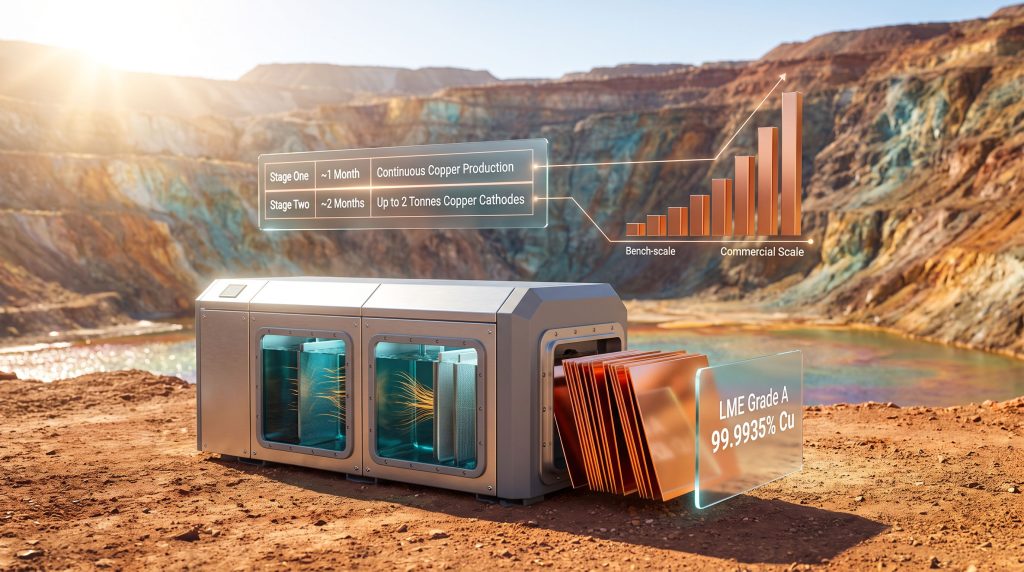
- LME Grade A copper output — bench-scale testing using actual Copper Cities feedstock has already demonstrated production at the highest purity standard recognised by the London Metal Exchange, requiring a minimum copper content of 99.9935%
Why LME Grade A matters: Copper cathode must meet this specification to be tradeable on global commodity markets without penalty or further refining. Achieving it directly from a dilute legacy water feedstock at bench scale is technically significant — most intermediate recovery processes yield blister copper or lower-purity forms requiring additional processing steps before they reach market.
The technology's MIT research heritage means its foundational intellectual property draws on electrochemical engineering principles developed within one of the world's leading materials science environments. BHP Ventures' decision to back the company reflects the strategic logic of investing early in technologies capable of unlocking value from assets that major miners already own but cannot currently monetise.
The Two-Stage Arizona Pilot: Structure, Objectives, and Targets
The Copper Cities pilot is structured as a deliberate, evidence-building progression rather than a single large-scale deployment. This phased architecture reflects a Technology Readiness Level (TRL) advancement strategy designed to de-risk each step before committing to larger capital expenditure.
| Pilot Stage | Timeline | Duration | Primary Target | Key Evaluation Criteria |
|---|---|---|---|---|
| Stage One | August 2026 | ~1 month | Continuous copper production | Uptime, autonomy, throughput consistency, product quality |
| Stage Two | Later 2026 | ~2 months | Up to 2 tonnes copper cathodes | Commercial-scale performance, scalability indicators |
Stage One commenced in August 2026 and focuses on establishing that the SiTration system can operate continuously and autonomously in a real-world field environment. The emphasis on autonomous operation is deliberate — legacy sites by definition lack the workforce infrastructure of an active mine. A technology that requires constant on-site supervision is commercially less attractive than one capable of running with minimal intervention.
Stage Two scales the ambition considerably. Targeting production of up to two tonnes of commercial-scale copper cathodes over approximately two months, this phase will generate the operational dataset needed to assess whether the technology can perform at a level that justifies broader deployment across BHP's Legacy Assets portfolio — and potentially at other sites operated by third parties.
BHP's General Manager of Legacy Assets has characterised the pilot as an opportunity to generate technical and operational insights extending well beyond this single site, reinforcing that the programme is positioned as a scalable knowledge-building exercise with implications across multiple geographies and asset types. (Global Mining Market, August 2026)
Legacy Asset Economics: Why the Financial Logic Is Compelling
The Hidden Cost Structure of Post-Operational Sites
What makes brownfield copper recovery from impacted water streams financially interesting is the cost structure comparison against conventional alternatives. Operators of legacy mine sites face an ongoing obligation to manage residual water — whether through evaporation ponds, water treatment facilities, or regulated discharge pathways. These are costs that must be incurred regardless of whether any copper is recovered.
SiTration's approach inverts this equation. If a water treatment obligation already exists, deploying copper recovery technology transforms a mandatory cost centre into a potential revenue stream. The incremental capital cost is structurally lower than building a standalone processing plant, and the permitting pathway at an already-operating legacy site is typically less complex than at a greenfield development.
This economic framing matters for how investors evaluate the technology. The relevant comparison is not simply the cost of recovering copper versus the copper price — it is the cost of recovery relative to the water management cost that would be incurred anyway. In addition, copper investment strategies that incorporate brownfield recovery assets may offer more resilient risk-adjusted returns than purely greenfield-focused approaches.
Greenfield vs Brownfield: A Timeline Comparison
- Greenfield copper mine: Discovery to production typically 16 to 20 years; full permitting, environmental impact assessment, feasibility studies, financing, construction
- Brownfield legacy recovery: Existing infrastructure footprint, established environmental baseline, no new land disturbance, reduced community consultation requirements
- Regulatory complexity: Legacy sites operating within existing approved footprints generally face fewer novel permitting hurdles than new mine developments
Technology Comparison: SiTration vs Conventional SX-EW
| Attribute | Conventional SX-EW | SiTration Electro-Extraction |
|---|---|---|
| Optimal feedstock grade | Moderate-to-high concentration leach solutions | Dilute, chemically complex streams |
| Chemical inputs required | Organic solvents, stripping acids | None reported |
| Waste streams generated | Raffinate, spent reagent | No new waste streams reported |
| Product quality | LME Grade A (achievable) | LME Grade A (demonstrated at bench scale) |
| Infrastructure requirements | Large fixed civil works | Modular, potentially mobile |
| Legacy site applicability | Limited by grade thresholds | Purpose-designed for this application |
| Autonomy capability | Requires operational workforce | Designed for autonomous operation |
The modularity dimension deserves particular attention. Conventional hydrometallurgical plants require significant civil works — concrete foundations, piping networks, reagent storage, power infrastructure — that are economically justifiable only above certain throughput thresholds. A modular, relocatable extraction unit changes this calculus entirely, enabling deployment at sites too small or too dispersed to warrant fixed plant construction.
For junior miners and mid-tier operators managing legacy portfolios without the balance sheet of a major, this distinction could be the difference between an asset that generates ongoing cost and one that generates intermittent revenue.
The next major ASX story will hit our subscribers first
The Broader Industry Implication: Redefining What a Mine Asset Is
Stranded Copper in Legacy Water: The Scale of the Opportunity
The Copper Cities pilot is one data point within a much larger potential opportunity. Across Arizona alone, hundreds of legacy mine sites contain varying concentrations of mining-impacted water. Scale this to major copper-producing regions globally — Chile's Atacama, Peru's central highlands, Australia's Olympic Dam region, Zambia's Copperbelt — and the aggregate volume of dilute copper-bearing water being managed as a liability rather than a resource is substantial.
No reliable global aggregate figure exists for the total copper value contained in legacy mine water streams, which is itself telling. The resource has not been systematically quantified because, until recently, no cost-effective recovery pathway existed. SiTration's technology, if validated at commercial scale, would create both the economic incentive and the technical mechanism to begin that quantification process. The future of copper mining may depend heavily on precisely this kind of innovation unlocking value from assets previously considered exhausted.
Water Stewardship as a Dual-Purpose Outcome
An underappreciated dimension of the BHP and SiTration copper recovery technology programme is its environmental co-benefit. Mining-impacted water that is left untreated or inadequately managed represents a regulatory and reputational risk for legacy site operators. Copper, along with co-dissolved heavy metals, can affect surrounding groundwater and surface water systems.
A technology that recovers copper while simultaneously reducing the metal load in managed water streams achieves two objectives simultaneously: it generates commercial value and improves the environmental compliance profile of the site. For large mining companies operating under increasing ESG scrutiny, this dual-purpose outcome has strategic value beyond the copper tonnes recovered.
However, addressing the underlying copper supply crunch will require more than individual pilot programmes — it demands a systematic rethinking of how the industry classifies and manages post-operational assets at scale.
Treating mining-impacted water as a recoverable resource rather than a disposal problem reframes the entire economic and regulatory logic of legacy site management. This perspective shift could prove as important as the technology itself.
Frequently Asked Questions: BHP, SiTration, and Arizona Copper Recovery
What is SiTration and where did the technology originate?
SiTration is an MIT spin-out company that has developed an electro-extraction and advanced filtration system for recovering copper and other critical metals from dilute and chemically complex water streams. The company has received investment from BHP Ventures as part of BHP's strategic engagement with emerging extraction technologies.
What is the Copper Cities site?
Copper Cities is a historic open pit copper mine in Arizona's Globe-Miami district. It operated from 1954 to 1975, with heap leach activity continuing until 1982. The site is now managed within BHP's Legacy Assets portfolio and provides the feedstock water for the SiTration pilot.
What copper purity does the SiTration process achieve?
Bench-scale testing using Copper Cities feedstock has demonstrated production of LME Grade A copper, which requires a minimum purity of 99.9935% and represents the highest standard of refined copper traded on global commodity markets.
Does the process use chemicals or create additional waste?
Based on reported characteristics, the SiTration system operates without chemical reagent inputs and does not generate new waste streams, distinguishing it from conventional SX-EW processing circuits that rely heavily on organic solvents and stripping acids.
What is the production target for the Arizona pilot?
The second stage of the pilot, planned for later in 2026, is targeting production of up to two tonnes of commercial-scale copper cathodes over approximately two months of operation.
Key Takeaways: What the BHP-SiTration Pilot Signals for Copper Supply
- Brownfield copper recovery from legacy water is emerging as a structurally distinct category within the copper supply landscape, enabled by electrochemical technologies that conventional hydrometallurgy cannot replicate
- The cost logic is asymmetric and favourable: where water management obligations already exist, copper recovery adds revenue potential at lower incremental capital cost than standalone plant construction
- LME Grade A output from dilute feedstocks at bench scale is a technically meaningful result that differentiates SiTration's approach from lower-purity intermediate recovery methods
- Autonomous operation capability is not merely a convenience feature — it is a commercial necessity for deploying technology across dispersed, understaffed legacy sites
- The Arizona pilot's two-stage structure reflects disciplined technology de-risking, generating the evidence base needed to justify broader deployment decisions
- The environmental and commercial objectives align, creating an unusual situation where copper recovery simultaneously improves regulatory compliance and generates asset value
Disclaimer: This article contains forward-looking statements and projections regarding pilot programme outcomes, technology performance, and market trends. These involve inherent uncertainties and should not be construed as financial advice. Readers should conduct independent research before making any investment decisions. Pilot results referenced reflect bench-scale testing outcomes and field-stage results remain subject to operational validation.
Want to Spot the Next Major Copper Discovery Before the Market Does?
Discovery Alert's proprietary Discovery IQ model scans ASX announcements in real time, instantly identifying significant mineral discoveries — including copper — and delivering actionable alerts to subscribers before the broader market has time to react. Explore how historic discoveries have generated extraordinary returns on Discovery Alert's dedicated discoveries page, and begin your 14-day free trial today to position yourself ahead of the next major find.