August 21, 2026
The Hidden Complexity Behind Copper-Zinc-Silver Processing Plants
Polymetallic sulphide deposits are among the most technically demanding ore types in the base metals industry. Unlike single-commodity operations where the processing circuit is relatively linear, copper-zinc-silver systems require a precisely choreographed sequence of liberation, separation, and concentration steps — each one calibrated to the specific mineralogical fingerprint of the ore body in question. Get any stage wrong, and the downstream consequences compound rapidly: poor liberation leads to locked particles in flotation; over-grinding wastes energy and creates slimes that suppress recovery; reagent imbalances cause one metal's minerals to contaminate another's concentrate stream.
It is within this technical context that the Metso Yitirrti processing equipment package awarded to Develop Global's Pilbara project deserves close examination. This is not simply a procurement announcement — it is a window into how a modern polymetallic concentrator is engineered from first principles, and what each equipment choice reveals about the ore body, the project economics, and the operational philosophy underpinning a 1.5 million tonne per annum processing operation.
When big ASX news breaks, our subscribers know first
Understanding the Yitirrti Project and Its Mineralogical Challenge
A Polymetallic Deposit in One of Australia's Most Productive Geological Provinces
Develop Global's Yitirrti project sits within the Pilbara region of Western Australia, a geological terrain best known historically for its iron ore wealth but increasingly recognised for its base metals endowment. The project targets a copper-zinc-silver ore body — a combination that places it firmly within the category of volcanogenic massive sulphide (VMS) style mineralisation, one of the most economically significant ore deposit types globally.
The three payable metals at Yitirrti are not simply co-located — they are mineralogically intertwined in ways that create both opportunity and challenge:
- Copper typically occurs as chalcopyrite (CuFeS₂), a sulphide mineral with well-understood flotation chemistry
- Zinc occurs primarily as sphalerite (ZnS), which is notoriously difficult to separate from chalcopyrite because both respond similarly to many flotation reagents
- Silver is commonly distributed as fine inclusions within copper sulphide minerals, meaning it reports naturally to the copper concentrate stream as a payable by-product — but its recovery depends entirely on copper flotation efficiency
This mineralogical architecture means that selective separation — recovering copper and zinc into separate, saleable concentrate streams — requires a carefully staged flotation circuit with precise pH control, selective depressant chemistry, and tight particle size management throughout.
Why 1.5 Mtpa Throughput Is a Critical Design Threshold
The Yitirrti concentrator is designed to process 1.5 million tonnes of ore per annum. This throughput figure sits at a scale where individual equipment sizing decisions carry significant financial consequences. A 1% improvement in overall metal recovery across a 1.5 Mtpa copper-zinc operation can translate into millions of dollars in additional annual revenue, depending on prevailing metal prices. Conversely, systematic equipment underperformance at this scale compounds into material earnings shortfalls across the project's operating life.
Equipment selection at the 1.5 Mtpa scale is not merely a technical exercise — it is a financial decision with decade-long consequences. Every percentage point of recovery improvement or loss is amplified across the full ore throughput volume for the life of mine.
The Metso Equipment Order: Structure, Scope, and Commercial Significance
How the Procurement Was Structured
The equipment order was placed by GR Engineering Services on behalf of project owner Develop Global. GR Engineering is a Perth-based minerals processing engineering firm with an established track record in Australian concentrator delivery. Its role here is as the engineering, procurement, and construction management (EPCM) contractor — responsible for translating the project's process design into physical equipment specifications and managing supplier relationships.
This procurement model is standard for mid-tier Australian mining projects:
- The project owner (Develop Global) appoints an EPCM firm (GR Engineering Services)
- The EPCM firm manages equipment specifications, supplier tendering, and procurement
- The original equipment manufacturer (Metso) receives the commercial order through this structure
- Metso books the order within its Minerals segment Q2 2026 orders received
The Q2 2026 booking confirmation is significant because it establishes the commercial transaction as formally concluded during the April-to-June 2026 period, locking in delivery timelines, pricing, and manufacturing schedules. Furthermore, Metso's announcement of this contract confirms the full scope of the equipment package to be delivered to site.
What Single-Vendor Supply Means in Practice
Sourcing the majority of a concentrator's core equipment from a single OEM like Metso offers operational advantages that extend well beyond initial procurement convenience:
- Simplified spare parts management: A unified parts inventory across multiple equipment types reduces warehousing complexity and working capital tied up in spares
- Consolidated technical support: One vendor relationship covers training, commissioning assistance, and warranty claims across the full equipment suite
- Reduced interface risk: Equipment from the same manufacturer is engineered with compatible design standards, reducing the risk of integration problems during commissioning
- Performance guarantee clarity: When recovery or throughput targets are not met, attributing responsibility is more straightforward with a single-vendor package
The copper leaching process innovations Metso has developed in recent years further illustrate how the company's integrated approach to mineral processing technology benefits project owners seeking cohesive circuit solutions.
Inside the Concentrator: A Stage-by-Stage Equipment Analysis
Primary Crushing — Nordberg C Series Jaw Crusher
The first physical transformation of run-of-mine ore occurs at the jaw crusher. The Nordberg C Series platform applies compressive force between a fixed jaw plate and a moving jaw driven by an eccentric shaft, fracturing ore along natural grain boundaries and crystal interfaces. For high-grade polymetallic sulphide ores — which can be both competent (hard) and abrasive due to their sulphide mineral content — the C Series is engineered for high mechanical availability and extended liner service life.
The critical performance metric at this stage is not just throughput but consistency of product size distribution. Irregular primary crusher output causes downstream surging in the secondary crushing and grinding circuits, which destabilises flotation feed conditions — one of the most common, and costly, operational problems in concentrator plants.
Secondary and Tertiary Crushing — Nordberg HP450e Cone Crushers
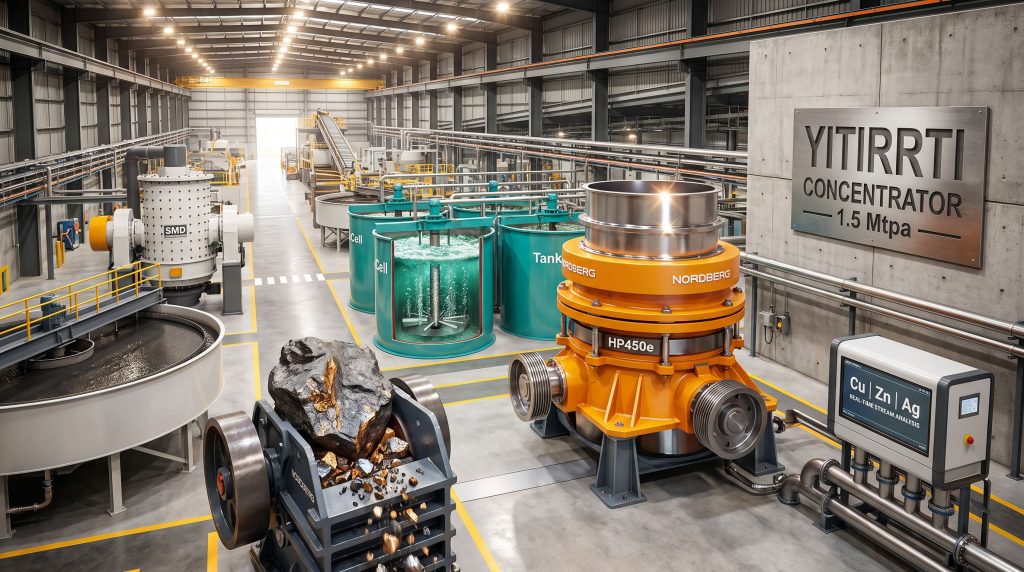
The HP450e cone crushers take the primary crushed product and progressively reduce it toward the target feed size for the grinding circuit. The HP Series is built around a steep crushing chamber angle and high eccentric throw, which together deliver a high reduction ratio and a tightly distributed product size.
In a typical closed-circuit configuration, the cone crusher operates in combination with a vibrating screen. Oversize material is recirculated back to the crusher until it passes the screen aperture — ensuring that the grinding circuit receives a consistent, well-sized feed. This matters enormously for energy efficiency: grinding is the most energy-intensive stage in the entire concentrator, and reducing the work imposed on the mill by delivering a tightly controlled feed size directly reduces power consumption per tonne processed.
Industry data from the International Energy Agency indicates that grinding circuits in minerals processing facilities account for approximately 3-4% of global electricity consumption. At operations running 1.5 Mtpa, optimising the crush-to-grind interface can represent hundreds of thousands of dollars in annual power cost savings.
For copper-zinc-silver circuits, the target grinding mill feed size from the crushing circuit is typically in the 10-25mm range (F80), calibrated to the downstream grinding circuit's design capacity and the ore's specific work index.
Controlled Feed Delivery — Apron Feeder
The apron feeder is one of the least glamorous but most practically important pieces of equipment in the circuit. Its function is deceptively simple: deliver a steady, metered flow of crushed ore from the feed stockpile or surge bin to the grinding mill at a controlled, consistent rate.
Unlike belt feeders, apron feeders use interlocking steel pans mounted on a heavy-duty chain, making them capable of handling sharp, coarse, high-bulk-density materials without the belt damage that would rapidly occur under those conditions. In a polymetallic sulphide operation, where feed material can include hard, angular rock fragments with abrasive pyrite content, this design robustness is not a luxury — it is a practical necessity.
Consistent feed rate to the grinding mill is a foundational requirement for stable concentrator operation. Feed rate variability propagates through every downstream circuit: mill load fluctuates, cyclone feed density shifts, flotation feed grade becomes erratic, and reagent dosing falls out of optimisation. Preventing that chain reaction starts with the apron feeder.
Flotation — TankCell Flotation Cells
The TankCell flotation cells are the commercial heart of the Yitirrti concentrator — the point where mineralogical value is captured and separated from waste gangue. Flotation works by exploiting the difference in surface hydrophobicity between target sulphide minerals and gangue minerals. Reagents called collectors are added to selectively coat the surfaces of copper and zinc sulphide minerals, making them water-repellent. Air is then injected into the cell, and hydrophobic mineral particles attach to rising air bubbles, floating to the froth layer where they are recovered.
The TankCell design features a large cylindrical tank geometry that promotes uniform air distribution and optimal slurry residence time across the full cell volume. This is particularly important at the rougher flotation stage, where the objective is maximum recovery of payable minerals — any mineral grain that passes through the rougher circuit without floating is largely unrecoverable.
The copper-zinc separation challenge adds a layer of complexity not present in single-metal circuits:
- Copper flotation first: Under natural or mildly acidic pH conditions, chalcopyrite floats readily while sphalerite is depressed using zinc sulphate and sodium cyanide or similar depressants
- Zinc activation: After copper is removed, the pH is raised and copper sulphate is added to activate sphalerite surfaces, enabling zinc flotation
- Silver co-recovery: Fine silver inclusions within chalcopyrite report to the copper concentrate naturally — but maximising silver recovery requires optimal copper flotation efficiency, because any copper lost to tailings takes associated silver with it
| Flotation Stage | Target Mineral | Key Reagents | pH Range |
|---|---|---|---|
| Copper Rougher | Chalcopyrite (Cu) | Xanthate collector, frother | 7.5-9.0 |
| Zinc Depressant Stage | Sphalerite (Zn) depressed | Zinc sulphate, sodium cyanide | 8.5-10.0 |
| Zinc Activation | Sphalerite (Zn) | Copper sulphate activator | 10.0-11.5 |
| Cleaner Flotation | Both Cu and Zn | pH modifiers, selective collectors | Variable |
Fine Grinding — Stirred Media Detritor (SMD) Regrind Mills
One of the most technically sophisticated elements of the Metso Yitirrti processing equipment package is the inclusion of Stirred Media Detritor regrind mills. The SMD operates on a fundamentally different principle to conventional ball mills: instead of tumbling a heavy charge of steel balls inside a rotating drum, the SMD uses a rotating agitator to stir fine ceramic or steel grinding media at high intensity within a stationary vessel.
This distinction matters enormously at fine particle sizes. Conventional ball mills become progressively less energy-efficient as target grind size falls below approximately 75 microns (P80) — the energy input per unit of size reduction increases sharply. Stirred mills, by contrast, maintain high grinding efficiency at particle sizes down to 20 microns or finer, making them the technology of choice for regrinding applications across modern base metals operations.
At Yitirrti, SMD regrind mills are applied to intermediate flotation products — typically the rougher concentrate — before cleaner flotation stages. The rationale is mineralogical:
- In complex polymetallic sulphide ores, copper and zinc mineral grains are frequently intergrown at fine scales, meaning that primary grinding to 75-100 microns leaves a significant proportion of grains still locked together
- Regrinding the rougher concentrate to sub-40 micron particle sizes liberates these locked grains, enabling the cleaner flotation circuit to produce a higher-grade, lower-contamination final concentrate
- Improved cleaner concentrate grade directly affects smelter payability — smelters apply penalty charges for contaminants like zinc in copper concentrate, or copper in zinc concentrate
A lesser-known dynamic in polymetallic concentrate marketing is that smelter penalty thresholds for penalty elements can fundamentally alter the economic value of a concentrate, sometimes by more than the metal price itself. A zinc concentrate with elevated copper content, for example, may face penalties that wipe out the economic benefit of that copper being present. Regrind mills are therefore not just a metallurgical tool — they are a revenue protection mechanism.
Dewatering — Thickeners
Thickeners perform solid-liquid separation across two critical streams: concentrate products and tailings. For concentrates, thickening increases pulp density before pressure filtration and loading for shipment, reducing moisture content and transport costs. For tailings, thickening recovers process water for recirculation back into the circuit.
Water recovery through thickening carries particular strategic weight in the Pilbara region. Western Australia's inland water resources are finite, and processing operations at scale face genuine constraints on fresh water access. A well-designed thickening circuit can recycle 60-80% of process water back into the concentrator, dramatically reducing fresh water demand and the associated operational and environmental costs of water procurement.
Real-Time Process Intelligence — Slurry Analyzers
The inclusion of online slurry analyzers in the Metso Yitirrti processing equipment package represents a meaningful commitment to data-driven process control. These instruments — typically based on X-ray fluorescence (XRF) spectroscopy — continuously measure the elemental composition of slurry streams at key circuit points without requiring sample collection, preparation, or laboratory analysis.
In a polymetallic circuit where three separate payable metal streams must be simultaneously optimised, the value of real-time grade data cannot be overstated:
- Flotation feed grade monitoring enables proactive reagent dosing adjustments before circuit performance degrades
- Concentrate grade tracking confirms that final products meet contract specification before shipment, avoiding costly reblending or rejection
- Tailings grade surveillance provides early warning of recovery losses, triggering immediate process interventions
- Mass balance verification in real time allows metallurgical accounting to be conducted with much greater precision than laboratory turnaround times permit
Historically, concentrator operators relied on laboratory assay results with turnarounds of several hours — meaning that a flotation circuit could run sub-optimally for an entire shift before corrective action was taken. Online slurry analyzers compress that feedback loop to minutes, making them one of the highest-return technology investments available in modern concentrator design. In addition, check sampling methods remain an important complement to online analysis for verifying data integrity across the circuit.
Benchmarking the Circuit Against Industry Practice
| Circuit Element | Yitirrti (Metso Package) | Typical Industry Approach | Notes |
|---|---|---|---|
| Primary Crushing | Nordberg C Series Jaw | Jaw or gyratory (scale-dependent) | Appropriate for 1.5 Mtpa; gyratories typically favoured above ~5 Mtpa |
| Secondary Crushing | HP450e Cone | Cone or HPGR | HPGR gaining traction for hard ores; HP Series remains widely trusted |
| Fine Grinding | SMD Regrind Mills | IsaMill or SMD | Both are stirred mill technologies; SMD standard in Metso-supplied circuits |
| Flotation | TankCell | Tank cells or column cells | Columns preferred in cleaner duties; TankCells versatile across rougher and cleaner |
| Process Control | Online Slurry Analyzers | Online XRF or laboratory assay | Online analysis now considered best practice at new greenfield projects |
| Dewatering | Thickeners | Thickeners plus pressure filtration | Pressure filtration commonly added downstream of thickeners for dry stack tailings |
What the Equipment Order Signals About Project Maturity
In the mining project development lifecycle, the placement of a major equipment order covering the full concentrator circuit from primary crushing through to process monitoring is a definitive signal of project advancement. Equipment orders of this breadth and complexity are placed during one of two phases: late in the definitive feasibility study execution phase, or following a positive Final Investment Decision (FID) as the project enters early construction.
Either interpretation positions Yitirrti as having moved well beyond desktop engineering and into committed capital deployment. For investors and industry observers tracking Develop Global's project pipeline, this procurement milestone carries more informational weight than a project update announcement might suggest on the surface.
Lead times for major processing equipment reinforce this reading. Large flotation cells, thickeners, and cone crushers typically carry manufacturing and delivery lead times of 12 to 24 months from order placement to site arrival. An order booked in Q2 2026 therefore targets site delivery in the mid-to-late 2027 window, aligning with concentrator commissioning timelines for a project that began civil and structural construction in 2026 or early 2027.
Early equipment procurement also serves as a capital cost management tool. By locking in pricing at order placement, Develop Global insulates the project from inflationary pressure in steel, copper wiring, and specialised manufacturing inputs — all of which have demonstrated significant volatility over recent years. Furthermore, interpreting drill results from the Yitirrti resource base underpins the ore characterisation data that feeds directly into equipment sizing and circuit design decisions.
The next major ASX story will hit our subscribers first
Metso's Position in Australia's Growing Base Metals Equipment Market
Metso's minerals processing portfolio spans crushing, grinding, flotation, filtration, and process analytics — giving the company the rare capability to supply a near-complete concentrator circuit from a single vendor relationship. Following the 2023 demerger that separated its flow control division (now Valmet) from its minerals processing operations, Metso operates as a focused minerals processing technology company.
In Australia's base metals project pipeline, Metso competes primarily with FLSmidth, Weir Minerals, and Sandvik for major processing plant contracts. The Yitirrti equipment award demonstrates competitive strength in the mid-tier project segment, where the ability to offer integrated circuit solutions is increasingly valued over component-by-component tendering from multiple suppliers.
Australia's base metals development pipeline has deepened considerably over the 2024-2026 period, driven by sustained copper demand from electrification infrastructure and zinc's critical role in galvanised steel for construction and renewable energy applications. For equipment suppliers like Metso, this pipeline represents a sustained order book opportunity extending well into the 2030s.
Frequently Asked Questions
What metals does Yitirrti produce?
The Yitirrti project processes a copper-zinc-silver polymetallic ore body in Western Australia's Pilbara region. The concentrator is designed to produce separate copper and zinc concentrate streams, with silver recovering as a payable by-product within the copper concentrate.
What is the Yitirrti plant's processing capacity?
The concentrator is designed for a throughput of 1.5 million tonnes of ore per annum (Mtpa), placing it in the mid-scale range for Australian base metals processing operations.
Who placed the Metso equipment order?
GR Engineering Services placed the order on behalf of Develop Global. GR Engineering is acting as the engineering firm responsible for plant design and procurement on the project.
Why are SMD regrind mills used instead of conventional ball mills for regrinding?
Stirred Media Detritors are significantly more energy-efficient than conventional ball mills at fine particle sizes below approximately 75 microns. For polymetallic sulphide circuits where locked mineral intergrowths require ultra-fine liberation, SMDs achieve the necessary grind size at substantially lower energy cost per tonne, while also producing a tighter particle size distribution that benefits downstream flotation selectivity.
When was the Metso order formally booked?
Metso confirmed the order was recorded in its Minerals segment Q2 2026 orders received, confirming the commercial transaction was finalised during the April to June 2026 period.
Disclaimer: This article contains forward-looking statements regarding project timelines, equipment delivery schedules, and operational outcomes. These projections involve assumptions and uncertainties, and actual outcomes may differ materially from those described. This content is provided for informational purposes only and does not constitute financial or investment advice. Readers should conduct their own independent research and consult qualified advisers before making investment decisions.
Want to Catch the Next Major Base Metals Discovery Before the Market Does?
Discovery Alert's proprietary Discovery IQ model scans ASX announcements in real time, instantly identifying significant mineral discoveries across copper, zinc, silver, and more than 30 other commodities — transforming complex data into clear, actionable opportunities for investors at every experience level. Explore why historic mineral discoveries have delivered extraordinary returns and begin your 14-day free trial today to position yourself ahead of the broader market.