August 21, 2026
The Invisible Copper Mine Hidden in Plain Sight
The global mining industry has long operated on a forward-looking premise: find new deposits, secure permits, build infrastructure, and extract value from the earth. Yet one of the most compelling copper supply opportunities in North America requires none of those steps. It already exists, already contains dissolved copper in measurable concentrations, and already sits within reach of processing infrastructure. The challenge is not geological discovery but technological conversion — and copper recovery from legacy mine water is rapidly becoming central to that conversation.
Legacy mine water, the acidic, metal-laden drainage that accumulates in and around historic mining operations, has been treated as an environmental problem for decades. Containment, treatment, and discharge have collectively consumed billions of dollars across the American Southwest alone. That framing, however, is beginning to shift. What was once a liability column entry is being reconsidered as a recoverable asset, one that could contribute meaningfully to domestic copper supply without a single metre of new drilling.
When big ASX news breaks, our subscribers know first
Why Legacy Mine Water Deserves a Second Look
Historic copper mining districts across Arizona and the broader American Southwest left behind more than a century of extraction infrastructure and a formidable environmental footprint. What is less widely appreciated is that the same ore bodies responsible for those legacy environmental conditions also left behind substantial concentrations of dissolved copper in associated water bodies, pit lakes, and acid mine drainage systems.
The Chemistry Behind the Opportunity
The chemistry behind this is not complex. When sulfide minerals, particularly chalcopyrite and its relatives, are exposed to oxygen and water following the cessation of active mining, a slow but continuous oxidation reaction occurs. This process, sometimes assisted by naturally occurring bacteria such as Acidithiobacillus ferrooxidans, generates sulfuric acid that dissolves copper from the surrounding rock matrix. The result is a persistent, self-replenishing supply of copper-bearing water that can persist for generations after mining activity has stopped.
Copper concentrations in acid mine drainage (AMD) can range from 0.1 grams per litre to as high as 5 grams per litre depending on the host rock composition, depth, and the extent of prior oxidation. At the upper end of that range, these solutions become economically interesting, particularly when the recovery technology eliminates the reagent costs and waste disposal obligations that burden conventional hydrometallurgy.
The Copper Cities Site: Understanding the Scale of the Opportunity
Few legacy sites illustrate the intersection of historical significance and modern recovery potential better than the Copper Cities deposit in Arizona's historic Globe-Miami mining district. The site produced approximately 400,000 tonnes of copper between the 1950s and 1980s, making it one of the more productive operations in a region that defined American copper output for much of the twentieth century.
Sites with that kind of production legacy generate persistent dissolved copper loads in their associated water bodies for reasons that go beyond simple leaching. Decades of ore processing left behind partially oxidised sulfide material in tailings, waste dumps, and pit walls, all of which continue to contribute soluble copper to drainage water. The longer a site has been inactive, the more thoroughly oxidised the near-surface material becomes, and in many cases, the more consistent the dissolved copper concentration in the resulting drainage.
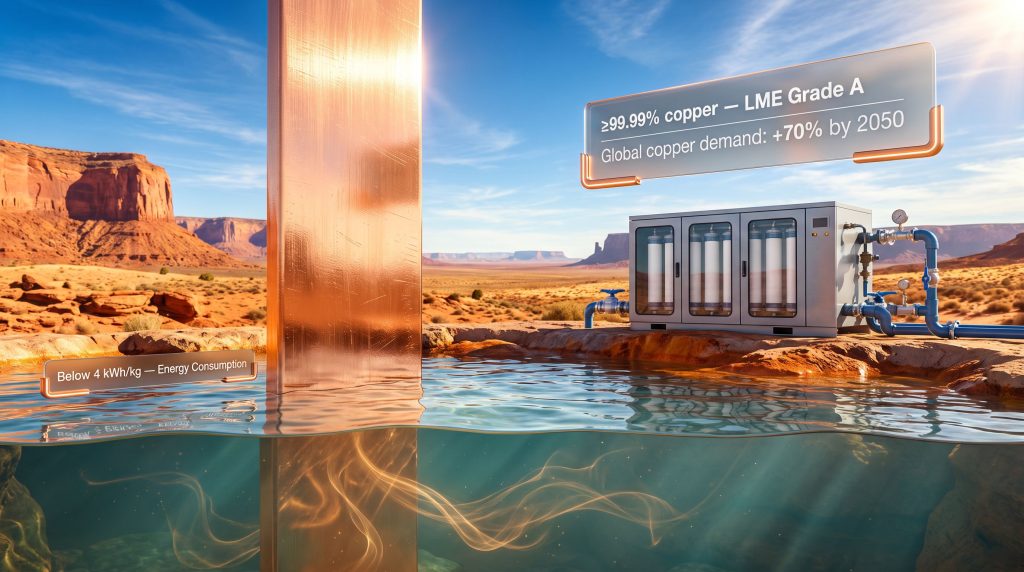
Furthermore, the broader copper supply crunch facing global markets makes legacy site recovery even more strategically compelling. The American Southwest is estimated to contain billions of dollars' worth of copper locked within legacy mining water, a figure that becomes increasingly relevant as global copper demand is projected to grow by approximately 70% by 2050, according to publicly available long-range supply forecasts.
It is this intersection of existing dissolved resource and projected demand growth that is drawing serious technical and commercial attention to legacy site recovery as a supply pathway.
Electrochemical Filtration: How the Technology Actually Works
Among the various approaches being applied to copper recovery from legacy mine water, electrochemical membrane filtration represents perhaps the most significant departure from conventional processing. Unlike solvent extraction and electrowinning (SX-EW), which requires organic solvents and multiple processing stages, or cementation on iron, which generates iron sludge byproducts, electrochemical membrane systems operate without any chemical reagents whatsoever.
Step-by-Step Process Breakdown
The operating principle is based on electrokinetic separation: an applied electrical potential drives the selective migration of positively charged copper ions through a specialised ion-exchange membrane, where they are reduced and deposited directly onto a cathode surface as metallic copper. The step-by-step process works as follows:
- Feedstock intake — Legacy mine water is drawn from the site water body or drainage collection system.
- Pre-screening — Suspended solids and gross particulate matter are removed to protect membrane integrity and maintain consistent process performance.
- Electrochemical separation — An applied electrical field drives selective copper ion migration through the specialised membrane, leaving other dissolved species behind.
- Cathodic deposition — Copper ions are reduced at the cathode surface and deposited as metallic copper with high purity.
- Cathode harvesting — Deposited copper is stripped from the cathode and processed into commercial copper cathode product meeting London Metal Exchange Grade A specifications.
- Treated water discharge or reuse — The treated effluent, from which copper has been selectively removed, can be reused on-site or discharged in compliance with applicable regulatory standards.
Bench-scale testing using real Copper Cities site feedstock has already demonstrated the production of LME Grade A copper through this process, without chemical inputs and without generating new waste streams. Preliminary energy consumption data places the process below 4 kWh per kilogram of recovered copper, a figure that is competitive with conventional primary copper production benchmarks. For a broader perspective, BHP and an MIT spinout are trialling comparable copper recovery technology at a historic Arizona mine, reinforcing the commercial momentum behind this approach.
Technology Comparison: How Recovery Methods Stack Up
Not all legacy mine water recovery projects will favour electrochemical approaches. Feedstock chemistry, site geography, available infrastructure, and project scale all influence technology selection. The table below summarises the key characteristics of the principal methods currently applied or under development for copper recovery from mine water.
| Technology | Chemical Input | Waste Generated | Output Quality | Key Advantage |
|---|---|---|---|---|
| SX-EW | Yes (organic solvents) | Moderate | LME Grade A | Proven at scale |
| Cementation on Iron | Minimal | Iron sludge | Lower purity | Low capital cost |
| Ion Exchange Resins | Regenerant chemicals | Brine waste | High purity | Selectivity |
| Electrochemical Membrane | None | Minimal | LME Grade A | Zero reagents |
| Precipitation/Neutralisation | Lime or alkali | Metal hydroxide sludge | Concentrate | pH versatility |
| Bio-based/Bioleaching | None | Negligible | Moderate | Low input cost |
In addition, the copper leaching process continues to evolve rapidly, with newer configurations offering improved selectivity and reduced environmental impact across a range of legacy site conditions.
Pilot Structure and Commercial Pathway
The pilot programme at Copper Cities is structured in two distinct phases, reflecting a disciplined approach to technical validation before commercial commitment. The initial phase, beginning in August 2026, involves a small-scale continuous production run over one month, focused on validating autonomous operation under real site conditions.
The second phase, planned for later in 2026, targets the production of up to two tonnes of commercial-grade copper cathodes over a two-month period. This phased structure is significant from an investment risk perspective. Rather than committing to large capital expenditure before process performance is validated at the target site, the two-phase approach allows technical and operational parameters to be refined incrementally.
Autonomous operation capability is a particularly important variable at remote legacy sites, where staffing costs and logistical complexity can significantly erode project economics if continuous human supervision is required.
The next major ASX story will hit our subscribers first
The Economics of Recovery: Where the Numbers Get Interesting
The economic case for copper recovery from legacy mine water is built on several compounding advantages that distinguish it from both primary mining and conventional secondary recovery.
| Economic Factor | Favourable Conditions | Risk Factors |
|---|---|---|
| Input costs | Zero chemical reagents (select technologies) | Energy cost sensitivity |
| Copper price | Strong long-term demand outlook | Short-term price volatility |
| Environmental position | Remediation credit potential | Legacy liability complexity |
| Feedstock | Existing dissolved copper resource | Concentration variability |
| Capital requirements | Modular, scalable deployment | Commercial-scale proof still emerging |
| Water recovery | Up to 99.8% reclaim adds dual revenue | Discharge permitting requirements |
Cost estimates for advanced electrochemical recovery systems suggest potential production costs as low as $0.25 per pound of copper at sufficient scale, though this figure is highly sensitive to feedstock concentration and throughput volume. Conventional primary copper production typically sits in the range of $1.50 to $2.50 per pound for most operating mines globally.
This suggests that legacy water recovery, when successfully scaled, could genuinely compete at the lower end of the global cost curve. The dual-value proposition is also worth noting: because advanced recovery systems can achieve water recovery rates of up to 99.8%, the treated effluent itself represents a secondary output with potential value in water-scarce regions like Arizona, where water rights carry significant economic weight.
Environmental Remediation as a Revenue Strategy
One of the most underappreciated dimensions of legacy mine water recovery is the extent to which it reframes the relationship between environmental compliance and commercial activity. Under the conventional model, mine water treatment is a pure cost centre. Operators neutralise acid drainage, remove metals through precipitation, and dispose of the resulting sludge, generating no revenue and accumulating ongoing liability.
Aligning Profit with Environmental Performance
Recovery-oriented approaches invert that logic entirely. By treating dissolved copper as a product rather than a contaminant to be sequestered, operators simultaneously reduce the environmental loading of discharge water and generate commercially saleable metal. The more copper removed from the water, the better the environmental outcome and the greater the revenue generated.
This structural alignment between environmental performance and commercial return is what separates legacy mine water recovery from most other forms of environmental remediation. It creates an incentive architecture where the most profitable operating mode and the most environmentally responsible operating mode are the same thing.
Regulatory frameworks governing acid mine drainage treatment in the United States, including Clean Water Act provisions and state-level discharge standards, already require many legacy site operators to treat mine water before discharge. The in-situ leaching benefits observed at comparable projects further underscore how recovery-oriented treatment can satisfy compliance obligations whilst simultaneously generating commercial value.
Recovery technology that meets those discharge standards whilst extracting commercial value does not require new regulatory frameworks to operate. It simply needs to satisfy existing discharge quality requirements, with the copper extraction being an integrated step within that compliance process. Moreover, the rehabilitation of copper mine sites provides an additional framework within which recovery projects can be positioned as a net positive environmental outcome.
Where Legacy Mine Water Recovery Fits in the Broader Copper Supply Landscape
Placing legacy mine water recovery within the wider spectrum of copper supply pathways reveals its distinctive competitive position, particularly on the dimensions of lead time and environmental footprint.
| Supply Source | Lead Time to Production | Environmental Footprint | Scalability |
|---|---|---|---|
| Greenfield primary mining | 10–20 years | High | High (eventually) |
| Brownfield mine expansion | 5–10 years | Moderate | Moderate |
| Legacy mine water recovery | 1–3 years (pilot to commercial) | Low | Moderate |
| Copper recycling (scrap) | Immediate | Low | High |
| Deep-sea nodule extraction | 10+ years | Unknown | Speculative |
The compressed development timeline of legacy site recovery, potentially as short as one to three years from pilot validation to commercial deployment, is arguably its most strategically significant attribute. In a supply environment where greenfield copper projects routinely take two decades from discovery to production, the ability to bring new domestic copper supply online within a single investment cycle is genuinely differentiated.
Consequently, those exploring copper investment opportunities would do well to consider legacy site recovery as a legitimate emerging supply category within a diversified portfolio approach.
Frequently Asked Questions: Copper Recovery from Legacy Mine Water
What grade of copper can be produced from legacy mine water?
Advanced electrochemical recovery processes have demonstrated the ability to produce London Metal Exchange Grade A copper, a purity level of 99.99%, directly from dilute legacy mine water feedstock without intermediate smelting or refining steps.
Does electrochemical membrane recovery require chemical inputs?
Systems based on electrochemical membrane separation operate entirely without chemical reagents. This distinguishes them from conventional solvent extraction methods and eliminates the reagent procurement, handling, and waste disposal costs associated with those approaches.
How much energy does it take to recover copper from mine water?
Bench-scale testing at the Copper Cities site has recorded energy consumption below 4 kWh per kilogram of recovered copper, which is competitive with conventional copper production energy benchmarks.
What happens to the water after copper is removed?
Advanced systems can achieve water recovery rates of up to 99.8%, meaning treated effluent can be reused on-site or safely discharged, adding a secondary value stream to the process.
Can recovery projects satisfy environmental compliance obligations simultaneously?
Where existing regulatory frameworks already require mine water treatment before discharge, electrochemical recovery systems that meet discharge quality standards can satisfy compliance obligations as an integrated function of the commercial recovery process.
What Successful Validation Would Mean for the Industry
If the Copper Cities pilots demonstrate commercial-scale viability, the implications extend well beyond a single site in Arizona. The Globe-Miami district is one of dozens of analogous legacy copper mining districts across the American Southwest, and historic copper mining regions exist across the globe, from the Atacama to the Iberian Pyrite Belt to the copper belts of Central Africa.
Each of those regions contains legacy water bodies with dissolved copper loads that have never been systematically quantified as recoverable resources. A successful commercial-scale validation in Arizona would establish the technical and economic template for replication across those analogous environments, potentially adding a new recognised category to the global secondary copper supply landscape.
The pathway from pilot validation to commercial deployment across multiple legacy sites would likely require modular, standardised plant designs capable of being configured to site-specific feedstock chemistry. The autonomous operation capability being tested at Copper Cities is central to that scalability thesis. However, if the technology can run continuously at a remote legacy site without permanent staffing, the logistical barriers to multi-site deployment fall substantially.
The future of copper mining increasingly hinges on the ability to extract value from previously overlooked resources, and legacy mine water represents one of the most accessible and least capital-intensive of those opportunities available today.
Readers seeking additional coverage of emerging mineral recovery technologies and copper market developments can explore ongoing technical and industry reporting available through Mining Weekly at miningweekly.com.
This article contains forward-looking statements and projections regarding copper demand, recovery economics, and technology performance. These represent estimates based on publicly available data and pilot-stage results. Actual outcomes may differ materially. Nothing in this article constitutes financial or investment advice.
Want to Stay Ahead of the Next Major Copper Discovery?
Discovery Alert's proprietary Discovery IQ model scans ASX announcements in real time, delivering instant alerts on significant copper and mineral discoveries so investors can act before the broader market catches on — explore historic discovery returns on the Discovery Alert discoveries page to see what early positioning can mean, then begin your 14-day free trial to secure your market-leading edge.