July 27, 2026
The Quiet Shift Turning Copper and Nickel Into the Oil of the 21st Century
For most of the past century, metals like copper and nickel were evaluated almost exclusively through the lens of industrial economics: supply, demand, and price cycles. That analytical framework is rapidly becoming obsolete. The forces now driving these materials into a new era are not cyclical fluctuations but structural transformations in how the world generates, stores, and distributes energy. The convergence of electrification policy, geopolitical supply anxiety, and industrial reshoring has quietly elevated Vale Base Metals cobre e níquel minerais críticos from procurement considerations into questions of national strategy.
Understanding what this shift means for producers, investors, and the broader mining sector requires stepping back from short-term price movements and examining the deeper architecture of a global economy in transition.
When big ASX news breaks, our subscribers know first
Why Copper and Nickel Have Become Geopolitical Assets
The energy transition is not simply an environmental programme. It is a complete rewiring of industrial civilisation, and copper sits at the centre of almost every circuit involved. Global copper demand is projected to grow by approximately 50% by 2040, driven by the simultaneous electrification of transportation, power generation, and digital infrastructure. Electric vehicles require nearly three times more copper than conventional combustion engine automobiles, creating an unprecedented structural demand signal that persists regardless of short-term economic conditions.
The digital infrastructure angle is less discussed but equally significant. United States data centres are on a trajectory to consume between 5% and 14% of total national electricity demand by 2030, a near-tripling of their current footprint. Every megawatt of additional data centre capacity requires copper-intensive electrical infrastructure from generation through to delivery. This is a demand driver that barely existed a decade ago and is now scaling at exponential rates.
Nickel presents an equally compelling structural narrative. Total global nickel demand is forecast to expand by approximately 42% over the next decade, but the most strategically important growth is concentrated in the high-purity, high-value segment, where demand is projected to increase by 29%. This is the segment directly linked to lithium-ion battery manufacturing, where Class I nickel, produced primarily from sulphide ore deposits, commands the premium pricing and supply security that battery manufacturers urgently require. Furthermore, the battery metals investment landscape continues to evolve rapidly as policy commitments solidify across major economies.
The demand for these minerals is not cyclical in the traditional sense. It is structural, policy-driven, and accelerating. Nations and companies that secure reliable access to copper and nickel supply chains will hold a foundational advantage in the next phase of industrial development.
What has changed most profoundly is the geopolitical framing. Western economies spent decades benefiting from abundant, competitively priced mineral supply without examining the concentration of production and processing capacity. That era is ending. Supply chain disruptions, trade tensions, and geopolitical conflicts have transformed critical minerals and energy security into a first-order strategic priority, accelerating a race to identify and develop Western-aligned sources of production at scale.
Vale Base Metals: From Peripheral Division to Strategic Core
Within the corporate architecture of Vale S.A., the metals division known as Vale Base Metals occupies an increasingly central position. To understand why this matters, it helps to appreciate how Vale's CFO Marcelo Bacci has described the company's operating model: a two-engine business in which two distinct and complementary growth vectors drive the enterprise forward.
The first engine is the mature, cash-generative iron ore business, which operates at production volumes between 335 and 345 million tonnes annually, with a stated target of reaching 360 million tonnes. This segment generates substantial, predictable cash flow with limited growth ambition. It is the foundation that funds everything else.
The second engine is Vale Base Metals, a business characterised by accelerating organic growth projected at 4% to 6% per year, expanding exposure to critical minerals, and improving operational fundamentals. The relationship between these two engines is deliberately symbiotic: iron ore cash flows finance the capital requirements of the metals division's growth programme, creating a self-reinforcing investment cycle that does not depend exclusively on external capital markets.
The EBITDA transition underway within this structure is perhaps the clearest indicator of how significantly Vale's strategic centre of gravity is shifting:
| Period | VBM Share of Vale Consolidated EBITDA |
|---|---|
| 2024 (actual) | ~10% |
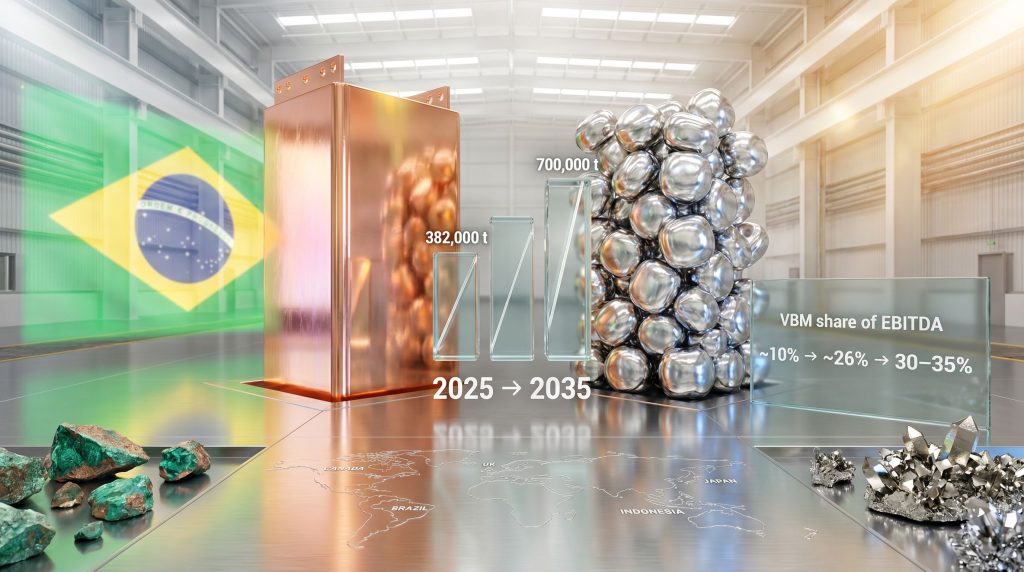
| 2025 (projected) | ~26% |
| Long-term target | 30% to 35% |
| Global diversified mining peers (average) | 25% to 45% |
This trajectory represents more than an internal financial reallocation. It signals a fundamental requalification of Vale's risk and growth profile in the eyes of capital markets. Closing the gap between VBM's current EBITDA contribution and the 25% to 45% range recorded by globally diversified peers effectively transforms Vale from an iron ore company with a metals division into a genuinely diversified critical minerals producer.
The operational foundation underpinning this transition is the Carajás region of Brazil, where Vale has maintained continuous operations for more than 40 years. This longevity creates competitive advantages that cannot be replicated quickly by new entrants: established infrastructure, institutional relationships, geological knowledge accumulated over decades, and a workforce with deep operational expertise. For brownfield expansion projects, these assets translate directly into lower execution risk and compressed capital requirements compared to greenfield alternatives elsewhere in the world.
Reversing a Decade of Guidance Failures: The Operational Turnaround
Perhaps the most significant and least widely appreciated aspect of Vale Base Metals' recent performance is not its growth projections but its operational credibility recovery. For approximately a decade, the division consistently failed to meet its own production guidance, a pattern that systematically eroded investor confidence and kept a discount embedded in market valuations.
When CEO Shaun Usmar took over the business in October 2024, his diagnosis was direct: the organisation had become operationally over-complex, managerially centralised, and burdened by global overhead structures that consumed resources without generating proportional value. The response was equally direct.
The three pillars of the operational restructuring were:
-
Reduction of more than US$400 million in global overhead expenditure, eliminating cost layers that had accumulated over years of expansion without corresponding discipline
-
Adoption of a decentralised management model, shifting decision-making authority closer to operational assets and removing bureaucratic friction from the execution process
-
A fundamental reorientation of management philosophy, from systemic complexity toward consistent delivery of operational fundamentals
The financial results of this restructuring are measurable and significant. EBITDA improved by US$1.9 billion relative to the prior year. Crucially, approximately US$850 million of that improvement was directly attributable to management actions rather than commodity price movements. This distinction matters enormously for investors attempting to assess whether a performance improvement is structural or merely a product of a favourable pricing environment.
When the majority of an EBITDA improvement is driven by operational decisions rather than market prices, the signal carries genuine structural weight. It indicates that the underlying business transformation is real, not simply a commodity cycle beneficiary.
The culmination of this transformation was 2025 copper production of 382,000 tonnes, which represented the first time in a decade that Vale Base Metals had exceeded its own guidance. This milestone carries significance beyond the production number itself. It marks a transition in narrative from chronic underdelivery to demonstrated execution capability, a shift that historically precedes meaningful rerating in capital markets.
The Copper Growth Roadmap: 382,000 Tonnes to 700,000 Tonnes by 2035
The strategic growth ambition of Vale Base Metals in copper is substantial by any measure. The division targets 700,000 tonnes of annual copper production by 2035, representing approximately 83% growth over a decade from the 2025 baseline. In the context of a widening copper supply crunch, this expansion positions the division as a critical counterweight to projected global deficits.
What distinguishes this target from aspirational guidance is the specificity of the project pipeline underpinning it. Chief Technical Officer Chris McCleave has been explicit that the portfolio represents executable projects at different stages of maturity, not a collection of conceptual opportunities. The pipeline encompasses two distinct geographic hubs in Brazil plus an international joint venture.
Hub Sul: Bacaba and Alemão
Bacaba serves as the near-term anchor of the southern hub and is already in active construction at approximately 23% physical completion. The project's financial profile has been dramatically improved through disciplined technical redesign:
- Project capital reduced by approximately 50% relative to the original feasibility study, with no increase in operating costs
- Internal rate of return improved from approximately 15% to over 60% following the redesign
- Demonstrates that scope simplification, strong partnerships, and better technical decisions can simultaneously enhance returns and reduce execution risk
Alemão represents the medium-term growth vector from the same hub. Originally designed as a conventional open-pit operation, the project was fundamentally redesigned as a sublevel stoping underground mining operation. This redesign delivered approximately US$500 million in CAPEX optimisation while maintaining production estimates of 80,000 tonnes of copper per year plus 140,000 ounces of gold per year. The preliminary licence was applied for in October 2025, with active risk mitigation strategies underway to address the regulatory timeline.
Hub Norte: Paulo Afonso
The northern hub's primary growth project is Paulo Afonso, a conventional open-pit operation featuring a 12 million tonne per year processing plant. The project targets annual production of 80,000 tonnes of copper and carries an estimated mine life of approximately 16 years, establishing it as a significant and durable addition to VBM's production base.
International Expansion: Victor NRSE, Sudbury
The Canadian growth vector involves a joint venture with Glencore at the Victor NRSE project in Sudbury, Ontario. This operation projects annual production of 50,000 tonnes of copper with a mine life exceeding 20 years. The polymetallic nature of the deposit, which also produces nickel, gold, platinum, and palladium as byproducts, meaningfully broadens the revenue profile and economic resilience of the project.
| Project | Location | Cu Production (t/yr) | Key Feature |
|---|---|---|---|
| Bacaba | Brazil (Hub Sul) | Undisclosed near-term | 50% CAPEX reduction, IRR >60% |
| Alemão | Brazil (Hub Sul) | 80,000 | Underground redesign, +140k oz Au |
| Paulo Afonso | Brazil (Hub Norte) | 80,000 | 16-year life, 12Mt/yr plant |
| Victor NRSE | Canada (Sudbury) | 50,000 | 20+ year life, polymetallic |
Coarse Particle Flotation: The Technology Quietly Transforming Production Economics
Among the technical innovations driving Vale Base Metals' production expansion, Coarse Particle Flotation (CPF) stands out for a characteristic that rarely attracts attention in mining sector discussions: its ability to generate incremental production without building new mines.
How CPF Works
Traditional flotation processing requires ore to be ground to a fine particle size before valuable minerals can be separated from waste material. This fine grinding step is energy-intensive, capital-intensive, and creates a bottleneck that constrains the throughput of the entire processing chain. CPF fundamentally inverts this sequence by removing waste material at a coarser particle size, before the fine grinding stage commences.
The practical effect is that the mills receive a higher-grade, lower-mass feed, reducing their workload and releasing latent capacity across the downstream processing chain without requiring new grinding infrastructure to be installed.
Quantified Impact at Salobo
The implementation of CPF technology at Vale's Salobo copper operation in Brazil demonstrates the technology's material impact:
| Performance Metric | CPF Impact at Salobo |
|---|---|
| Additional processing capacity | ~6 million tonnes per year |
| Specific energy consumption reduction | ~10% |
| Additional copper production | ~30,000 tonnes per year |
These gains are achieved through process engineering rather than mine expansion, which compresses the capital cost per incremental tonne of copper produced. For investors focused on capital efficiency metrics, this distinction is meaningful: CPF generates production upside at a fraction of the cost of equivalent greenfield capacity.
The Scalability Dimension
The strategic value of CPF extends well beyond a single installation at Salobo. The technology's modular architecture enables gradual implementation across multiple concentrators throughout the VBM portfolio. Each successive deployment multiplies the aggregate production benefit without requiring proportional increases in mining activity or capital expenditure. This scalability characteristic positions CPF as a portfolio-level growth lever rather than a site-specific optimisation tool.
The next major ASX story will hit our subscribers first
Vale Base Metals' Nickel Strategy: Class I Quality in a Class of Its Own
While copper dominates the growth narrative, Vale Base Metals' nickel operations carry their own strategic significance within the critical minerals landscape. The division operates across five countries, including Brazil, Canada, Indonesia, the United Kingdom, and Japan, providing a geographic diversification that reduces concentration risk in any single regulatory or political environment.
The nickel strategy is deliberately focused on the high-purity Class I segment, produced primarily from sulphide ore deposits. This product specification is directly compatible with lithium-ion battery cathode manufacturing, which represents the fastest-growing and highest-margin application for nickel in the energy transition. The 29% projected growth in the high-value nickel segment corresponds precisely to the portion of the market where VBM has positioned its production capacity. Consequently, the prospects for nickel market recovery are closely tied to how effectively producers like VBM scale their Class I output to meet battery supply chain demand.
Cobalt and platinum group metals (PGMs) extracted as byproducts of nickel operations further enhance the value per tonne processed, creating a multi-commodity revenue stream that strengthens project economics beyond the primary nickel price. The division has stated an objective of ranking among the top five global nickel producers, a target that, if achieved, would establish VBM as a tier-one supplier to the battery supply chain.
How VBM Compares to Global Mining Peers
The competitive benchmarking exercise is instructive for contextualising where Vale Base Metals sits in the global mining landscape and where it is heading. The key metric for comparison is the contribution of base metals to consolidated EBITDA, a measure that reveals how strategically central these businesses are within their respective parent companies.
| Company Profile | Base Metals EBITDA Contribution |
|---|---|
| Vale Base Metals (2024 actual) | ~10% |
| Vale Base Metals (2025 projected) | ~26% |
| Vale Base Metals (long-term target) | 30% to 35% |
| Global diversified mining peers (range) | 25% to 45% |
The convergence trajectory is clear. Within a twelve-month period, VBM is projected to move from representing a minor segment of Vale's consolidated financial performance to approaching the lower boundary of what globally diversified peers achieve. This convergence carries structural implications for how Vale S.A. is valued and perceived in equity markets.
The structural competitive advantages underpinning this transition include:
- More than four decades of continuous operational presence in Carajás, creating irreplaceable institutional knowledge and infrastructure advantages
- A project pipeline with demonstrably high returns, including Bacaba's redesigned IRR exceeding 60%, well above typical industry thresholds for project sanction
- Adoption of CPF technology that generates production growth at low incremental capital cost
- Geographic diversification across five countries that distributes regulatory and geopolitical risk
- A financial restructuring that has already delivered US$850 million in management-driven EBITDA improvement, demonstrating execution capability independent of commodity price cycles
What This Means for the Global Critical Minerals Supply Chain
The transformation of Vale Base Metals cobre e níquel minerais críticos into a credible global-scale producer carries implications that extend well beyond the company's own financial performance. Brazil, as a politically stable jurisdiction with significant copper and nickel reserves, occupies a strategically valuable position in the global critical minerals map at a time when Western economies are actively seeking to diversify supply chains away from concentrated sources.
VBM's operational model, combining technical project redesign to enhance capital efficiency, organisational restructuring to improve execution discipline, and technology deployment to extract incremental production from existing infrastructure, offers a replicable framework for an industry under pressure to deliver more with greater accountability. In addition, investors exploring copper investment strategies will find VBM's project pipeline and capital efficiency metrics particularly instructive as a benchmark for evaluating production-stage assets.
For investors assessing the mining sector's role in the energy transition, the VBM story represents a case study in how underperforming assets can be repositioned through management discipline rather than exclusively through capital investment. The fact that a substantial portion of a multi-billion dollar EBITDA improvement was driven by operational decisions rather than commodity prices is a signal that deserves attention as a model for value creation in an industry where capital discipline has historically been inconsistent.
Disclaimer: This article is intended for informational purposes only and does not constitute financial advice. Projections, forecasts, and targets referenced throughout this article are forward-looking statements subject to material uncertainty. Readers should conduct their own due diligence and consult qualified financial advisers before making any investment decisions. Past operational performance and stated targets are not guarantees of future results.
Want to Identify the Next Major Mineral Discovery Before the Broader Market Does?
The structural shift driving copper and nickel demand creates compelling opportunities for investors positioned ahead of significant ASX announcements — Discovery Alert's proprietary Discovery IQ model delivers real-time alerts on critical mineral discoveries, transforming complex geological data into actionable insights for traders and long-term investors alike. Explore historic examples of major mineral discoveries and their market returns, then begin your 14-day free trial to ensure you are never the last to know when the next transformative discovery is announced.