August 7, 2026
The Geology of Scarcity: Why Copper's Supply Problem Cannot Be Solved With Money Alone
Most commodity markets eventually self-correct. Prices rise, capital flows toward new supply, and within a few years the market rebalances. Copper is different. Its bull market is not simply a function of demand outpacing supply in the short term. The copper prices bull market Chile forecast AI clean energy demand dynamic reflects something far more fundamental: a geological and logistical reality that no amount of capital expenditure can fix quickly.
The ore bodies that once delivered high-grade copper at low cost are aging, thinning, and deepening. New discoveries that could replace them are located in remote, complex jurisdictions, requiring between 15 and 20 years to bring into production. Furthermore, the clean energy demand surge and AI infrastructure buildout are locking in a supply deficit that will define commodity markets for the next decade and beyond.
When big ASX news breaks, our subscribers know first
Chile's Forecast Signals More Than a Price Revision
When the world's largest copper-producing nation revises its price outlook upward despite simultaneously lowering its domestic economic growth forecast, the market pays attention. The Chile copper price forecast from Chile's central bank stands at $5.90 per pound for 2026, even as broader economic conditions in the country soften. The revision is a meaningful signal: institutional confidence in sustained global copper demand is high enough to decouple the price outlook from the domestic macro environment.
Chile's copper commission, Cochilco, has echoed this view, citing tight global supply and growing consumption from renewable energy systems, electric transport networks, and digital infrastructure as the primary drivers. The official forecast path tells a clear story:
| Year | Chile Central Bank Copper Price Forecast |
|---|---|
| 2026 | $5.90 per pound |
| 2027 | $5.20 per pound |
| 2028 | $5.00 per pound |
Even the outer-year forecasts remain well above historical price averages, suggesting Chilean policymakers view the current price environment as structurally anchored rather than cyclically elevated. This is a country whose fiscal revenues are deeply tied to copper export receipts, so conservative forecasting is institutionally incentivised. A bullish revision, consequently, carries additional interpretive weight.
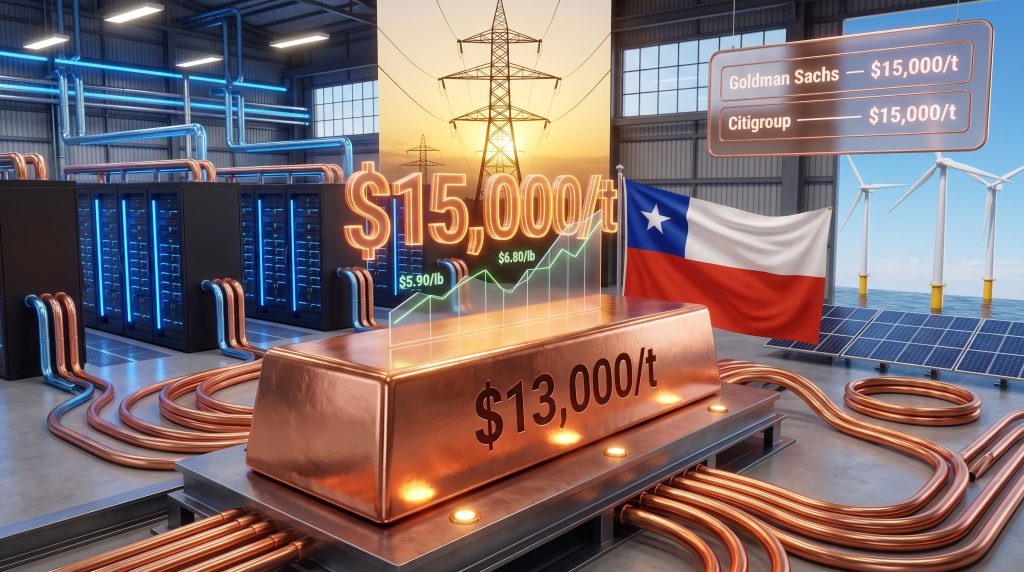
*Copper has crossed $13,000 per metric ton in 2026, a level that most commodity analysts treat as a structural threshold rather than a speculative overshoot. Major financial institutions including Goldman Sachs and Citigroup have published long-term targets of $15,000 per metric ton (~$6.80/lb), while technical analysis of chart formations suggests a potential breakout scenario reaching $16,500 to $16,700 per metric ton ($7.40 to $7.50/lb) if current momentum is sustained.*
AI Infrastructure: A Demand Category That Did Not Exist Five Years Ago
The copper clean energy demand narrative is well established, however, the AI infrastructure component is newer, faster-moving, and less well understood by most market participants. The copper intensity of a hyperscale AI data center is staggering at the facility level. A large-scale installation can consume up to 50,000 metric tons of copper during its construction phase alone, used across electrical cabling, transformers, switchgear, substations, uninterruptible power systems, and liquid cooling infrastructure.
BloombergNEF projects that AI-related facilities will collectively generate approximately 400,000 metric tons of annual copper demand over the coming decade. To contextualise that figure: it represents a demand category that effectively did not exist as a standalone line item in copper consumption models five years ago. By 2026, AI data centers are projected to account for roughly 475,000 metric tons of copper demand in aggregate construction and operational terms.
The IEA's copper research projects that global data center electricity consumption will exceed 945 TWh annually by 2030, a figure roughly equivalent to Japan's entire yearly electricity use. The majority of this growth is attributable to AI workloads, and every terawatt-hour of additional electricity demand requires additional copper infrastructure at the generation, transmission, and consumption end.
Major technology companies including Google, Microsoft, Amazon, and Meta are accelerating data center construction programmes across multiple continents, embedding sustained copper demand into their long-term capital expenditure cycles. This is not discretionary spending. These companies have made binding commitments to AI infrastructure that cannot be unwound without significant competitive consequences.
What Makes AI Copper Demand Structurally Sticky
Unlike cyclical industrial demand, AI-driven copper consumption has several characteristics that make it resistant to economic downturns:
- Technology companies have multi-year construction pipelines that are not cancelled in response to short-term economic softness
- Data center build programmes are tied to competitive positioning in AI, creating strategic rather than purely financial decision-making
- The electricity infrastructure required to power AI facilities must be built before the facilities themselves can operate, meaning copper demand precedes revenue generation
- Grid connection requirements for large data centers often require dedicated substation construction, adding a further copper-intensive layer beyond the facility itself
Clean Energy's Copper Dependency: The Numbers Behind the Transition
The clean energy transition has been the dominant long-term copper demand narrative for several years, and the data continues to support it. The IEA estimates that battery electric vehicles require approximately 2.5 times more copper than their internal combustion engine counterparts. Offshore wind turbines carry roughly five times more copper per megawatt of capacity than gas-fired generation. Solar photovoltaic installations, while less copper-intensive per unit, are being deployed at such scale that their aggregate contribution to demand is substantial.
| Technology | Copper Intensity Relative to Conventional Equivalent |
|---|---|
| Battery Electric Vehicle | ~2.5x to 4x more than a gasoline vehicle |
| Offshore Wind Turbine | ~5x more per MW than gas-fired generation |
| Solar PV Farm | Significant copper in inverters, cabling, and grid connection |
| AI Hyperscale Data Center | Up to 50,000 metric tons per facility (construction phase) |
| Grid Transmission Infrastructure | Copper-intensive at every transformer and substation node |
The IEA projects that clean energy applications could account for close to half of all global copper demand by 2040 under a net-zero emissions pathway. Power grid expansion represents the single largest copper demand growth category within that projection. In addition, the World Bank has underscored the urgency of grid investment, noting that global electricity networks require rapid and sustained expansion to accommodate cleaner energy sources and rising overall demand.
Chile's Supply Constraints: The Ore Grade Problem
Chile produced approximately 5.3 million metric tons of copper in 2025, representing roughly one-quarter of global mine output according to USGS data. Its flagship assets, including Escondida, Collahuasi, and the Codelco production outlook of state-owned operations, supply manufacturers across Asia, Europe, and the Americas. Cochilco projects national output could reach approximately 5.54 million metric tons by 2034, but the pathway to that target is constrained by declining ore grades.
This is a geological reality that deserves more attention than it typically receives in mainstream commodity coverage. As copper mines age, the richest ore bodies are progressively depleted. Operators are forced to process increasing volumes of lower-grade material to maintain production levels, raising per-unit production costs significantly and increasing energy and water consumption per tonne of copper produced.
In Chile's case, water scarcity in the Atacama region adds a further operational constraint, with many mines reliant on expensive desalination infrastructure to sustain operations. Codelco has acknowledged that its production trajectory is likely to remain close to current levels in the near term rather than scaling toward its long-term ambition of 1.7 million metric tons per year by 2030.
Output from Codelco's own mines reached 1.33 million metric tons in the most recent reporting year, still recovering from a multi-decade production low recorded in 2022 and 2023. Anglo American and Codelco have also completed a strategic deal providing access to approximately 2.7 million metric tons of Chilean copper resources, signalling long-term positioning by major miners in anticipation of sustained demand.
The 15-to-20-Year Mine Development Gap
Perhaps the most underappreciated dynamic in the copper prices bull market Chile forecast AI clean energy demand debate is the sheer length of time required to bring a new mine from discovery to commercial production. The IEA places this timeline at 15 to 20 years, encompassing geological assessment, resource definition drilling, environmental impact studies, permitting processes, community consultation, project financing, engineering design, and physical construction.
Consequently, even a decisive wave of project approvals in 2025 and 2026 would not translate into meaningful new copper supply until the mid-to-late 2030s at the earliest. Understanding the copper supply crunch is therefore essential, as the supply response mechanism is simply too slow to respond to demand signals within the timeframe that matters most for the energy transition.
S&P Global projects that global copper demand could expand from approximately 28 million metric tons in 2025 to 42 million metric tons by 2040, a near-doubling driven by electrification, AI infrastructure, and clean energy deployment.
| Supply-Side Challenge | Consequence for the Market |
|---|---|
| Declining ore grades at mature mines | Higher unit costs, falling output per tonne processed |
| 15 to 20-year development pipeline | No quick supply response to elevated prices |
| Project execution delays and cost overruns | Reduces effective new supply additions |
| Geopolitical risk and trade tariff uncertainty | Disrupts supply chains and introduces price volatility |
| Environmental permitting complexity | Further extends development timelines |
| Water scarcity in key producing regions | Adds operational cost and constrains throughput |
The next major ASX story will hit our subscribers first
Risks That Could Interrupt the Bull Market Trend
A balanced assessment requires acknowledging the risks that could create volatility or temporary price corrections, even if the long-term structural case remains intact.
- A significant slowdown in global manufacturing activity could suppress near-term industrial copper demand, particularly from construction and heavy industry sectors
- Trade policy shifts and tariff escalation between major copper-consuming and producing nations introduce periodic price volatility
- Some analysts caution that a portion of copper's recent price appreciation reflects speculative futures positioning rather than immediate physical demand, creating conditions for short-term corrections
- Currency movements and central bank tightening cycles can weigh on commodity prices across economic cycles, regardless of structural demand factors
Disclaimer: The price forecasts and analyst targets referenced in this article reflect institutional projections at a specific point in time and should not be interpreted as guaranteed outcomes. Commodity markets are inherently volatile, and actual price outcomes may differ materially from published forecasts. This article does not constitute financial or investment advice.
That said, the structural demand drivers underpinning the copper price drivers outlook are anchored in capital commitments, policy frameworks, and technological trajectories extending well beyond any single economic cycle. Chile's own conservative forecasting approach, which still yields a $5.90/lb average for 2026, reflects baseline institutional confidence that the demand side of the equation is durable.
Copper Demand by Sector: The Pathway to 2040
Understanding where copper demand growth will come from over the next fifteen years is essential for contextualising both the price outlook and the investment opportunity within the mining sector. The following sectors represent the primary growth drivers identified by the IEA, S&P Global, and BloombergNEF:
- Power grid and transmission infrastructure — the single largest demand growth category, requiring copper at every substation, transformer, and cable run as networks expand to accommodate renewable generation
- Electric vehicles and EV charging networks — rapidly scaling copper intensity as global EV adoption accelerates across passenger, commercial, and heavy transport segments
- Renewable energy generation — solar, wind, and hydropower installations each require substantial copper content at installation and grid connection stages
- AI and digital infrastructure — now a structurally significant and fast-growing demand category, as outlined in S&P Global's copper and AI research, that did not exist at scale five years ago
- Grid-scale battery storage — growing as utilities deploy large-scale storage to manage intermittency in renewable energy systems
- Hydrogen production infrastructure — early-stage but copper-intensive at the electrolysis, compression, and distribution layers
The convergence of these demand streams creates a compounding effect that no single sector analysis can fully capture. Furthermore, the future of copper mining will depend heavily on how the industry adapts to meet these multiplying demands whilst navigating the geological and logistical constraints outlined throughout this analysis.
Copper Prices Bull Market: Key Questions Answered
What is driving the copper bull market in 2026?
The copper prices bull market Chile forecast AI clean energy demand dynamic is sustained by two structural forces growing faster than global mine supply can respond: the rapid buildout of AI hyperscale data center infrastructure and the accelerating global clean energy transition, encompassing EVs, renewable power generation, battery storage, and electricity grid modernisation.
How much copper does a large AI data center use?
A large-scale AI facility can require up to 50,000 metric tons of copper during construction, deployed across electrical cabling, transformers, substations, cooling systems, and backup power infrastructure.
Why is copper supply struggling to keep pace with demand?
New copper mines require 15 to 20 years from discovery to commercial production. Existing mines face declining ore grades requiring more material to be processed for the same output. Combined with project delays, rising development costs, and geopolitical disruptions, supply growth is structurally constrained relative to the pace of demand expansion.
What are the long-term copper price targets from major financial institutions?
Goldman Sachs and Citigroup both maintain long-term copper price targets of $15,000 per metric ton (~$6.80/lb). Technical chart analysis points to a potential breakout scenario reaching $16,500 to $16,700 per metric ton ($7.40 to $7.50/lb) if current momentum holds. JPMorgan has projected $12,500 per metric ton for the near term. For further context on where prices may head, copper forecasts into 2026 suggest the structural case for elevated prices remains firmly intact.
How large could global copper demand become by 2040?
S&P Global projects global copper demand expanding from approximately 28 million metric tons in 2025 to 42 million metric tons by 2040, a near-doubling driven primarily by electrification, AI infrastructure, and clean energy deployment across all major economies.
Want to Position Ahead of the Next Major Copper Discovery on the ASX?
Discovery Alert's proprietary Discovery IQ model delivers real-time alerts the moment significant mineral discoveries — including copper — are announced on the ASX, translating complex geological data into actionable investment insights for both short-term traders and long-term investors. Explore historic examples of major discovery returns and begin your 14-day free trial today to ensure you are positioned ahead of the broader market.