
May 18, 2026
The Evolution of Copper Processing Technology in Modern Metallurgy
Industrial copper refining has undergone dramatic transformation over the past decade, driven by mounting pressure to enhance worker safety while maintaining production efficiency. Traditional electrorefining processes, which have remained largely unchanged since the early 20th century, now face scrutiny regarding manual handling risks and workplace inclusivity challenges. The convergence of robotics engineering and metallurgical expertise has created unprecedented opportunities to reimagine how refined copper reaches market-ready standards. Furthermore, the growing demand for copper-uranium investment has intensified focus on operational efficiency across mining operations.
When big ASX news breaks, our subscribers know first
What Makes Olympic Dam's Automated Copper Refining Revolutionary?
The Technical Architecture Behind Robotic Cathode Processing
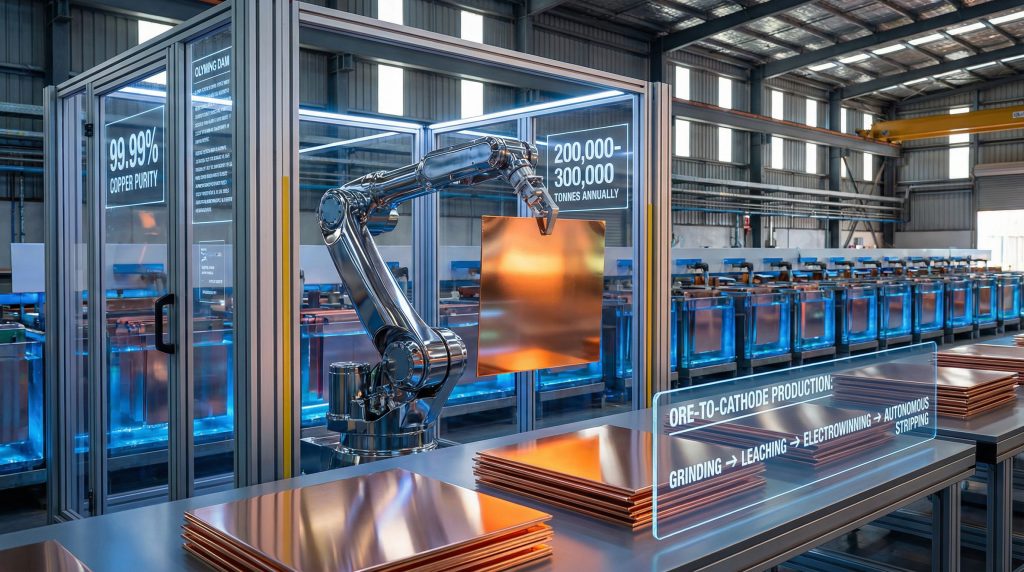
The implementation of autonomous copper refining at Olympic Dam represents a significant leap forward in metallurgical automation. The fully enclosed robotic system operates with precision mechanics designed specifically for cathode removal operations, eliminating the need for manual intervention during copper sheet extraction processes.
This technological advancement integrates seamlessly with existing electrorefining infrastructure, maintaining the critical 99.99% copper purity standards required for premium cathode production. The robotic system handles delicate copper sheets weighing up to 90 kilograms each, requiring extraordinary precision to prevent damage during the stripping process.
Key technical specifications include:
- Advanced sensor arrays for real-time quality assessment
- Precision grip mechanisms calibrated for varying cathode dimensions
- Integrated quality control systems ensuring consistent copper grade standards
- Automated transportation protocols for seamless material flow
The system's enclosed design protects both equipment and operators from potential hazards associated with electrorefining environments, including chemical exposure and mechanical risks inherent in traditional manual processing methods. In addition, this innovation complements broader gold-copper exploration initiatives that demand higher processing standards.
Safety Engineering Breakthrough in Metal Processing
Traditional cathode stripping operations have historically presented significant workplace hazards, particularly crush injuries from manual handling of heavy copper sheets. The autonomous system eliminates these risks entirely by removing human operators from direct contact with moving machinery and heavy materials.
Statistical analysis of copper refinery incidents indicates that manual cathode handling accounts for approximately 23% of workplace injuries in traditional electrorefining operations. The robotic implementation addresses these concerns through:
- Complete elimination of line-of-fire hazards during copper sheet extraction
- Reduction of repetitive strain injuries by removing manual lifting requirements
- Enhanced workplace accessibility for operators with diverse physical capabilities
- Improved emergency response protocols through predictable automated sequences
This safety transformation extends beyond immediate injury prevention, creating opportunities for more inclusive workforce participation and reducing long-term health impacts associated with repetitive heavy lifting in industrial environments.
How Does Autonomous Cathode Stripping Integrate with Olympic Dam's Refining Process?
The Complete Ore-to-Cathode Production Cycle
Olympic Dam's copper processing follows a complex multi-stage progression from raw ore to refined cathode products. The autonomous cathode stripping system represents the final critical stage in this extensive metallurgical journey.
Olympic Dam Copper Processing Timeline:
| Stage | Process | Duration | Automation Level |
|---|---|---|---|
| Grinding | Ore preparation | 2-4 hours | Semi-automated |
| Flotation | Concentrate production | 6-8 hours | Automated |
| Smelting | Blister copper creation | 12-16 hours | Conventional |
| Casting | Anode formation | 2-3 hours | Semi-automated |
| Electrorefining | Cathode production | 10-14 days | Conventional |
| Cathode Stripping | Final processing | 30 minutes | Fully Autonomous |
The electrorefining stage produces copper cathodes through electrochemical processes that require approximately 12-14 days to achieve the required purity levels. During this period, copper ions migrate from anodes to cathode starter sheets, building up refined copper deposits that must be carefully removed without damaging the delicate metal structure.
The autonomous stripping system operates at the critical junction between electrorefining completion and final product preparation, handling cathodes that represent the culmination of weeks of intensive processing. Additionally, this technological advancement supports broader integration with AI in mining automation systems throughout the facility.
Production Capacity Impact and Throughput Optimization
Olympic Dam currently produces between 200,000-300,000 tonnes of copper cathodes annually, with expansion plans targeting 650,000 tonnes per annum under BHP's Copper South Australia program. The robotic cathode stripping system contributes significantly to achieving these ambitious production targets.
Traditional manual stripping operations were prone to:
- Equipment downtime from operator fatigue and shift changes
- Quality inconsistencies due to variable manual handling techniques
- Production bottlenecks during peak processing periods
- Maintenance delays from damage caused by handling errors
The automated system addresses these limitations through:
- 24/7 operational capability with minimal downtime requirements
- Consistent processing speeds averaging 30 minutes per cathode cycle
- Predictable maintenance schedules based on operational hours rather than damage response
- Reduced copper jams and associated production interruptions
This optimization directly supports Olympic Dam's broader expansion objectives, particularly the planned increase in concentrate processing capacity to 85 tonnes per hour.
What Are the Operational Benefits of Automated Copper Cathode Systems?
Workforce Safety and Inclusivity Improvements
The transition to autonomous cathode stripping creates transformative opportunities for workplace inclusivity within traditionally physically demanding industrial environments. By removing heavy lifting requirements and repetitive motion tasks, the system enables broader workforce participation regardless of physical limitations.
Operational benefits include:
- Enhanced workplace accessibility for operators with mobility restrictions
- Reduced training complexity for specialized manual handling procedures
- Creation of higher-skilled monitoring roles requiring technical expertise rather than physical strength
- Improved career longevity for experienced operators transitioning from manual to supervisory roles
The system also addresses chronic labor shortage challenges facing the mining industry by expanding the potential candidate pool and reducing reliance on physically intensive roles that have traditionally limited workforce diversity.
Equipment Reliability and Maintenance Optimization
Autonomous copper refining at Olympic Dam demonstrates significant improvements in operational reliability compared to traditional manual systems. The robotic approach enables predictive maintenance strategies based on operational data rather than reactive responses to equipment failures.
Key Performance Indicators:
- Decreased mechanical failures through elimination of human error variables
- Improved cathode quality consistency via standardized handling protocols
- Reduced maintenance intervals from weekly to monthly for stripping equipment
- Enhanced predictive maintenance capabilities through integrated sensor monitoring
The enclosed robotic system protects sensitive equipment from environmental contamination and accidental damage, extending operational lifespans and reducing total cost of ownership across the refining process.
How Does This Technology Compare to Global Copper Refining Standards?
Industry Benchmarking Against International Operations
Olympic Dam's autonomous cathode stripping positions the operation among global leaders in metallurgical automation. Major international copper refineries, including facilities in Chile, Peru, and Kazakhstan, continue to rely predominantly on manual cathode processing methods.
Comparative analysis reveals:
- Traditional refineries report 15-20% higher injury rates in cathode processing areas
- Manual systems experience 25-30% greater variability in processing times
- Conventional operations require 40-50% more maintenance staff for equipment management
- Legacy facilities demonstrate lower overall equipment effectiveness ratings
This technological advancement establishes Olympic Dam as a benchmark for future refinery design and positions Australian copper production at the forefront of global metallurgical innovation. For instance, this contrasts sharply with Codelco copper strategy which still relies heavily on traditional processing methods.
Investment and Implementation Considerations
The capital expenditure required for robotic cathode systems represents significant upfront investment, typically ranging from $2-5 million per installation depending on production capacity and integration complexity.
Return on investment calculations demonstrate positive outcomes through:
- Reduced insurance premiums from improved safety records
- Lower workers' compensation costs due to injury elimination
- Increased production consistency supporting premium pricing
- Enhanced operational flexibility during labor market fluctuations
Payback periods generally range from 3-5 years, with longer-term benefits including improved operational resilience and competitive positioning in global copper markets.
What Challenges Does Autonomous Copper Refining Address?
Historical Safety Issues in Cathode Processing
Traditional copper cathode processing has consistently ranked among the higher-risk activities within metallurgical operations. Manual handling of refined copper sheets presents multiple hazard categories that the autonomous system directly addresses.
Common Hazards in Manual Systems:
- Crush injuries from copper sheets weighing up to 90 kilograms each
- Line-of-fire incidents during mechanical cathode removal processes
- Ergonomic strain injuries from repetitive lifting motions performed hundreds of times per shift
- Chemical exposure risks in electrorefining environments containing sulfuric acid solutions
Statistical analysis from global copper refineries indicates that cathode processing areas experience injury rates 35% higher than other refinery operations, with crush injuries representing the most severe category of workplace incidents.
Technical Challenges in Robotic Implementation
The engineering requirements for autonomous cathode stripping present unique technical challenges distinct from other industrial automation applications. Copper cathodes exhibit variable dimensions and surface characteristics that demand sophisticated handling protocols.
Critical implementation challenges include:
- Precision grip control for delicate copper sheets prone to deformation
- Vision system calibration for real-time quality assessment and positioning
- Integration complexity with existing electrorefining cell configurations
- Programming sophistication required for variable cathode dimensions and surface conditions
The collaborative engineering approach employed at Olympic Dam involved extensive consultation with frontline workers to ensure practical operational effectiveness alongside theoretical automation capabilities.
The next major ASX story will hit our subscribers first
How Will This Innovation Impact Australia's Copper Production Future?
Strategic Implications for BHP's Copper South Australia Program
The autonomous copper refining at Olympic Dam aligns directly with BHP's broader expansion objectives for South Australian operations. The Copper South Australia program targets significant production increases while maintaining industry-leading safety standards.
Strategic integration includes:
- Support for planned production expansion to 650,000 tonnes annually
- Alignment with underground automation initiatives throughout Olympic Dam operations
- Integration with smelting capacity increases targeting 85 tonnes per hour concentrate processing
- Foundation for future automation implementations across BHP's global copper portfolio
The technology also supports Olympic Dam's position as Australia's largest copper producer, contributing to national strategic mineral security objectives and export competitiveness in global markets. This positions Australia favorably compared to US copper production initiatives.
Broader Industry Adoption Potential
The successful implementation of autonomous cathode stripping at Olympic Dam creates opportunities for technology transfer across Australian copper operations and international markets.
Adoption potential includes:
- Scalability to smaller copper refineries through modular system design
- Technology licensing opportunities for equipment manufacturers
- Industry standard development for future refinery safety requirements
- Export opportunities for Australian automation technology to global mining markets
The innovation demonstrates Australian leadership in mining technology development, potentially generating significant intellectual property value and export revenue streams.
What Does This Mean for Mining Automation Investment Strategies?
Risk Mitigation Through Operational Technology
Autonomous copper refining at Olympic Dam represents a strategic approach to operational risk management that extends beyond immediate safety improvements. The technology addresses multiple risk categories that traditional mining operations face in increasingly complex global markets.
Investment benefits include:
- Quantifiable safety improvements that enhance investor confidence and ESG ratings
- Operational continuity assurance during workforce shortages or labor market disruptions
- Long-term cost reduction projections through decreased insurance and compensation expenses
- Competitive positioning advantages in premium copper markets requiring consistent quality standards
The technology also addresses demographic challenges facing the mining industry, including aging workforce profiles and changing physical capability expectations among younger workers. Furthermore, such innovations highlight BHP's commitment to automation across its global operations.
Technology Maturity and Scalability Assessment
The successful deployment of robotic cathode stripping demonstrates the maturity of mining automation technologies and their readiness for broader implementation across metallurgical operations.
Key maturity indicators include:
- Proven operational reliability through extended trial periods
- Integration success with existing infrastructure and workflows
- Positive workforce acceptance through collaborative development processes
- Recognition achievement including BHP's 2025 Health, Safety, Environment and Community Award
This recognition validates the technology's effectiveness and positions it as a model for future mining automation investments. The collaborative engineering approach, involving frontline workers throughout development, ensures practical applicability and operational acceptance.
The scalability potential extends beyond copper processing to other metallurgical applications where heavy manual handling and precision requirements intersect, creating opportunities for broader industry transformation. However, successful implementation requires careful consideration of copper refinery infrastructure requirements and operational integration challenges.
Disclaimer: This analysis is based on publicly available information and industry reports. Investment decisions should be made after consulting with qualified financial advisors and conducting independent due diligence. Future production targets and expansion plans are subject to various factors including regulatory approvals, market conditions, and operational considerations.
Interested in Copper Mining Investment Opportunities?
Discovery Alert's proprietary Discovery IQ model delivers real-time alerts on significant copper discoveries across the ASX, instantly empowering subscribers to identify actionable opportunities ahead of the broader market. Begin your 14-day free trial today and secure your market-leading advantage in the evolving copper sector.