July 20, 2026
The Structural Case for Copper: Why Supply Cannot Keep Pace With a Rapidly Electrifying World
The history of commodity markets is filled with cycles of boom, bust, and eventual equilibrium. Prices spike, capital floods in, new supply emerges, and the cycle resets. Copper, however, is entering a phase where the traditional mechanics of this cycle are being fundamentally disrupted. The Creamer Media IN FOCUS Copper and the Next Phase of Mining Growth series examines precisely this disruption — exploring forces that are not cyclical in nature but structural, long-duration, and converging simultaneously in a way that has no meaningful historical parallel.
Understanding what this means for the mining industry, for investors, and for the broader global economy requires looking beyond short-term price charts and into the geological, financial, and technological realities that will define copper's role over the next two decades.
When big ASX news breaks, our subscribers know first
Why Copper Has Become the Metal Underpinning the Energy Transition
Copper's physical properties make it essentially irreplaceable in electrical applications. Its conductivity is surpassed only by silver, which is far too expensive for large-scale infrastructure deployment. Aluminium is used as a partial substitute in some overhead transmission lines, but it cannot replicate copper's performance in motors, transformers, printed circuit boards, or the dense wiring harnesses inside electric vehicles.
This is a critical distinction when comparing copper to other metals caught up in the energy transition narrative. Lithium chemistry in batteries has already evolved significantly, with sodium-ion and solid-state technologies offering meaningful substitution pathways over time. Cobalt's role in cathode chemistry has been progressively engineered down. Copper, however, faces no such competitive pressure. Its physical role in moving electricity from one point to another cannot be substituted at the scale that modern infrastructure demands.
What Are the Three Demand Megatrends Driving Copper Consumption?
Three copper demand drivers are now pressing on the copper market at the same time:
- The electrification of transport, with battery electric vehicles consuming approximately 83 kg of copper each compared to roughly 23 kg in a conventional internal combustion engine vehicle
- The rapid scaling of renewable energy generation, where solar photovoltaic farms require approximately 5 to 6 tonnes of copper per megawatt installed and offshore wind turbines consume 8 to 10 tonnes per megawatt
- The global buildout of artificial intelligence computing infrastructure, a demand category that was largely absent from pre-2023 forecasting models and is now emerging as a material and fast-growing source of copper consumption
That third driver deserves particular attention. AI data centres are not simply warehouses full of computers. They are extraordinarily copper-intensive facilities. Power delivery systems operating at high voltages, liquid cooling infrastructure, and the dense copper cabling running between thousands of servers and network switches all require substantial volumes of refined copper. Analysts who modelled copper demand as recently as 2022 did not adequately account for the scale or pace of this buildout, meaning current demand projections almost certainly understate the full picture.
Quantifying the Supply-Demand Imbalance
The numbers defining copper's structural imbalance are significant and worth examining in detail.
| Metric | Figure |
|---|---|
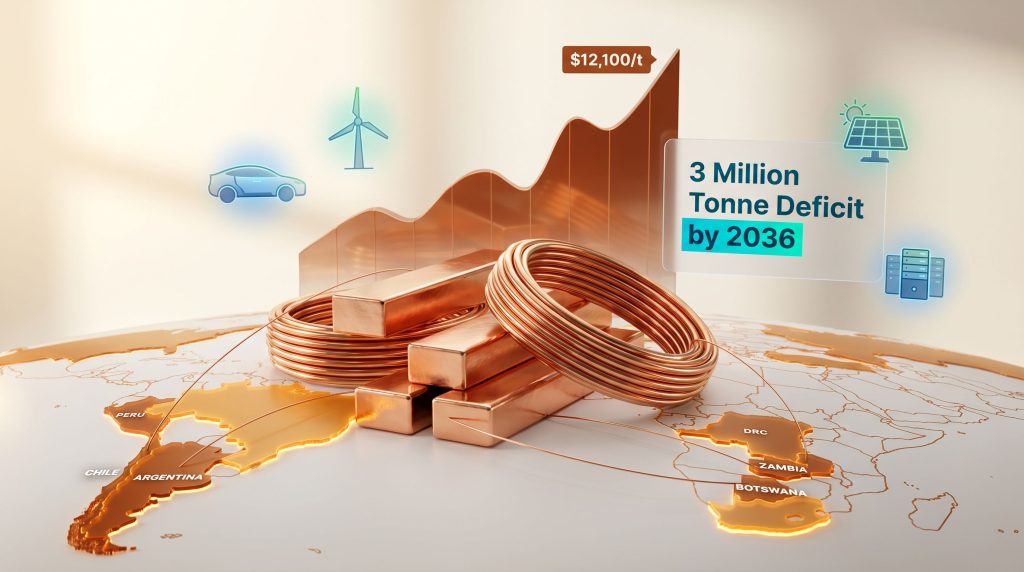
| Projected cumulative supply deficit by 2036 | Approximately 3 million tonnes |
| Forecast LME copper price (2026 average) | Just above $12,100 per tonne |
| Capital investment required over the next decade | Estimated $250 billion |
| Typical mine development timeline | 15 to 20 years |
| Major new copper discoveries in the past decade | Effectively none at scale |
The scale of the projected 3-million-tonne cumulative deficit by 2036 is historically significant. For context, total global refined copper consumption currently sits at roughly 25 to 26 million tonnes annually. A structural shortfall of 3 million tonnes represents more than 10% of current annual demand, compounding over time in a market where new supply cannot be rapidly deployed. The copper supply crunch facing the industry makes this imbalance one of the most consequential commodity stories of the decade.
The combination of accelerating demand from electrification, renewable energy, and AI infrastructure colliding with a decade-long underinvestment in exploration and development creates conditions unlike any previous copper market cycle. Price signals alone cannot resolve structural constraints that are measured in decades, not months.
The supply side of this equation is where the challenge becomes most acute. Copper mine development is not like drilling an oil well or opening a quarry. From the initial discovery of a viable orebody through exploration, resource definition, feasibility studies, environmental permitting, financing, and construction, a new copper mine requires 15 to 20 years before it produces its first tonne of refined metal. This timeline exists even under favourable conditions.
The Exploration Pipeline Problem: A Decade of Insufficient Discovery
One of the least-discussed but most consequential aspects of the copper market outlook is the near-total absence of major new discoveries over the past decade. The world's known copper deposits are aging. The large, shallow, high-grade orebodies that underpinned production growth through the 20th century have largely been exhausted or are in advanced depletion.
What remains in the discovery pipeline skews toward deeper deposits, lower ore grades, and more geographically remote locations — all of which substantially increase the capital cost and technical complexity of bringing new supply to market.
Ore grade is a critical concept here that investors and non-specialists often underestimate. Ore grade refers to the concentration of copper within the rock that must be mined and processed. A deposit grading 2% copper means that two tonnes of copper can theoretically be extracted from every 100 tonnes of rock mined. As grades decline, the volume of rock that must be moved, crushed, and processed to produce the same amount of copper increases significantly, driving up energy consumption, water use, and operational cost per tonne of finished metal.
The global average copper ore grade at producing mines has been declining for decades. Many of the world's largest and most productive copper mines are now processing ore that would have been considered sub-economic in earlier generations of mining. This grade decline is not a short-term phenomenon — it is a geological reality that will continue to affect production costs and capital requirements across the industry.
Where New Supply Is Most Likely to Emerge
The geographic distribution of future copper supply is concentrated in a relatively small number of jurisdictions, each with its own distinct risk profile.
Latin America remains the dominant copper-producing region globally:
- Chile, the world's largest copper producer, is experiencing declining ore grades at its flagship operations and faces significant water scarcity constraints in the Atacama Desert, where much of its production is concentrated
- Peru holds substantial reserve bases but has faced persistent social licence challenges, community opposition to mining projects, and complex permitting environments that have delayed multiple major developments
- The Argentina copper potential is increasingly recognised as a frontier jurisdiction for new project development, with significant geological prospectivity and an improving investment climate in certain provinces
Sub-Saharan Africa represents the other major concentration of future supply potential:
- Zambia has historically been a major copper producer and is experiencing renewed investment interest as its regulatory environment stabilises
- The Democratic Republic of Congo holds a vast copper resource base but operates in one of the world's most complex environments from a political, logistical, and community relations perspective
- Botswana is an emerging copper jurisdiction with improving regulatory conditions and relatively lower political risk compared to some regional neighbours
Even assuming accelerated development in all these regions, the 15 to 20 year mine development timeline means that supply responses to current demand signals will not meaningfully enter the market until the late 2030s at the earliest.
The $250 Billion Capital Gap: Who Bears the Cost of New Copper Supply?
The estimated $250 billion capital investment gap required over the next decade is not simply a funding problem. It reflects a deeper structural challenge in how the mining industry allocates risk-adjusted capital to long-duration, complex projects.
Junior exploration companies, which have historically served as the industry's primary discovery engine, are operating in a difficult capital markets environment. Access to equity finance for speculative exploration has contracted significantly. Institutional investors that might once have provided risk capital for early-stage copper exploration have shifted toward assets with shorter investment horizons and clearer return profiles.
Furthermore, majors and juniors in copper are navigating an M&A landscape where organic greenfield exploration at the scale required to replenish the global discovery pipeline has not been occurring at sufficient pace. Major mining companies have instead been selectively expanding their copper exposure primarily through mergers, acquisitions, and the development of projects that are already well-advanced in their permitting and feasibility phases.
The investment gap is being partially filled by state-backed entities, particularly from China, which has pursued a deliberate long-term strategy of securing copper supply through equity stakes, offtake agreements, and direct investment in mining projects across Africa and Latin America. This trend has significant implications for where refined copper ends up flowing once new supply does eventually come online.
Comparing Copper With Other Energy Transition Metals
| Metal | Primary Demand Driver | Supply Flexibility | Substitution Risk |
|---|---|---|---|
| Copper | Electrification, AI, grid infrastructure | Low (long lead times) | Very Low |
| Lithium | EV batteries | Moderate | Moderate |
| Cobalt | EV batteries | Moderate | High |
| Nickel | Stainless steel, batteries | Moderate | Moderate |
| Rare Earths | Magnets, electronics | Low | Low |
Copper's position in this comparison is distinctive. It combines very low substitution risk with very low supply flexibility, creating conditions for sustained price support that metals with higher substitution potential cannot replicate over the long term.
Copper Intensity Across Key Electrification Technologies
| Application | Estimated Copper Content |
|---|---|
| Internal combustion engine vehicle | Approximately 23 kg |
| Battery electric vehicle | Approximately 83 kg |
| Fast EV charging station | 8 to 12 kg |
| Offshore wind turbine (per MW) | 8 to 10 tonnes |
| Solar PV installation (per MW) | 5 to 6 tonnes |
These figures illustrate why demand growth is so difficult to moderate. Every incremental unit of electrification infrastructure deployed requires copper, and the transition from fossil fuel-based energy systems to electrified ones is accelerating across nearly every major economy simultaneously.
The next major ASX story will hit our subscribers first
How the Mining Industry Is Responding
The copper supply challenge has not gone unnoticed within the mining industry itself. Several structural responses are now visible across the sector:
- Portfolio reweighting toward copper by major diversified mining companies, which are actively seeking to increase copper's contribution to overall revenue as commodity cycle diversification logic has evolved toward energy transition exposure
- Accelerating M&A activity in the copper sector, as organic growth through exploration has proven insufficient and acquiring advanced projects or producing assets has become the preferred pathway to rapid copper exposure growth
- Royalty and streaming structures emerging as alternative financing mechanisms, allowing project developers to access capital without dilutive equity raises while providing investors with leveraged exposure to copper price appreciation
- Technological investment in ore processing, including bioleaching, improved solvent extraction, and sensor-based ore sorting technologies that can extend the economic viability of lower-grade deposits
- Operational electrification of mine sites themselves, driven partly by carbon reduction commitments and partly by the economics of electrifying haulage and processing in regions where renewable energy is increasingly cost-competitive
The Informational Depth That Traditional Reporting Cannot Provide
One of the most significant gaps in public understanding of the copper market is the disconnect between short-term price reporting and the structural forces that will determine supply and demand balances over the next two decades. News cycle coverage captures price movements, production disruptions, and demand data releases. It rarely provides the extended analytical framework needed to understand why those numbers move.
This is part of what makes long-form, expert-driven content formats increasingly valuable for audiences operating in mining, energy, and infrastructure sectors. The Creamer Media IN FOCUS Copper and the Next Phase of Mining Growth series, produced in partnership with Harmony Gold Mining Company and launched through Engineering News and Mining Weekly platforms in June 2026, is specifically designed to fill this analytical gap.
By bringing together mine operators, financial analysts, technical specialists, and industry strategists in multi-episode discussions, the series examines supply, demand, investment, and strategic dimensions of the copper market in the depth that the topic demands. It also provides a platform for examining Harmony Gold Mining Company's own strategic rationale for expanding into copper — an increasingly common move among established gold and diversified miners seeking exposure to structural growth metals.
In addition, the future of copper mining depends on exactly the kind of collaborative, multi-disciplinary dialogue this format enables. As noted by industry observers, audiences across industrial and mining sectors are increasingly seeking analytical depth rather than headline summaries, and the permanent accessibility of long-form digital content means a well-constructed series retains its value far beyond the initial publication window.
The Price Outlook and What Structural Deficits Mean for Long-Term Value
The forecast LME copper price of just above $12,100 per tonne for 2026 reflects a market that is already beginning to price in tightening concentrate availability, limited near-term mine supply additions, and the structural demand outlook. However, price forecasting in commodity markets is inherently uncertain, and investors should approach specific price targets with appropriate caution.
What the structural analysis does support with greater confidence is the directional thesis. A commodity facing simultaneously accelerating demand across multiple end-use categories, a depleted discovery pipeline, a $250 billion capital shortfall, and a 15 to 20 year lead time for new supply cannot resolve its imbalance quickly through price-induced supply responses. The constraints are geological and financial, not simply economic. The Creamer Media IN FOCUS Copper and the Next Phase of Mining Growth series exists precisely to illuminate these deeper dynamics for the audiences who need them most.
This article is intended for informational purposes only and does not constitute financial advice. Commodity price forecasts and market projections involve inherent uncertainty and should not be relied upon as the basis for investment decisions without independent verification and professional advice.
Frequently Asked Questions: Copper, Mining Growth, and the Energy Transition
Why Is Copper Considered Irreplaceable in Electrification Infrastructure?
Copper's combination of electrical conductivity, thermal properties, ductility, and corrosion resistance makes it the optimal material for motors, transformers, cabling, and power delivery systems. No commercially viable substitute exists at the scale that modern electrification infrastructure requires.
What Does Ore Grade Mean and Why Does It Matter for Investors?
Ore grade refers to the concentration of copper within the rock being mined. Declining grades mean more rock must be processed to produce the same amount of copper, increasing energy use, water consumption, and cost per tonne of output. Grade trends at producing mines are a critical indicator of long-term production cost trajectories.
How Does the AI Infrastructure Buildout Affect Copper Demand Forecasts?
AI data centres require copper-intensive power delivery systems, cooling infrastructure, and dense internal cabling. Because this demand category was not meaningfully modelled in pre-2023 forecasts, existing demand projections likely understate the full growth trajectory for copper consumption.
Why Has the Exploration Pipeline Run Dry?
Exploration budgets were structurally underfunded for much of the past decade as capital markets prioritised returns over long-duration speculative investment. Shallow, high-grade deposits have largely been found and developed, with remaining prospectivity concentrated in deeper, lower-grade, and more remote environments that require greater capital and technical capability.
What Is the Significance of the Projected 3-Million-Tonne Deficit by 2036?
Against annual global refined copper consumption of roughly 25 to 26 million tonnes, a cumulative deficit of 3 million tonnes represents a historically meaningful structural shortfall. Unlike short-cycle supply disruptions, this deficit is the result of long-duration underinvestment and geological depletion that cannot be resolved rapidly even with significant price incentives.
Want to Capitalise on the Next Major Copper Discovery Before the Broader Market?
Discovery Alert's proprietary Discovery IQ model delivers real-time alerts on significant ASX mineral discoveries, instantly cutting through complex geological and market data to surface actionable opportunities in copper and beyond — explore historic discovery returns to understand what's at stake, and begin your 14-day free trial today to position yourself ahead of the market.