May 12, 2026
The Quiet Transformation Reshaping Commodity Markets
Every major commodity supercycle in modern history has been preceded by a shift in who controls the flow of materials. In the 1970s, oil trading houses emerged as the dominant force in energy markets. In the 1990s, integrated mining and metals conglomerates redefined what a commodity company could look like. Today, a new convergence is underway, driven not by geological discovery or technological breakthrough, but by a fundamental rewiring of global energy infrastructure.
The electrification of transport, buildings, and industrial processes is not simply an energy story. It is a materials story. At the centre of that materials story sits copper, a metal whose electrical conductivity, durability, and near-universal application across clean energy systems makes it indispensable to every pathway toward a lower-carbon economy. When the world's largest independent energy trading company formalises its commitment to copper by joining the industry's most influential advocacy body, commodity market observers should take note.
The announcement that Vitol joins the International Copper Association marks more than a membership change. It signals the beginning of a structural realignment between energy trading and industrial metals that is likely to define the next decade of commodity market evolution. Furthermore, it underscores how the critical minerals energy transition is reshaping corporate strategy at the highest levels.
When big ASX news breaks, our subscribers know first
Understanding the ICA: More Than a Lobby Group
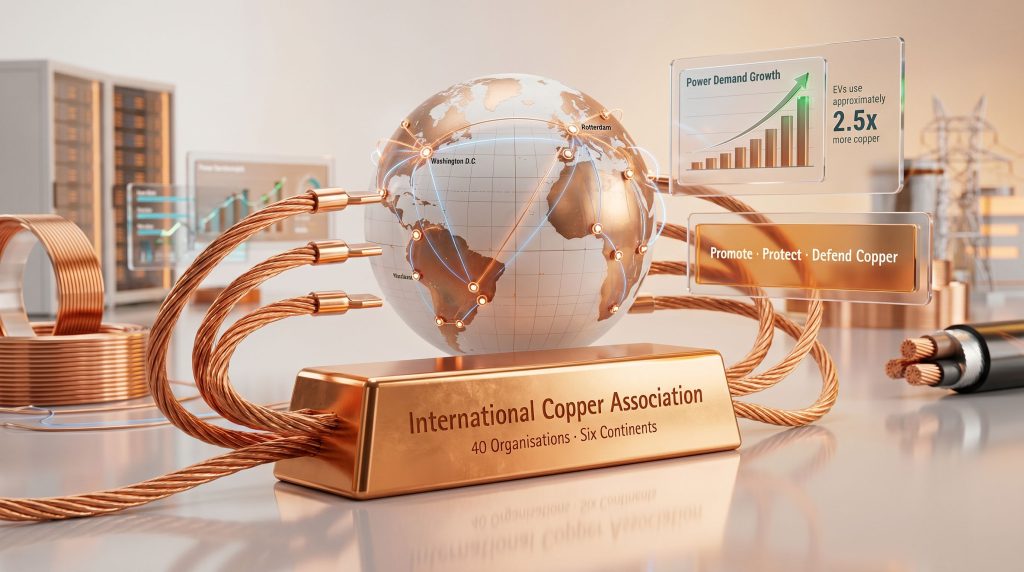
The International Copper Association operates as the global voice of the copper industry, but its mandate extends well beyond traditional industry representation. The ICA works to promote the value of copper across end-use markets, protect its commercial position against substitution risks, and sustain demand by engaging with policymakers, regulators, and industry stakeholders across the full supply chain.
The scale of its membership base is significant. The ICA represents more than 50% of global copper production through 40 member organisations spanning six continents. Headquartered in Washington, D.C., it maintains regional operational hubs across the United States, Europe, Asia, and Latin America, giving it genuine policy reach across the world's most important copper-consuming economies.
A Membership Ecosystem Built Across the Entire Value Chain
What distinguishes the ICA from narrower trade bodies is its intentional representation of the copper value chain from mine to end-use application. The membership structure spans:
| Member Category | Strategic Function |
|---|---|
| Upstream Producers | Supply-side advocacy and production data |
| Midstream Smelters and Refiners | Processing intelligence and quality standards |
| Downstream Fabricators and Manufacturers | Demand-side market development |
| Energy and Trading Participants (Emerging) | Market liquidity and price signal expertise |
This architecture allows the ICA to engage with policy debates from multiple vantage points simultaneously, whether the conversation is about renewable energy procurement, building efficiency standards, EV manufacturing targets, or grid modernisation investment. Vitol's addition, consequently, diversifies this ecosystem further by introducing a perspective historically absent from traditional copper industry bodies: that of the professional physical commodity trader.
What ICA Membership Actually Delivers
For a globally active commodities firm, ICA membership provides access to several strategically valuable resources:
- Coordinated industry advocacy on copper-related policy frameworks across key jurisdictions
- Participation in sustainability initiatives including the Copper Mark responsible sourcing standard and the circular economy framework
- Engagement with ICA's Copper Pathways Map, which tracks copper's role across decarbonisation scenarios
- Access to market intelligence data and member-only research that informs commercial decision-making
- Collaborative engagement with the full copper supply chain, from miners and smelters to fabricators and end-users
Vitol: A Company That Has Quietly Redefined Independent Trading
Established in Rotterdam in 1966, Vitol has grown from a regional oil trading operation into the world's leading independent energy trader. Its core business centres on the trading of crude oil, refined petroleum products, natural gas, and liquefied natural gas, supported by a portfolio of complementary energy infrastructure assets that enhance its physical trading capabilities across global markets.
What separates Vitol from financial commodity participants is its deep physical trading infrastructure. The firm's global logistics network, storage capacity, shipping relationships, and counterparty depth give it a structural advantage when navigating the complexities of physical commodity markets, including managing quality differentials, geographic arbitrage, and supply chain disruptions.
Why Copper? Decoding the Strategic Logic Behind the Expansion
The strategic reasoning behind Vitol's expansion into copper becomes clear when viewed through the lens of energy demand evolution. As Bruno Porto, Vitol's Head of Copper, noted in the ICA membership announcement, power demand is expected to continue growing structurally, and copper is fundamentally integral to the infrastructure enabling this growth. This is not a speculative position — it reflects a well-documented industrial reality.
Consider the copper intensity embedded across the emerging energy infrastructure stack:
- Electric vehicles require substantially more copper than conventional internal combustion engine vehicles, with estimates typically ranging from 60 to 80 kilograms per EV compared to roughly 20 to 25 kilograms for a traditional vehicle
- Offshore wind installations are among the most copper-intensive energy technologies, requiring significant wiring for both generation and offshore-to-onshore transmission cables
- Solar photovoltaic installations, battery storage systems, and EV charging networks all require copper-intensive electrical interconnection
- Grid modernisation programmes across North America, Europe, and Asia represent multi-decade capital deployment cycles, all of which depend on copper wiring, transformers, and conductors
"For a company like Vitol, which already possesses the physical trading infrastructure, counterparty networks, and logistics expertise to operate in complex global commodity markets, copper represents a natural adjacent market rather than an entirely new capability build."
The Appointment of a Dedicated Head of Copper: Reading the Signal
One of the most revealing aspects of this development is the existence of a dedicated Head of Copper role within Vitol's organisational structure. In commodity trading firms, the creation of a named leadership position for a specific commodity signals intentional, funded commitment — not opportunistic positioning.
Professional traders operating within major firms understand that resources follow conviction. When a firm appoints a senior figure to lead a copper trading desk, it is simultaneously allocating capital, building counterparty relationships, and investing in market intelligence infrastructure. The subsequent decision to join the ICA reinforces this commitment by embedding Vitol within the industry's primary advocacy and networking infrastructure. Indeed, Vitol's copper trading expansion has attracted considerable attention across the commodities sector.
What This Means for the Copper Market: Liquidity, Intelligence, and Advocacy
How Trading Firm Participation Changes Market Dynamics
The entry of sophisticated commodity traders into physical copper markets carries implications that extend beyond simple volume increases. Trading firms with deep physical infrastructure play a distinct role in commodity markets that differs from both producers and end-users.
Specifically, well-capitalised physical traders:
- Improve market liquidity by standing ready to buy and sell across a wider range of conditions and counterparties
- Reduce transaction costs through tighter bid-ask spreads driven by higher trading velocity
- Provide bridge financing and physical supply continuity during periods of market stress or supply disruption
- Enhance price discovery through active participation across spot, forward, and derivative markets
- Introduce geographic and grade arbitrage that helps align prices across regions and reduces persistent local market dislocations
However, it is equally important to acknowledge the countervailing dynamic. As major trading firms allocate larger books to copper, the market may experience increased financialisation, where price movements are amplified by trading positions disconnected from immediate physical supply and demand fundamentals. This is a pattern observed across other commodities that attracted significant trading firm interest during structural demand shifts.
Strengthening ICA's Advocacy Capabilities
From the ICA's perspective, Vitol's membership introduces a dimension of commercial market intelligence that complements the organisation's existing strengths in technical and policy advocacy.
ICA Chair Steven Rowland and CEO Juan Ignacio Díaz jointly acknowledged that Vitol's presence in the metals industry will help strengthen the ICA's core strategy of promoting, protecting, and defending copper. This language is precise and worth unpacking.
Trading firms possess something that producers and fabricators typically do not have in equal measure: real-time visibility into global physical copper flows. A major trader actively transacting across multiple geographies observes demand signals, supply bottlenecks, and pricing dynamics as they emerge — often before this information is captured in official statistics or public market data. Understanding the copper price growth drivers at play reinforces why this intelligence has meaningful value in shaping data-driven policy advocacy.
The Broader Trend: Energy-Metals Convergence Is Accelerating
Vitol joins the International Copper Association as one visible data point within a broader industry-wide trend of energy sector firms repositioning themselves for exposure to the metals that underpin the energy transition. Furthermore, this development should not be viewed as an isolated corporate event.
Three Scenarios for How This Strategy Could Evolve
| Strategic Pathway | Description | Key Indicators to Watch |
|---|---|---|
| Physical Trading Expansion | Vitol scales copper spot and term trading volumes globally | Rising copper trading volumes attributed to independent traders; increased ICA engagement |
| Infrastructure Investment | Vitol acquires equity in copper processing, warehousing, or logistics assets | Corporate announcements, capital expenditure disclosures, asset acquisitions |
| Upstream Participation | Vitol co-invests in copper mining or concentrate offtake agreements | Long-term supply agreements, project financing participation |
The first scenario is the most probable near-term pathway given alignment with Vitol's existing core competency in physical trading. The second follows a well-established playbook that Vitol and other major trading firms have executed successfully in energy infrastructure. The third represents a higher capital intensity commitment, more likely to emerge over a longer time horizon if copper markets remain structurally tight. In any scenario, the future of copper mining will be shaped by exactly these kinds of strategic commitments from major market participants.
Why Supply Constraints Are Amplifying Trader Interest
One dimension of copper market dynamics that receives less mainstream attention is the structural challenge facing the supply side. New copper mine development requires long lead times, typically spanning a decade or more from discovery to first production. Ore grades at existing mines have been declining over recent decades as easily accessible high-grade deposits are progressively depleted.
This emerging copper supply crunch, layered against the demand growth driven by electrification, creates precisely the kind of structural imbalance that sophisticated commodity traders are built to navigate. When supply is tight and demand is growing, physical trading firms that can source, move, and deliver material efficiently extract significant commercial value from the resulting price volatility and geographic differentials.
"The combination of declining ore grades at existing mines, multi-decade permitting timelines for new projects, and accelerating copper demand from the energy transition creates a supply-demand dynamic that is fundamentally different from the cyclical imbalances traders have historically managed."
Copper's Irreplaceable Role in the Electrification Economy
A point worth emphasising for readers less familiar with materials science is why copper specifically occupies this strategic position rather than an alternative conductor. Copper's electrical conductivity is second only to silver among commercially available metals, combining high conductivity with mechanical strength, corrosion resistance, ease of fabrication, and full recyclability at commercial scale.
Aluminium is used as a substitute in some high-voltage transmission applications, but copper's superior conductivity per unit cross-section makes it the preferred material wherever installation space, heat management, or weight constraints matter. This is why electric motors, transformers, inverters, and charging infrastructure all rely predominantly on copper rather than aluminium.
The recyclability factor deserves particular attention. Copper is one of the few industrial materials that retains its full physical properties through recycling. Secondary copper, produced from scrap, accounts for a substantial portion of global copper supply and can be reintroduced into the value chain at a fraction of the energy cost of primary smelting. The ICA's circular economy and urban mining initiatives reflect this reality, positioning copper's recyclability as both an environmental advantage and a supply security mechanism.
The next major ASX story will hit our subscribers first
Key Indicators to Monitor as This Story Develops
For those tracking the intersection of commodity trading and energy transition metals — and evaluating relevant copper investment strategies — the following developments will be particularly informative:
- Whether other major independent energy trading firms announce similar expansions into copper or adjacent critical minerals
- The trajectory of Vitol's physical copper trading volumes and the breadth of its counterparty relationships
- ICA policy submissions and advocacy initiatives that draw on Vitol's commercial market intelligence
- Copper price behaviour during periods of market stress, and whether increased trading firm participation affects volatility patterns
- Long-term offtake agreements or infrastructure investments indicating Vitol is deepening its copper commitment beyond pure trading
The decision by Vitol to join the International Copper Association is a compact announcement with significant strategic implications. It reflects how the boundary between energy trading and metals markets is not merely blurring but actively dissolving, driven by the inexorable logic of a world that needs more copper to build the infrastructure of its energy future.
This article is intended for informational purposes only and does not constitute financial or investment advice. Readers should conduct their own due diligence before making any investment decisions. All figures relating to copper intensity in EVs and renewable energy systems reflect estimates from publicly available industry research and may vary depending on source methodology and technology specifications.
Want to Capitalise on the Structural Shift Driving Copper Demand?
Discovery Alert's proprietary Discovery IQ model delivers real-time alerts on significant ASX copper and critical mineral discoveries, instantly translating complex geological data into actionable investment insights — so subscribers can position themselves ahead of the broader market. Explore Discovery Alert's dedicated discoveries page to understand how historic mineral discoveries have generated substantial returns, and begin a 14-day free trial to secure a market-leading edge as the energy transition reshapes commodity markets.