
May 15, 2026
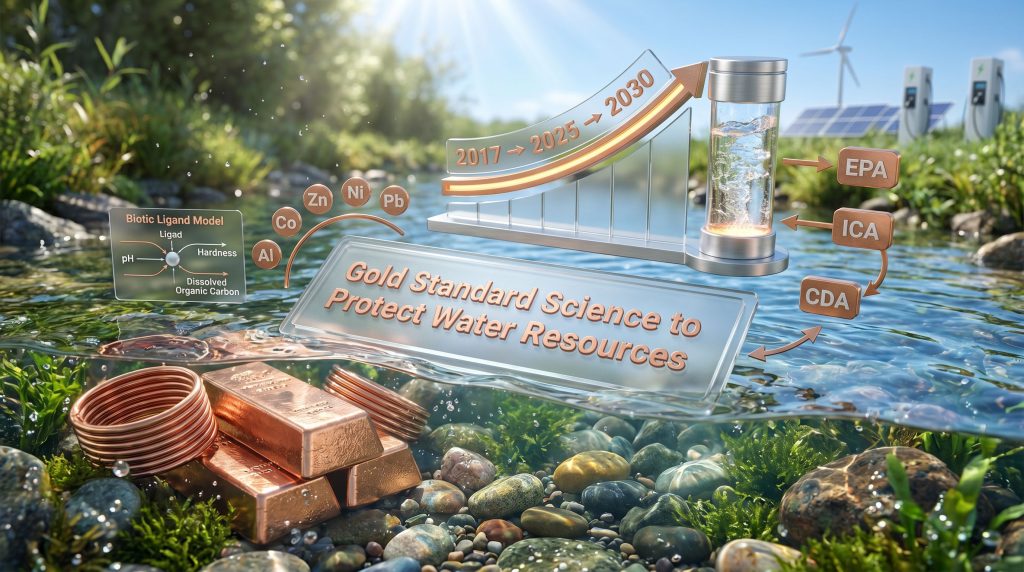
When Environmental Governance Meets Industrial Reality: The Science Behind Copper Water Standards
Environmental regulation rarely moves in straight lines. The standards governing how much of a given metal can safely exist in a river, estuary, or coastal waterway are not fixed in stone — they are living scientific constructs, continuously updated as aquatic toxicology research deepens and analytical methods improve. For industries that mine, refine, fabricate, or install copper at scale, the trajectory of these standards carries real economic weight. Regulatory thresholds that are too aggressive relative to actual ecological risk can distort supply chains, inflate compliance costs, and create investment uncertainty across sectors that depend on copper-intensive infrastructure.
This is precisely why the renewal of the International Copper Association U.S. EPA research partnership, confirmed in April 2026, matters beyond a routine administrative update. It reflects a durable model for keeping regulatory science current, proportionate, and credible — with implications that extend well beyond a single metal. Furthermore, understanding the broader copper supply trends helps contextualise why proportionate regulation is so commercially significant.
When big ASX news breaks, our subscribers know first
What CRADAs Actually Do (and Why That Matters for Metals Policy)
At the centre of this collaboration is a legal instrument that most people outside federal regulatory circles have never encountered: the Cooperative Research and Development Agreement, or CRADA. Authorised under U.S. law, CRADAs allow federal agencies and private entities to exchange data, expertise, and research outputs without direct monetary transfer between the parties. They are not grants, not contracts, and not lobbying vehicles. They are structured scientific collaborations, governed by shared methodological standards and subject to the same peer-review requirements as federally funded research.
For water quality science specifically, CRADAs fill a critical gap. The U.S. Environmental Protection Agency has the regulatory authority to set national ambient water quality criteria (AWQC) for metals, but it does not always possess the volume of site-specific ecotoxicological data needed to make those determinations with high precision. Industry, by contrast, often holds extensive datasets on how metals behave across diverse aquatic environments but lacks a formal, credible pathway to contribute that data to regulatory processes. CRADAs bridge this gap.
The legitimacy of industry-contributed data in regulatory science depends entirely on methodological transparency. For a CRADA-generated dataset to influence federal criteria, it must satisfy the same peer-review standards applied to any EPA-funded study — a requirement that simultaneously protects scientific integrity and limits the scope for self-serving submissions.
The eight-association metals coalition operating under this framework spans a broad range of industrially critical materials, including aluminium, cobalt, copper, lead, zinc, and nickel. The breadth of this coalition is significant: it suggests that the science-based regulatory engagement model pioneered in copper is being deliberately extended across the full spectrum of metals that modern industrial economies depend upon.
The ICA–EPA Partnership: Nine Years of Continuous Science
The formal research collaboration between the International Copper Association, its U.S. affiliate the Copper Development Association (CDA), and the EPA was first established in 2017. The original CRADA created an institutional channel for the copper industry to contribute peer-reviewed ecotoxicological data directly to the EPA's water quality criteria development process — a significant structural innovation in how metals regulation is approached in the United States.
The April 2026 renewal of the International Copper Association U.S. EPA research partnership extends this collaboration into a new phase, building on nearly a decade of joint scientific work. Both the ICA and CDA have publicly stated their commitment to advancing the science needed to evaluate safe copper concentrations in both freshwater and marine ecosystems — not as a defensive posture against regulation, but as a proactive investment in the credibility of the standards themselves.
Key Institutional Stakeholders
| Stakeholder | Role |
|---|---|
| U.S. Environmental Protection Agency (EPA) | Regulatory authority setting national ambient water quality criteria |
| International Copper Association (ICA) | Global copper industry science coordination and advocacy |
| Copper Development Association (CDA) | U.S.-based ICA affiliate; primary industry liaison to EPA under the CRADA |
| Eight-Association Metals Coalition | Broader multi-metal science collaboration covering aluminium, cobalt, copper, lead, zinc, and nickel |
The CDA's role as the operational interface between ICA's global science programmes and EPA's regulatory machinery is particularly important. As the U.S.-registered affiliate of the ICA, it carries both the institutional credibility and the jurisdictional standing to engage directly with federal regulatory processes in a way that a purely international body could not.
How Copper Toxicity Science Actually Works
One of the least understood aspects of metals water quality regulation is that a single copper concentration threshold cannot adequately protect aquatic ecosystems across all water body types. Copper's toxicity to aquatic organisms is not a fixed quantity — it varies substantially depending on local water chemistry conditions. The three variables with the greatest influence are:
- pH levels (more acidic water generally increases copper bioavailability)
- Water hardness (calcium and magnesium ions compete with copper at biological binding sites, reducing toxicity in hard water)
- Dissolved organic carbon (DOC) (organic matter binds copper ions, reducing the fraction available to interact with aquatic life)
This is why regulatory science has moved toward chemistry-adjusted, site-specific criteria rather than universal thresholds. The Biotic Ligand Model (BLM) is the primary scientific framework used to account for this variability. By incorporating water chemistry inputs, the BLM calculates the concentration of copper ions that will actually bind to biological targets in aquatic organisms under local conditions — producing toxicity predictions that are far more ecologically meaningful than static, one-size-fits-all limits.
The practical implication is significant. A copper concentration that poses genuine ecological risk in a soft, low-DOC mountain stream may be entirely benign in a hard, organically rich lowland river. Regulatory standards that fail to account for this distinction are both scientifically inaccurate and potentially counterproductive — either over-restricting copper in low-risk environments or failing to protect genuinely vulnerable ecosystems.
From Laboratory to Federal Register: The Science Pipeline
The journey from ecotoxicological data to enforceable water quality criteria involves multiple stages of review and institutional validation:
- Data generation: Ecotoxicological studies are conducted under standardised protocols to measure chronic and acute copper toxicity across aquatic species
- Peer review: Submitted studies undergo independent scientific review meeting EPA's data quality standards
- CRADA submission: Industry-contributed data is formally incorporated into the collaborative research programme
- EPA integration: EPA's Office of Water evaluates all available data, including CRADA contributions, in developing updated national ambient water quality criteria
- Public notice and comment: Proposed criteria revisions are published for stakeholder input before finalisation
- Criteria adoption: Final criteria are issued and may be incorporated into state water quality standards
Regulatory Landscape: AWQC, LCRI, and the Dual Standard Problem
A common source of confusion in copper regulation is the distinction between two entirely separate regulatory frameworks that both involve copper and water:
- Ambient Water Quality Criteria (AWQC): Governed by the Clean Water Act, these standards protect aquatic ecosystems from copper pollution in rivers, lakes, estuaries, and coastal waters. They are the primary focus of the ICA–EPA CRADA partnership.
- Drinking Water Standards (MCLs): Governed by the Safe Drinking Water Act, these set maximum contaminant levels for copper in water delivered to consumers through distribution systems.
Both frameworks matter to the copper industry, but they address fundamentally different exposure pathways and are developed through separate regulatory processes. The EPA's Lead and Copper Rule Improvements (LCRI), proposed in 2023 with public comment periods extending through late 2024, primarily addresses drinking water infrastructure — specifically the replacement of lead service lines and monitoring requirements for copper corrosion in distribution systems. While the LCRI does not directly set ambient aquatic criteria, it creates overlapping regulatory considerations for how copper concentration thresholds are communicated and managed across the water policy landscape.
Disclaimer: Regulatory timelines and rule finalisation dates are subject to change. Readers should consult current EPA publications and the Federal Register for the most recent status of the LCRI and related rulemaking.
Copper's Role in the Energy Transition and Why Regulatory Clarity Is a Commercial Issue
The stakes of getting copper water quality regulation right have grown substantially as the metal's centrality to decarbonisation infrastructure has become undeniable. Indeed, critical minerals in the energy transition are facing unprecedented demand pressures, and copper sits firmly at the centre of that dynamic. Copper is the primary conductor in virtually every electrical system that powers the modern economy, and its demand profile is set to intensify considerably as electrification expands:
- Electric vehicles use two to four times more copper than equivalent internal combustion engine vehicles
- Offshore wind turbines require significant copper quantities in generators, cabling, and grid connections
- Solar photovoltaic installations depend on copper wiring and inverter components
- Grid-scale battery storage systems and EV charging networks are both copper-intensive at the infrastructure level
Against this backdrop, regulatory unpredictability around copper water standards is not merely an environmental compliance issue — it is a supply chain risk. When environmental thresholds shift in ways that are not grounded in the best available science, they can create legal uncertainty for mining operations, processing facilities, and infrastructure projects. Proportionate, evidence-based standards reduce this uncertainty and support the investment confidence needed to scale copper supply in line with electrification timelines. Consequently, commodity price impacts from regulatory shifts can ripple across entire mining portfolios.
The next major ASX story will hit our subscribers first
Multi-Metal Dimensions: Why the Eight-Association Coalition Matters
The breadth of the coalition participating in the renewed EPA partnership reflects a deliberate strategy within the metals industry: rather than pursuing regulatory engagement metal by metal, the coalition approach establishes a shared scientific framework applicable across aluminium, cobalt, copper, lead, nickel, and zinc simultaneously.
This matters for several reasons:
- Regulatory consistency: A unified methodological approach reduces the risk of inconsistent treatment across metals that share similar aquatic toxicology characteristics
- Scientific efficiency: Pooling research resources across multiple metals associations allows for more comprehensive ecotoxicological datasets than any single metal's industry could generate alone
- Policy signal: The coalition's scale demonstrates that science-based regulatory engagement is an industry-wide norm, not a practice unique to a single commodity
The alignment between this multi-metal framework and broader U.S. critical minerals demand considerations — which identify copper, cobalt, and nickel as strategically essential for national energy and defence supply chains — adds another dimension to the partnership's significance. However, it is important to note that this alignment reflects broader policy context rather than any specific project-level support or designation.
Copper Stewardship and ESG: The Life Cycle Dimension
The renewed ICA–EPA partnership also connects to the copper industry's positioning within environmental, social, and governance (ESG) disclosure frameworks. The ICA's Copper Life Cycle Assessment (LCA) programme quantifies the environmental impacts of copper across its full value chain — from ore extraction and smelting through fabrication, use, and end-of-life recycling. This methodology provides a scientifically defensible basis for environmental claims that increasingly matter in green procurement decisions and investor due diligence processes.
Water quality science sits directly within this LCA framework. Credible, peer-reviewed data on copper's aquatic environmental profile strengthens the evidentiary basis for responsible sourcing claims and supports copper's competitiveness relative to substitute materials in applications where environmental performance is evaluated. In addition, copper investment strategies increasingly factor in a producer's regulatory track record as a material consideration.
Collaborative Outputs: What the Partnership Produces
| Collaboration Type | Regulatory or Market Output | Primary Beneficiary |
|---|---|---|
| Water quality CRADA | Updated ambient water quality criteria for copper in aquatic ecosystems | Aquatic ecosystems; copper industry |
| Lead and Copper Rule engagement | Drinking water infrastructure standards development | Municipal water systems; consumers |
| Copper LCA data programme | ESG and green procurement frameworks | Manufacturers; institutional investors |
| Antimicrobial copper data library | EPA-registered efficacy claims for copper alloy surfaces | Public health; healthcare and building sectors |
The Policy Outlook: What Renewal Signals for the Decade Ahead
The decision to renew the International Copper Association U.S. EPA research partnership in 2026 carries forward implications across three time horizons:
Near term (2025–2027):
- Completion of updated ambient water quality criteria informed by the renewed CRADA science programme
- Continued industry engagement with the EPA's LCRI finalisation process
- Integration of CRADA-generated ecotoxicological data into EPA guidance and criteria documents
Medium term (2027–2030):
- Potential expansion of the multi-metal coalition framework as critical minerals policy evolves at the federal level
- Growing alignment between EPA water quality science and emerging international standards, including those developing under the European Union's Water Framework Directive and Critical Raw Materials Act
- Increasing investor focus on regulatory engagement track records as a material ESG factor in mining and metals sector analysis
Longer term:
- The durability of science-based regulatory frameworks as a competitive moat for responsible copper producers relative to jurisdictions with less rigorous environmental governance
- The ICA's ongoing mission to position copper as an indispensable enabler of the global energy transition, with regulatory credibility as a foundational element of that positioning
The most durable competitive advantage the copper industry can build in an era of accelerating electrification demand is not price, not grade, and not geography — it is the institutional credibility that comes from consistently advancing regulatory science rather than contesting it.
The renewal of this research partnership is, at its core, a statement about methodology: that the most defensible path to proportionate environmental regulation is through transparent, peer-reviewed science generated collaboratively between the parties who understand the data best. For an industry whose growth trajectory is increasingly tied to the global energy transition, that methodology may prove to be one of its most durable long-term assets.
Further information on the EPA's water quality criteria development process is available via the official EPA public-private partnership announcement. Additional context on the International Copper Association's science and sustainability programmes is available at internationalcopper.org.
This article contains forward-looking statements and regulatory timeline references that are subject to change. Readers are advised to consult primary regulatory sources including the Federal Register and EPA official publications for current information. Nothing in this article constitutes investment advice.
Want To Capitalise on the Next Major Copper Discovery Before the Market Catches On?
As copper demand accelerates across electrification and energy transition infrastructure, identifying significant ASX copper discoveries at the moment of announcement has never been more commercially valuable. Discovery Alert's proprietary Discovery IQ model delivers real-time alerts on significant mineral discoveries — including copper — the moment they hit the ASX, transforming complex geological data into actionable insights, and its dedicated discoveries page showcases the historic returns that major discoveries have delivered. Begin your 14-day free trial today and position yourself ahead of the broader market.