
June 10, 2026
Australia's Transmission Infrastructure at a Crossroads
Across the National Electricity Market, a fundamental tension is playing itself out in slow motion. The energy transition demands vast quantities of new generation capacity, yet generation without transmission is stranded power. Nowhere is this dynamic more visible than in remote Australia, where resource-rich regions sit disconnected from the grid infrastructure that would unlock their full economic and industrial potential. High-voltage transmission lines are, in this context, not merely engineering projects but economic multipliers, capable of transforming isolated mineral corridors into viable industrial precincts almost overnight.
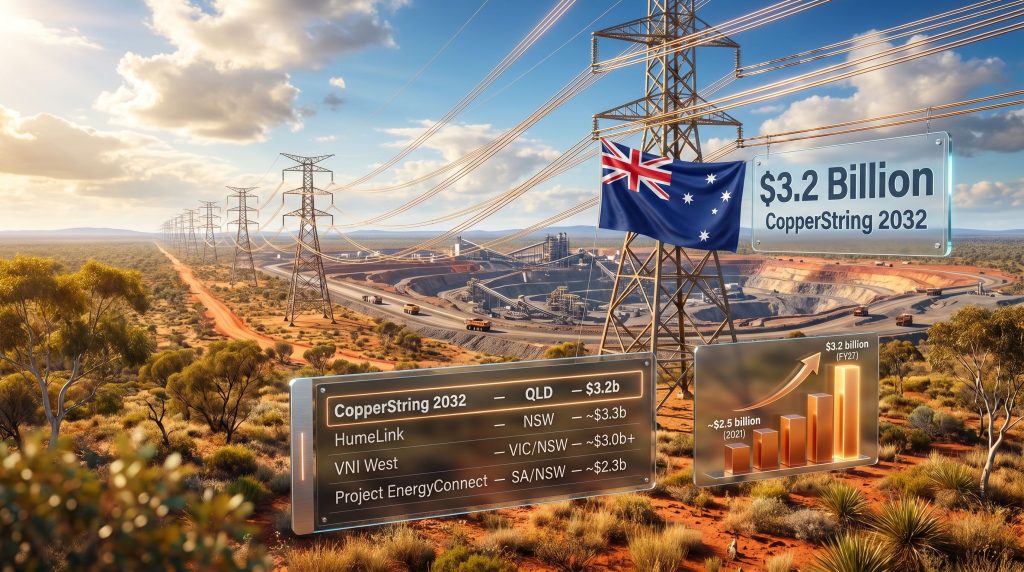
It is within this broader structural reality that the Queensland Government's decision to commit an additional $420 million to the CopperString 2032 project in its FY27 State Budget takes on its fullest significance. With this latest allocation, the CopperString budget hits record $3.2b in total committed public investment, confirming the project's position as one of the most substantial transmission infrastructure undertakings in Queensland's history.
When big ASX news breaks, our subscribers know first
Understanding the CopperString 2032 Project
CopperString 2032 is a high-voltage transmission line project designed to connect North West Queensland's resource-laden interior to the National Electricity Market (NEM). The line would extend from the existing grid at Townsville, running approximately 1,500 kilometres westward to reach the Mount Isa region, one of Australia's most historically significant base metals producing areas.
The project's name encodes its delivery ambition, with 2032 representing the target completion window. Upon completion, CopperString would be one of the longest new transmission corridors constructed in Australia in modern times, capable of delivering reliable grid power to communities and industrial operations that have historically depended on expensive diesel generation or isolated power systems.
What the Transmission Line Would Actually Deliver
Beyond raw distance, the technical scope of CopperString encompasses:
- High-voltage alternating current (HVAC) transmission infrastructure rated to carry significant industrial loads
- New substation infrastructure at multiple points along the corridor
- Grid integration works connecting to the NEM at the Townsville end
- Provision for renewable energy injection from solar and wind resources along the route
- Improved energy reliability for existing mining operations and regional communities in the Mount Isa basin
The renewable energy dimension is particularly significant. Because the corridor traverses some of Queensland's highest solar irradiance zones, CopperString creates the physical infrastructure through which large-scale renewable energy generation could be built and dispatched into the broader grid, supporting Queensland's stated renewable energy objectives.
Breaking Down the $3.2 Billion Budget Commitment
The FY27 State Budget allocation of $420 million brings cumulative committed public investment to $3.2 billion. It is important to understand what this figure represents and what it does not. The $3.2 billion reflects the Queensland Government's confirmed capital commitment as disclosed through its budget process, rather than an independent whole-of-project cost estimate.
The project's cost trajectory has evolved considerably since its earliest public incarnations:
| Budget Milestone | Estimated Cost | Period |
|---|---|---|
| Initial Project Estimate | ~$2.5 billion | December 2021 |
| Revised Upward Estimate | ~$5.0 billion | March 2023 |
| Current State Budget Commitment | $3.2 billion | FY27 (June 2026) |
| FY27 Incremental Allocation | $420 million | June 2026 |
The $3.2 billion figure represents the Queensland Government's committed public investment envelope as disclosed in the FY27 State Budget. It is distinct from broader project cost estimates that have varied considerably depending on scope assumptions and cost methodology applied at different points in time.
Why Transmission Costs Keep Rising Across Australia
CopperString's cost evolution is not an outlier. Across the NEM, large-scale transmission projects have consistently seen upward revisions driven by a consistent set of structural pressures:
- Labour and logistics premiums in remote and regional construction environments, where skilled crews, accommodation, and site access all carry significant cost loadings
- Materials inflation affecting steel towers, copper and aluminium conductors, transformer equipment, and civil construction inputs
- Environmental and heritage compliance requirements that can trigger design changes, route modifications, and extended approval timelines
- Grid integration complexity that expands as renewable energy targets evolve and system planning requirements become more sophisticated
A comparison with other major transmission builds currently underway or recently completed across Australia illustrates that this dynamic is systemic rather than project-specific. Furthermore, the Australian Energy Regulator's analysis of electricity networks reinforces how broadly these cost pressures are being felt across the sector:
| Project | State | Estimated Cost | Status |
|---|---|---|---|
| CopperString 2032 | QLD | $3.2b (committed) | Under development |
| HumeLink | NSW | ~$3.3b | Under construction |
| VNI West | VIC/NSW | ~$3.0b+ | Planning phase |
| Project EnergyConnect | SA/NSW | ~$2.3b | Operational |
Cost escalation in large transmission projects is a pattern observed consistently across the National Electricity Market. The critical evaluative question is not whether costs have risen, but whether the economic value enabled by the infrastructure justifies the revised investment commitment.
The Resource Endowment Case: Why North West Queensland Needs This Infrastructure
The economic logic underpinning CopperString is rooted in the mineral wealth of the North West Queensland region. The Mount Isa basin hosts one of the most significant polymetallic resource concentrations in the Southern Hemisphere. Key commodities include:
- Copper, a foundational industrial and clean energy metal experiencing structural demand growth from electrification trends
- Zinc and silver, co-products of lead-zinc mining operations with well-established global markets
- Cobalt, a critical battery metal present in association with some base metal deposits in the region
- Phosphate, relevant to agricultural supply chains and increasingly to industrial applications
The challenge these resources face is fundamentally an energy access problem. Remote mining operations disconnected from the grid must generate their own power, typically through diesel, which carries high operating costs, logistical complexity, and carbon intensity. Australia's critical minerals sector stands to benefit considerably from grid connection through CopperString, which would fundamentally alter the economics of both existing and potential new operations by:
- Reducing energy costs per unit of production significantly compared to diesel generation
- Enabling electrification of process loads currently running on fossil fuels
- Creating the conditions for renewable energy power purchase agreements, further reducing operating costs
- Unlocking economically marginal deposits that were previously unviable due to prohibitive power costs
The Stranded Asset Problem in Remote Minerals
A less-discussed dynamic in the CopperString conversation is the concept of the stranded resource. Across North West Queensland, there are known mineral deposits that have been explored, partially characterised, and then effectively shelved, not because the geology is insufficient, but because the power cost to develop them commercially renders the economics unworkable.
Reliable, competitively priced grid electricity has the potential to reclassify a meaningful portion of these resources from marginal to viable. This is a materially different value proposition than simply servicing existing mines. CopperString's completion could catalyse an entirely new wave of resource development across the corridor, with flow-on effects for exploration activity, tenement values, and regional employment.
Is the Budget Escalation a Warning Sign or a Rational Repricing?
For observers tracking the project's cost history, the journey from an initial ~$2.5 billion estimate in 2021 to a $5.0 billion revised figure in 2023, and now a $3.2 billion committed envelope in 2026, raises legitimate questions about project scope, cost control methodology, and delivery confidence.
Several interpretive frameworks are worth applying here:
Scope-adjusted repricing occurs when a project's technical requirements evolve beyond the original conception, requiring additional infrastructure, enhanced specifications, or route modifications. This is distinct from pure cost overrun, which implies the same scope delivered at higher than anticipated cost.
Optimism bias is a well-documented phenomenon in large infrastructure projects globally, where initial estimates systematically understate final costs. Research by infrastructure economists suggests this bias is particularly pronounced in greenfield projects with high technical and environmental uncertainty, which describes CopperString precisely.
Market timing effects mean that the 2021 estimate was produced in a cost environment that has since experienced significant inflation in construction labour, materials, and equipment. The same physical scope costs meaningfully more to deliver in 2025–26 than it would have in 2021.
Understanding which combination of these factors is driving the CopperString budget trajectory is important for assessing the credibility of the current $3.2 billion commitment figure and the likelihood of further revisions before 2032.
Regional and Economic Multiplier Effects
Large transmission infrastructure projects of this scale generate economic value beyond their direct construction activity. For North West Queensland, the multiplier effects of CopperString's completion would likely operate across several dimensions:
- Direct construction employment, estimated to involve thousands of workers across the multi-year build phase, generating wages and local expenditure across Townsville and North West Queensland communities
- Operational employment in new and expanded mining and processing operations enabled by grid access
- Supply chain activation across engineering, logistics, materials supply, and technical services sectors
- Community services demand growing in tandem with increased regional population and economic activity
The broader historical evidence from comparable transmission-enabled resource development in Australia suggests that the catalytic effect on surrounding resource investment can be several multiples of the transmission infrastructure spend itself. However, precise multiplier estimates vary considerably depending on the assumptions applied. In addition, Australia's resource export capacity could be meaningfully enhanced if projects like CopperString successfully unlock previously stranded mineral endowments.
The next major ASX story will hit our subscribers first
Delivery Risks and Timeline Pressures
Achieving a 2032 completion target from a 2026 budget commitment requires sustained execution across several parallel workstreams:
- Finalisation of environmental impact assessments and regulatory approvals along the full corridor length
- Resolution of native title and cultural heritage obligations with Traditional Owner groups along the route
- Procurement of long-lead transmission equipment, including high-voltage transformers and switchgear, which globally face extended delivery timelines due to supply chain constraints
- Mobilisation of specialist high-voltage construction crews in a market where such skills are in tight supply across multiple concurrent Australian and global projects
The global transmission equipment supply chain deserves particular attention. High-voltage power transformers, a critical component of any major transmission project, currently face manufacturing lead times of three to five years in some cases, driven by surging global demand for grid infrastructure. Early procurement decisions are therefore not merely logistical considerations but strategic imperatives for projects with fixed delivery targets.
Frequently Asked Questions: CopperString Budget and Project Status
What is the current total budget for CopperString?
The Queensland Government's committed investment in CopperString now stands at $3.2 billion, following a $420 million allocation in the FY27 State Budget announced in June 2026.
Why has the CopperString budget increased over time?
Project cost estimates have been revised upward at multiple points since inception, reflecting expanded scope, materials cost inflation, remote construction premiums, and evolving grid integration requirements. This pattern is consistent with large-scale transmission projects across Australia.
When is CopperString expected to be completed?
The project name references 2032 as its target completion window, though delivery timelines remain subject to approvals, procurement outcomes, and construction progress.
What regions will CopperString connect?
The transmission line is designed to connect North West Queensland's resource regions, centred on the Mount Isa area, to the National Electricity Market via Townsville, enabling reliable grid power access for industrial and community users.
How does CopperString support Australia's critical minerals sector?
By delivering competitively priced, reliable grid electricity to remote mining regions, CopperString has the potential to reduce operating costs for existing producers. Furthermore, the critical minerals energy transition agenda gives additional weight to projects that can unlock deposits of copper, zinc, cobalt, and phosphate that are central to global clean energy supply chains.
CopperString as a Template for Resource-Enabling Transmission
The deeper significance of the CopperString budget hits record $3.2b extends well beyond Queensland's borders. Australia's resource wealth is disproportionately located in remote regions that lack grid connectivity, a structural mismatch that affects project economics across Western Australia, the Northern Territory, and parts of South Australia equally.
CopperString, if successfully delivered, would offer a replicable model for how public transmission investment can unlock private resource sector capital at scale. The economic logic is straightforward: where the enabling infrastructure cost is justified by the value of resources unlocked, public investment in transmission can generate returns through royalties, taxes, employment, and supply chain activity that far exceed the initial capital outlay. Consequently, copper and uranium investment across Australia and comparable markets could see meaningful uplift as grid-enabling projects mature.
For investors, analysts, and policymakers watching Australia's critical minerals ambitions, CopperString represents a high-stakes test of whether the country can actually build the enabling infrastructure its resource endowment requires, on time, within a credible budget, and with the grid integration quality that modern mining and processing operations demand.
This article contains forward-looking statements and projections regarding project timelines, economic multipliers, and cost trajectories. These involve inherent uncertainty and should not be relied upon as financial advice. Readers are encouraged to conduct independent analysis and consult qualified advisers before making any investment decisions related to projects or sectors discussed herein.
Readers seeking ongoing coverage of Queensland's energy infrastructure pipeline and transmission investment developments can explore related reporting via the Australian Mining Review at australianminingreview.com.au.
Want to Track the ASX Mineral Discoveries Unlocked by Infrastructure Like CopperString?
As transmission projects open up previously stranded resource corridors across North West Queensland and beyond, new mineral discoveries on the ASX are poised to follow — and Discovery Alert's proprietary Discovery IQ model delivers real-time alerts the moment significant discoveries are announced, turning complex mineral data into actionable investment insights. Explore historic examples of major discovery returns on Discovery Alert's dedicated discoveries page, and begin your 14-day free trial today to position yourself ahead of the broader market.