June 10, 2026
The Structural Shift Redefining How Industrial Metals Create Value
For most of the past century, the economics of aluminium production followed a familiar pattern: mine bauxite, refine it into alumina, smelt it into primary metal, and sell it at whatever price the London Metal Exchange happened to be quoting that week. The business model rewarded scale and energy efficiency above everything else. Margins were thin, cyclical, and largely outside any producer's control.
That model is fracturing. Across the global aluminium industry, the producers capturing the most durable earnings growth are not those with the largest smelting capacity, but those who have invested most aggressively in converting primary metal into application-specific, high-specification downstream products. The Hindalco value-added aluminium business growth story sits at the centre of this structural transition, and the financial results emerging from its downstream segment suggest the inflection point has moved well beyond theory.
When big ASX news breaks, our subscribers know first
From Metal Producer to Downstream Manufacturer: Understanding the Strategic Logic
Why Primary Aluminium Alone Cannot Sustain Earnings Growth
Primary aluminium pricing is almost entirely a function of global LME benchmarks, energy input costs, and macroeconomic demand cycles. A smelter in India faces the same price ceiling as one in Canada or the Middle East. The only levers available are cost reduction and volume expansion, both of which face physical and capital limits over time.
Downstream value-added products operate under an entirely different commercial framework. Pricing is negotiated against customer specifications, application complexity, dimensional tolerances, surface quality, and supply reliability. A battery enclosure for an electric vehicle platform is not priced against LME aluminium. It is priced against the engineering performance it must deliver, the qualification process the supplier has passed, and the supply chain security the customer requires. This structural repricing of aluminium away from commodity benchmarks is the core earnings quality argument underpinning Hindalco's high-value aluminium strategy.
The 2018 Capital Reallocation Decision
Hindalco's leadership began deliberately shifting capital allocation toward downstream operations in 2018. This was not a reactive response to commodity price weakness but a proactive portfolio repositioning decision, recognising that the next phase of industrial aluminium demand, driven by electrification, lightweighting, and infrastructure build-out, would reward manufacturers capable of producing precision-engineered products over those simply producing ingot.
The company is now entering the harvest phase of that multi-year investment cycle. Capital deployed from 2018 onward into flat-rolled products, extrusions, fabricated components, and branded building products is beginning to generate the returns that were projected when the original allocation decisions were made.
Defining the Downstream Portfolio: What Value-Added Actually Means
The Spectrum From Standard to Premium
The term value-added aluminium covers a wide range of products, and not all command equal premiums. Understanding the distinction between product tiers is important for assessing margin quality.
| Product Category | Application Sector | Margin Profile vs. Primary Aluminium |
|---|---|---|
| Flat-Rolled Products (FRP) | Automotive, Packaging, Industrial | Significantly Higher |
| Battery Enclosures | EV and Energy Storage | Premium |
| High-End Extrusions | Construction, Transport, Data Centres | Higher |
| AC Fins | HVAC and Cooling Infrastructure | Moderate-High |
| Eternia Window Systems | Residential and Commercial Construction | Branded Premium |
At the lower end of the downstream spectrum, standard flat-rolled products still command meaningful premiums over primary metal, largely because of the processing cost and equipment intensity involved. At the higher end, products such as battery enclosures for electric vehicle platforms or precision extrusions for data centre thermal management carry premiums that reflect qualification barriers, design collaboration with customers, and long-term supply agreements.
Premiumisation Is Not Simply Volume Growth
A critical distinction often missed in surface-level analysis of downstream aluminium businesses is the difference between volume-driven revenue growth and mix-driven margin expansion. A producer can increase downstream volumes significantly while still generating modest EBITDA growth if the product mix skews toward lower-value categories. True premiumisation occurs when a growing proportion of volume shifts into higher-specification, application-critical products where pricing power is structurally superior. Hindalco's Q1 FY26 results suggest the mix shift is real.
Q1 FY26 Downstream Performance: Reading the Numbers Carefully
The 108% EBITDA Jump in Context
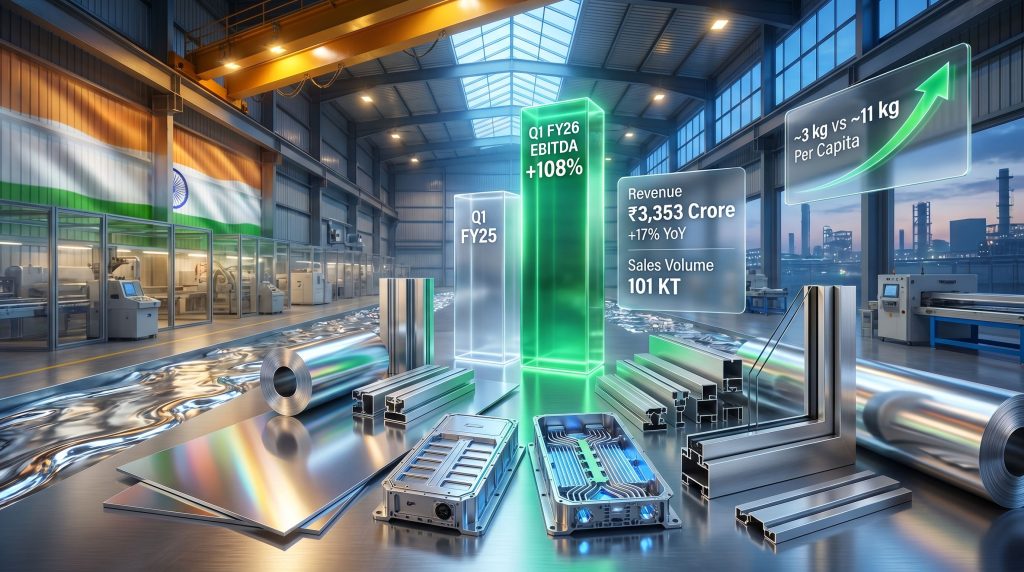
The headline figures from Hindalco's downstream segment in the first quarter of FY26 are striking:
- Sales Volume: 101 kilotonnes, up 6% year-on-year
- Revenue: ₹3,353 crore, up 17% year-on-year
- EBITDA: ₹229 crore, up 108% year-on-year
- Key contributors: Battery enclosure ramp-up, premium flat-rolled product mix improvement, higher value-added product contribution
The divergence between volume growth of 6% and revenue growth of 17% immediately signals that realised pricing per tonne improved substantially. The further divergence between 17% revenue growth and 108% EBITDA growth confirms that the revenue improvement was concentrated in higher-margin product categories rather than being diluted across the full portfolio.
This pattern, where EBITDA grows at a multiple of revenue growth, is the financial signature of successful product mix premiumisation. It is difficult to sustain unless the underlying customer relationships, product qualifications, and manufacturing capabilities genuinely support a higher-value product position. Furthermore, the commodity price exposure inherent in primary aluminium becomes progressively less dominant as this mix shift continues.
What a 15 to 18% Annual EBITDA Growth Target Signals
Hindalco has outlined a target of approximately 15 to 18% annual EBITDA growth from its downstream segment over a five-year horizon. At the lower bound of this range, the segment's operating profit would roughly double over the five-year period. At the upper bound, it would more than double. For a segment that generated ₹229 crore in a single quarter, the compounding implications for group-level earnings quality are material.
A 15% compound annual growth rate applied to downstream EBITDA over five years produces a cumulative gain of approximately 100%. An 18% rate produces a cumulative gain of approximately 130%. Either outcome represents a fundamental re-rating of the earnings contribution from a segment that was relatively modest in the group's overall financial profile just several years ago.
The Demand Sectors Driving Downstream Aluminium Consumption
Electric Vehicles: More Than a Trend
The aluminium content of electric vehicles exceeds that of equivalent internal combustion engine vehicles by a meaningful margin. Battery enclosures alone represent a significant new demand category that did not exist at scale a decade ago. Beyond enclosures, EV platforms require structural frames, body panels, heat management components, and suspension elements, many of which are now specified in aluminium to offset battery weight. Consequently, battery materials demand is reshaping downstream aluminium priorities in ways that were not anticipated even a few years ago.
| End-Use Sector | Aluminium Application | Growth Catalyst |
|---|---|---|
| Electric Vehicles | Battery enclosures, body panels, structural frames | EV adoption acceleration |
| Data Centres | Thermal management, cabling, structural components | AI infrastructure buildout |
| Renewable Energy | Solar frames, grid storage enclosures | Energy transition investment |
| HVAC and Cooling | AC fins, heat exchangers | Urbanisation, climate demand |
| Construction | Window systems, facades, modular kitchens | Premiumisation of built environment |
Data Centres: The Underappreciated Demand Driver
The rapid expansion of artificial intelligence infrastructure has created a data centre construction boom that is generating significant and largely underappreciated demand for downstream aluminium products. Thermal management systems, cabling infrastructure, and structural components within large-scale data centre facilities consume substantial quantities of precision-fabricated aluminium. This is a demand category with a growth trajectory that is relatively insulated from traditional economic cycles and is growing faster than most aluminium demand forecasters incorporated into their base-case projections even two years ago.
Cooling Infrastructure and Renewable Energy
Urbanisation across tropical and subtropical geographies is driving long-cycle demand growth for HVAC systems, where aluminium fins are a primary component in heat exchangers. Simultaneously, the global build-out of solar generation capacity and grid-scale battery storage is consuming growing volumes of aluminium in frames, mounting systems, and enclosure structures. In addition, energy transition demand is amplifying the need for precisely the downstream product categories that Hindalco is scaling most aggressively.
Capacity Being Added to Support the Growth Ambition
Key Projects Under Development
Hindalco's capital deployment plan of approximately USD 5 billion across a five-year period in India spans both upstream and downstream operations. On the downstream side, several specific projects are central to delivering the EBITDA growth target:
- 170 KT Aditya Flat-Rolled Products Facility – A large-scale addition to domestic FRP capacity targeting automotive, packaging, and industrial customers.
- Aluminium AC Fins Plant – Dedicated capacity aimed at the growing HVAC and cooling infrastructure market.
- Copper IGT Facility – A downstream diversification project extending the value-added manufacturing portfolio beyond aluminium.
- Silvassa Extrusion Plant – Deepening domestic extrusion capacity to serve construction, transport, and industrial customers.
The scale of this capital commitment signals a long-cycle manufacturing ambition, not a short-term trading response to favourable market conditions. Commissioning timelines and expansion details across these projects will be among the most important determinants of whether the five-year EBITDA targets are achieved.
The next major ASX story will hit our subscribers first
Eternia: The Brand-Building Dimension of the Downstream Strategy
From Industrial Metal to Consumer Product
Most downstream aluminium strategies stop at industrial supply chains. Hindalco's Eternia brand represents a different and less commonly pursued strategic vector: building consumer-facing brand equity on top of manufacturing capability. Eternia sells premium aluminium windows, doors, and related building products through branded retail and project channels rather than as industrial commodity supply.
The business has achieved a compound annual growth rate of approximately 65% over the three years since its meaningful commercial launch, a trajectory that reflects both the low base from which it started and genuine market traction in premium building products.
Hindalco has set a revenue target of ₹10,000 million (approximately USD 104.86 million) for the Eternia segment by FY29. Even if growth moderates substantially from the recent 65% CAGR trajectory, the mathematics of compounding from the current base suggest this target is within reach. The significance of this target is not simply the revenue quantum but the margin profile it represents. Branded consumer products in the building materials category typically carry gross margin structures that are fundamentally superior to industrial aluminium supply.
The next category expansion planned under the Eternia umbrella is aluminium modular kitchens. This extension signals that Hindalco views the brand as a platform for capturing consumer premiums across multiple building product categories, not simply a niche window and door business.
Global M&A as a Downstream Capability Multiplier
Novelis, Aleris, and the Hydro Extrusion Acquisition
Hindalco's downstream ambitions are reinforced by a series of strategic acquisitions that have given the group a genuinely global downstream manufacturing footprint. The acquisition of Novelis created one of the world's largest aluminium rolling businesses, with operations across North America, Europe, and Asia serving the automotive, beverage can, and specialty packaging markets. The subsequent acquisition of Aleris added further flat-rolled product capacity and expanded the automotive aluminium supply position.
More recently, the acquisition of a significant portion of Hydro's extrusion business added European downstream depth in precision extrusions, a move that diversified the group's downstream exposure across geographies and end-use sectors simultaneously.
These acquisitions collectively position Hindalco as arguably the world's most diversified value-added aluminium manufacturer by geography and product category. This global footprint provides competitive intelligence on customer requirements in mature markets, technology transfer into Indian operations, and supply chain optionality that purely domestic peers cannot replicate. For context on how Hindalco compares to other leading aluminium producers globally, the breadth of this downstream portfolio is genuinely exceptional.
India's Position in the Global Aluminium Value Chain
The Import Substitution Opportunity
India currently imports significant volumes of downstream aluminium products despite being one of the world's largest producers of primary aluminium. This structural anomaly reflects the historical underinvestment in domestic downstream conversion capacity relative to upstream smelting. Hindalco's expansion directly addresses this gap, substituting imports with domestically manufactured value-added products and capturing the conversion margin that was previously ceding to foreign producers.
| Metric | India (Current) | Global Average | Implication |
|---|---|---|---|
| Per-Capita Aluminium Consumption | ~3 kg | ~11 kg | Significant structural headroom |
| Downstream Conversion Rate | ~40 to 45% | ~65 to 70% | Capacity expansion opportunity |
| EV Penetration (Aluminium Demand Multiplier) | Early-stage | Mature in key markets | Long-cycle demand catalyst |
India's per-capita aluminium consumption of approximately 3 kg compares to a global average of around 11 kg, with developed economies consuming significantly more. This gap is not simply a reflection of lower income levels but of an underdeveloped downstream manufacturing ecosystem that has historically limited the range of aluminium-intensive products manufactured and consumed domestically. As that ecosystem develops, consumption intensity is structurally likely to rise toward regional and global benchmarks over a multi-decade horizon.
Key Risks to Monitor
Execution, Competition, and External Shocks
No investment thesis is complete without an honest accounting of the risks. For Hindalco's downstream growth narrative, the primary risk categories include:
- Execution risk: Commissioning large-scale manufacturing facilities on time and achieving planned production ramp-ups consistently across multiple simultaneous projects is operationally complex.
- Raw material cost volatility: Upstream alumina and bauxite costs flow through to downstream margins. Periods of elevated upstream input costs can compress downstream EBITDA even when product demand and pricing remain healthy.
- Domestic competition: Other Indian aluminium producers are also investing in downstream capacity, and the competitive dynamics of the domestic value-added market will intensify as industry-wide capacity expands.
- Global demand uncertainty: A significant deceleration in EV adoption rates, data centre investment, or renewable energy deployment would reduce the growth rate of the high-value end markets that underpin the premium product mix thesis.
Investors and analysts should treat the 15 to 18% EBITDA growth projection as a management target reflecting a base case of favourable market development, not as a guaranteed outcome. Forward-looking projections of this nature are subject to material uncertainty.
Frequently Asked Questions: Hindalco Value-Added Aluminium Business Growth
What is Hindalco's projected EBITDA growth rate for its downstream aluminium segment?
Hindalco's management has outlined a target of approximately 15 to 18% annual EBITDA growth from the downstream segment over a five-year horizon, driven by capacity additions, product mix improvement, and growing demand from EV, data centre, and renewable energy end markets.
Which sectors are expected to drive the most demand for value-added aluminium products?
Electric vehicle manufacturing, data centre infrastructure, renewable energy systems, HVAC and cooling equipment, and premium construction products are the primary growth sectors identified by Hindalco's management as drivers of downstream aluminium demand.
What is the Eternia brand and how does it contribute to the downstream strategy?
Eternia is Hindalco's consumer-facing branded business selling premium aluminium windows, doors, and building products. It represents the highest-margin tier of the downstream portfolio and is targeting ₹10,000 million in revenue by FY29, with aluminium modular kitchen products planned as the next category extension.
How does value-added aluminium differ from primary aluminium in terms of margins?
Primary aluminium margins are largely determined by LME benchmark prices and energy costs, making them highly cyclical. Value-added downstream products are priced against customer specifications and application requirements, creating more stable and structurally superior margin profiles that are less correlated with commodity price movements.
What major capacity projects is Hindalco commissioning to support downstream ambitions?
Key projects include the 170 KT Aditya FRP facility, an aluminium AC fins plant, the Silvassa extrusion plant, and a copper IGT facility, collectively supported by approximately USD 5 billion in India-focused capital expenditure over five years.
How does Hindalco's global footprint through Novelis and Aleris support its value-added strategy?
Novelis and Aleris provide Hindalco with global rolled products manufacturing capabilities, access to automotive and packaging customers in mature markets, and technology transfer that supports the development of higher-specification products in the Indian downstream operations.
What the Downstream Pivot Means for Long-Term Earnings Quality
Shifting the Earnings Structure
The most significant long-term implication of Hindalco's downstream investment programme is a structural change in the group's earnings composition. As the downstream segment grows as a proportion of total revenue and EBITDA, the group's overall earnings profile becomes progressively less correlated with LME aluminium price cycles. This is a qualitative improvement in earnings stability that markets typically reward with higher valuation multiples over time.
The Q1 FY26 downstream EBITDA of ₹229 crore, representing a 108% year-on-year increase, is not an anomalous data point. It is an early signal that the long-cycle capital investments made since 2018 are beginning to generate the compounding returns that were originally projected. Combined with a five-year capacity addition pipeline, a global downstream platform through Novelis and related acquisitions, and a consumer brand in Eternia that is growing at exceptional rates, the Hindalco value-added aluminium business growth story has both structural depth and near-term financial momentum.
Whether the 15 to 18% annual EBITDA growth target is fully achieved will depend on execution quality, end-market development, and competitive dynamics that remain uncertain. However, the directional logic of the strategy, moving from commodity metal production toward application-specific manufacturing and branded consumer products, is grounded in sound industrial economics and is consistent with how the world's most successful aluminium businesses have created durable long-term value.
This article is intended for informational purposes only and does not constitute financial advice. Forward-looking projections and growth targets discussed herein reflect management guidance and are subject to material uncertainty. Readers should conduct their own independent research before making investment decisions.
Want to Stay Ahead of the Next Major ASX Mineral Discovery?
While Hindalco's downstream pivot illustrates how structural shifts in metals demand can generate exceptional long-term value, Discovery Alert's proprietary Discovery IQ model delivers real-time alerts the moment significant mineral discoveries are announced on the ASX — transforming complex data across 30-plus commodities into clear, actionable insights for investors at every level. Explore historic discoveries and the returns they generated, then begin your 14-day free trial to ensure you're positioned ahead of the market when the next major opportunity emerges.