June 10, 2026
The Battery Metals Bottleneck Nobody Talks About
The global pivot toward electrification has created an uncomfortable reality for battery supply chain strategists: the minerals that matter most are overwhelmingly concentrated in one country, and for years, the capital and technical expertise flowing toward them has come predominantly from one direction. The Democratic Republic of Congo sits at the centre of this tension, holding an estimated 70% or more of the world's cobalt reserves while ranking among the top five copper-producing nations globally. For investors and industrial groups watching the critical minerals race unfold, the country's Haut-Katanga and Lualaba provinces represent both the greatest opportunity and the most complex operating environment in the sector.
It is within this context that the Lloyds Chemaf DRC takeover deserves serious analytical attention, not simply as a corporate transaction, but as a strategic inflection point in the broader contest for non-Chinese critical mineral access.
When big ASX news breaks, our subscribers know first
What the Lloyds Chemaf DRC Takeover Actually Involves
The Acquisition Vehicle and Ownership Architecture
Understanding the transaction requires first understanding its structural design. The acquisition was executed through Virtus Lloyds Minerals Holding (VLMH), a joint venture purpose-built to acquire Chemaf's asset portfolio. VLMH completed the purchase of 100% of Chemaf's assets for $30 million paid to Chemaf's former shareholders. That headline figure, however, significantly understates the true financial exposure of the deal.
Embedded within the transaction is an assumption of Chemaf's legacy debt, estimated at approximately $1 billion. This inherited liability position transforms what appears to be a modest acquisition price into one of the most financially consequential copper-cobalt turnaround bets in the DRC in recent years.
The ownership split within VLMH places Virtus Minerals at 51% and Lloyds Metals and Energy at 49%. A further planned equity transfer of 10% to the Congolese state is anticipated as part of compliance with the DRC's Mining Code, which mandates a degree of state participation in foreign-controlled mining operations. How that 10% dilution is ultimately absorbed across the existing shareholder structure will have important implications for effective decision-making authority.
| Component | Detail |
|---|---|
| Acquisition Vehicle | Virtus Lloyds Minerals Holding (VLMH) |
| Asset Purchase Price | $30 million (paid to former shareholders) |
| Lloyds Stake in VLMH | 49% |
| Virtus Minerals Stake in VLMH | 51% |
| Planned DRC State Equity Transfer | 10% |
| Estimated Legacy Debt Assumed | ~$1 billion |
| Regulatory Approval Required | DRC government sign-off |
Why the Debt Figure Dominates Everything Else
A $1 billion debt burden layered onto a copper-cobalt asset that is not yet in full production creates a capital allocation problem of the first order. Before a single tonne of copper cathode is produced and sold, the new ownership group must navigate creditor relationships, assess repayment sequencing, and determine whether production restart revenues can meaningfully service obligations while simultaneously funding the capital expenditure required to bring the Mutoshi expansion project online.
This dynamic is not unusual in DRC mining turnarounds, but the scale here is significant. Creditor negotiations, production-linked repayment structures, or partial equity dilution mechanisms are all plausible resolution pathways, but each carries its own risk profile for existing shareholders.
Lloyds Metals and Energy: Strengths, Gaps, and the Thriveni Factor
A Large-Scale Miner Stepping Into New Technical Territory
Lloyds Metals and Energy has historically built its operational identity around iron ore production in India, a commodity environment defined by high volumes, relatively standardised processing, and well-established logistics infrastructure. Its strategic expansion into copper and cobalt represents a deliberate pivot toward energy-transition minerals, but it also introduces a meaningful technical step-change.
In 2025, Lloyds consolidated its position by raising its ownership stake in Thriveni Earthmovers to nearly 80%, creating a vertically integrated mining services and production platform. Thriveni is widely regarded as one of India's leading private mining contractors, with deep expertise in large-volume extraction, open-pit mine ramp-up, and coal operations across multiple geographies.
The operational logic is clear: Thriveni's ramp-up management capabilities, demonstrated across some of India's most demanding open-pit environments, are transferable assets when it comes to mobilising a stalled DRC mine. What is less transferable is the technical discipline of hydrometallurgical processing, the chemical-intensive method used to refine copper cathodes and cobalt hydroxide from mixed oxide ores. This is a fundamentally different knowledge domain from iron ore beneficiation or coal extraction, and it represents the key capability gap the new leadership team must address.
The New Leadership Architecture at Chemaf
Who Is Running the Turnaround?
An organisational chart dated to late May and early June 2026 provides the clearest picture yet of Lloyds' operational influence over Chemaf. According to reporting on the acquisition, three executives now hold the critical positions:
-
Phillip Braun, CEO of Virtus Minerals, has been installed as Chemaf's acting CEO, establishing Virtus' operational authority at the top of the hierarchy.
-
Sooryanarayanan (Soorya) Prabhakaran, a senior executive director within the Lloyds and Thriveni group, has been designated as CEO-in-waiting. His formal mandate covers establishing, commissioning, and scaling up Chemaf's DRC mining operations. Before his involvement in this transaction, Prabhakaran led Thriveni's iron ore operations in Odisha, India, where he oversaw a production increase from 20 million tonnes per year to 40 million tonnes per year, effectively doubling output. This ramp-up credential is directly relevant to Chemaf's restart requirements.
-
Subramanian Alagappan has been appointed Deputy CEO. With nearly three decades of experience across coal mining, iron ore, and large open-pit operations in India, Indonesia, China, and Mozambique, Alagappan brings a genuinely international operational profile. He concurrently serves as Lloyds and Thriveni's country head in the DRC.
| Executive | Role at Chemaf | Prior Background | Copper-Cobalt Exposure |
|---|---|---|---|
| Phillip Braun | Acting CEO | Virtus CEO, corporate M&A | Moderate (via Virtus deal history) |
| Soorya Prabhakaran | CEO-Designate | Thriveni Iron Ore Head, Odisha (20Mt to 40Mt/yr) | Limited |
| Subramanian Alagappan | Deputy CEO | Coal, iron ore, open-pit across India, Indonesia, China, Mozambique | Limited |
The team assembled at Chemaf carries formidable credentials in high-volume mining ramp-up and operational mobilisation. However, the hydrometallurgical processing of copper cathodes and cobalt hydroxide represents a technically distinct discipline requiring specialist knowledge that this team has had limited direct exposure to. Bridging this gap, whether through specialist hires, technical partnerships, or accelerated on-the-ground learning, will be one of the defining variables in the turnaround timeline.
The Surya Mines Proving Ground
Before Chemaf entered the picture, Lloyds had already established its first African foothold through Surya Mines SARL, a DRC operation in Haut-Katanga. The group holds a 50% stake in Nexus Holdco, which in turn owns 90% of Surya, according to a company communication dated January 6, 2026.
Surya's hydrometallurgical plant at Kitemina carries an announced capacity of 30,000 tonnes per year of copper cathodes and 5,000 tonnes per year of cobalt hydroxide. Operations commenced in March 2026, giving Lloyds its first live experience operating copper-cobalt processing infrastructure in the DRC. The group also conducts exploration activity across 16 mining concessions in the Likasi region. This operational experience, even if still in early stages, provides meaningful on-the-ground context that the Surya platform can transfer to the Chemaf turnaround.
Chemaf's Production Assets: What the Numbers Actually Mean
The Etoile Plant Baseline and the Mutoshi Ambition
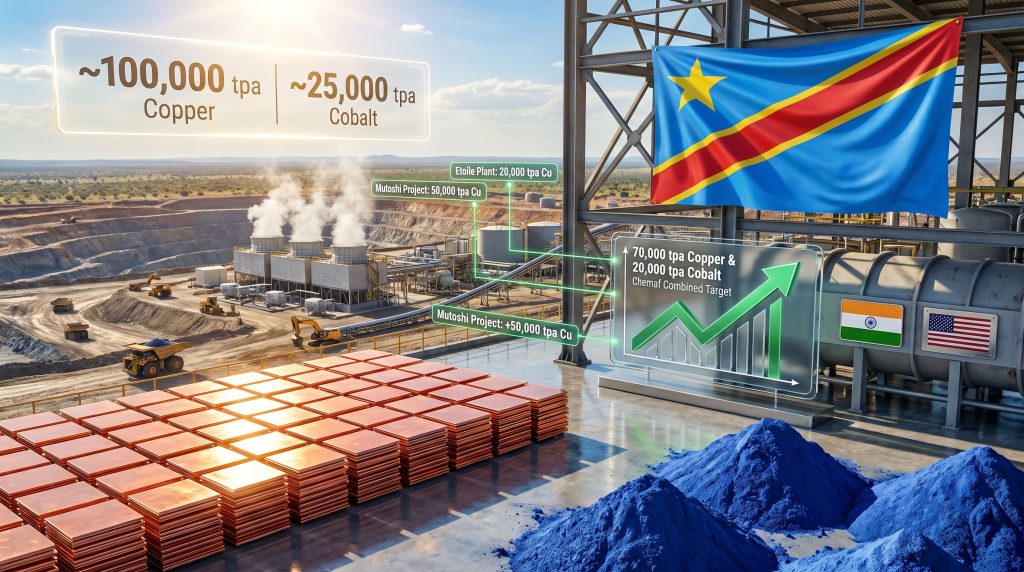
Chemaf's current processing infrastructure is centred on the Etoile plant, which carries a stated capacity of 20,000 tonnes per year of copper cathodes and 4,000 tonnes per year of cobalt. As of mid-2026, the plant remains in restart phase, with confirmed production timelines yet to be publicly communicated.
The transformational component of the Chemaf story lies with the Mutoshi project, a large-scale development initiative targeting an incremental 50,000 tonnes per year of copper and 16,000 tonnes per year of cobalt upon completion. Mutoshi, if delivered, would more than triple Chemaf's copper output capacity and quadruple its cobalt capacity relative to the Etoile baseline. Furthermore, Virtus has committed a reported $700 million toward realising these copper-cobalt assets in the DRC, underscoring the scale of ambition behind the project.
| Asset | Copper Capacity (tpa) | Cobalt Capacity (tpa) |
|---|---|---|
| Chemaf Etoile Plant (existing) | 20,000 | 4,000 |
| Mutoshi Project (upon completion) | 50,000 | 16,000 |
| Chemaf Total (combined) | 70,000 | 20,000 |
| Surya Mines, Kitemina Plant | 30,000 | 5,000 |
| Lloyds DRC Portfolio Total | ~100,000 | ~25,000 |
A combined DRC copper output of approximately 100,000 tonnes per year would position Lloyds among the more significant non-Chinese copper producers operating in the country, a strategically meaningful milestone given the sustained focus on diversifying DRC cobalt and copper supply away from Chinese-affiliated entities.
What the Cobalt Capacity Figure Means in Market Context
Cobalt is not a uniformly traded commodity. The form in which it leaves the processing plant, whether as cobalt hydroxide (the typical intermediate product from DRC hydrometallurgical operations) or as refined cobalt sulfate (the battery-ready precursor), determines where it sits in the supply chain and which buyers it can attract. DRC producers, including Chemaf's prospective operations, predominantly produce cobalt hydroxide, which is then further refined, predominantly in China, into the sulfate and oxide forms used in battery cathode manufacturing.
This refining dependency is a structural feature of the DRC cobalt landscape that investors often underestimate. It means that even a non-Chinese producer of cobalt in the DRC may still be feeding Chinese refining infrastructure, complicating the narrative around supply chain diversification unless downstream processing is also localised or redirected.
The Biggest Risks to the Chemaf Turnaround
Five Challenges That Will Define Outcomes
The turnaround roadmap is sequential by necessity, and each step creates preconditions for the next:
-
Stabilise and assess Etoile plant infrastructure to determine the capital and timeline required for restart.
-
Address workforce and contractor arrears owed to more than 3,000 direct employees and subcontractors. Unresolved wage obligations are not merely an ethical concern; they represent an operational risk that directly affects workforce cooperation, productivity, and community relations in the surrounding area.
-
Secure working capital financing sufficient to fund operational restart without being constrained by existing debt obligations.
-
Establish a credible Mutoshi project capital plan, including construction timeline, financing structure, and milestone-based disbursement framework.
-
Deliver verifiable first production output to validate investor communications and build operational credibility with lenders, off-take partners, and the DRC government.
Each of these steps is individually complex. Executing them in sequence while managing a $1 billion debt overhang elevates the execution risk profile considerably.
The next major ASX story will hit our subscribers first
Geopolitical Dimensions: India, the US, and the Non-Chinese DRC Play
Why the Ownership Structure Matters Beyond Financials
The VLMH joint venture, combining Indian capital from Lloyds with US-based Virtus Minerals, represents an ownership configuration that aligns with the strategic interests of multiple Western-aligned governments seeking to reduce supply chain dependency on Chinese-controlled cobalt and copper flows. The DRC's cobalt sector has historically been shaped by significant Chinese investment in mining, processing, and logistics infrastructure, a concentration that has drawn sustained attention from policymakers in Washington, Brussels, and Tokyo.
The Lloyds Chemaf DRC takeover does not in itself resolve the downstream refining dependency issue described above, but it does establish a non-Chinese foothold at the upstream production level. For India, the transaction aligns with a broader pattern of outward mining investment in Africa, where Indian industrial groups are increasingly pursuing energy-transition commodity assets. This dynamic is closely tied to the US-China cobalt rivalry that continues to shape investment strategies across the region.
The structural parallel worth examining is the difference in investment model. Chinese DRC investments have typically involved integrated financing packages, long-term off-take agreements, and infrastructure co-investment, creating deep interdependencies. The Lloyds-Virtus model relies more heavily on existing asset restructuring and operational expertise transfer, without the infrastructure financing overlay that has characterised Chinese entrants.
Three Scenarios for the Lloyds Chemaf Turnaround
How Outcomes Could Diverge From 2026 to 2030
Scenario 1: Accelerated Execution (Bull Case)
Debt restructuring progresses within 12 to 18 months, enabling Etoile to restart at partial capacity by late 2026. Mutoshi secures project financing and reaches construction completion between 2028 and 2029. Combined Lloyds DRC output approaches 100,000 tonnes of copper per year by 2030. The group establishes itself as a benchmark non-Chinese copper-cobalt producer in the country.
Scenario 2: Managed Progression (Base Case)
Debt negotiations extend beyond 2026, delaying a full Etoile restart to mid-2027 at the earliest. The Mutoshi timeline slips to 2030 or beyond due to capital prioritisation. Surya Mines provides a stable partial cash flow base that indirectly funds Chemaf obligations, but the broader 100,000-tonne copper ambition remains aspirational within the decade rather than confirmed.
Scenario 3: Structural Impediment (Bear Case)
The debt burden proves irresolvable without material equity dilution or selective asset sales. Workforce arrears escalate into operational disruptions or regulatory intervention. Mutoshi remains stranded; Etoile operates persistently below nameplate capacity. Lloyds' DRC ambitions contract to Surya Mines alone, with Chemaf requiring a secondary restructuring or partial divestment to recover strategic value. However, given the broader context of the DRC cobalt export environment in 2025, the incentives to persevere remain considerable.
Frequently Asked Questions: Lloyds Chemaf DRC Takeover
What did Lloyds acquire through the Chemaf transaction?
Through its 49% stake in VLMH, Lloyds gained part-ownership and operational involvement across Chemaf's copper-cobalt asset portfolio, including the Etoile processing plant and the Mutoshi development project in the DRC.
How much did the acquisition actually cost?
The direct shareholder payment was $30 million. However, the transaction also involved assuming approximately $1 billion in legacy Chemaf debt, making the true financial exposure significantly larger.
What is Chemaf's production capacity?
The Etoile plant carries a stated capacity of 20,000 tonnes per year of copper cathodes and 4,000 tonnes per year of cobalt. The Mutoshi project, when complete, is targeted to add a further 50,000 tonnes of copper and 16,000 tonnes of cobalt per year.
What is Lloyds' combined DRC production ambition?
Combining Chemaf and Surya Mines, Lloyds is targeting approximately 100,000 tonnes per year of copper and around 20,000 to 25,000 tonnes per year of cobalt across its DRC operations. Furthermore, the impact on cobalt prices from expanded non-Chinese production at this scale could be meaningful for the broader market.
What are the primary risks to the turnaround?
The principal challenges are resolving the approximately $1 billion in inherited debt, addressing wage arrears owed to more than 3,000 workers and contractors, restarting the Etoile plant, completing Mutoshi, and building hydrometallurgical processing expertise within a leadership team whose background is predominantly in iron ore and coal.
This article contains forward-looking analysis, scenario projections, and financial commentary based on publicly available information as of June 2026. It does not constitute financial or investment advice. Readers should conduct independent due diligence before making any investment decisions. Production targets, capacity figures, and debt estimates referenced are drawn from company communications and public reporting; actual outcomes may differ materially.
Want to Stay Ahead of the Next Major Critical Minerals Discovery?
Discovery Alert's proprietary Discovery IQ model delivers real-time alerts the moment significant ASX mineral discoveries are announced, turning complex commodity data into actionable insights for both short-term traders and long-term investors — explore historic discovery returns on the Discovery Alert discoveries page to understand what's possible, and begin your 14-day free trial today to position yourself ahead of the broader market.