June 10, 2026
The Investor Who Stayed Put: How a Decade of Patience Transformed $10,000 into $52,500
Long-term investing in commodity-linked equities is one of the most psychologically demanding strategies available to retail investors. Unlike technology stocks, where narrative momentum can sustain valuations during loss-making phases, resources companies are brutally exposed to the raw arithmetic of commodity prices, balance sheet leverage, and capital allocation decisions. When those forces align in your favour across multiple cycles, the compounding outcome can be extraordinary.
Understanding how wealth actually accumulates in blue-chip resources stocks requires looking beyond headline share price movements and into the full anatomy of total return: capital growth, dividend income, franking credits, and the often-underestimated power of holding through periods of maximum pessimism.
Few case studies illustrate this more vividly than asking what would have happened if you invested $10,000 in BHP shares exactly ten years ago.
When big ASX news breaks, our subscribers know first
Setting the Scene: What Made 2016 Such a Difficult Entry Point
June 2016 represented one of the most psychologically hostile environments for ASX resources investors in a generation. China's economic growth rate had decelerated meaningfully from its post-GFC peaks, and the knock-on effect for global commodity markets was severe. The iron ore demand outlook had deteriorated sharply, with prices collapsing from above US$100 per tonne in 2013 to briefly trade below US$40 per tonne by late 2015, a drawdown of more than 60% in roughly two years.
The sentiment destruction was amplified in February 2016 when BHP announced its first dividend cut in 16 years, reducing its payout by close to 75%. For income-focused investors who had treated BHP's dividend as a near-certainty, this was a serious psychological rupture. Institutional and retail capital flooded out of the resources sector, and BHP shares touched multi-year lows near A$14 to A$16 per share on the ASX.
This is precisely the environment that behavioural finance research consistently identifies as producing the highest long-term forward returns: a period where factual bad news has already been priced into valuations, sentiment has reached deeply negative territory, and the marginal seller has largely exhausted themselves.
Historically, the periods of maximum pessimism in cyclical industries have also been the periods of maximum long-term opportunity. The difficulty is that human psychology makes acting on that insight almost impossibly hard in real time.
So, If You Invested $10,000 in BHP Shares 10 Years Ago, What Would It Be Worth?
The numbers tell a story that most investors sitting in cash or term deposits in 2016 would find confronting today.
Capital Appreciation: The Share Price Alone
At approximately A$16 per share in June 2016, a $10,000 investment would have secured roughly 625 shares before brokerage costs. With BHP shares trading at approximately A$60 per share today, those same 625 shares carry a capital value of approximately A$37,500, representing a capital gain of roughly 275% on the original outlay.
That figure alone significantly outperforms most traditional asset classes over the same period. However, for BHP shareholders, capital appreciation is only one dimension of the story.
The Dividend Engine: Income That Changed the Equation
BHP has historically operated under a dividend policy targeting distribution of between 50% and 75% of underlying attributable profit as fully franked dividends, paid twice annually. Over the ten-year period from mid-2016 to mid-2026, BHP paid cumulative dividends of approximately A$24 per share, a figure heavily influenced by the extraordinary commodity super cycle of 2021 and 2022 when iron ore briefly exceeded US$220 per tonne.
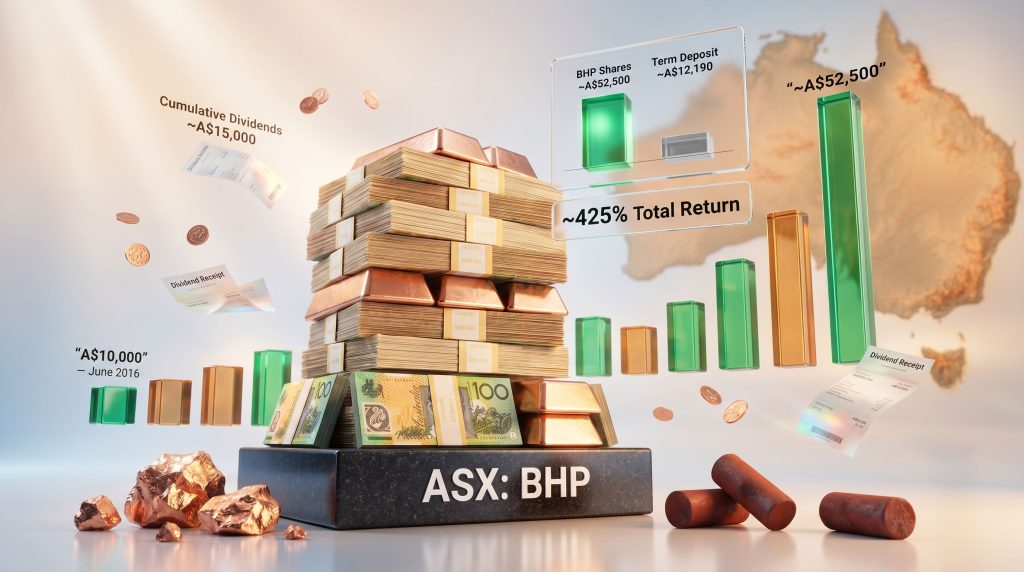
On a holding of 625 shares, that translates to approximately A$15,000 in cumulative dividend income received over the decade, before considering the additional after-tax value delivered through franking credit benefits to Australian resident shareholders.
The Full Picture: Total Portfolio Value
| Return Component | Value |
|---|---|
| Initial Investment (June 2016) | A$10,000 |
| Capital Value Today (625 shares x ~A$60) | A$37,500 |
| Cumulative Dividends Received | A$15,000 |
| Total Portfolio Value | ~A$52,500 |
| Total Return Over 10 Years | ~425% |
| Approximate Annualised CAGR | ~17.8% per annum |
A total return of approximately 425% over ten years from a single blue-chip ASX holding is a result that would satisfy most professional fund managers benchmarked against the broader market.
How Does That Compare to Where Your Money Could Have Gone Instead?
The true value of any investment outcome is best understood in comparison to realistic alternatives available at the same time.
| Investment Vehicle | Initial Amount | Return Assumption | Value After 10 Years |
|---|---|---|---|
| BHP Shares (capital + dividends) | A$10,000 | ~425% total | ~A$52,500 |
| Term Deposit (2% p.a.) | A$10,000 | ~21.9% total | ~A$12,190 |
| ASX 200 Index (~9% p.a.) | A$10,000 | ~137% total | ~A$23,700 |
| Cash Savings Account (~1.5% p.a.) | A$10,000 | ~16% total | ~A$11,600 |
The gap between A$52,500 and A$12,190 from an identical starting capital over ten years is not just a financial statistic. For many Australian investors approaching retirement, that difference is structurally significant. It represents the boundary between financial independence and reliance on external income support in retirement.
It is also worth noting that the BHP outcome does not include the additional tax benefit from franking credits, which for Australian resident shareholders in lower marginal tax brackets, including SMSF members in pension phase, can meaningfully improve the effective after-tax yield. An SMSF in pension phase paying zero tax can receive a full cash refund of the franking credits attached to BHP dividends, further widening the return gap against term deposits or unfranked income instruments.
The Dividend Reinvestment Plan Effect
For investors who elected to participate in a dividend reinvestment plan throughout this period, the outcome would have been even more compelling. Rather than receiving cash dividends, reinvested dividends purchase additional shares at a small discount to the prevailing market price, increasing the share count over time and allowing the compounding effect to accelerate. An investor who reinvested every dividend payment over the decade would hold a materially larger share position today than the baseline 625 shares used in this analysis.
Three Distinct Phases That Built BHP's Ten-Year Return
BHP's exceptional decade-long performance was not the product of a single commodity cycle or a single strategic decision. It was built across three meaningfully different macro environments, each with distinct drivers.
Phase One: Recovery from the Commodity Trough (2016 to 2019)
The initial recovery phase was driven by the normalisation of iron ore supply and demand dynamics following the capacity oversupply crisis of 2013 to 2016. As Chinese steel production stabilised and higher-cost iron ore producers exited the market, the iron ore price rebounded from sub-US$40 back above US$100 per tonne. BHP's share price more than doubled from its 2016 lows during this phase.
Critically, BHP used this period to aggressively repair its balance sheet, reducing net debt and divesting non-core assets. The petroleum business was eventually spun off as Woodside absorbed BHP's oil and gas assets, sharpening BHP's focus on its core mining operations. Dividend payments were progressively restored as free cash flow recovered, rewarding patient shareholders who had absorbed the pain of the 2016 cut.
Phase Two: The Commodity Super Cycle (2020 to 2022)
The second phase was arguably the most lucrative single period in BHP's modern history. The combination of COVID-19-related fiscal stimulus, infrastructure spending programmes in China, and supply chain disruptions created an unprecedented commodity demand surge. Iron ore briefly surpassed US$220 per tonne in mid-2021, a record high that triggered record dividend payouts from BHP.
A notable and often underappreciated dimension of this period is the quality and grade advantage that BHP's Pilbara iron ore operations hold. BHP's flagship mines produce high-grade iron ore with relatively low penalty elements, which attracts premium pricing from steel mills that increasingly prioritise ore chemistry to manage blast furnace efficiency and reduce carbon emissions per tonne of steel produced.
As Chinese steelmakers faced tighter environmental compliance standards, the premium for cleaner, higher-grade iron ore inputs widened, further benefiting BHP's realised prices above benchmark levels.
The iron ore grade premium is a frequently overlooked driver of BHP's earnings resilience. In a lower price environment, high-grade ore producers maintain margin where lower-grade competitors face losses.
During 2021 and 2022 alone, BHP returned an extraordinary volume of capital to shareholders through dividends and buybacks, with some estimates suggesting that dividend income in those years alone returned close to half of the original 2016 entry-level investment.
Phase Three: The Copper Transition Era (2023 to Present)
The most structurally significant development in BHP's recent history is the shift in its earnings composition. For the first time in the company's 136-year history, copper revenues surpassed iron ore earnings, marking a fundamental transition in BHP's commodity identity.
This transition has been driven by a convergence of demand forces that have pushed the copper price above US$13,000 per tonne: the accelerating buildout of AI data centre infrastructure, the global rollout of electric vehicle charging networks, and the electrification of grid infrastructure required to support renewable energy capacity additions. Furthermore, the copper supply crunch affecting global mining has added additional upward pressure on prices, benefiting BHP's expanding copper operations considerably.
A less commonly discussed factor in the copper demand outlook is the grade decline problem affecting the global copper mining industry. The average copper ore grade being mined globally has fallen significantly over the past three decades as the highest-quality deposits have been progressively depleted. This structural supply constraint means that even modest demand growth translates into tighter market balances than historical precedent might suggest.
BHP's copper growth strategy targets 3% to 4% copper-equivalent production growth per annum through 2035, underpinned by its Escondida and Pampa Norte operations in Chile, the Olympic Dam complex in South Australia, and a series of brownfield expansion projects. Escondida alone is the world's largest copper mine by production volume, providing BHP with a scale advantage and cost position that most copper producers cannot replicate.
What $10,000 Invested in BHP Shares Today Might Be Worth by 2036
Past performance provides no guarantee of future returns, and the commodity cycles that drove BHP's decade of outperformance may not repeat in the same sequence or magnitude. What forward analysis can offer, however, is a structured framework for thinking about the range of plausible outcomes.
| Scenario | Core Assumption | Projected Value of $10,000 by 2036 |
|---|---|---|
| Bear Case | Iron ore price weakness, copper delays | ~A$14,000 to A$18,000 |
| Base Case | Moderate copper growth, stable dividends | ~A$25,000 to A$30,000 |
| Bull Case | Copper super cycle, record dividends | ~A$40,000 to A$50,000+ |
The base case scenario, in which BHP delivers roughly half the total return of the past decade through copper production growth and consistent dividends, would transform a $10,000 investment today into approximately A$30,000 by 2036.
Important Disclaimer: All scenario projections above are illustrative estimates only and do not constitute financial advice. Commodity prices, production outcomes, and macroeconomic conditions are inherently uncertain. Past performance is not indicative of future returns. Investors should assess their personal circumstances and seek advice from a licensed financial adviser before making any investment decision.
Key Risks That Could Alter the Forward Trajectory
- Iron ore price vulnerability: China's property sector remains structurally challenged, and a prolonged contraction in Chinese steel demand could weigh on BHP's largest single revenue stream.
- Copper project execution risk: Large-scale mining expansions are capital-intensive and subject to delays, cost overruns, and permitting challenges across multiple jurisdictions.
- Geopolitical exposure: BHP's copper operations are concentrated in Chile, where regulatory and fiscal frameworks for mining have been subject to political debate in recent years.
- Currency dynamics: BHP's revenues are predominantly denominated in USD while its ASX-listed shares are priced in AUD. A strengthening Australian dollar reduces the AUD value of USD-denominated earnings.
- Energy transition policy volatility: While copper is a primary beneficiary of decarbonisation, shifts in government policy around electric vehicle mandates or renewable energy targets could alter the demand trajectory.
The next major ASX story will hit our subscribers first
Understanding the Mechanics Behind BHP's Durable Return Profile
Why Tier 1 Asset Quality Matters More Than Most Investors Realise
BHP's long-term return advantage is deeply rooted in the quality of its underlying mine portfolio. The term "Tier 1 asset" in the mining industry refers to operations that combine several critical characteristics:
- Low cash cost position: Operating costs in the lowest quartile globally, ensuring profitability is maintained even when commodity prices decline significantly.
- Long mine life: Reserve and resource bases that support decades of production without the need for constant capital reinvestment to extend operational life.
- Large scale: Production volumes large enough to absorb fixed infrastructure costs efficiently and maintain leverage in offtake negotiations.
- Favourable metallurgy: Ore chemistry that responds well to standard processing techniques, reducing the capital and operating cost of extraction and refining.
BHP's Pilbara iron ore operations and Escondida copper mine both satisfy all four criteria. This asset quality is not easily replicated by competitors, and it creates a durable cost advantage that protects margins across commodity price cycles.
How Fully Franked Dividends Create a Structural Advantage for Australian Investors
The Australian dividend imputation system is one of the most investor-friendly tax frameworks for income-oriented shareholders anywhere in the developed world, and it is frequently underappreciated in total return calculations.
When BHP pays a fully franked dividend, it attaches imputation credits representing the corporate tax already paid on the underlying earnings. For Australian resident shareholders, these credits can be used to offset personal income tax liability. For SMSF investors in pension phase or individuals with low taxable income, the credits can generate a direct cash refund from the Australian Taxation Office.
In practical terms, the effective after-tax yield on BHP's fully franked dividends can be 30% to 40% higher than the headline cash yield for eligible Australian investors when grossed-up franking credits are included. This advantage does not exist for term deposits, international equities, or unfranked ASX dividends.
Is BHP Suited to Your Investment Portfolio?
| Investor Profile | BHP Suitability | Primary Consideration |
|---|---|---|
| Long-term wealth builders (10+ year horizon) | High | Commodity cycle patience required |
| Dividend income seekers (SMSF or retirees) | High | Franking credits amplify after-tax yield |
| Short-term traders | Low | Earnings volatility linked to commodity prices |
| ESG-focused investors | Moderate | Active decarbonisation strategy; residual coal exposure |
| Growth-oriented investors | Moderate | Copper growth story is compelling; not a tech-style return profile |
Key Metrics Worth Monitoring Before Investing
- Price-to-Earnings Ratio: Assess against BHP's own historical range and against diversified global mining peers.
- Grossed-Up Dividend Yield: Always calculate the franking-adjusted yield for Australian investors, not just the cash yield.
- Net Debt to EBITDA: BHP's balance sheet discipline has been a key enabler of its dividend capacity through downturns.
- Free Cash Flow Yield: The primary indicator of BHP's ability to sustain distributions without eroding balance sheet strength.
- Copper Production Growth Rate: The most important forward-looking value driver for BHP's earnings mix over the coming decade.
Frequently Asked Questions About BHP Shares and Long-Term Returns
How much would $10,000 invested in BHP shares 10 years ago be worth today?
Based on a June 2016 entry price of approximately A$16 per share, a $10,000 investment would have acquired roughly 625 shares. At approximately A$60 per share today, capital value alone stands at approximately A$37,500. Including approximately A$15,000 in cumulative dividends received over the decade, the total estimated portfolio value is approximately A$52,500, representing a total return of roughly 425% over ten years. You can explore this further using BHP's historical price data to verify the entry and exit points used in this analysis.
Does BHP pay fully franked dividends?
Yes. BHP has historically paid fully franked dividends twice per year, distributing between 50% and 75% of underlying attributable profit. The franking credits attached to these payments deliver meaningful additional after-tax value for Australian resident investors, particularly those in superannuation or lower marginal tax brackets.
What is BHP's typical dividend yield?
BHP's trailing dividend yield fluctuates with commodity prices and earnings, typically ranging between 3% and 6% on a cash basis at current price levels. The grossed-up yield, which includes the value of attached franking credits, is materially higher for eligible Australian investors.
Is BHP a strong long-term investment looking forward to 2036?
BHP's forward investment case centres on its copper growth strategy, targeting 3% to 4% copper-equivalent production growth through 2035. Structural demand from AI infrastructure, electric vehicles, and grid electrification provides a long-duration tailwind for copper prices. However, investors should weigh this against iron ore price sensitivity, project execution risk, and commodity price cyclicality before making any investment decision.
How can Australian investors purchase BHP shares?
BHP shares (ASX: BHP) are available through any licensed Australian stockbroker or online share trading platform. BHP also offers a Dividend Reinvestment Plan that enables shareholders to automatically reinvest dividend income into additional shares at a small discount to market price, compounding returns over time without requiring additional capital contributions.
The Deepest Lesson: What BHP's Decade Really Teaches Investors
The most important insight from examining a decade of BHP returns is not a number. It is a behavioural observation.
The investors who generated the ~425% total return were not those who timed the commodity cycle perfectly, predicted the iron ore super cycle of 2021, or anticipated copper's structural demand surge from AI and electrification. They were investors who bought a high-quality, diversified resources business when the sentiment was worst, held it through multiple periods of volatility and negative headlines, and collected their dividends along the way.
The investors who sold in June 2016 when BHP cut its dividend and the iron ore price was near its floor missed one of the most powerful blue-chip return periods in ASX history. Consequently, many of those same investors likely deployed their capital into cash or term deposits that, over the same decade, delivered less than a quarter of BHP's total return.
The most consequential wealth destruction in long-term investing rarely comes from holding quality businesses through difficult periods. It comes from selling them at precisely the moment when the recovery becomes most likely.
Whether BHP replicates this performance over the next decade depends on factors that cannot be known today: copper demand growth rates, Chinese economic trajectory, geopolitical stability across BHP's operating regions, and commodity price cycles that have never historically been perfectly predictable. What can be said with confidence is that BHP enters the next decade with a stronger commodity mix, a cleaner balance sheet, and a more compelling structural growth story than it had in 2016.
For Australian investors building long-term portfolios, understanding the full anatomy of how if you invested $10,000 in BHP shares 10 years ago it compounded into $52,500 provides a powerful template for evaluating quality, patience, and the compounding power of franked dividends working together over time.
This article contains general information only and does not constitute personal financial advice. Past performance is not indicative of future returns. All figures relating to share prices, dividends, and projected outcomes are approximate and for illustrative purposes only. Investors should consider their personal financial circumstances and consult a licensed financial adviser before making any investment decisions. BHP Group Ltd (ASX: BHP) is referenced as a major ASX-listed resources company for educational purposes.
Want to Catch the Next Major Mineral Discovery Before the Broader Market Does?
While blue-chip holdings like BHP reward patient, long-term investors, the most explosive returns in the resources sector have historically come from identifying significant mineral discoveries at the point of announcement — and Discovery Alert's proprietary Discovery IQ model does exactly that, delivering real-time ASX discovery alerts to subscribers the moment they emerge. Explore historic examples of what major mineral discoveries have returned and begin a 14-day free trial to position yourself ahead of the market.