
June 10, 2026
The Hidden Economics of Smelter Survival: Why Critical Minerals Change Everything
For most of the twentieth century, the calculus governing industrial subsidies was straightforward: governments funded struggling factories to preserve jobs, stabilise regional economies, and avoid the political fallout of mass unemployment. The logic was blunt, the justification largely social, and the outcomes were measured in headcounts rather than strategic outcomes.
That calculus has shifted dramatically. Today, when a government commits hundreds of millions of dollars to an ageing smelting operation, the conversation is no longer solely about protecting workers from redundancy. It is about supply chain architecture, technological sovereignty, and the race to control the processing infrastructure underpinning the global energy transition. Nyrstar smelter funding in Hobart and Port Pirie sits squarely at the intersection of these forces, and understanding it requires looking well beyond the headline dollar figures.
When big ASX news breaks, our subscribers know first
Two Sites, Two Funding Rounds, One Strategic Gamble
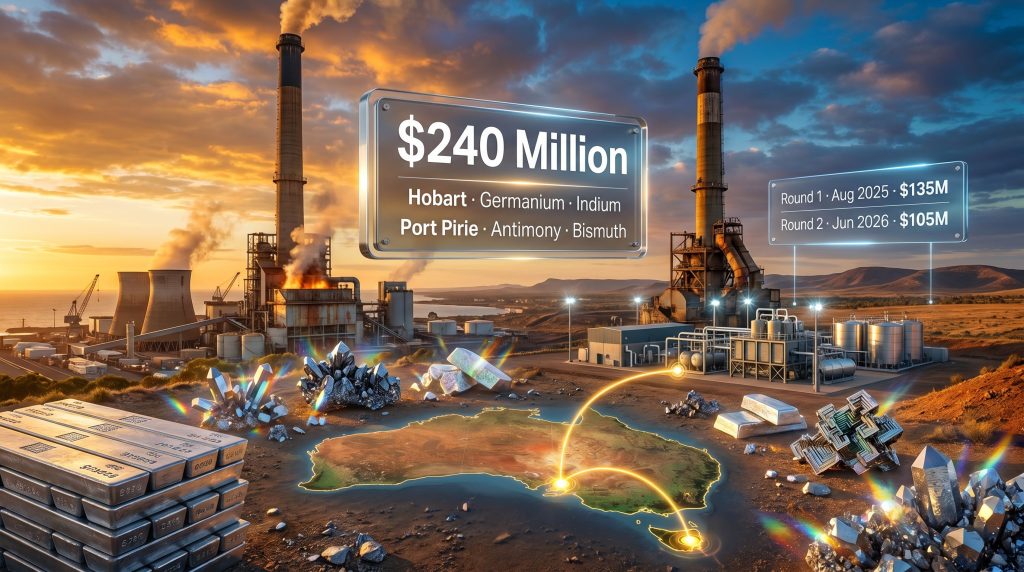
The cumulative government commitment to Nyrstar's Australian smelting operations has now exceeded $240 million across two separate intervention packages. The first, announced in August 2025, totalled $135 million split across three jurisdictions: the federal government contributed $57.5 million, South Australia provided $55 million, and Tasmania contributed $22.5 million. That package expired on May 1, 2026, and a successor arrangement worth $105 million was announced on June 10, 2026, extending operational support through to the end of the year.
| Funding Round | Date Announced | Total Value | Federal Share | SA Share | TAS Share | Operational Expiry |
|---|---|---|---|---|---|---|
| Round 1 | August 2025 | $135 million | $57.5 million | $55 million | $22.5 million | May 1, 2026 |
| Round 2 | June 10, 2026 | $105 million | TBC | TBC | TBC | December 31, 2026 |
| Combined | $240+ million |
The second package carries a dual mandate: keep both facilities operational through to December 2026 while simultaneously funding a pre-feasibility study and progressing a full feasibility study into expanded critical and strategic minerals production. This is where the story becomes substantially more complex than a standard industrial preservation exercise. The critical minerals demand surge globally has fundamentally altered how governments value existing processing infrastructure.
What Nyrstar Actually Produces, and Why the Feedstock Matters
Nyrstar's Port Pirie operations involve a polymetallic lead smelter, recovering lead, silver, and a range of trace co-products from complex ore feeds. The Hobart facility, furthermore, is a zinc smelter processing zinc concentrates into refined zinc metal. Both operations are what industry practitioners call custom smelters, meaning they process third-party concentrates rather than feeding from captive mines.
This business model exposes them directly to global treatment charge dynamics and commodity price cycles in ways that vertically integrated producers are partially insulated from.
What makes the current situation distinct from a conventional smelter rescue is the co-product profile hidden within those concentrates. Lead and zinc ores, particularly the complex polymetallic feedstocks processed at Port Pirie, often carry trace quantities of strategically significant metals that were historically treated as minor by-products or simply lost in the smelting process. These include:
- Antimony — a critical input for flame retardants, ammunition, and grid-scale energy storage batteries
- Bismuth — used in pharmaceuticals, cosmetics, and as a lead substitute in various alloys
- Germanium — a semiconductor material vital for fibre optics, infrared optics, and defence electronics
- Indium — a thin-film coating material essential to flat panel displays and photovoltaic cells
The technical challenge is that recovering these metals at commercially meaningful concentrations requires dedicated extraction circuits that do not currently exist at either facility. This is precisely what the feasibility studies are designed to evaluate.
The Antimony Opportunity at Port Pirie: Smaller Than It Looks, But Rarer Than You Think
Why Antimony Has Captured Political Attention
Of all the critical minerals under consideration, antimony at Port Pirie has attracted the most political attention. South Australian Premier Peter Malinauskas has described the possibility of producing antimony and other critical metals at Port Pirie as a genuinely rare opportunity worth investigating thoroughly, with the investment from three governments designed to ensure that evaluation can proceed without interruption.
The strategic context justifying this enthusiasm is real. China currently dominates global antimony production and refining, accounting for the majority of world supply. Russia holds the second-largest production base. Western-aligned producers are extraordinarily scarce, and the United States, European Union, and allied nations have all flagged antimony as a critical mineral requiring supply chain diversification. The antimony supply risks for defence and industrial users in particular have made this a pressing geopolitical concern.
If Port Pirie's pilot plant demonstrates commercial viability, it would position the facility as potentially Australia's only antimony producer and one of a small number of non-Chinese processors globally.
What Tempers the Enthusiasm?
However, several technical and commercial realities temper the enthusiasm:
- Antimony concentrations in Port Pirie's current feedstock are modest, and the economics of dedicated recovery circuits depend heavily on input grade consistency.
- The pilot plant is designed to test extraction at scale, not confirm it. Commercial viability remains an open question.
- Capital requirements to build a full-scale antimony recovery circuit would likely exceed what government feasibility grants alone can finance, requiring private co-investment.
- Antimony prices are themselves volatile, and the economics that justify investment today may look different by the time a final investment decision is reached in 2027 or beyond.
Furthermore, understanding antimony as an antimony critical mineral with broad industrial applications helps clarify why governments are willing to absorb significant near-term cost to preserve the option of domestic production.
The antimony story is compelling precisely because it layers genuine strategic value on top of existing infrastructure. But compelling narratives and commercially bankable projects are not the same thing, and the feasibility process exists specifically to determine whether the gap between them can be closed.
The Employment Dimension: Numbers That Carry Political Weight
The workforce argument has driven successive rounds of government support, and the numbers involved are substantial enough to be taken seriously in the context of regional industrial economies.
| Site | Direct Employment | Indirect Employment (Estimated) |
|---|---|---|
| Port Pirie smelter | ~800 direct jobs | Significant regional supply chain exposure |
| Hobart smelter | ~600 direct jobs | ~1,000 indirect jobs (Tasmania-wide estimate) |
| Combined direct | ~1,400 workers |
In Port Pirie, which has a population of roughly 14,000 people, 800 direct smelter jobs represents an extraordinary concentration of industrial employment for a single facility. The economic multiplier effects, flowing through local contractors, transport operators, equipment suppliers, and service businesses, mean the actual community exposure is considerably larger than the headline employment figure suggests.
Tasmania's situation mirrors this dynamic. The Tasmanian Premier confirmed the June 2026 package secures 600 direct jobs at the Hobart smelter, alongside an estimated 1,000 additional indirect positions dependent on the facility's continued operation. In an island state with a relatively small and geographically concentrated economy, a sudden industrial closure of this scale would represent a structural shock rather than a manageable market adjustment.
Why the First Package Expired Without a Long-Term Resolution
The gap between the expiry of the August 2025 package on May 1, 2026, and the announcement of the successor arrangement on June 10, 2026, was a period of significant operational uncertainty for both sites. Understanding why that gap existed reveals the fundamental structural tension at the heart of this funding story.
Several interconnected factors have prevented Nyrstar from achieving the commercial self-sufficiency that would eliminate the need for public support:
- Zinc treatment charge compression: Global zinc smelting margins have been squeezed by a combination of concentrate oversupply and subdued refined zinc prices, creating a structural profitability problem for custom smelters worldwide.
- Capital intensity of the critical minerals pivot: Installing dedicated extraction circuits for antimony, germanium, or indium requires significant upfront capital that cannot be self-funded from current operating cash flows.
- Feasibility study timelines: Pre-feasibility and full feasibility work takes time. The studies being funded under the current package will not deliver definitive answers until late 2026 at the earliest, meaning operational support must bridge that analytical gap.
- Regulatory uncertainty in Tasmania: Reports emerging in early 2026 indicated that Tasmanian environmental regulators elected not to introduce tighter lead-in-air emissions standards following industry objections. This raises questions about the long-term environmental framework within which future investment at Hobart would operate, adding a layer of uncertainty for potential private co-investors.
The next major ASX story will hit our subscribers first
The Greenfield Replacement Cost Argument: Why Demolition Is Not a Free Option
One dimension of this funding debate that receives insufficient analytical attention is the true cost of allowing the facilities to close. Industrial processing infrastructure of the kind operated at Hobart and Port Pirie is not simply a collection of depreciating assets that can be written off and replaced if circumstances improve.
It represents accumulated capital, skilled workforce expertise, established logistics networks, regulatory licences, and community infrastructure that took decades to build.
Rebuilding equivalent smelting and co-product recovery capacity from greenfield status in Australia would cost multiples of the current support packages, consume a decade or more in permitting and construction timelines, and require the re-establishment of skilled trade workforces that, once dispersed, are extremely difficult to reconstitute.
From this perspective, the $240 million committed across two funding rounds is not simply a subsidy to a struggling company; it is, at minimum in part, the cost of maintaining an industrial option that would be far more expensive to recreate than to preserve.
This replacement cost argument has historically been underweighted in Australian industrial policy debates, where short-term fiscal accountability frameworks tend to dominate analysis. The critical minerals context has forced a more sophisticated assessment of what is actually being preserved.
Feasibility Studies as Decision Infrastructure: What Happens After December 2026
The Roadmap of Key Milestones
The pre-feasibility and feasibility work being funded under the June 2026 package is not merely bureaucratic process. It is the analytical foundation on which a major capital allocation decision will be made. Conducting a robust definitive feasibility study is critical to ensuring any long-term investment decision rests on credible engineering and economic data.
The roadmap of milestones now facing both sites and their government supporters looks broadly as follows:
- Mid-2026: Completion of pre-feasibility study, establishing whether critical minerals recovery at each site is technically achievable at meaningful scale.
- Late 2026: Full feasibility study progression, incorporating detailed engineering assessments, capital cost estimates, and preliminary economic modelling.
- End of 2026: Operational funding window closes. Investment decision required on whether to commit to full-scale critical minerals transformation.
- 2027 and beyond: If studies are favourable and capital is secured, commencement of construction and commissioning of new recovery circuits. Commercial production of critical minerals remains several years away under even the most optimistic timeline.
The critical unknown is what happens if the feasibility studies return results that are technically promising but commercially marginal. In that scenario, governments face a third decision point: extend support further into a longer capital development cycle, accept a modified version of the project at reduced scope, or concede that the commercial case cannot be made and manage an orderly wind-down.
The Broader Policy Debate: Three Lenses on $240 Million in Public Capital
Reasonable analysts looking at this situation reach genuinely different conclusions depending on the framework they apply.
The industrial policy lens treats the Nyrstar facilities as strategic national assets temporarily caught in a difficult market cycle. The cost of preservation is lower than the cost of reconstruction, the critical minerals opportunity is real if not yet confirmed, and the regional employment consequences of closure are severe enough to justify public intervention during a transition period.
The fiscal accountability lens raises legitimate concerns about the pattern of short-term rolling support packages. Each successive round defers rather than resolves the fundamental question of commercial viability. Without a credible private sector co-investment pathway, there is a risk that public capital is being deployed to maintain assets whose long-term economics do not support survival without ongoing subsidy.
The community sustainability lens focuses on the human geography of industrial decline. Port Pirie and greater Hobart are not abstract economic units; they are communities with limited alternative employment options at the industrial scale Nyrstar currently provides. The assistance package for Nyrstar smelters has consequently become as much a community preservation measure as an industrial policy tool.
None of these lenses is individually sufficient. The most honest assessment of Nyrstar smelter funding in Hobart and Port Pirie acknowledges that all three perspectives are simultaneously valid, and that the feasibility work now underway is the mechanism through which a genuine resolution — rather than another deferral — must eventually be found. In addition, the bismuth export controls increasingly reshaping global supply chains further underscore the strategic value of retaining domestic processing capability across the full suite of co-product metals both facilities can potentially recover.
The federal government's partnership to scope critical minerals and protect jobs at both sites signals that this calculus extends well beyond short-term fiscal relief. However, whether the feasibility studies ultimately validate that strategic judgement remains the defining question facing policymakers, investors, and the communities dependent on these facilities as 2026 draws to a close.
This article is informational in nature and does not constitute financial, investment, or policy advice. Forecasts, feasibility outcomes, and commercial projections discussed are speculative and subject to change based on study results, commodity price movements, and government decisions not yet made. Readers should conduct independent research before drawing conclusions about the long-term commercial prospects of the facilities discussed.
Want to Know Which ASX Critical Minerals Discoveries Are Happening Right Now?
Discovery Alert's proprietary Discovery IQ model delivers real-time alerts the moment significant mineral discoveries — including critical minerals like antimony, germanium, and bismuth — are announced on the ASX, transforming complex data into clear, actionable investment insights. Explore historic discoveries and their remarkable returns, then start your 14-day free trial to ensure you're positioned ahead of the market when the next major find is announced.