
June 22, 2026
The Critical Infrastructure Race Shaping Global Energy Markets
Massive liquefied natural gas developments across East Africa represent more than isolated commercial ventures. These projects embody fundamental shifts in how emerging economies position themselves within evolving global energy architectures. The region's offshore hydrocarbon reserves have attracted unprecedented international investment commitments, creating complex webs of geopolitical influence that extend far beyond traditional resource extraction models.
The transformation reflects broader market dynamics where established supply chains face disruption from geopolitical tensions, climate policy pressures, and evolving consumer demand patterns. Moreover, oil price movements continue to influence energy project economics across global markets. Energy-importing nations increasingly seek diversified supply sources, while resource-rich developing countries pursue strategies to monetise their natural endowments through sophisticated industrial partnerships.
When big ASX news breaks, our subscribers know first
Tanzania's Strategic Pivot Toward Investment Partnership
Tanzania has undergone a remarkable policy transformation since 2022, reversing decades of resource nationalism that previously deterred major international energy investments. Under President Samia Suluhu Hassan's administration, the country has systematically dismantled regulatory barriers that had stalled critical infrastructure development during the previous government's tenure.
The policy shift addresses fundamental investor concerns about contractual stability and regulatory predictability. Previously, Tanzania pursued economic nationalism through forced contract renegotiations, elevated taxation structures, and challenges to international arbitration mechanisms. This approach created substantial uncertainty for long-term capital commitments, particularly in capital-intensive sectors requiring multi-decade investment horizons.
Key policy reforms introduced since 2022 include:
- Reduced unilateral renegotiation risk through enhanced contract sanctity protections
- Streamlined regulatory frameworks emphasising predictable approval processes
- International engagement protocols prioritising transparent stakeholder communication
- Fiscal regime stability commitments reducing arbitrary taxation changes
The transformation gained international attention when Equinor, the Norwegian energy major, had previously written down approximately $1 billion on Tanzanian LNG investments due to prolonged negotiation stalemates. This substantial financial impact demonstrated the real costs of regulatory uncertainty on major energy developments.
Minister Kitila Mkumbo's announcement in London regarding the Tanzania LNG project June 2026 deal timeline signals the government's commitment to completing this strategic pivot. The ministerial statement emphasised that commercial negotiations had reached completion, with remaining discussions focused on legal framework finalisation. This development parallels energy transition challenges faced by other resource-rich nations globally.
Project Scale Analysis: Beyond Conventional Development Models
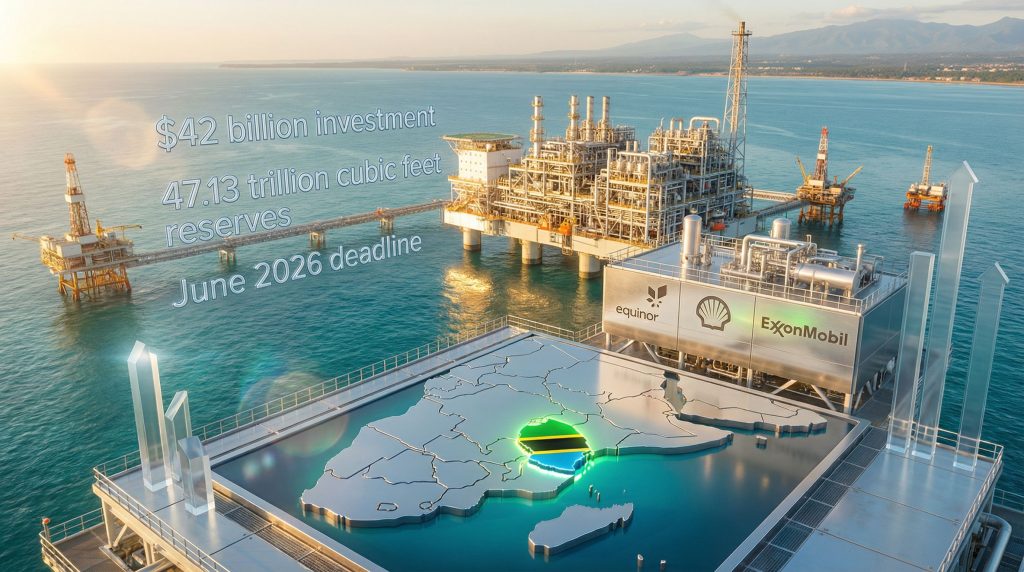
The Tanzania LNG project represents extraordinary scale across multiple dimensions, fundamentally distinguishing it from conventional energy developments. With 47.13 trillion cubic feet of proven offshore natural gas reserves, the project targets resource monetisation through integrated LNG export infrastructure requiring comprehensive industrial ecosystem development.
Reserve Quality and Production Potential
Tanzania's offshore gas fields demonstrate exceptional characteristics for commercial LNG development:
- Reserve concentration: 47.13 TCF represents substantial resource density in accessible offshore blocks
- Gas composition: High methane content suitable for direct LNG processing without extensive treatment
- Production sustainability: Reserve-to-production ratios support multi-decade extraction programs
- Infrastructure proximity: Offshore fields positioned for efficient pipeline connections to onshore processing facilities
Investment Magnitude Context
The $42 billion investment commitment establishes this project as Tanzania's largest ever industrial development. This figure encompasses multiple development phases spanning infrastructure construction, technology deployment, and operational capacity building over an estimated 8-year development timeline following Final Investment Decision achievement.
Investment breakdown across project phases includes:
| Development Phase | Estimated Investment | Timeline | Key Activities |
|---|---|---|---|
| Pre-development | $3-5 billion | Years 1-2 | Engineering, permitting, site preparation |
| Infrastructure Construction | $25-30 billion | Years 3-6 | LNG plant, pipelines, port facilities |
| Commissioning & Startup | $8-10 billion | Years 7-8 | Testing, optimisation, initial production |
| Working Capital | $4-7 billion | Ongoing | Operations, maintenance, contingencies |
The project's employment projections exceed 100,000 direct and indirect positions, spanning construction, operations, and supporting service industries. This workforce requirement necessitates comprehensive skills development programs addressing technical specialisations in LNG processing, offshore operations, and industrial maintenance.
Consortium Architecture and Strategic Control
The Tanzania LNG project consortium reflects sophisticated partnership structures balancing operational expertise, financial capacity, and market access requirements. Equinor and Shell serve as joint lead operators, bringing complementary technological capabilities and established LNG market relationships.
Lead Operator Responsibilities
Equinor's strategic positioning leverages extensive offshore development experience from North Sea operations, while Shell's global LNG portfolio provides integrated value chain expertise from production through final sales. This dual leadership model distributes technical and commercial risks while maintaining unified project execution standards.
ExxonMobil's participation adds significant financial capacity and deepwater development expertise, particularly valuable given Tanzania's offshore field locations requiring advanced subsea production systems. The company's global LNG operations provide additional market access channels and technical benchmarking capabilities.
Asian Market Access Strategy
Pavilion Energy and Medco Energi represent strategic Asian market access, reflecting evolving global LNG trade patterns. Pavilion Energy, Singapore's state-owned LNG trader, provides direct access to Southeast Asian markets experiencing rapid demand growth. Medco Energi's Indonesian operations offer regional infrastructure synergies and emerging market expertise.
These Asian partnerships address fundamental market positioning questions:
- Demand security: Long-term supply agreements reducing market risk
- Logistics optimisation: Regional shipping and storage infrastructure access
- Price discovery: Competitive benchmarking against established Asian LNG hubs
- Political relationships: Government-to-government energy partnership frameworks
Tanzania Petroleum Development Corporation (TPDC) maintains national interest representation while providing local regulatory interface and domestic market integration capabilities. TPDC's participation ensures alignment between commercial objectives and national development priorities.
Risk Assessment Framework: Critical Success Variables
The Tanzania LNG project June 2026 deal faces multiple risk categories requiring sophisticated mitigation strategies. Success depends on coordinated management of political, financial, operational, and market uncertainties that could significantly impact project viability.
Political and Regulatory Risk Management
Tanzania's regulatory framework negotiations focus on three critical instruments requiring finalisation before the June 2026 deadline:
- Host Government Agreement (HGA): Establishes fiscal terms, tax obligations, and revenue sharing mechanisms
- Production Sharing Agreement (PSA): Defines resource extraction rights, environmental obligations, and operational standards
- Legal framework integration: Ensures consistency between commercial agreements and national legislation
The government's current approach emphasises contractual stability while maintaining sovereign control over natural resource development. Furthermore, OPEC production impact considerations influence broader energy market contexts affecting project economics. Minister Mkumbo's announcement that commercial negotiations had reached completion suggests fundamental terms agreement, with remaining discussions focused on legal implementation mechanisms.
Critical Risk Factor: The 2023 financial agreement that subsequently triggered renegotiation requests demonstrates ongoing tension between commercial optimisation and political oversight requirements.
Market and Financial Risk Considerations
Global LNG market dynamics significantly influence project economics, particularly given 8-year development timelines extending well beyond current price forecasting horizons. The Ukraine conflict's impact on European energy security created favourable conditions for new LNG supply development, but sustained market support requires careful demand analysis.
Financial risk factors include:
- Capital cost inflation: Global infrastructure development experiencing significant cost pressures
- Interest rate environment: Multi-billion dollar financing sensitive to global monetary policy
- Currency exposure: Long-term contracts denominated in multiple currencies create hedging requirements
- Competition timing: Mozambique and other regional projects potentially saturating target markets
Final Investment Decision requirements extend beyond commercial agreement completion. Consequently, natural gas price trends continue to influence investor sentiment across global markets. FID achievement necessitates comprehensive financing arrangement completion, including development bank participation, commercial lending facilities, and potentially sovereign guarantee structures.
Operational and Security Risk Assessment
Regional security considerations gained prominence following delays at Mozambique LNG projects due to insurgency activities affecting northern regions. While Tanzania maintains relative political stability, offshore infrastructure requires comprehensive security planning addressing multiple threat vectors.
Operational complexity factors include:
- Offshore infrastructure: Deepwater production systems requiring specialised vessels and technical expertise
- Onshore processing facilities: LNG plant construction in emerging market environments with limited industrial infrastructure
- Skills availability: Technical workforce development for specialised LNG operations
- Supply chain logistics: Equipment and materials transportation to remote coastal locations
The 8-year development timeline provides sufficient duration for comprehensive infrastructure development but creates extended exposure to external risk factors. Project success requires sustained political support, market conditions, and operational execution across multiple electoral cycles and economic environments.
Economic Impact Beyond Employment Projections
Tanzania's $42 billion LNG development creates economic transformation opportunities extending far beyond direct project employment. The investment magnitude represents approximately 25-30% of Tanzania's annual GDP, establishing this development as a fundamental economic catalyst with multi-generational impact potential.
Direct Economic Transformation
The 100,000 employment positions encompass diverse skill categories requiring comprehensive workforce development programs:
- Construction phase: 60,000-70,000 temporary positions during peak building activities
- Operations phase: 15,000-20,000 permanent positions for long-term facility management
- Support services: 15,000-25,000 indirect positions in logistics, maintenance, and administration
- Local content: Government requirements for domestic supplier participation creating additional economic multipliers
Revenue generation potential transforms Tanzania's fiscal position through multiple channels:
- Corporate taxation on consortium profits generates substantial government revenues
- Royalty payments provide direct resource monetisation independent of profit margins
- Employment taxation creates payroll-based revenue streams
- Local procurement requirements stimulate domestic industrial development
Industrial Development Catalyst Effects
LNG project infrastructure creates foundation for broader industrial development through shared infrastructure utilisation:
- Port facilities support expanded international trade beyond energy exports
- Power generation capacity provides reliable electricity for manufacturing development
- Transportation networks facilitate broader economic integration
- Skills development creates human capital applicable across multiple industries
Domestic energy security improvements through natural gas utilisation for power generation address critical infrastructure constraints limiting economic growth. Reliable electricity supply enables manufacturing sector expansion, agricultural processing development, and service industry growth.
The next major ASX story will hit our subscribers first
Regional Competition Analysis: East African LNG Race
The Tanzania LNG project competes within broader East African energy development context, particularly against Mozambique's multiple LNG initiatives targeting similar Asian export markets. This regional competition influences project positioning, market access strategies, and ultimate commercial viability.
Comparative Project Analysis
| Project Characteristic | Tanzania LNG | Mozambique Area 1 | Mozambique Area 4 |
|---|---|---|---|
| Reserve Base | 47.13 TCF proven | 75+ TCF estimated | 85+ TCF estimated |
| Investment Scale | $42 billion | $20+ billion | $30+ billion |
| Lead Operators | Equinor/Shell | Total Energies | Eni/ExxonMobil |
| Political Stability | Improving trend | Security challenges | Insurgency impacts |
| Infrastructure Status | Planning phase | Construction delays | Force majeure declared |
| Market Access | Asian focus | Global diversification | European priority |
Strategic Positioning Advantages
Tanzania's competitive positioning benefits from several factors distinguishing it from Mozambican developments:
- Political stability: Consistent government support without security disruption risks
- Regulatory predictability: Clear legal framework development under current administration
- Infrastructure proximity: Coastal access without inland transportation requirements
- Market timing: Development schedule potentially capturing supply gap from delayed competitors
Mozambique's challenges create market opportunities for Tanzanian LNG, particularly regarding Asian market access where demand growth continues despite global economic uncertainties. Security issues affecting Mozambican projects have created buyer interest in alternative supply sources with lower political risk profiles.
Investment Decision Framework and Due Diligence
Investors evaluating the Tanzania LNG project June 2026 deal require comprehensive risk-adjusted return analysis incorporating multiple scenario outcomes. The project's scale and complexity necessitate sophisticated evaluation frameworks addressing political, commercial, and operational variables across extended time horizons.
Due Diligence Priorities
Fiscal regime competitiveness analysis must evaluate Tanzania's tax structure against competing LNG developments globally. Key evaluation criteria include:
- Government take percentages across different price scenarios
- Cost recovery mechanisms for capital expenditure
- Tax stability agreements providing long-term fiscal predictability
- Local content requirements and associated cost implications
Infrastructure readiness assessment examines Tanzania's capacity to support massive industrial development:
- Port capacity for equipment imports and LNG exports
- Power grid stability for processing facility requirements
- Transportation networks connecting offshore facilities to onshore infrastructure
- Labour availability and skills development program effectiveness
Strategic Value Proposition Analysis
The project's strategic value extends beyond traditional return on investment calculations, encompassing energy security contributions and market positioning benefits. Additionally, investment strategy essentials remain crucial for major energy project evaluation frameworks.
Asian market access advantages:
- Geographic proximity reducing transportation costs versus Atlantic Basin suppliers
- Shipping route optimisation through established Indian Ocean trading patterns
- Political relationships leveraging Tanzania's non-aligned foreign policy positioning
- Supply diversification for Asian buyers reducing dependence on traditional suppliers
Portfolio integration benefits:
- Technology deployment showcasing advanced LNG processing capabilities
- Operational expertise development applicable to other emerging market projects
- Government relations establishing frameworks for future resource developments
- Market presence in growing East African energy sector
Scenario Planning: Multiple Future Pathways
The Tanzania LNG project's success depends on numerous variables creating multiple potential outcome scenarios. Comprehensive scenario analysis provides investors and stakeholders with risk-adjusted decision frameworks addressing uncertainty across political, commercial, and operational dimensions.
Optimistic Development Scenario
Accelerated execution pathway assumes optimal alignment of political support, market conditions, and operational efficiency:
Timeline achievements:
- June 2026: Legal framework agreement signed on schedule
- Q4 2026: Final Investment Decision achieved with full financing commitment
- 2027-2031: Construction phase completed within budget and timeline
- 2032-2033: First LNG production commencing commercial operations
Market positioning outcomes:
- Asian market penetration: Successful long-term supply contract negotiations
- Price competitiveness: Achieved through operational efficiency and favourable fiscal terms
- Regional leadership: Tanzania established as premier East African energy hub
- Economic transformation: Substantial GDP growth and industrial development catalysed
Base Case Development Scenario
Managed progress pathway incorporates realistic execution challenges while maintaining fundamental project viability:
Adjusted timeline expectations:
- Q3 2026: Agreement completion with minor legal framework delays
- Mid-2027: FID achievement following extended financing negotiations
- 2028-2034: Construction phase with typical emerging market implementation delays
- 2034-2035: Production commencement with gradual capacity ramp-up
Balanced risk management:
- Market access: Diversified buyer portfolio reducing single-customer dependence
- Cost management: Inflation-adjusted project economics with contingency planning
- Political stability: Sustained government support despite normal electoral cycles
- Operational learning: Knowledge transfer from other regional LNG developments
Risk-Adjusted Scenario Outcomes
Prolonged negotiation pathway addresses potential obstacles that could significantly delay or modify project structure:
Challenge factors:
- Legal framework complexity: Extended negotiations beyond Tanzania LNG project June 2026 deal timeline
- Financing constraints: Global capital market conditions limiting large-scale project funding
- Competitive pressure: Mozambican projects resolving security issues and accelerating development
- Market saturation: Asian LNG demand growth slower than projected
Mitigation strategies:
- Phased development: Smaller initial capacity with expansion options
- Alternative markets: European supply diversification opportunities
- Technology optimisation: Cost reduction through improved processing efficiency
- Partnership restructuring: Modified consortium arrangements optimising risk distribution
Global Energy Security Implications
The Tanzania LNG project represents more than regional energy development, contributing to fundamental restructuring of global energy supply chains facing unprecedented disruption from geopolitical tensions, climate policy evolution, and market demand transformation.
Geopolitical Supply Diversification
Energy importing nations increasingly prioritise supply source diversification following recent geopolitical disruptions demonstrating vulnerability of concentrated supplier relationships. East African LNG development provides strategic alternatives to traditional suppliers facing political instability or policy conflicts.
Regional significance factors:
- Non-aligned positioning: Tanzania's foreign policy independence appeals to buyers seeking politically neutral suppliers
- Maritime security: Indian Ocean shipping routes provide alternative pathways to traditional supply corridors
- Scalable development: Multiple East African projects create regional supply hub potential
- Market access: Geographic positioning serving both Asian and European import markets
Energy Transition Integration
Natural gas positioning within global energy transition strategies creates complex market dynamics affecting long-term LNG demand projections. The Tanzania LNG project's 8-year development timeline extends into periods where renewable energy deployment may significantly alter fossil fuel demand patterns.
Transition-aware planning considerations:
- Bridge fuel utilisation: Natural gas serving as cleaner alternative during renewable energy scaling
- Industrial applications: LNG serving as feedstock for petrochemical and manufacturing processes
- Peak demand management: Gas-fired power generation providing renewable energy intermittency backup
- Carbon capture readiness: Infrastructure designed for potential future carbon management technologies
Critical Success Requirements and Implementation
The Tanzania LNG project June 2026 deal requires coordinated execution across multiple dimensions, with success depending on sustained alignment between government policy, industry partnership, and market conditions over extended development periods.
Government Execution Excellence
Policy consistency across electoral cycles ensures investor confidence in long-term commitment frameworks:
- Institutional capacity: Regulatory agencies equipped with technical expertise for complex project oversight
- Transparency protocols: Clear decision-making processes reducing corruption risks and delays
- Stakeholder engagement: Community consultation mechanisms addressing local development concerns
- International coordination: Regional cooperation frameworks facilitating cross-border infrastructure development
Industry Partnership Optimisation
Consortium coordination requires sophisticated management structures balancing diverse participant interests while maintaining unified execution standards:
Technology transfer commitments:
- Local skills development: Comprehensive training programs building Tanzanian technical capacity
- Knowledge sharing: Best practices transfer from global LNG operations experience
- Innovation deployment: Advanced technologies optimising operational efficiency and environmental performance
- Supply chain integration: Local content requirements balanced with international quality standards
Market Positioning Strategies
Commercial success depends on competitive positioning within evolving global LNG markets characterised by changing demand patterns and new supply source development:
Pricing competitiveness:
- Cost optimisation: Operational efficiency minimising production costs
- Flexible contracting: Supply agreement structures accommodating market volatility
- Quality assurance: Product specifications meeting or exceeding international standards
- Delivery reliability: Operational consistency building long-term customer relationships
Tanzania's Energy Superpower Trajectory
The June 2026 deadline represents a transformational moment extending beyond contractual milestones toward Tanzania's emergence as a significant regional energy player. Success requires balancing commercial optimisation with national development objectives while navigating complex global energy market dynamics.
Domestic energy transformation through natural gas utilisation creates foundation for broader economic development, addressing electricity access constraints that limit industrial growth and social development. The project's dual objectives of export revenue generation and domestic energy security improvement reflect sophisticated resource management strategies.
Regional leadership positioning establishes Tanzania as an East African energy hub facilitating cross-border infrastructure development and regional market integration. This strategic positioning creates long-term competitive advantages extending beyond individual project success toward sustained economic transformation. According to Market Screener, the project timeline remains crucial for maintaining investor confidence across global markets.
The Tanzania LNG project embodies emerging market energy development complexities, requiring coordinated management of technical, financial, political, and social challenges. The $42 billion investment commitment represents unprecedented industrial development scale for Tanzania, creating both transformational opportunities and substantial execution risks.
Market dynamics supporting the project include sustained Asian LNG demand growth, supply diversification priorities among major importers, and geopolitical conditions favouring non-aligned suppliers. However, success requires consistent execution across multiple risk dimensions over extended development timelines.
Tanzania's strategic pivot toward investment-friendly policies under President Hassan's administration creates favourable conditions for complex international partnerships. The Tanzania LNG Terminal project demonstrates the technical complexity and scale of infrastructure required for successful implementation. The June 2026 agreement target provides a critical milestone for demonstrating sustained government commitment to transparent, predictable regulatory frameworks supporting long-term industrial development.
This analysis incorporates multiple risk scenarios and market conditions. Investors should conduct independent due diligence and consider evolving political, commercial, and operational factors affecting project outcomes. LNG market projections involve substantial uncertainty regarding demand growth, competitive supply development, and global energy transition impacts on long-term natural gas utilisation.
Seeking Opportunities in East African Energy Developments?
Discovery Alert's proprietary Discovery IQ model delivers real-time alerts on significant energy and commodities discoveries across the ASX, instantly empowering subscribers to identify actionable opportunities ahead of the broader market. Understand why major mineral and energy discoveries can lead to substantial market returns by exploring Discovery Alert's dedicated discoveries page, showcasing historic examples of exceptional outcomes, and begin your 30-day free trial today to position yourself ahead of the market.