
July 25, 2026
Understanding Critical Infrastructure Vulnerabilities in Today's Energy Landscape
Energy infrastructure systems worldwide face unprecedented challenges as operational complexities intersect with evolving security threats. The interconnected nature of modern energy networks creates cascading vulnerabilities that extend far beyond individual facility operations, revealing systemic weaknesses that demand comprehensive strategic analysis.
The concentration of critical processing capacity within specific geographic regions amplifies these vulnerabilities, creating scenarios where targeted disruptions can generate disproportionate global impacts. Understanding these dynamics requires examining both immediate operational consequences and longer-term structural implications for energy security.
When big ASX news breaks, our subscribers know first
Regional Energy Infrastructure Under Systematic Pressure
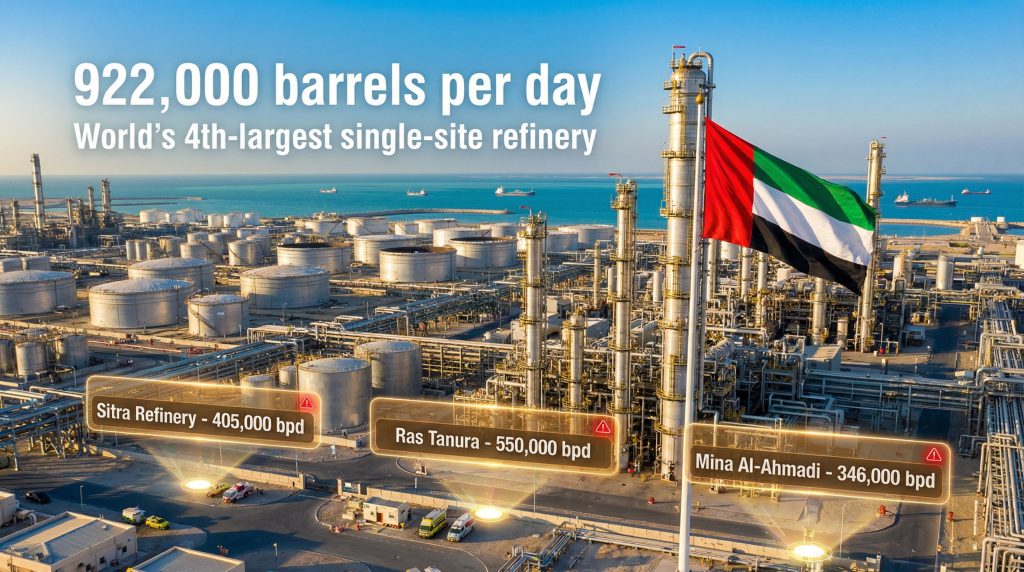
The drone attack at ADNOC's Ruwais complex represents a significant escalation in the targeting of Middle Eastern energy infrastructure, highlighting the systematic nature of current threats facing the region's critical facilities. This incident at the 817,000 barrels per day processing complex demonstrates how coordinated attacks are specifically designed to maximise disruption across multiple operational systems simultaneously.
Furthermore, the OPEC production impact from these disruptions extends beyond immediate facility damage. The Ruwais facility's integrated structure exemplifies modern energy infrastructure complexity, combining:
- 417,000 b/d Ruwais West refinery (shut down as precautionary measure)
- 400,000 b/d Ruwais East refinery
- 2 million tonnes per year Fertil urea plant operated by Fertiglobe
- Integrated petrochemical processing units
- Strategic storage and distribution networks
Technical Response Patterns to Infrastructure Attacks
Following the drone attack at ADNOC's Ruwais complex, operational protocols revealed sophisticated risk management strategies that prioritise both safety and production continuity. ADNOC's statement that it continues operations whilst "carefully managing offshore production levels to address storage requirements" indicates a calibrated response that balances security concerns with operational necessities.
The precautionary shutdown of Ruwais West demonstrates industry-standard crisis response protocols where facilities implement protective measures even when direct damage may be limited. This approach reflects lessons learnt from previous regional incidents where secondary effects proved more damaging than initial strikes.
In addition, the fire incident at an unidentified facility within the complex, with no reported injuries, showcases both the effectiveness of safety protocols and the potential for escalation in similar scenarios. According to Reuters, the company's decision not to disclose which specific facility was struck indicates operational security considerations that extend beyond immediate damage assessment.
Coordinated Regional Production Disruptions
Analysis of regional production data reveals the systematic nature of current disruptions, with estimated 6.2 to 6.9 million barrels per day of supply taken offline across five OPEC+ producers. This represents one of the largest coordinated supply disruptions in recent energy market history.
Country-Specific Impact Analysis
| Producer | February Output | Current Status | Estimated Reduction |
|---|---|---|---|
| Saudi Arabia | 10.88 million b/d | 2.0-2.5 million b/d offline | Offshore field closures |
| Iraq | 4.42 million b/d | 1.5-1.7 million b/d by March 8 | Export terminal shutdown |
| Kuwait | 2.59 million b/d | Declining to 1.5 million b/d | Force majeure declared |
| UAE | 3.53 million b/d | 2.7-3.0 million b/d | Adcop pipeline capacity exceeded |
| Bahrain | Regional capacity | 405,000 b/d Sitra offline | Refinery force majeure |
Saudi Arabia's Strategic Field Management:
The deliberate closure of Safaniya, Marjan, Zuluf, and Abu Safa fields represents a 2.0 to 2.5 million barrel per day reduction achieved through strategic field selection rather than blanket shutdowns. This approach preserves onshore production capabilities that can be redirected through alternative export routes.
However, the US oil production decline adds additional complexity to global supply dynamics. Iraq's progression from 4.42 million b/d in February to an expected 1.2 to 1.3 million b/d demonstrates the rapid pace at which logistics constraints force production cuts.
The redirection of crude to domestic refineries with excess products moving to storage creates a bottleneck scenario as storage capacity reaches limits. Consequently, the UAE's operation of the Adcop pipeline at 1.7 to 1.8 million b/d, exceeding its nameplate capacity of 1.5 million b/d, illustrates infrastructure adaptation under crisis conditions.
Critical Chokepoint Dependencies and Alternative Routes
The Strait of Hormuz disruption has created a near-complete halt in the 14 million barrels per day of crude shipments that typically transit this critical waterway. This represents approximately one-fifth of globally traded oil, demonstrating the concentration risk inherent in current energy trade patterns.
What Are Saudi Arabia's Red Sea Pivot Strategy Options?
Saudi Aramco CEO Amin Nasser's characterisation of the situation as "the biggest crisis the region's oil and gas industry has faced" underscores the severity of current disruptions. The company's commitment to utilise the full 7.0 million b/d capacity of the East-West pipeline represents a fundamental shift in export strategy.
Yanbu Port Capacity Constraints:
Despite the pipeline's 7.0 million b/d capacity, Yanbu's actual loading capability presents significant limitations:
- Nominal capacity: 4.5 million b/d across two terminals
- Yanbu North: 1.5 million b/d capacity
- Yanbu South: 3.0 million b/d capacity
- Effective capacity estimate: 4.0 million b/d (untested at scale)
- Historical peak: 1.7 million b/d loaded in August 2024
- Current storage: 22 million barrels (60% of capacity)
Complex Logistics for Asian Markets:
VLCCs loading at Yanbu cannot cross the Suez Canal fully laden, requiring a multi-step process:
- Partial cargo discharge into the 2.3 million b/d Sumed pipeline at Ain Sukhna
- Transit to Sidi Kerir in the Mediterranean
- Cargo reload for final destination
- Extended routing via Cape of Good Hope for Asian deliveries
This operational complexity significantly increases transportation costs and delivery timeframes, fundamentally altering the economics of Saudi crude delivery to key Asian markets.
Market Psychology and Price Volatility Dynamics
The extreme price volatility observed during recent trading sessions reveals the market's struggle to price unprecedented supply disruptions. ICE Brent futures' movement from near $120/bl peaks to settlements below $90/bl within single trading sessions demonstrates the intersection of supply fundamentals with speculative positioning and policy uncertainty.
For instance, the oil-price rally analysis reveals how multiple factors contribute to these unprecedented price swings.
Government Response Impact on Market Sentiment
President Trump's contradictory statements describing the conflict as both "practically over" and "just beginning" created additional market uncertainty. His commitment to US-backed insurance and naval convoys for Middle East Gulf shipping, contingent on reduced military operations, introduced conditional supply restoration scenarios that markets found difficult to price.
The administration's selective relief from Russia sanctions, enabling Indian refiners to import Russian crude for one month, signals potential policy flexibility that could partially offset Middle Eastern supply losses. Trump's indication that additional sanction removals are "on the way" creates anticipation for broader supply availability from previously restricted sources.
Moreover, the global trade impact from these sanctions modifications extends beyond energy markets alone.
Strategic Reserve Considerations:
The G7's statement regarding preparedness to "support global supply of energy such as stockpile release" in coordination with international partners indicates potential for strategic reserve deployment, though no immediate releases were announced. This represents a policy tool that could provide temporary supply relief whilst alternative logistics arrangements develop.
Infrastructure Resilience and Defence Adaptations
The UAE's reported interception of over 1,000 drones and 200+ missiles demonstrates significant defensive capabilities, yet the successful drone attack at ADNOC's Ruwais complex reveals persistent vulnerabilities in comprehensive protection strategies. Current defence systems achieve estimated 85-90% interception rates but struggle with saturation attacks and simultaneous multi-vector threats.
Evolving Defence Strategies
Layered Defence Implementation:
Energy companies are implementing comprehensive security upgrades including:
- Enhanced air defence systems integration with regional command structures
- Advanced threat detection technologies utilising radar and sensor networks
- Hardened facility construction designed to withstand explosive impacts
- Rapid response capability development for post-incident recovery
Operational Redundancy Development:
Strategic adaptations focus on system resilience through:
- Distributed processing capabilities across multiple facilities
- Alternative export route development and capacity expansion
- Enhanced strategic storage capacity to buffer supply disruptions
- Cross-border pipeline network optimisation
The next major ASX story will hit our subscribers first
Long-Term Structural Market Implications
The sustained targeting of Gulf energy infrastructure accelerates existing trends toward supply chain diversification whilst creating new imperatives for international cooperation in critical infrastructure protection. Investment priorities are shifting from pure efficiency optimisation toward resilience and redundancy integration.
Capital Allocation Pattern Changes
Security Infrastructure Investment:
Current incidents are driving increased spending on:
- Integrated air defence system installations across facility networks
- Advanced autonomous monitoring technologies for perimeter security
- Hardened control room construction and backup operational centres
- Emergency response and rapid repair capability development
Geographic Diversification Acceleration:
Long-term investment patterns show movement toward:
- Non-Gulf production capacity expansion in alternative regions
- Distributed refining infrastructure development closer to consumption centres
- Alternative transportation network creation including pipeline and marine routes
- Enhanced strategic storage systems in consuming countries
Alternative Export Infrastructure Development
The crisis has exposed the limitations of existing alternative export infrastructure, particularly the capacity constraints at non-Hormuz routes. The Iraq-Ceyhan pipeline's repeated closures, with flows reduced to 50,000 b/d (25% of normal capacity) before the latest shutdown, demonstrate the vulnerability of alternative routes to regional conflicts.
Furthermore, WTI and Brent trends reflect these infrastructure constraints in their pricing differentials.
Technical Pipeline Specifications:
Key alternative route capabilities include:
- UAE Adcop Pipeline: Currently operating above nameplate 1.5 million b/d capacity
- Saudi East-West Pipeline: 7.0 million b/d design capacity with Yanbu port limitations
- Iraq-Turkey Pipeline: Normal capacity constrained by security and political factors
- Sumed Pipeline (Egypt): 2.3 million b/d capacity for Red Sea to Mediterranean transit
Strategic Scenario Modelling for Market Evolution
Multiple scenarios emerge from continued infrastructure targeting, ranging from temporary market disruption to fundamental restructuring of global energy trade patterns.
Short-Term Market Dynamics (3-6 months)
Supply Management Scenarios:
Probable developments include continued production curtailments as storage capacity reaches limits across the Gulf region. Iraq's transition from 4.42 million b/d export-focused production to domestic refinery processing demonstrates the adaptation pattern where producers cannot export but cannot halt all operations.
Kuwait's force majeure declarations for both crude and refined product exports, combined with refinery utilisation at 50% capacity, exemplify the systematic approach to managing constrained logistics environments.
Price Stabilisation Factors:
Market stabilisation depends on successful implementation of alternative export routes and potential strategic reserve releases coordinated among consuming nations. The effectiveness of Saudi Arabia's Red Sea export expansion and UAE's pipeline capacity optimisation will determine regional supply availability.
Medium-Term Infrastructure Adaptation (1-2 years)
Enhanced Defence Integration:
Expected developments include deployment of advanced autonomous defence systems with improved coordination between regional air defence networks. Investment in redundant facilities and distributed processing capabilities will reduce vulnerability to single-point-of-failure scenarios.
International Cooperation Frameworks:
Multilateral security arrangements will likely expand beyond traditional bilateral agreements, incorporating shared intelligence systems and coordinated response protocols. Technology sharing initiatives for advanced detection and defence systems will become standard industry practice.
Long-Term Energy Security Architecture (3-5 years)
Structural Trade Pattern Changes:
Permanent shifts toward distributed energy infrastructure will reduce dependence on concentrated processing and export facilities. Enhanced strategic reserve policies globally will provide buffer capacity for future disruptions.
The deployment of advanced autonomous defence systems and fundamental reconfiguration of global energy security architecture will emerge as standard operational requirements rather than optional enhancements.
According to Bloomberg, the drone attack at ADNOC's Ruwais complex exemplifies these evolving security challenges.
Investment Strategy Implications:
Organisations adapting quickly to changing security dynamics will gain competitive advantages in maintaining market access during crisis periods. The integration of security considerations into fundamental business planning will become essential for operational continuity.
Success in this evolving environment requires coordination between advanced defence technologies, international cooperation frameworks, and strategic investment in distributed, resilient energy infrastructure. The lessons learnt from current disruptions will shape energy security strategies for decades to come.
Please note that this analysis contains forward-looking statements and scenarios that involve predictions and assumptions about future market conditions. Actual outcomes may differ significantly from these projections due to changing geopolitical, economic, and technological factors.
Ready to Capitalise on Energy Security Investment Opportunities?
Discovery Alert's proprietary Discovery IQ model delivers real-time alerts on significant ASX mineral discoveries, instantly empowering subscribers to identify actionable opportunities in energy-critical minerals and metals ahead of the broader market. Begin your 14-day free trial today and secure your market-leading advantage whilst global energy infrastructure dynamics create unprecedented investment potential.