August 14, 2026
Critical Metal Fundamentals in Tailings Extraction Systems
Modern semiconductor manufacturing depends entirely on ultra-high purity gallium, creating structural supply vulnerabilities when production concentrates in single geographic regions. Understanding gallium's metallurgical behavior within sulfide mineral systems becomes essential as alternative supply sources emerge from unconventional deposits like Peru's Quiulacocha tailings facility.
Traditional gallium production relies on aluminum smelting byproducts, where gallium concentrates in the Bayer process liquor at approximately 0.003-0.005% concentrations. This dependency creates bottlenecks in gallium availability during aluminum market downturns, forcing semiconductor manufacturers to maintain strategic stockpiles or seek alternative supply pathways.
Gallium extraction at Quiulacocha represents a fundamentally different metallurgical approach, targeting polymetallic sulfide assemblages where gallium substitutes for aluminum and zinc within crystal lattices. Recovery processes must address complex mineralogical associations while maintaining economic viability across multiple metal streams.
When big ASX news breaks, our subscribers know first
Hydrometallurgical Processing Pathways for Complex Sulfides
Multi-metal recovery from sulfide-rich tailings requires sequential separation processes optimised for different metallurgical behaviours. Gallium's chemical properties enable recovery through established hydrometallurgical circuits, but optimisation requires understanding of specific mineral deportment patterns.
Primary Processing Sequence:
- Selective flotation to concentrate sulfide minerals containing gallium
- Roasting or pressure oxidation to break down sulfide matrices
- Controlled acid leaching to dissolve target metals
- Solvent extraction for metal separation and purification
- Electrowinning to produce high-purity metal products
The technical advantage stems from gallium's behaviour during sulfide oxidation, where controlled atmospheric conditions prevent gallium losses while maximising dissolution of associated metals like silver, zinc, and lead. This simultaneous recovery creates operational efficiencies unavailable in single-metal processing systems.
Recovery optimisation depends on precise pH control during leaching stages, as gallium forms amphoteric hydroxides that dissolve in both acidic and alkaline conditions. Maintaining optimal pH ranges of 1.5-2.0 during initial leaching, followed by controlled alkaline conditions for selective precipitation, enables gallium concentrations suitable for electrowinning processes.
Furthermore, modern waste management solutions have evolved to address the complex processing residues generated during multi-metal extraction, creating additional operational advantages for integrated processing systems.
Geological Architecture of Gallium-Bearing Tailings Deposits
Understanding gallium distribution within the Quiulacocha tailings mass requires analysis of both historical processing methods and subsequent weathering patterns that concentrate or redistribute metals over decades of surface exposure.
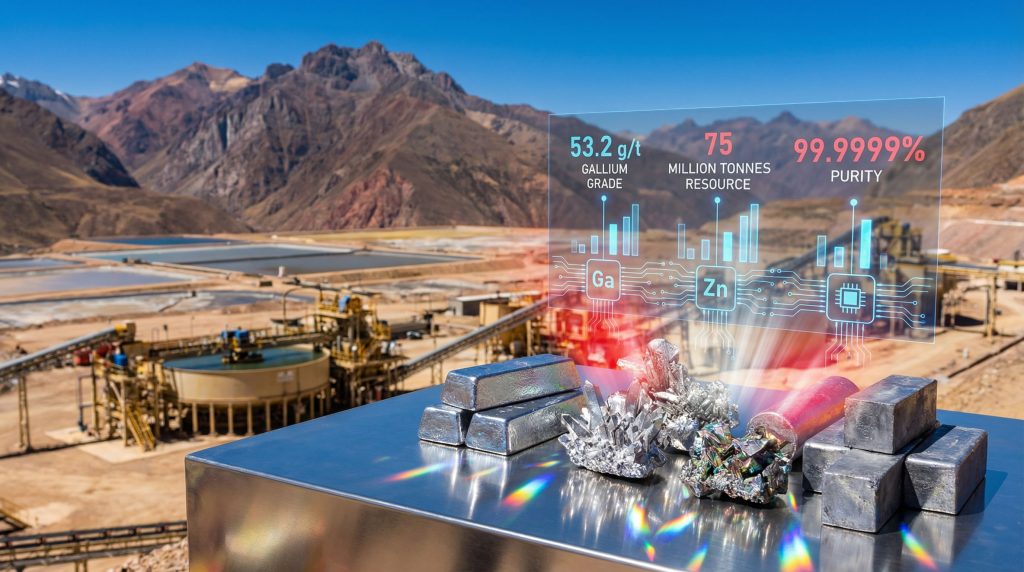
The tailings facility represents the accumulated residue from over 100 years of polymetallic sulfide processing at the Cerro de Pasco mining complex. Historical flotation circuits achieved approximately 60% recovery of primary metals, leaving significant residual concentrations in tailings streams that were deposited across the facility's 75-million-tonne capacity.
Spatial Grade Distribution Patterns:
| Location | Gallium Grade | Silver Grade | Zinc Grade | Lead Grade |
|---|---|---|---|---|
| Southern Zones | 50-110 g/t | 55-65 g/t | 1.8-2.2% | 1.0-1.3% |
| Central Areas | 45-65 g/t | 48-58 g/t | 1.3-1.7% | 0.7-1.0% |
| Northern Sections | 35-55 g/t | 40-50 g/t | 1.1-1.5% | 0.6-0.9% |
This grade variation reflects historical processing changes, ore type variations, and depositional patterns that concentrated heavier sulfide minerals in specific zones. Surface enrichment in southern sections results from both primary deposition patterns and secondary concentration through weathering processes.
Mineralogical Controls on Metal Accessibility
Gallium occurs primarily within sphalerite (zinc sulfide) crystal structures, where it substitutes for zinc atoms in ratios typically ranging from 10-500 parts per million. This solid solution behaviour creates both opportunities and technical challenges for selective recovery processes.
Critical Mineralogical Associations:
- Sphalerite-hosted gallium: Requires zinc flotation and subsequent hydrometallurgical treatment
- Galena-associated gallium: Lower concentrations but potentially easier liberation
- Secondary sulfate minerals: Formed through weathering, may concentrate gallium in near-surface zones
Technical Insight: The presence of gallium within primary sulfide minerals rather than oxide phases significantly affects processing complexity but enables integrated recovery circuits that maximise overall metal extraction efficiency while sharing infrastructure costs across multiple revenue streams.
Liberation characteristics determine the effectiveness of flotation separation, where optimal grinding must balance gallium accessibility against processing costs. Moreover, mineralogy and economics considerations indicate that 80% passing 150 micrometers achieves adequate liberation while maintaining reasonable grinding costs for the planned throughput rates.
Economic Integration Through Multi-Metal Processing Systems
Revenue optimisation in tailings reprocessing operations depends on successfully recovering multiple metals through shared processing infrastructure, creating economies of scale unavailable to single-commodity extraction projects.
Integrated Recovery Economics:
| Metal | Contribution to NSR | Processing Synergy | Market Strategic Value |
|---|---|---|---|
| Silver | Primary driver | Established flotation | Precious metal stability |
| Gallium | Premium margin | Shared circuits | Strategic material status |
| Zinc | Base load | Standard processes | Industrial demand |
| Lead | Supplemental | Proven technology | Secondary revenue |
The economic framework benefits from processing complementarity, where gallium recovery occurs within existing base metal circuits without requiring dedicated processing trains. This integration reduces unit operating costs while creating multiple revenue streams that buffer against individual commodity price volatility.
Planned processing rates of 3.6 million tonnes annually support steady-state operations over a 20-year mine life, with scalability potential to 7.2 million tonnes through equipment optimisation and process improvements. This throughput flexibility enables production adjustments based on market conditions and metallurgical performance validation.
Strategic Metal Premium Valuation
Gallium's classification as a critical material by major economies creates market dynamics distinct from conventional base metals, where supply security concerns drive premium pricing and government stockpiling programs.
Current market conditions reflect concentrated production geography, with China controlling approximately 98% of global gallium supply while consuming roughly 70% of production domestically. This supply concentration creates strategic vulnerabilities for defence and technology industries dependent on gallium-based semiconductors.
Critical Applications Driving Strategic Value:
- Gallium arsenide (GaAs) semiconductors: High-frequency electronics, satellite communications
- Gallium nitride (GaN) devices: Power electronics, LED lighting, military radar systems
- Solar cell technologies: High-efficiency photovoltaic systems
- Medical imaging equipment: Radiopharmaceutical applications
The United States maintains 100% import dependence for gallium, creating policy-level interest in domestic production capabilities that could reduce strategic material vulnerabilities. Recent Pentagon assessments specifically identify tailings reprocessing as among the fastest pathways to increase gallium availability, positioning projects like Quiulacocha within active supply security discussions.
However, the mining industry evolution has increasingly focused on strategic material supply chain security, creating additional opportunities for projects that can demonstrate reliable gallium production capabilities.
Processing Technology Optimisation and Scale-Up Considerations
Successful transition from metallurgical testing to commercial production requires addressing technical risks specific to gallium recovery while maintaining economic performance across all target metals.
Key Technical Development Areas:
- Gallium deportment characterisation: Understanding specific mineral associations affecting liberation requirements
- Process circuit optimisation: Maximising gallium recovery while maintaining base metal performance
- Quality control systems: Achieving semiconductor-grade purity specifications consistently
- Environmental compliance: Managing processing residues and meeting discharge requirements
Gallium purification to semiconductor specifications (99.9999% purity) requires specialised electrorefining processes distinct from conventional base metal electrowinning. These high-purity requirements create both technical challenges and significant value additions, as semiconductor-grade gallium commands premium pricing over standard commercial grades.
In addition, strategic gallium research indicates that gallium extraction at Quiulacocha could play a critical role in addressing global supply security concerns for this strategic element.
Metallurgical Risk Assessment and Mitigation
Recovery assumptions for gallium extraction at Quiulacocha rely on established hydrometallurgical principles, but specific performance validation requires comprehensive testing programs addressing unique aspects of the tailings mineralogy.
Primary Technical Risks:
- Gallium recovery rates: Current assumptions of 40-70% require validation through continuous testing
- Interference effects: Other metals may impact gallium separation efficiency during processing
- Reagent consumption: Specialised chemicals for gallium extraction may affect operating costs
- Scale-up performance: Laboratory results must translate effectively to industrial-scale operations
Mitigation strategies include staged testing programs progressing from batch-scale optimisation through pilot plant validation to commercial implementation. This phased approach enables technical risk reduction while providing operational data for economic modelling and process optimisation.
Consequently, recent drilling campaign results have confirmed high-grade mineralisation including significant gallium concentrations, providing additional confidence in the technical approach.
Infrastructure Advantages and Regional Processing Capabilities
Peru's established mining infrastructure provides significant operational advantages for tailings reprocessing projects, reducing both capital requirements and development timelines compared to greenfield operations in remote locations.
Regional Infrastructure Benefits:
- Skilled workforce: Experienced miners and metallurgical technicians familiar with complex polymetallic processing
- Processing facilities: Existing plants available for toll treatment or acquisition arrangements
- Transportation networks: Road and rail connections to Pacific ports for international markets
- Regulatory framework: Established permitting processes for mining and metallurgical operations
Environmental remediation integration creates additional advantages, as tailings reprocessing addresses historical environmental liabilities while generating economic value. This dual-purpose approach improves community acceptance and regulatory support while reducing overall project risk profiles.
The Quiulacocha facility's location within the established Cerro de Pasco mining district provides access to existing infrastructure including power supply, water management systems, and waste disposal facilities. These infrastructure advantages reduce capital intensity compared to remote tailings projects requiring complete greenfield development.
Furthermore, mine reclamation innovations continue to advance the technical possibilities for combining environmental restoration with economic metal recovery, creating synergistic benefits for projects like Quiulacocha.
The next major ASX story will hit our subscribers first
Market Positioning and Supply Chain Strategic Value
Gallium's role in next-generation semiconductor technologies creates market positioning opportunities distinct from conventional base metals, where strategic material classifications drive government and industrial interest in supply security.
Strategic Supply Chain Factors:
- Domestic production incentives: Government policies supporting critical material supply diversification
- Technology sector demand: Growing requirements for high-performance semiconductors in defence applications
- Supply security premiums: Buyers willing to pay premiums for non-Chinese gallium sources
- Stockpiling programs: Government purchases for strategic material reserves
Market access for gallium products requires meeting stringent quality specifications while maintaining cost competitiveness against established suppliers. Success depends on achieving consistent purity levels, reliable delivery schedules, and pricing structures that attract customers seeking supply diversification.
The semiconductor industry's supply chain security focus creates opportunities for new gallium sources that can demonstrate reliable production capabilities and meet quality requirements. Early market development through government stockpiling programs or defence contractor relationships could provide revenue stability during production ramp-up phases.
Additionally, the critical minerals trade environment continues to evolve as nations prioritise supply security for strategic materials, creating market opportunities for reliable gallium producers outside traditional supply chains.
Investment Framework and Risk-Adjusted Return Potential
Gallium extraction at Quiulacocha presents a unique investment proposition combining low-cost tailings extraction with strategic metal exposure and multi-commodity revenue diversification, but success requires careful evaluation of technical and market risks.
Investment Advantages:
- Proven resource base: 75 million tonnes of above-ground material with consistent grades
- Low extraction costs: $1-2 per tonne processing costs versus conventional mining operations
- Strategic metal exposure: Gallium provides premium pricing and policy-level support
- Infrastructure leverage: Existing regional capabilities reduce capital requirements
- Revenue diversification: Multiple metal streams buffer commodity price volatility
Key Risk Factors:
- Metallurgical performance: Recovery rates must meet economic assumptions for project viability
- Market development: Gallium sales require establishing customer relationships and quality validation
- Regulatory compliance: Environmental permitting for new processing methods and waste management
- Capital requirements: Specialised processing equipment for gallium purification increases investment needs
The investment case depends on successfully demonstrating metallurgical recoveries, achieving quality specifications, and accessing gallium markets while maintaining competitive costs across all metal products. Each milestone achievement reduces technical risk while improving project economics and strategic positioning.
Development Timeline and Value Catalysts
Phase 1: Technical Validation (2025-2026)
- Comprehensive metallurgical testing programs
- Process optimisation and flowsheet development
- Environmental permitting and compliance planning
- Market development and customer qualification
Phase 2: Pilot Operations (2026-2027)
- Continuous processing trials and equipment testing
- Quality control validation and certification processes
- Customer sampling and approval programs
- Financial arrangements and production partnerships
Phase 3: Commercial Production (2027-2028)
- Full-scale processing facility construction and commissioning
- Production ramp-up and operational optimisation
- Market penetration and revenue growth
- Expansion planning based on performance results
The technical and market development pathway provides multiple value inflection points where successful milestone achievement reduces investment risk while improving economic returns. Strategic metal positioning creates potential for accelerated development through government support or strategic partnerships with technology companies requiring secure gallium supplies.
Disclaimer: This analysis involves speculative assessments of technical performance, market conditions, and economic projections. Actual results may differ significantly from projections due to metallurgical, regulatory, market, and operational factors beyond current knowledge. Investors should conduct independent due diligence and consider professional advice before making investment decisions.
Want to Spot the Next Strategic Metal Discovery?
Discovery Alert's proprietary Discovery IQ model delivers instant notifications when significant ASX mineral discoveries are announced, helping investors identify strategic metal opportunities like gallium before broader market recognition. Take advantage of our comprehensive discoveries page showcasing historic returns from major mineral discoveries, then begin your 14-day free trial to position yourself ahead of the market in critical materials investing.