May 20, 2026
The Processing Bottleneck at the Heart of America's Critical Minerals Challenge
There is a paradox embedded in the geography of American industry. The continental United States sits atop some of the most geologically diverse mineral endowments on Earth, yet for decades the nation has watched the most value-intensive stages of turning those resources into usable materials migrate offshore. DOE funding for U.S. minerals processing is now driving some of the most consequential industrial policy decisions in a generation, targeting precisely the structural vulnerability this creates.
Understanding why this happened requires distinguishing between two fundamentally different industrial activities: extraction and processing. Mining extracts ore from the ground. Processing transforms that ore into the refined, separated, and chemically pure materials that electronics, motors, batteries, and defence systems actually require. The second step is technically harder, more capital-intensive, and more environmentally regulated than the first.
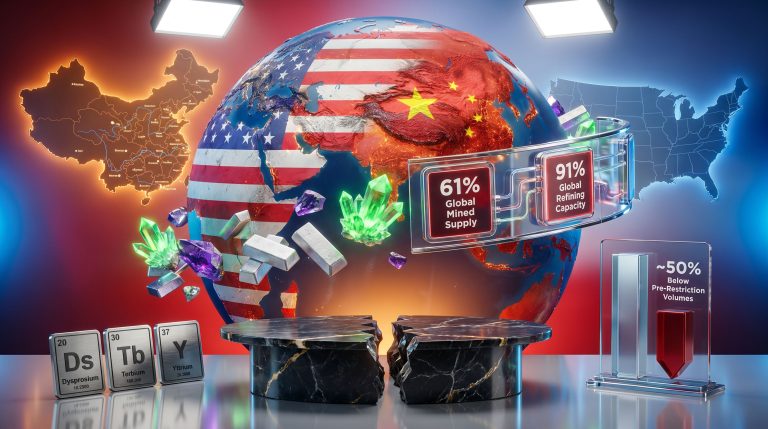
Over several decades, those factors pushed processing capacity toward lower-cost jurisdictions, most notably China, which today controls the majority of global rare earth element separation capacity, dominates primary magnesium production, and holds commanding positions across battery material refining. The rare earth supply chain importance cannot be overstated in this context.
The consequence is not theoretical. When a U.S. manufacturer needs separated neodymium oxide for a permanent magnet, or refined cobalt sulphate for a battery cathode, there are very few domestic facilities capable of supplying it regardless of how much ore sits in American ground. That chokepoint, located firmly in the processing and refining stage, is now the primary target of DOE funding for U.S. minerals processing.
When big ASX news breaks, our subscribers know first
Why Processing, Not Mining, Is the New Policy Battleground
Federal mineral policy in the United States spent most of the past century focused on extraction: leasing, permitting, royalties, and resource assessment. The strategic logic was straightforward because physical access to ore was considered the binding constraint. However, that logic no longer holds.
Today the binding constraint is the capacity to convert ore, waste streams, and recycled feedstocks into specification-grade materials that advanced industries can actually use. China recognised this earlier than most Western governments, building integrated processing infrastructure over decades that now gives it leverage at every node of the critical minerals supply chain.
It accounts for roughly 85 to 90 percent of global rare earth processing, an estimated 80 percent or more of global magnesium primary production, and similarly dominant shares across graphite anode material, battery-grade lithium compounds, and cobalt refining. The rare earth processing challenges facing the West are consequently severe.
The strategic demand side compounds the problem. Electric vehicle motors require neodymium-iron-boron permanent magnets. Grid-scale storage systems require lithium, cobalt, nickel, and manganese in refined forms. Semiconductor fabrication requires ultra-pure silicon, gallium, and germanium. Advanced radar and sonar systems require terbium and dysprosium. Each of these materials passes through a processing stage that the United States currently lacks the capacity to perform at meaningful scale.
The geopolitical implication is direct: a nation that cannot refine its own strategic materials cannot guarantee the supply chains of its own defence and energy industries, regardless of what it mines.
What the DOE's Critical Material Innovation Programme Actually Does
The Department of Energy's approach to closing the processing gap is structured around a tiered funding mechanism administered through its Office of Critical Minerals and Energy Innovation. The relevant funding vehicle, the Critical Material Innovation, Efficiency, and Alternatives programme, is designed to move technologies through successive readiness levels rather than attempting to jump directly from laboratory research to commercial production — a sequencing error that has historically destroyed value in capital-intensive industries.
Projects are evaluated on several dimensions simultaneously: technical readiness, domestic feedstock availability, commercial pathway viability, and institutional capacity to execute. Eligible applicants span national laboratories, universities, research institutes, and private-sector companies, with multi-institutional consortia increasingly common because no single organisation typically holds all the required capabilities.
The latest selection round, announced in May 2026, demonstrates how this architecture functions in practice. Nineteen projects were selected to share $45.7 million in federal funding, split across two distinct investment tiers that correspond to different technology readiness levels. The DOE's critical minerals programme provides further detail on programme objectives and eligibility criteria.
A Snapshot of the Broader Funding Landscape
The $45.7 million selection sits within a considerably larger federal capital deployment strategy. Across announced and planned rounds from mid-2025 through mid-2026, the DOE has committed or signalled over $1.5 billion in combined support for critical minerals processing, recycling, and supply chain development, excluding Inflation Reduction Act-linked tax incentives.
| Funding Round | Announced | Total Value | Primary Focus |
|---|---|---|---|
| Battery and Rare Earth Materials Package | August 2025 | ~$1 billion (planned) | Battery processing, byproduct recovery, REE extraction |
| Domestic Critical Materials Processing Initiative | March 2026 | $500 million | Processing and manufacturing infrastructure |
| Critical Minerals and Materials Accelerator | April 2026 | Up to $69 million | Prototype and pilot technologies, recycling, semiconductor-grade materials |
| Pilot-Scale and Next-Gen Technologies Selection | May 2026 | $45.7 million | 19 projects across REE separation, magnesium, bench-scale R&D |
The layered structure is deliberate. Committing large capital to unproven technologies at commercial scale is how industrial programmes fail. The tiered approach requires technologies to demonstrate performance at each stage before unlocking the larger capital commitments associated with demonstration and full commercialisation.
Breaking Down the $45.7 Million: Two Investment Tiers, One Strategic Purpose
Tier 1: Pilot-Scale Facility Development
The larger awards within the May 2026 selection target the most commercially proximate challenge: scaling rare earth element separation and magnesium metal production from proven laboratory processes toward pre-commercial and eventually commercial-scale operations.
The concept of the valley of death is well understood in advanced materials development. A technology that works reliably at bench scale, processing kilograms of material per day, faces enormous engineering, economic, and logistical challenges when scaled to tonnes per day. Heat management changes. Chemical equilibria behave differently at volume. Capital costs and operating cost structures shift fundamentally.
Most promising laboratory technologies fail to survive this transition, which is precisely why federal pilot-scale investment carries strategic value that purely commercial capital cannot replicate. Furthermore, U.S. critical minerals production policy increasingly reinforces this investment rationale at the legislative level.
Pilot-scale projects within this selection draw from a wide range of domestic feedstocks:
- Primary ore deposits across active and undeveloped U.S. resource positions
- Historical mine waste and tailings from legacy extraction operations
- Industrial residues including coal combustion byproducts and manufacturing process waste
- Secondary and recycled materials including battery black mass and decommissioned permanent magnets
Individual project values across the selection range from approximately $700,000 to $50.5 million, reflecting both the combined DOE and non-DOE contributions required under cost-share structures.
Tier 2: Next-Generation Bench-Scale Technologies
The second category funds earlier-stage research into genuinely novel processing approaches that have not yet been demonstrated at any meaningful scale. This is the technology pipeline work that determines what pilot-scale programmes will exist in five to ten years.
Materials covered at this stage are considerably broader than the pilot-scale focus, encompassing graphite, lithium, nickel, cobalt, rare earth elements, manganese, silicon, and additional strategic minerals. The feedstock diversity is equally expansive:
- Ore bodies and mineral concentrates from conventional mining operations
- Geothermal and lithium-bearing brine systems
- Recycled battery black mass containing recoverable lithium, cobalt, nickel, and manganese
- End-of-life permanent magnets from motors, hard drives, and industrial equipment
- Coal combustion residues including fly ash with measurable rare earth concentrations
- Industrial wastewater and dilute aqueous streams containing dissolved strategic minerals
The multi-feedstock strategy embedded in this tier is arguably one of the most underappreciated aspects of the programme. By funding recovery from dilute and unconventional sources alongside primary ore processing, DOE is building resilience against feedstock concentration risk — the same vulnerability that makes dependence on single-source suppliers so dangerous.
The Two Priority Materials and Why They Were Chosen
Rare Earth Elements: Cracking the Separation Bottleneck
Rare earth elements are not particularly rare in the Earth's crust. Several of them are more abundant than copper. The difficulty is not geological scarcity but chemical inseparability: the 17 elements that comprise the rare earth group have almost identical ionic radii and chemical behaviour, making their separation technically demanding and capital-intensive.
The standard industrial method, solvent extraction, involves hundreds of sequential liquid-liquid separation stages and requires significant chemical inputs, infrastructure, and process control expertise. China mastered and vertically integrated this process over decades, creating cost structures and process efficiencies that Western entrants have struggled to match.
The United States currently mines rare earth ore at facilities including MP Materials' Mountain Pass operation in California, but the separated oxide products most industrial buyers actually need largely continue to be refined offshore. Domestic rare earth separation capacity is limited to a small number of facilities, none yet operating at a scale sufficient to supply anticipated demand from domestic EV, wind energy, and defence manufacturing.
Pilot-scale DOE investment in REE separation targets this specific bottleneck. The downstream implications are substantial: neodymium, praseodymium, terbium, and dysprosium are the critical inputs for NdFeB permanent magnets used in EV traction motors and wind turbine generators. Without domestic separation, a domestic magnet manufacturing industry remains hostage to foreign-refined material.
Magnesium: The Forgotten Strategic Metal
Magnesium receives considerably less public attention than lithium or rare earths, but its strategic position is arguably more immediately precarious. The United States has effectively no significant domestic primary magnesium production. The last major U.S. primary magnesium plant, US Magnesium's facility in Utah, is one of the only remaining Western producers, representing a fraction of global capacity.
China produces an estimated 85 to 90 percent of global primary magnesium, primarily through the Pidgeon process using ferrosilicon reduction of dolomite in Shanxi province. This concentration is so extreme that it creates single-point-of-failure risk for industries that depend on magnesium, including:
- Aerospace and automotive lightweighting applications where magnesium alloys reduce structural weight
- Defence components across aircraft, vehicles, and munitions where mass reduction is operationally critical
- Emerging battery chemistries that use magnesium as an anode material, potentially offering higher energy density than lithium-ion in next-generation formats
- Steel desulfurisation, where magnesium is used as a reagent in steelmaking processes
DOE pilot-scale investment in magnesium production represents an attempt to rebuild industrial capability the United States has largely allowed to atrophy. Unlike rare earths, where at least some domestic mining infrastructure exists, magnesium requires starting closer to zero on the domestic production side.
The FEOC Dimension: Security Restrictions Reshaping Project Eligibility
One policy layer that significantly shapes who can participate in DOE funding programmes — and who benefits from federally funded technology development — is the Foreign Entity of Concern framework. FEOC provisions restrict participation by companies or entities connected to adversarial nations, primarily China, Russia, Iran, and North Korea.
The 2025 and 2026 funding rounds have incorporated progressively tighter FEOC restrictions, responding to concerns that earlier programmes may have inadvertently facilitated technology transfer to supply chain participants with ownership or licensing ties to restricted jurisdictions.
The practical implications extend beyond simple eligibility screening:
- Technology licensing arrangements between U.S. awardees and international partners face enhanced scrutiny
- Joint ventures involving any FEOC-linked entity are effectively disqualified from participation
- IP developed under DOE grants is increasingly subject to commercialisation restrictions that limit foreign licensing
- Supply chain partners seeking qualification as domestic suppliers face due diligence requirements around ultimate beneficial ownership
For the critical minerals investment ecosystem, FEOC restrictions function as a structural realignment mechanism. In addition, considerations around critical minerals and energy security are increasingly shaping how these restrictions are enforced and interpreted.
The next major ASX story will hit our subscribers first
The Applicant Ecosystem: Who Executes These Projects
| Applicant Type | Role in the Ecosystem | Competitive Advantage |
|---|---|---|
| National Laboratories | Deep technical expertise, large-scale testing infrastructure | Access to DOE facilities and cross-programme collaboration |
| Universities | Fundamental research, workforce development | Long-term knowledge generation and talent pipeline |
| Research Institutes | Applied R&D, technology transfer | Bridge between academic discovery and commercial application |
| Private Companies | Commercial pathway development, scale-up | Market knowledge, manufacturing experience, investor relationships |
Multi-institutional consortia combining national laboratory technical depth with private-sector commercial experience are increasingly the preferred project structure. Geographic distribution of selected projects spans multiple U.S. states, serving both supply-chain redundancy goals and regional economic development objectives.
Mapping the Technology Readiness Architecture
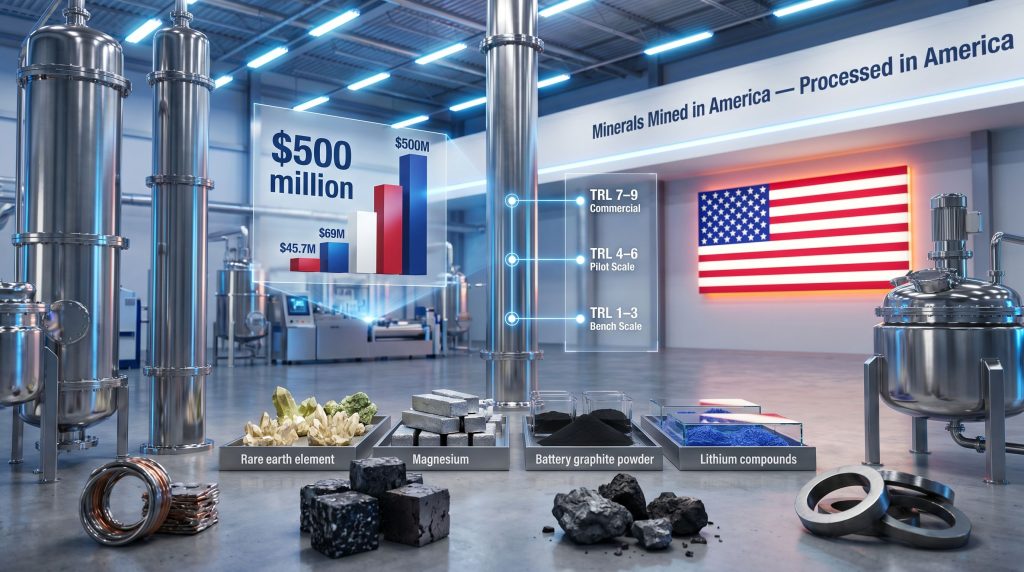
The full scope of DOE's layered investment strategy maps directly onto technology readiness levels, creating a progression from early-stage research through commercial deployment:
TRL 1-3: Basic Research
  --> Bench-Scale Next-Gen Technologies ($45.7M round, Tier 2)

TRL 4-6: Applied R&D and Pilot Scale
  --> Pilot-Scale Facilities ($45.7M round, Tier 1)
  --> Critical Minerals and Materials Accelerator ($69M)

TRL 7-9: Demonstration and Commercialisation
  --> $500M Domestic Critical Materials Processing Initiative
  --> ~$1B Battery and REE Materials Package
Private co-investment is a requirement across most of these tiers, not an optional feature. The cost-share structure means federal dollars are explicitly designed to leverage additional industry capital, with the total mobilised investment across the ecosystem exceeding the face value of any individual federal commitment.
How U.S. Policy Compares Globally
The United States is not operating in a vacuum. Allied and competing nations are pursuing parallel strategies with different mechanisms and urgencies. For instance, Europe's critical raw materials push through the Critical Raw Materials Act represents one of the most structured allied-nation responses to supply chain vulnerability.
| Dimension | United States | European Union | China |
|---|---|---|---|
| Primary Mechanism | DOE grants, loan guarantees, IRA tax credits | Critical Raw Materials Act, EIB financing | State-directed investment, SOE dominance |
| Processing Focus | Domestic pilot and commercial scale-up | Reducing import dependency, strategic stockpiling | Maintaining and expanding global market share |
| Recycling Integration | High priority (battery black mass, magnets) | High priority (CRMA recycling targets) | Growing, but secondary to primary production |
| FEOC and Security Restrictions | Strong and tightening through 2025-2026 | Moderate, diversification-focused | Not applicable |
| Total Capital Mobilised (2025-2026) | $1.5B+ across DOE programmes | EUR 1B+ under CRMA and EIB | Estimated $10B+ annually |
The scale disparity with China is significant and should not be minimised. Chinese state and private investment in critical minerals processing is estimated to exceed $10 billion annually, a figure that reflects decades of deliberate industrial policy rather than a recent reactive response. Closing the processing gap will require sustained multi-year investment cycles, not a single round of grants. According to a recent DOE announcement, securing domestic supply chains remains a top-tier national priority.
Structural Challenges That Capital Alone Cannot Resolve
Federal investment is necessary but not sufficient. Several structural barriers will constrain how quickly DOE funding for U.S. minerals processing translates into operational supply chain capacity.
Permitting timelines for new processing facilities remain measured in years even when federal interest in the project is strong. Environmental review processes applicable to hydrometallurgical facilities are technically complex and frequently contested.
Workforce gaps in metallurgical engineering, hydrometallurgy, solvent extraction chemistry, and advanced materials processing represent a genuine bottleneck. The United States has relatively few graduate programmes producing the specific technical expertise that rare earth separation and magnesium production facilities require.
Infrastructure access is a non-trivial constraint for processing facilities in resource-adjacent regions. Reliable power supply at competitive industrial rates, access to process water, and logistics connectivity all affect site selection and project economics in ways that federal grants cannot directly address.
Technology attrition from pilot to commercial scale is historically high in advanced materials processing. The valley of death is not merely a funding problem; it reflects genuine engineering challenges that require iterative problem-solving across multiple development cycles.
Projected Outcomes: Near, Medium, and Long-Term
Near-Term (2026-2028)
- Operational pilot-scale facilities demonstrating REE separation and magnesium production at pre-commercial throughput
- Validated bench-scale technology datasets enabling private investors to assess commercial viability with greater confidence
- Published performance benchmarks creating a basis for comparison against incumbent foreign processing operations
Medium-Term (2028-2032)
- First commercial-scale domestic REE separation facilities drawing on DOE-funded intellectual property and process development
- Meaningful domestic magnesium production capacity re-established for the first time in a generation
- Recycling and secondary recovery streams beginning to integrate structurally into battery and magnet material supply chains
Long-Term Strategic Outcomes
- Reduced import dependency for processed critical materials across energy, defence, and semiconductor manufacturing sectors
- A distributed domestic processing ecosystem spanning primary ore, industrial waste recovery, and recycled feedstock streams
- U.S. competitiveness in clean energy technology manufacturing supported by domestically derived and processed material inputs
What Investors and Industry Participants Should Monitor
For those tracking the commercial implications of DOE funding for U.S. minerals processing, several near-term signals carry particular weight:
- Progress timelines of pilot-scale REE separation and magnesium production projects from selection toward construction and commissioning milestones
- Private-sector partnership announcements from national laboratory awardees as commercialisation pathways develop around publicly funded IP
- Emerging offtake and supply agreements between federally supported processors and downstream manufacturers in the EV, wind, and defence sectors
- Legislative budget developments affecting DOE's Office of Critical Minerals and Energy Innovation in future appropriations cycles
- Expansion of the Critical Minerals and Materials Accelerator programme, for which 2026 application deadlines remain active, indicating continued near-term project selection activity
Disclaimer: This article is intended for informational purposes only and does not constitute financial or investment advice. Forward-looking statements about project timelines, commercial outcomes, and funding commitments are subject to change based on technical, regulatory, legislative, and market factors. Readers should conduct independent research before making investment decisions.
Frequently Asked Questions: DOE Funding for U.S. Minerals Processing
What is the DOE's Critical Material Innovation, Efficiency, and Alternatives programme?
It is a structured federal funding opportunity administered by DOE's Office of Critical Minerals and Energy Innovation, designed to support domestic development of critical mineral processing technologies across multiple readiness levels, from bench-scale research through pilot-scale demonstration and toward commercial deployment.
Which minerals are prioritised in the May 2026 selection?
At the pilot scale, the focus is rare earth elements and magnesium. At the bench scale, the programme covers graphite, lithium, nickel, cobalt, manganese, silicon, and additional strategic materials.
What feedstocks are eligible for DOE-funded processing projects?
Eligible feedstocks include primary ore, mine waste and tailings, industrial byproducts, coal combustion residues, recycled battery black mass, end-of-life permanent magnets, geothermal brines, and dilute wastewater streams containing dissolved strategic minerals.
What are FEOC restrictions in the context of DOE minerals funding?
Foreign Entity of Concern provisions restrict participation by companies linked to adversarial nations from receiving federal funding or benefiting from federally funded technology development in the critical minerals sector. They are designed to prevent federally funded intellectual property from strengthening supply chains controlled by geopolitical competitors.
How much has DOE committed to critical minerals processing since 2025?
Across announced and planned funding rounds from August 2025 through May 2026, DOE has committed or signalled more than $1.5 billion in combined support for critical minerals processing, recycling, and supply chain infrastructure, not including IRA-linked tax incentives that apply to qualifying domestic production facilities.
Want To Stay Ahead Of The Next Major Mineral Discovery?
Discovery Alert's proprietary Discovery IQ model delivers real-time alerts on significant ASX mineral discoveries — instantly transforming complex mineral data into actionable insights for both short-term traders and long-term investors. Explore historic discoveries and the exceptional returns they generated, then start your 14-day free trial at Discovery Alert to position yourself ahead of the broader market.