July 15, 2026
The Minerals Behind the Summit: Why Rare Earths Have Become the New Battleground in U.S.–China Relations
For decades, economists and trade strategists framed the U.S.–China rivalry through the lens of tariffs, market access, and currency manipulation. That framing is now obsolete. The competition has shifted decisively toward something far more tangible and far harder to replicate: physical control over the mineral inputs that make modern economies function. Rare earth elements sit at the absolute centre of this shift, and no diplomatic event in recent memory has illustrated that reality more starkly than what did not happen during the Trump rare earth deal in Beijing — or rather, the deal that failed to materialise during Donald Trump's May 2026 visit.
When big ASX news breaks, our subscribers know first
Refining Capacity, Not Mining Rights, Is Where China's Power Actually Lives
Understanding why the Trump rare earth deal in Beijing failed to materialise requires understanding the architecture of rare earth supply chains, because the leverage points are not where most people assume they are.
Rare earth elements are a group of 17 metallic elements that share similar chemical properties. Despite the name, most are not particularly scarce in the Earth's crust. What makes them strategically irreplaceable is the concentration of processing infrastructure required to convert raw ore into usable, high-purity compounds and then into finished components like permanent magnets.
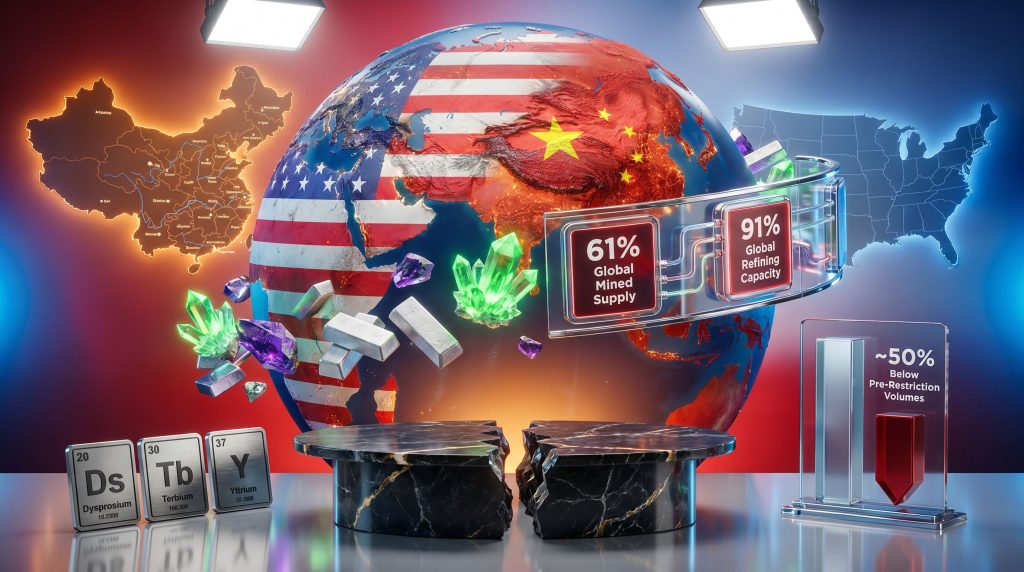
According to the International Energy Agency, China accounted for approximately 61% of global mined rare earth supply and a staggering 91% of global refining and processing capacity in 2024. Even when extraction occurs in other countries, the ore routinely travels to China for processing because no comparable alternative infrastructure exists at scale elsewhere. This creates a structural chokepoint that mining investment alone cannot solve.
The downstream picture is even more concentrated. China's share of global permanent magnet manufacturing is estimated at between 85% and 90%, and its dominance over heavy rare earth processing is effectively total. Heavy rare earths, which include elements like dysprosium and terbium, are geologically rarer and technically more difficult to separate than light rare earths, and China's advantages compound at every stage of the value chain.
| Supply Chain Stage | China's Estimated Global Share (2024) |
|---|---|
| Mined rare earth production | ~61% |
| Refining and processing capacity | ~91% |
| Permanent magnet manufacturing | ~85–90% |
| Heavy rare earth processing | Near-total dominance |
What the Beijing Summit Actually Produced
Trump's two-day summit with President Xi Jinping concluded without a confirmed, publicly detailed agreement on rare earth supply. Despite the U.S. President characterising the visit in highly positive terms and referencing trade deals, no binding commitments on rare earth exports or export licensing processes were formally announced. China's rare earth strategy throughout this period has been notably calculated, and the summit outcome reflects that deliberate approach.
U.S. Trade Representative Jamieson Greer stated publicly that rare earth import volumes had improved to better levels, though he acknowledged the pace of recovery remained slower than desired. On the question of extending the existing one-year trade truce framework, Greer noted that both sides appeared willing, but willingness and a signed agreement are categorically different things.
| Claim or Statement | Verified Outcome |
|---|---|
| Visit described as very successful | No concrete rare earth agreement publicly confirmed |
| References to fantastic trade deals | No implementation details released |
| U.S. Trade Representative cited improving import levels | Shipments still running approximately 50% below pre-restriction volumes |
| Both sides described as willing to extend truce | No formal extension announced as of the summit's conclusion |
The absence of a deal is not merely a procedural footnote. It reflects how entrenched China's structural position is and how limited Washington's near-term negotiating leverage actually is when the counterparty controls the only viable processing infrastructure. As reported by Mining.com, Trump left Beijing without any confirmed rare earth agreement, underscoring the depth of the impasse.
How China Converted Mineral Dominance Into a Diplomatic Weapon
The sequence of events leading to the Beijing summit illustrates the deliberate use of rare earth supply as a geopolitical instrument. Following Trump's announcement of sweeping tariffs in what became known as Liberation Day, Beijing responded by imposing rare earth export restrictions on a targeted basket of rare earth products. The choice of specific elements was not arbitrary.
The restricted elements included:
- Yttrium — used in LED lighting systems, radar arrays, and hydrogen fuel cells
- Dysprosium — a heavy rare earth element essential for high-coercivity permanent magnets used in electric vehicle traction motors and military hardware operating at elevated temperatures
- Terbium — critical for solid-state lighting phosphors and defence-grade magnetic applications requiring performance stability across wide temperature ranges
The downstream consequences were immediate and severe. Auto manufacturing plants across the United States and Europe faced temporary shutdowns as magnet supply chains were disrupted, exposing just how little buffer inventory existed within Western industrial systems. This was not a theoretical vulnerability being modelled in a think tank. It was a real operational failure with measurable economic consequences.
What makes dysprosium particularly critical, and less understood outside specialist circles, is its functional role within neodymium-iron-boron (NdFeB) permanent magnets. Without dysprosium additions, these magnets lose coercivity at the elevated operating temperatures found inside EV motors and aerospace systems. There is currently no commercially viable substitute. This makes dysprosium one of the few materials in modern manufacturing for which no engineering workaround exists at scale.
The Data Tells a Different Story Than the Diplomatic Rhetoric
Despite the trade truce framework agreed in late 2025, customs data available through mid-2026 reveals that shipments of key rare earth elements to the United States remain approximately 50% below the volumes recorded in the twelve months preceding China's export restrictions. This gap between diplomatic optimism and measurable trade flows is one of the most important signals for anyone assessing the practical status of the U.S.–China minerals relationship.
Exports of yttrium, dysprosium, and terbium to the U.S. remain approximately 50% below pre-restriction baselines even after the trade truce framework was established, according to customs data cited in reporting by the Canadian Mining Journal.
This persistent shortfall suggests that export licensing delays, rather than outright bans, have become China's preferred tool. Licensing delays are harder to categorise as a formal trade violation under international frameworks, yet they achieve many of the same supply disruption effects. They also maintain plausible deniability, as any individual shipment delay can be attributed to administrative processing rather than deliberate policy.
The Industries With the Most to Lose
The strategic significance of rare earth supply disruptions extends across multiple sectors, each with its own specific elemental dependencies and tolerance for substitution.
### Electric Vehicles
NdFeB permanent magnets in traction motors require a precise formulation of neodymium, praseodymium, dysprosium, and terbium. There is no current alternative magnet technology that matches the power density of NdFeB at commercially viable cost. Every major EV platform from every major manufacturer depends on this supply chain.
### Defence Systems
An F-35 fighter jet contains approximately 920 pounds of rare earth materials per aircraft, embedded across guidance systems, radar arrays, electric motors, and communication equipment. The broader U.S. defence industrial base relies on rare earths at virtually every level of advanced weapons systems.
### Renewable Energy
Direct-drive wind turbines use permanent magnet generators that require up to 600 pounds of rare earth magnets per turbine. As grid-scale wind deployment accelerates globally, the demand trajectory for relevant rare earths is structurally upward regardless of geopolitical conditions.
### Semiconductors and Advanced Electronics
This dependency is less visible but pervasive. Rare earths appear as polishing compounds in chip fabrication, as phosphors in display technologies, and as dopants in optical fibres and laser systems. Cerium-based slurries are central to chemical mechanical planarisation, a foundational step in semiconductor manufacturing. Furthermore, the processing challenges involved at this stage remain substantial and largely unresolved outside of Chinese facilities.
### Robotics and Automation
As industrial automation accelerates, the demand for compact, high-torque servo motors and actuators that rely on NdFeB magnets is growing rapidly. This represents a demand frontier that is still in relatively early stages, meaning the supply pressure from this sector will intensify over the coming decade.
The next major ASX story will hit our subscribers first
Three Scenarios for What Comes Next
The ambiguity produced by the Beijing summit creates a range of possible trajectories for rare earth markets and U.S. supply security. Each carries distinct implications for industry, investors, and policymakers.
Scenario 1: Trade Truce Extended, Shipments Gradually Normalise
Both sides agree formally to extend the trade truce, and export licensing processes begin to clear the backlog of delayed shipments. Rare earth volumes recover toward pre-restriction baselines over a 12 to 18 month period. Manufacturing disruptions ease while domestic and allied processing buildout continues in parallel. Geopolitical tension persists but remains managed.
Scenario 2: Framework Stalls, Licensing Delays Continue
No formal extension is agreed, and export licensing delays remain a persistent feature of the trade relationship. U.S. manufacturers face continued supply constraints on heavy rare earths, accelerating federal investment in domestic and allied alternatives. Prices for dysprosium, terbium, and yttrium face sustained upward pressure as buyers compete for constrained supply outside China.
Scenario 3: Negotiations Break Down, Full Re-escalation
A breakdown in broader trade negotiations triggers an expansion of China's export restrictions across a wider basket of rare earth and critical mineral products. Emergency procurement from Australia, Canada, and allied nations accelerates but cannot immediately fill the gap. Supply shocks ripple through EV production, defence procurement, and semiconductor fabrication on a timeline of months, not years.
Can the U.S. Build Its Way Out of This Dependency?
The honest answer is: eventually, but not quickly. Heidi Crebo-Rediker, a senior fellow at the Council on Foreign Relations, stated publicly in the context of the Beijing summit that the United States and its allies lack the capacity to mine, process, or invest at a pace that would rebuild supply chain resilience within any near-term timeframe. This assessment, coming from one of the more credible voices in U.S. strategic policy analysis, is notable for its candour.
The structural problem is not ore. The Mountain Pass mine in California operated by MP Materials is a genuine domestic resource. The U.S. government has taken the unprecedented step of acquiring a federal equity stake in MP Materials, signalling a shift toward treating critical mineral processing infrastructure as a national security asset rather than a purely commercial enterprise. However, the processing and magnet manufacturing capabilities required to convert that ore into finished defence and EV components remain heavily dependent on Chinese-controlled technology and supply chains.
Analysts broadly estimate that building competitive domestic refining and magnet manufacturing capacity at meaningful industrial scale would require a minimum of 10 to 15 years under current investment trajectories. That timeline assumes sustained political will, consistent capital allocation, and the successful development of workforce expertise that has largely migrated to Asia over the past three decades.
America's rare earth supply chain faces a particularly acute version of this challenge, given the scale of U.S. defence and technology sector demand relative to current domestic processing capacity. Allied diversification through partnerships with Australia, Japan, South Korea, and Canada offers a partial bridge. Australia in particular hosts significant deposits of both light and heavy rare earths and has been actively developing processing capabilities with government support. However, the refining bottleneck remains, and building alternative processing hubs requires not just capital but the resolution of significant environmental and regulatory challenges that slowed Western rare earth development in the first place.
The Structural Shift No Tariff Schedule Can Reverse
The deeper significance of the Trump rare earth deal in Beijing failing to materialise is what it reveals about the new architecture of U.S.–China competition. As Heidi Crebo-Rediker outlined in analysis published around the time of the summit, the centre of gravity in this rivalry has moved away from tariff schedules and toward China's physical control over the mineral supply chains that underpin both advanced manufacturing and modern military capability. CNBC's analysis of Trump's rare earth strategy similarly concludes that meaningful change will not come quickly, regardless of the diplomatic framing applied to any individual summit outcome.
This is a fundamentally different kind of leverage than tariffs. Tariffs can be adjusted, removed, or offset through policy mechanisms on both sides. Control over the only viable global processing infrastructure for a set of materials with no practical substitutes is structural, deeply embedded, and decades in the making. It cannot be negotiated away in a two-day summit, regardless of how the diplomatic optics are framed afterward.
The Beijing summit crystallised a reality that strategic analysts have been warning about for years: when one nation controls the refining chokepoint for materials embedded in every major technology platform, the leverage that creates is qualitatively different from anything a tariff schedule can replicate.
For investors, policymakers, and industrial planners, the absence of a deal from Beijing is not a temporary setback waiting to be corrected in the next round of talks. It is a signal that the structural dependency is real, that the timeline to address it is long, and that the volatility in rare earth markets is likely to remain elevated for the foreseeable future.
Frequently Asked Questions
Did Trump secure a rare earth deal in Beijing?
No confirmed or publicly detailed agreement emerged from the May 2026 Beijing summit. While both governments indicated a willingness to consider extending the existing trade truce framework, no binding rare earth supply commitment was formally announced.
Why does China control such a large share of rare earth processing?
China's processing dominance reflects several decades of deliberate industrial policy that combined state subsidies, vertically integrated infrastructure investment, tolerant environmental regulation at the processing stage, and a long-term strategic vision for mineral supply chain control that Western governments simply did not match.
Which rare earth elements are most critical to U.S. national security interests?
Dysprosium, terbium, neodymium, praseodymium, and yttrium are among the most strategically sensitive elements, given their roles in NdFeB permanent magnets for defence systems and EV motors, radar components, and advanced electronic systems.
How long would it realistically take to build independent U.S. rare earth processing capacity?
Analysts broadly estimate a minimum of 10 to 15 years to establish competitive domestic refining and magnet manufacturing at industrial scale, assuming sustained investment and policy consistency across multiple administrations.
What is the current state of rare earth shipments from China to the United States?
As of mid-2026, exports of key elements including yttrium, dysprosium, and terbium to the U.S. remain approximately 50% below the volumes recorded in the twelve months preceding China's export restriction measures, despite the trade truce framework.
What sectors face the greatest exposure to rare earth supply disruptions?
Electric vehicle manufacturing, defence systems production, semiconductor fabrication, renewable energy infrastructure, and the emerging robotics and industrial automation sector all carry significant and in most cases currently non-substitutable rare earth dependencies.
Disclaimer: This article contains forward-looking analysis, scenario projections, and third-party forecasts. These represent analytical perspectives rather than verified outcomes and should not be construed as investment advice. Readers should conduct independent research before making any investment decisions related to rare earth commodities, mining equities, or related sectors.
Want to Capitalise on the Next Major Rare Earth Discovery Before the Broader Market?
Discovery Alert's proprietary Discovery IQ model delivers real-time alerts the moment significant ASX mineral discoveries — including rare earths and other critical minerals — are announced, transforming complex geological data into clear, actionable investment insights for both short-term traders and long-term investors. Explore historic discoveries and their exceptional returns to understand the magnitude of opportunity these supply chain shifts can create, then begin your 14-day free trial at Discovery Alert to position yourself ahead of the market.