May 14, 2026
Critical Mineral Partnerships: Reshaping Global Supply Chain Architecture
Global supply chains for critical minerals face unprecedented transformation as nations prioritise strategic resource security over traditional cost optimisation models. The convergence of technological advancement, geopolitical tensions, and renewable energy transitions creates compelling drivers for bilateral cooperation frameworks that extend far beyond conventional trade relationships. This critical minerals energy security landscape demonstrates how the japan and india rare earth partnership exemplifies new approaches to resource diplomacy and supply chain resilience.
Understanding these dynamics requires examining how resource partnerships differ fundamentally from market-based transactions, incorporating technology transfer, long-term commitment structures, and risk-sharing mechanisms between sovereign nations.
Why Strategic Resource Alliances Transform Traditional Mining Economics
Strategic resource partnerships represent a fundamental departure from commodity trading relationships, incorporating government underwriting, intellectual property sharing, and commitment periods typically spanning 15-25 years. Unlike free trade agreements focused primarily on tariff reduction and market access, these frameworks involve direct sovereign participation in project financing, technology development, and supply guarantee mechanisms.
The economic rationale centres on supply security rather than efficiency optimisation. Nations accepting 15-25% price premiums over traditional suppliers in exchange for diversified sourcing, technological capability building, and reduced import dependency risks. This strategic hedging reflects lessons learned from recent export control escalations and supply chain disruptions across critical mineral markets.
Furthermore, the mining industry evolution demonstrates how these partnerships represent a big pivot strategy away from traditional market mechanisms.
Current Global Supply Concentration Statistics:
| Mineral Category | Primary Supplier | Market Share | Processing Capacity |
|---|---|---|---|
| Rare Earth Elements | China | 60% | 70% |
| Lithium Processing | China | 65% | 75% |
| Graphite (Natural) | China | 65% | 85% |
| Tungsten | China | 85% | 90% |
According to the U.S. Geological Survey 2024 Mineral Commodity Summaries, China controls approximately 60% of global rare earth element production capacity, with primary operations concentrated in Inner Mongolia and Sichuan provinces. The International Energy Agency reports that processing capacity concentration reaches 70% for rare earth elements, creating critical bottlenecks for technology-dependent manufacturing sectors.
Geopolitical Drivers Behind Supply Chain Diversification
Export control mechanisms have evolved from targeted sanctions to broader strategic competition tools, affecting technology transfer, investment flows, and long-term supply agreements. Recent restrictions on dual-use materials demonstrate how critical mineral access becomes leverage in broader geopolitical frameworks, motivating diversification strategies among importing nations.
The World Bank estimates that global demand for rare earth elements will increase by 500% by 2050 due to renewable energy transitions and electric vehicle manufacturing requirements. This demand surge, combined with supply concentration, creates strategic vulnerabilities that traditional market mechanisms cannot adequately address.
However, US–China trade war impacts continue to reshape bilateral trade relationships and supply chain strategies across multiple sectors.
Technology transfer components in resource partnerships serve multiple objectives: capability building, supply chain resilience, and diplomatic relationship strengthening. These arrangements typically include intellectual property sharing, technical training programs, and collaborative research initiatives extending beyond immediate extraction projects.
Regional alliance building through critical mineral cooperation creates interconnected supply networks that reduce single-supplier dependencies. The U.S.-European Union Critical Minerals Agreement (2023) and Australia-Japan rare earth cooperation frameworks demonstrate this approach, combining resource access with technology sharing and investment coordination.
When big ASX news breaks, our subscribers know first
Rajasthan's Geological Assets: Strategic Value Assessment
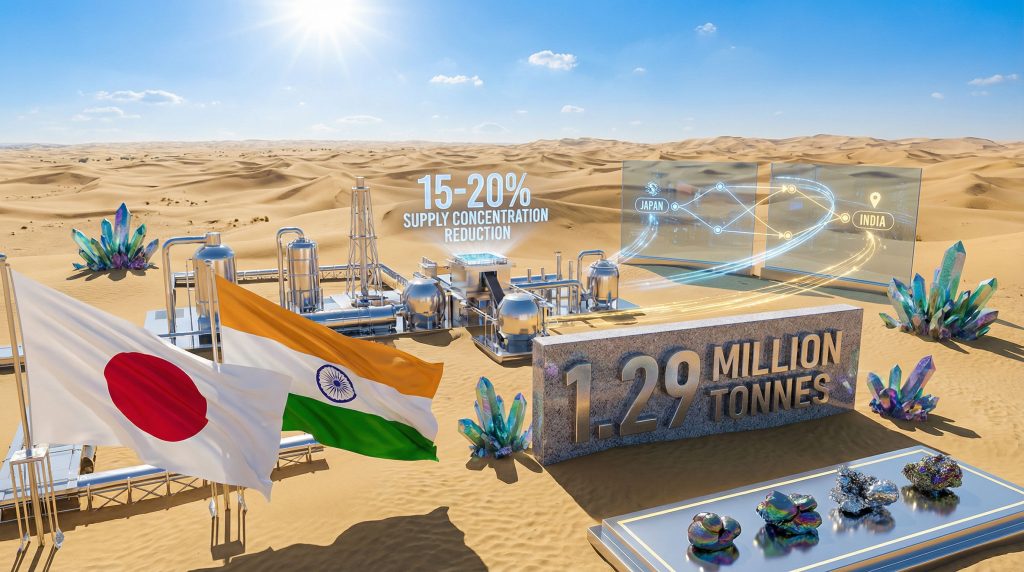
India's newly identified rare earth deposits in Rajasthan and Gujarat represent significant additions to global supply diversity, containing approximately 1.29 million tonnes of rare earth oxides according to Union Minister Kishan Reddy's parliamentary statement. These hard rock deposits possess distinct characteristics that differentiate them from ionic deposits dominating current global production.
Hard Rock Deposit Characteristics and Global Context
Hard rock rare earth deposits, primarily monazite-based formations found in Rajasthan and Gujarat, contain lower REO percentages (typically 0.1-0.5% REO content) compared to ionic deposits but provide greater mineralogical diversity and geographic concentration advantages. The International Atomic Energy Agency reports that hard rock extraction requires more advanced separation technologies compared to ionic deposits, creating both challenges and opportunities for technology transfer partnerships.
Rajasthan Deposit Technical Specifications:
- Total REO Content: 1.29 million tonnes identified across three primary deposits
- Mineral Composition: Monazite ((Ce,La,Th)PO₄) as primary rare earth-bearing mineral
- REE Distribution: Light rare earth elements (LREE) comprise 85-90% of content
- Heavy REE Content: 10-15% of total rare earth distribution
- Processing Complexity: Thorium content (2-5% of ore) requires specialised handling
According to the Geological Survey of India, these deposits provide processing yield potential of approximately 65-75% REO extraction efficiency from ore, requiring significant tailings management infrastructure but enabling substantial scale development within concentrated geographic regions.
Strategic Positioning and Infrastructure Advantages
Geographic concentration within Rajasthan and Gujarat enables unified infrastructure development, reducing capital requirements compared to distributed deposit locations. Desert positioning provides lower population density considerations, potentially reducing environmental impact concerns relative to populated mining regions while requiring advanced water management and transportation solutions.
Proximity to emerging Indian manufacturing hubs, particularly in Gujarat's industrial corridors, reduces transportation costs relative to African or Southeast Asian deposit alternatives. This geographic advantage becomes increasingly important as processing facilities require reliable logistics networks for both raw material input and finished product distribution.
Global Reserve Comparison:
- China: ~44 million tonnes (36.7% of global reserves)
- Myanmar: ~22 million tonnes (18.3% of global reserves)
- India: ~1.29 million tonnes (1.1% of global reserves)
- United States: ~1.8 million tonnes (1.5% of global reserves)
The U.S. Geological Survey reports global rare earth reserves totalling approximately 120 million tonnes of REO equivalent, placing India's identified deposits in the top 10 globally by reserve size, though significantly below major reserve holders.
Processing Challenges and Technology Requirements
Hard rock rare earth extraction from monazite deposits requires multi-stage processing technologies not currently deployed at scale in India. The Ministry of Mines' 2023 assessment indicates limited domestic capability in advanced separation and purification systems necessary for high-purity rare earth oxide production.
Essential Technology Components:
- Advanced crushing and grinding systems for ore preparation
- Chemical leaching processes using sulfuric or hydrochloric acid
- Multi-stage separation and purification infrastructure
- Solvent extraction or ion exchange technology for REE concentration
- Environmental remediation and waste management systems
Current Indian processing capacity remains below 5,000 tonnes REO annually according to government statistics, compared to global demand approaching 750,000 tonnes annually, indicating substantial development opportunity through technology transfer partnerships.
Technology Transfer Frameworks: Transforming Processing Capabilities
Japanese advanced rare earth processing technologies represent approximately 15-20 years of research and development investment, incorporating proprietary methodologies for hard rock extraction, separation, and purification. The Japan International Cooperation Agency has allocated funding for critical mineral supply chain development in Indo-Pacific regions, though specific allocation amounts remain undisclosed.
Advanced Hard Rock Processing Methodologies
Japanese companies, including JFE Steel and Mitsubishi Materials, have developed sophisticated ore beneficiation systems achieving superior recovery rates through multi-stage processing approaches. These technologies incorporate density separation, magnetic separation, and advanced leaching systems optimised for monazite processing.
Stage-by-Stage Processing Technology:
-
Beneficiation: Ore crushing to <200 mesh (75 microns), followed by density separation using heavy liquids (specific gravity 5.0-5.2 for monazite vs. 2.6-2.9 for gangue materials)
-
Leaching: Monazite concentrate treatment in 90-98% H₂SO₄ at 70-90°C for 2-4 hours, dissolving rare earth elements and producing rare earth sulfates
-
Purification: Pregnant leach solution filtration, followed by oxalic acid treatment to precipitate rare earth oxalates, then calcination at 800-900°C producing crude oxides
-
Separation: Crude rare earth oxide mixture separation via solvent extraction or ion exchange chromatography, producing individual element oxides (>99.9% purity)
-
Final Purification: Individual rare earth oxides undergo additional chemical processing achieving high-purity grades required for magnet manufacturing (>99.99% purity for neodymium and dysprosium)
Separation and Purification Technologies
Solvent extraction systems using di(2-ethylhexyl)phosphoric acid (D2EHPA) or similar extractants achieve 95-99% recovery rates while minimising environmental impact compared to traditional hydrometallurgical methods. According to the Society of Mining, Metallurgy & Exploration, these systems operate at throughput rates of 300-500 tonnes per day compared to 50-100 tonnes daily for ion exchange chromatography.
Ion exchange chromatography achieves superior purity levels (>99.99%) but operates at lower throughput rates, creating trade-offs between volume and quality requirements. Japanese technology providers have developed hybrid systems combining both approaches to optimise recovery rates and purity levels simultaneously.
Environmental Mitigation Capabilities:
- Acid recycling systems recovering 90-95% of H₂SO₄ used in leaching processes
- Water recycling systems achieving 85-90% recirculation rates
- Tailings neutralisation using lime or limestone, raising pH to 8.5-9.0
- Radioactive waste management for thorium and uranium daughters
- Zero liquid discharge systems for water-scarce desert operations
Industrial-Scale Infrastructure Development
Building processing facilities capable of handling Rajasthan's deposit scale requires substantial capital investment, estimated at $500 million to $1.2 billion USD for 50,000-100,000 tonnes REO annual capacity according to joint studies by industry participants and government agencies.
Development Timeline and Requirements:
| Phase | Duration | Key Activities | Investment Range |
|---|---|---|---|
| Design & Permitting | 12-18 months | Technology adaptation, environmental approvals | $50-100 million |
| Construction | 24-36 months | Facility construction, equipment installation | $400-800 million |
| Commissioning | 6-12 months | Operational testing, workforce training | $50-200 million |
| Total Project | 3.5-5.5 years | Full-scale operation achievement | $500-1,200 million |
Workforce requirements include 800-1,200 trained technical personnel, necessitating comprehensive training programs incorporating Japanese processing methodologies and quality control systems. Technical training initiatives must address both operational procedures and environmental management protocols specific to desert mining operations.
Global Market Impact: Supply Chain Diversification Analysis
Successful development of India's rare earth processing capabilities could reduce global supply concentration by 15-20% within a decade, assuming full-scale development of identified deposits and achievement of planned processing capacity. This market impact extends beyond simple supply addition, potentially affecting pricing dynamics, contract structures, and strategic planning across rare earth-dependent industries.
Supply Chain Redistribution Scenarios
Current rare earth market dynamics reflect high concentration risk, with limited alternative sources capable of providing diverse rare earth element portfolios at scale. India's entry as a significant processor could trigger supply chain redistribution affecting multiple sectors, from permanent magnet manufacturing to electronics production.
Market Share Redistribution Projections:
- Current Chinese Market Share: 60% production, 70% processing
- Potential Post-Development Share: 50-55% production, 60-65% processing
- India's Projected Market Share: 5-8% production, 8-12% processing
- Timeline for Market Impact: 7-10 years for meaningful volumes
Price stability implications include reduced volatility through supply diversification, though development costs may maintain price premiums for alternative suppliers. The Asian Development Bank's critical minerals study suggests that nations prioritising supply security accept 15-25% price premiums over traditional suppliers, indicating market willingness to support diversification initiatives.
Competitive Response from Established Producers
Market reactions from dominant suppliers typically include pricing adjustments, capacity expansion, and strategic partnership development to maintain market share. Recent export control implementations demonstrate how geopolitical considerations increasingly influence competitive strategies beyond traditional market mechanisms.
Counter-strategies may include:
- Accelerated capacity expansion in existing facilities
- Development of alternative deposit locations
- Strategic partnership formation with emerging producers
- Technology advancement to maintain processing advantages
- Regional alliance building to secure market access
Regional alliance formations create interconnected supply networks that reduce vulnerability to single-supplier disruptions while potentially creating new dependencies within alliance frameworks. These dynamics require careful monitoring as alternative supply sources develop operational capabilities.
Expanding Strategic Resource Cooperation: Beyond Rare Earths
The japan and india rare earth partnership framework extends beyond immediate rare earth development, incorporating broader critical mineral cooperation including lithium, copper, and cobalt resource development in third countries. This expansion demonstrates how bilateral resource partnerships evolve into comprehensive strategic frameworks addressing multiple supply chain vulnerabilities.
Third-Country Resource Development Models
Japanese interest in partnering with Indian companies for African resource development creates triangular cooperation models combining Japanese technology, Indian operational capabilities, and African resource endowments. These arrangements provide risk distribution, capability complementation, and market access advantages for all participants.
Target Mineral Categories for Expansion:
- Lithium: Battery manufacturing supply chain development
- Copper: Infrastructure and renewable energy applications
- Cobalt: Electric vehicle and energy storage systems
- Graphite: Battery anode materials and industrial applications
- Manganese: Steel production and battery chemistry applications
African resource development through bilateral cooperation frameworks enables scale economics, technology transfer, and market development that individual national approaches might not achieve. These models also provide pathways for infrastructure development, workforce training, and technology adaptation in resource-rich regions.
Furthermore, India's strategic mineral supply initiatives demonstrate expanding scope beyond bilateral partnerships to multilateral resource cooperation frameworks.
Technology Sector Integration and Manufacturing Synergies
Semiconductor industry cooperation frameworks complement rare earth development through integrated supply chain approaches addressing multiple critical materials simultaneously. Clean energy technology development partnerships create demand-side integration, ensuring processed materials find application in high-value manufacturing sectors.
Defence industry considerations add strategic dimensions to resource partnerships, particularly for rare earth elements used in advanced electronics, guidance systems, and communications equipment. Dual-use applications require careful technology transfer management and export control compliance across partnership frameworks.
Manufacturing Integration Opportunities:
- Permanent magnet manufacturing facility development
- Battery materials processing and cell production
- Semiconductor fabrication supply chain integration
- Clean energy component manufacturing
- Advanced materials research and development
Economic Security Dialogue: Institutional Framework Development
The planned early 2026 economic security dialogue between Japan and India establishes institutional mechanisms for ongoing cooperation, policy coordination, and project development oversight. This framework provides structured approaches to private sector engagement, regulatory harmonisation, and risk management across multiple project categories.
Private Sector Engagement Mechanisms
Business-to-business partnership facilitation requires government support for regulatory navigation, investment protection, and technology transfer approvals. Economic security dialogues create platforms for addressing commercial barriers, coordinating investment incentives, and managing political risks that could affect long-term project viability.
Institutional Structure Components:
- Government-to-government policy coordination mechanisms
- Private sector advisory groups and consultation processes
- Technical working groups for specific mineral categories
- Investment promotion and protection frameworks
- Regulatory harmonisation and standards alignment
- Dispute resolution and risk mitigation procedures
Private sector participation models include joint ventures, technology licensing agreements, long-term supply contracts, and investment partnerships with risk-sharing arrangements. These structures enable commercial flexibility whilst maintaining strategic objective alignment across government priorities.
According to Reuters' analysis of Japan-India rare earth discussions, the partnership will focus on developing alternative supply chains to reduce dependency on dominant suppliers, whilst Economic Times reports suggest comprehensive technology transfer agreements will form the partnership's cornerstone.
Timeline and Milestone Development
Early 2026 dialogue launch initiates comprehensive cooperation framework development, with medium-term phases (2026-2030) focusing on project implementation and capacity building. Long-term strategic objectives (2030-2040) target meaningful market impact and supply chain diversification achievement.
Development Phase Milestones:
| Phase | Timeline | Key Milestones | Success Metrics |
|---|---|---|---|
| Dialogue Launch | Early 2026 | Framework agreement, pilot project identification | Signed MOUs, funding commitments |
| Pilot Implementation | 2026-2028 | Technology transfer, facility construction | Operational facilities, trained workforce |
| Scale Development | 2028-2032 | Commercial production, market integration | Production volumes, market share |
| Strategic Impact | 2032-2040 | Supply chain transformation, regional leadership | Global supply diversification |
Success metrics include production volume achievement, technology transfer effectiveness, workforce development outcomes, and supply chain resilience improvement. These indicators provide measurable assessment of partnership progress and strategic objective fulfillment.
The next major ASX story will hit our subscribers first
Implementation Challenges and Risk Assessment
Technical and operational hurdles include hard rock extraction complexity, quality control requirements, and scalability challenges from pilot to commercial operations. Learning curve management requires comprehensive technology transfer programs, operational training, and continuous improvement processes to achieve international standards.
Technical and Operational Risk Factors
Hard rock rare earth extraction presents greater technical complexity compared to ionic deposit processing, requiring advanced separation technologies and environmental management systems. Quality control and international standards compliance necessitate substantial investment in laboratory capabilities, testing equipment, and certification processes.
Primary Risk Categories:
- Technical Execution: Processing technology adaptation and optimisation
- Environmental Management: Waste handling, water treatment, and regulatory compliance
- Quality Control: Product purity standards and customer specification achievement
- Scalability: Transition from pilot operations to commercial production volumes
- Workforce Development: Technical training and capability building requirements
Scalability challenges include maintaining consistent product quality at increased production volumes, managing complex supply chain logistics, and ensuring reliable utility and infrastructure support for expanded operations.
Regulatory and Environmental Considerations
Indian mining permit processes require comprehensive environmental impact assessments, community consultation, and regulatory approval coordination across multiple agencies. Desert operations present unique environmental challenges including water sourcing, waste management, and ecosystem impact mitigation.
International compliance requirements for technology transfer include export control regulations, intellectual property protection, and investment screening procedures. These regulatory frameworks affect project timeline, investment structure, and operational procedures throughout development phases.
Environmental Management Requirements:
- Water sourcing and conservation in desert environments
- Tailings management and long-term storage solutions
- Air quality monitoring and dust control systems
- Radioactive materials handling and disposal protocols
- Community impact mitigation and stakeholder engagement
Market and Financial Risk Assessment
Commodity price volatility affects project economics through revenue uncertainty and investment return calculations. Rare earth markets exhibit significant price fluctuations due to supply concentration, demand variability, and geopolitical influences on trade flows.
Currency fluctuation impacts on long-term agreements require hedging strategies and flexible pricing mechanisms. Japan-India projects involve multiple currency exposures including USD for international sales, JPY for technology payments, and INR for domestic operations.
Financial Risk Mitigation Strategies:
- Long-term supply contract development with price adjustment mechanisms
- Currency hedging for multi-year investment and operational cash flows
- Diversified customer base development to reduce market concentration risk
- Government investment guarantees and political risk insurance
- Flexible production capacity to respond to market demand changes
Competition from established suppliers creates pricing pressure and market access challenges for new entrants. Competitive response may include capacity expansion, pricing adjustments, and strategic partnership formation to maintain market position.
Strategic Implications for Regional Security Architecture
Quad Initiative integration provides multilateral framework support for bilateral resource partnerships, incorporating Australian mineral expertise and U.S. technology capabilities into broader Indo-Pacific cooperation structures. This integration enhances project viability through expanded technical resources, market access, and investment capacity.
Multilateral Cooperation and Alliance Integration
Regional supply chain resilience building requires coordinated approaches across multiple bilateral partnerships, creating interconnected networks that reduce single-supplier dependencies whilst managing alliance-specific risks. Australian rare earth processing experience and U.S. downstream manufacturing capabilities provide complementary strengths to Japan-India cooperation.
Quad Initiative Complementarities:
- Australia: Mining expertise, established processing operations, regulatory frameworks
- United States: Downstream manufacturing, technology development, market access
- Japan: Processing technology, investment capital, quality control systems
- India: Resource endowments, workforce capabilities, manufacturing capacity
Multilateral coordination enables larger-scale projects, risk distribution across multiple partners, and comprehensive supply chain development addressing extraction, processing, and manufacturing requirements simultaneously.
Strategic Competition and Response Dynamics
Export control escalation scenarios require careful partnership management to avoid triggering additional restrictions or retaliation measures. Technology transfer arrangements must balance capability building objectives with export control compliance and strategic competition considerations.
Alternative partnership development by established suppliers creates competitive pressure for project success and market acceptance. Regional competition includes resource partnerships between other nation pairs, technology development initiatives, and alternative supply chain arrangements.
Strategic Response Scenarios:
- Escalation: Additional export controls and technology restrictions
- Competition: Alternative partnership development and capacity expansion
- Cooperation: Multilateral frameworks and shared technology development
- Fragmentation: Regional bloc formation and reduced global integration
Technology competition acceleration through strategic partnerships requires substantial research and development investment, intellectual property management, and innovation ecosystem development to maintain competitive advantages.
Future Scenario Analysis: Partnership Success Pathways
High success scenarios involve full-scale production achievement within projected timelines, successful technology transfer and domestic capability building, and meaningful market impact reducing global supply concentration. These outcomes require sustained political commitment, technical execution excellence, and favourable market conditions throughout development phases.
High Success Scenario Outcomes
Full-scale production achievement enables India to become a significant rare earth processor, achieving 50,000-100,000 tonnes REO annual capacity within a decade. Technology transfer success creates domestic technical capabilities supporting independent operations and potential technology export to other developing nations.
High Success Metrics:
- Production Capacity: 75,000-100,000 tonnes REO annually by 2035
- Market Share: 8-12% of global rare earth processing capacity
- Technology Transfer: Domestic capability for independent operations
- Regional Impact: Alternative supply source for Asian manufacturing
- Economic Impact: $2-3 billion annual export revenue generation
Regional leadership in alternative supply chain development positions India as a hub for critical mineral processing, attracting additional international partnerships and investment in related mineral processing capabilities.
Moderate Success and Adaptive Outcomes
Moderate success scenarios involve partial implementation achieving limited production volumes focused on specific market niches or customer segments. Selective technology transfer creates capability gaps requiring continued partnership dependence for advanced processing requirements.
Limited production volumes (20,000-40,000 tonnes REO annually) may focus on specific rare earth elements or applications where technical requirements are less demanding. Niche market positioning could serve domestic demand and regional customers without directly competing with established global suppliers.
Moderate Success Characteristics:
- Selective rare earth element focus (light REEs primarily)
- Domestic market priority with limited export development
- Continued technology partnership dependence for advanced processing
- Gradual capability building over extended timelines
- Regional supply chain integration rather than global market impact
Risk Mitigation and Adaptive Management
Diversified investment approaches distribute risks across multiple projects, technology sources, and market applications. Flexible agreement structures enable adaptation to changing market conditions, technological developments, and geopolitical circumstances affecting partnership viability.
Adaptive Management Strategies:
- Modular facility development enabling capacity adjustment
- Multiple technology source diversification reducing single-supplier dependence
- Flexible production mix responding to market demand changes
- Phased investment commitment aligned with milestone achievement
- Contingency planning for geopolitical disruption scenarios
Contingency planning addresses potential geopolitical disruptions, technology access restrictions, and market access barriers that could affect project implementation and operational success.
Investment and partnership decisions involving critical mineral projects carry substantial risks including commodity price volatility, regulatory changes, and geopolitical developments. This analysis provides educational information and should not be considered investment advice. Prospective investors should conduct independent due diligence and consult qualified advisors before making investment decisions.
The japan and india rare earth partnership represents a significant development in global critical mineral cooperation, potentially reshaping supply chain dynamics through strategic alliance frameworks prioritising long-term security over short-term cost optimisation. Success depends on technical execution, sustained political commitment, and adaptive management responding to evolving market and geopolitical conditions.
Ready to Capitalise on the Next Critical Mineral Discovery?
Discovery Alert's proprietary Discovery IQ model delivers real-time alerts on significant ASX mineral discoveries, instantly empowering subscribers to identify actionable opportunities ahead of the broader market. Understand why historic discoveries can generate substantial returns by exploring major mining breakthroughs, then begin your 14-day free trial today to position yourself ahead of the market.