May 16, 2026
The evolving landscape of mineral resource allocation continues to reshape global supply chains, particularly as nations strive to secure domestic production capabilities for strategic materials. India's approach to critical minerals strategy exemplifies this transformation, where electronic procurement mechanisms combine transparency with competitive price discovery. The e-auction of mineral blocks system has emerged as a cornerstone of India's resource governance strategy, fundamentally altering how mining rights are distributed across the subcontinent.
Understanding India's Digital Mining Revolution
The evolution of mineral resource allocation in India represents a paradigm shift from discretionary assignment to systematic competitive bidding through electronic platforms. This transformation addresses longstanding concerns about transparency whilst optimising revenue generation for both federal and state governments. Furthermore, the mining industry evolution demonstrates how technology integration enhances operational efficiency across resource development projects.
The legal foundation supporting this digital transformation stems from comprehensive amendments to mining legislation, establishing clear protocols for competitive bidding whilst maintaining environmental and social safeguards. The electronic bidding infrastructure eliminates traditional opacity in resource allocation, creating auditable trails that enhance accountability across the entire process.
The Strategic Importance of Critical Mineral Classification
Critical minerals differ significantly from conventional resources due to their strategic applications in advanced manufacturing and defence technologies. Rare Earth Elements (REE), Lithium, Tungsten, Graphite, Vanadium, Titanium, Glauconite, and Rock Phosphate represent the core categories being prioritised through India's auction framework. These materials serve as foundational inputs for:
- Clean energy infrastructure: Solar panel components, wind turbine magnets, battery manufacturing
- Advanced manufacturing: Electronics, precision instruments, automotive applications
- Defence technologies: Strategic alloys, specialised equipment, communication systems
- Agricultural productivity: Fertiliser components, soil enhancement materials
The geopolitical significance of these resources cannot be understated, as global production remains heavily concentrated in specific regions, creating potential supply chain vulnerabilities for importing nations. Consequently, data-driven mining operations are becoming essential for optimising extraction efficiency and environmental compliance.
When big ASX news breaks, our subscribers know first
How India's Two-Stage E-Auction Process Functions
The structured approach to mineral block allocation incorporates rigorous qualification standards followed by competitive price discovery mechanisms. This dual-stage framework ensures technical competency whilst maintaining competitive dynamics throughout the bidding process.
Stage One: Technical Qualification and Eligibility Assessment
The initial qualification phase establishes minimum standards for participation, including:
- Legal compliance verification: Indian entity registration under applicable corporate legislation
- Technical capability assessment: Demonstrated expertise in mineral exploration and development
- Financial capacity evaluation: Working capital requirements and investment commitment evidence
- Digital signature certification: Electronic authentication for secure platform participation
Reserve price calculations utilise Auction Sale Price (ASP) methodologies that incorporate geological assessments, market valuations, and regional development factors. This systematic approach replaces subjective pricing with data-driven reserve price establishment.
Stage Two: Competitive Electronic Bidding
Qualified participants advance to real-time electronic bidding platforms where competitive dynamics determine final allocation outcomes. The forward ascending auction format ensures transparent price discovery whilst maintaining technical security standards through tamper-proof audit mechanisms.
Key features include:
- Simultaneous bid processing: Real-time competition management across multiple participants
- Premium percentage structures: Revenue-sharing arrangements with state governments
- Payment obligation frameworks: Immediate financial commitments upon successful bidding
- Performance monitoring: Ongoing compliance verification throughout development phases
Strategic Significance of India's Seventh Tranche Auction
The current auction cycle demonstrates expanded geographical coverage and diversified mineral portfolios, reflecting India's comprehensive approach to resource development. Nineteen critical mineral mines distributed across ten states represent significant progress in domestic supply chain development.
The seventh tranche of critical mineral auctions showcases the government's commitment to enhancing mineral access for clean energy and defence applications. Additionally, mineral auction summaries provide comprehensive data on previous successful bids and market trends.
Geographic Distribution and Resource Mapping
The multi-state coverage spanning from Arunachal Pradesh to Uttarakhand creates strategic redundancy whilst optimising transportation logistics. This geographical diversification includes:
| State | Strategic Advantage | Infrastructure Readiness |
|---|---|---|
| Arunachal Pradesh | Eastern corridor access | Developing connectivity |
| Bihar | Central logistics hub | Established rail networks |
| Chhattisgarh | Industrial concentration | Mining infrastructure |
| Gujarat | Port proximity | Export capabilities |
| Karnataka | Technology cluster | Processing facilities |
| Madhya Pradesh | Central positioning | Multi-modal transport |
| Odisha | Mining expertise | Established operations |
| Rajasthan | Mineral diversity | Desert logistics |
| Telangana | Technology integration | Digital infrastructure |
| Uttarakhand | Mountain resources | Environmental challenges |
Critical Mineral Portfolio Composition
The mineral selection reflects strategic prioritisation based on import dependency reduction and clean energy transition requirements. Each category addresses specific supply chain vulnerabilities:
Rare Earth Elements serve as essential components in permanent magnets for wind turbines and electric vehicle motors. Global production concentration has created strategic vulnerabilities that domestic production aims to address.
Lithium reserves directly support India's electric vehicle manufacturing ambitions and energy storage requirements. In fact, recent developments in lithium extraction boost technologies promise enhanced efficiency in processing operations.
Tungsten and Vanadium applications in defence technologies and industrial processes require secure supply chains, making domestic production strategically valuable.
Rock Phosphate and Glauconite address agricultural productivity and food security considerations, supporting India's farming sector sustainability.
Comparative Analysis with International Mining Allocation Systems
India's electronic auction approach contrasts significantly with resource allocation mechanisms employed by other major mining jurisdictions. Understanding these differences provides context for evaluating the system's effectiveness.
Australia's Competitive Tender Framework
Australia employs competitive tender processes with explicit exploration commitments and environmental performance standards. The Australian system emphasises:
- Work program commitments: Mandatory exploration expenditure requirements
- Environmental bonding: Financial guarantees for site rehabilitation
- Community consultation: Stakeholder engagement protocols
- Performance monitoring: Ongoing compliance verification systems
Canada's Provincial Jurisdiction Model
Canadian mineral rights allocation varies by province, creating diverse regulatory environments. Key characteristics include:
- Staking systems: First-come, first-served claim registration in some provinces
- Competitive bidding: Auction-based allocation for strategic areas
- Indigenous consultation: Constitutional requirements for community engagement
- Federal-provincial coordination: Shared jurisdiction over resource development
Chile's State-Controlled Lithium Strategy
Chile maintains state ownership of lithium resources whilst permitting private sector participation through special agreements. This approach demonstrates:
- Strategic resource control: Government oversight of critical mineral development
- Technology transfer requirements: Knowledge sharing obligations for operators
- Environmental standards: Strict water usage and ecosystem protection protocols
- Revenue optimisation: Maximising state benefits from resource extraction
Investment Implications and Market Dynamics
The e-auction of mineral blocks creates distinct investment considerations that differ from traditional mining sector opportunities. Understanding these dynamics becomes crucial for evaluating participation strategies and expected returns.
Market Access and Competition Structures
Entry requirements establish minimum standards whilst maintaining competitive accessibility. The technical qualification thresholds create natural filters that prevent speculative participation without operational capability.
Financial capacity requirements vary based on mineral category and estimated development costs. Capital expenditure projections for critical mineral projects often exceed conventional mining investments due to:
- Advanced processing requirements: Specialised refining and purification technologies
- Environmental compliance costs: Stricter standards for critical mineral extraction
- Infrastructure development needs: Transportation and utility access in remote locations
- Technology acquisition expenses: Imported equipment and technical expertise
Revenue Models and Profitability Frameworks
The auction premium structure creates ongoing revenue sharing arrangements that impact project economics throughout operational phases. Understanding these obligations becomes essential for accurate financial modelling.
Upfront payment structures require immediate capital upon successful bidding, affecting project financing and cash flow management. Winners must balance:
- Auction premium payments: Percentage-based revenue sharing with state governments
- Development capital requirements: Exploration, infrastructure, and processing facility investments
- Operational working capital: Ongoing production and maintenance expenses
- Market price volatility: Commodity price fluctuations affecting revenue projections
District Mineral Foundation Integration and Community Benefits
The District Mineral Foundation (DMF) framework represents innovative integration of community development with resource extraction. This mechanism addresses traditional concerns about mining impacts whilst creating sustainable benefit distribution systems.
Community Benefit Distribution Mechanisms
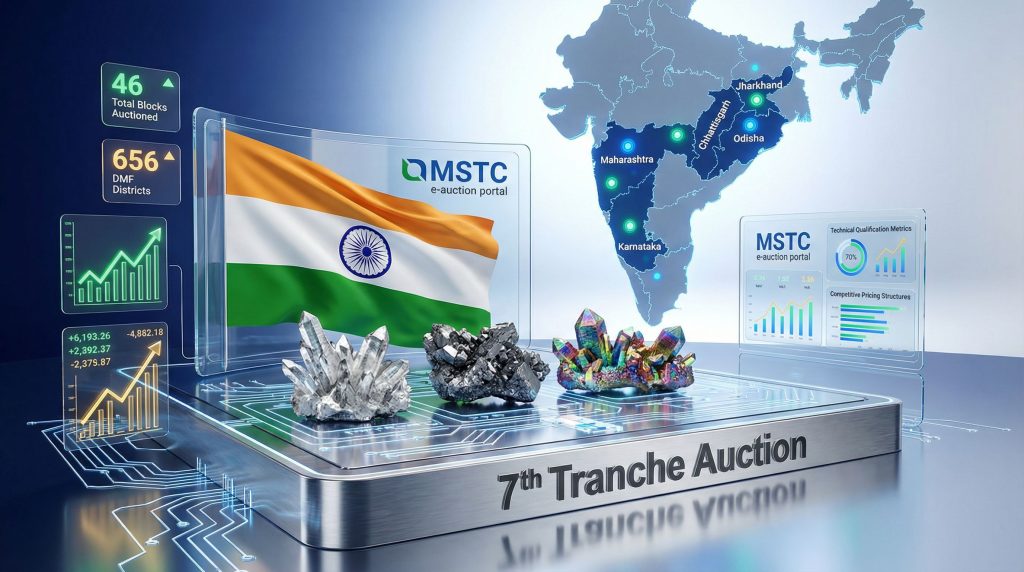
DMF operations span 656 districts across 23 states, demonstrating comprehensive geographical coverage. The concentration of 75 percent of total DMF corpus in Aspirational Districts reflects targeted development prioritisation for economically disadvantaged regions.
Benefit distribution priorities include:
- Infrastructure development: Roads, telecommunications, water supply systems
- Educational initiatives: Schools, technical training, scholarship programmes
- Healthcare facilities: Clinics, equipment, medical personnel support
- Livelihood programmes: Skill development, entrepreneurship support, agricultural assistance
Social Licence to Operate Considerations
Community acceptance becomes increasingly important as mining operations expand into previously undeveloped regions. The DMF framework creates formal mechanisms for ongoing stakeholder engagement and benefit sharing.
Environmental impact assessments now incorporate community consultation requirements, ensuring local concerns receive consideration during project planning phases. This participatory approach aims to prevent conflicts whilst maintaining operational efficiency.
The next major ASX story will hit our subscribers first
Technology Integration in Modern Mining Auctions
The MSTC e-auction portal represents significant technological advancement in government procurement systems. Platform capabilities extend beyond simple bidding functionality to encompass comprehensive project management and monitoring systems.
Digital Platform Architecture and Security
Advanced security protocols protect against manipulation whilst maintaining transparency throughout the bidding process. Key technological features include:
- Blockchain integration potential: Immutable transaction records and audit trails
- Multi-factor authentication: Enhanced security for participant verification
- Real-time monitoring: Simultaneous bid tracking and competitive analysis
- Data analytics integration: Market intelligence and pricing trend analysis
Future Technology Applications
Emerging technologies promise further enhancement of auction efficiency and transparency. Potential developments include:
Artificial Intelligence applications for geological data analysis and resource estimation accuracy improvements.
Machine learning algorithms for auction outcome prediction and optimal bidding strategy development.
Internet of Things integration for real-time environmental monitoring and compliance verification during development phases.
Critical Mineral Auctions and India's Clean Energy Transition
The auction system directly supports India's renewable energy expansion goals by securing domestic supply chains for essential materials. This strategic alignment creates synergies between resource development and clean energy deployment.
Supply Chain Security Strategy
Domestic production capability reduces import dependency whilst creating strategic reserves for emergency situations. The approach addresses several key vulnerabilities:
Import concentration risks where single-country sourcing creates geopolitical dependencies.
Price volatility exposure through international commodity markets beyond domestic control.
Transportation security concerns for critical materials crossing international borders.
Quality control assurance through domestic processing and refining capabilities.
Integration with Renewable Energy Manufacturing
Critical mineral availability directly impacts India's ability to manufacture renewable energy components domestically rather than importing finished products. This vertical integration strategy includes:
- Solar panel production: Silicon processing and rare earth component manufacturing
- Wind turbine manufacturing: Permanent magnet production using domestic REE sources
- Battery manufacturing: Lithium processing facilities and cathode material production
- Grid infrastructure: Transformer and conductor manufacturing using strategic minerals
Success Factors for E-Auction Participation
Successful participation in India's e-auction of mineral blocks requires comprehensive preparation across technical, financial, and strategic dimensions. Understanding these requirements enables informed decision-making about participation strategies.
Technical Qualification Optimisation
Geological expertise requirements extend beyond basic mining knowledge to encompass critical mineral-specific extraction and processing technologies. Successful bidders typically demonstrate:
Resource evaluation capabilities including advanced geological modelling and reserve estimation methodologies.
Environmental impact assessment expertise covering water usage, waste management, and ecosystem protection protocols.
Processing technology access for value-added production rather than raw material export.
Regulatory compliance experience with environmental, safety, and community engagement requirements.
Bidding Strategy Development
Optimal bidding approaches require comprehensive analysis of multiple factors affecting project viability and competitive positioning. Strategic considerations include:
- Reserve price analysis: Understanding ASP calculation methodologies and margin implications
- Resource quality assessment: Geological surveys, grade analysis, and processing requirements
- Infrastructure cost evaluation: Transportation, utilities, and processing facility development
- Market demand projections: Long-term pricing trends and supply-demand dynamics
Future Challenges and Opportunities in India's Mining Sector
The e-auction of mineral blocks system continues evolving as India refines its approach to resource governance and development. Several trends will shape future auction cycles and industry development.
Regulatory Evolution and Policy Refinements
Ongoing policy development addresses emerging challenges whilst maintaining competitive auction integrity. Key areas include:
Environmental standards enhancement reflecting international best practices and climate commitments. The sustainable mining transformation demonstrates how regulatory evolution drives operational improvements across the sector.
Technology transfer requirements encouraging knowledge sharing and domestic capability development.
Community benefit optimisation improving DMF effectiveness and stakeholder satisfaction.
Regional development integration aligning mining projects with broader economic development strategies.
Market Development and Value Chain Integration
Future auction success depends on creating comprehensive value chains rather than simple extraction operations. This evolution includes:
Processing infrastructure development for value-added production and export capabilities.
Research and development partnerships with academic institutions and technology companies.
International market access through quality standards and export promotion initiatives.
Circular economy integration incorporating recycling and waste reduction technologies.
Emerging Trends and Future Predictions
Several developments will likely influence future auction cycles and industry structure:
Block size optimisation balancing accessibility for smaller operators with operational efficiency requirements.
Sector-specific auction formats tailored to different mineral categories and development timelines.
International participation potential as foreign investment regulations evolve.
Technology-driven exploration using advanced geological survey techniques and data analytics.
The success of India's e-auction of mineral blocks system will ultimately be measured by its ability to balance resource development with environmental protection and community benefits whilst supporting the nation's strategic objectives in clean energy transition and economic development.
Disclaimer: This analysis is based on publicly available information and should not be considered as investment advice. Potential participants in mineral auctions should conduct independent due diligence and consult with qualified professionals before making investment decisions. Regulatory frameworks and auction procedures may change, affecting the information presented.
Curious About India's Critical Mineral Investment Opportunities?
Discovery Alert's proprietary Discovery IQ model delivers real-time notifications on significant ASX mineral discoveries, providing subscribers with actionable insights into emerging opportunities in the critical minerals space. Begin your 14-day free trial today to secure your market-leading advantage in identifying the next major discovery before the broader market catches on.