June 8, 2026
The Hidden Chokepoint: Why America's Industrial Future Depends on Elements It Barely Processes
The history of industrial power has rarely been determined by who owns raw materials. More often, it has been shaped by who controls the transformation of those materials into something the world cannot do without. Steel, semiconductors, and synthetic chemicals all tell the same story: the nation that masters the processing stage captures the strategic leverage. Today, that lesson is playing out again through Pentagon Deal Team Six, a rapid-response unit targeting seventeen metallic elements embedded inside technologies that virtually every nation on earth now depends upon.
Rare earth elements occupy a paradoxical position in global geopolitics. They are not genuinely scarce in geological terms. Deposits exist across North America, Australia, Africa, and South America. Yet the infrastructure required to separate, refine, and transform these elements into high-performance permanent magnets remains concentrated in one country to a degree that has no parallel in modern commodity markets. Understanding this paradox is essential to understanding why the United States has launched the most aggressive government-directed industrial investment campaign it has attempted since wartime mobilisation.
When big ASX news breaks, our subscribers know first
Why Rare Earths Are Not Really Rare
The term "rare earth" is one of the more misleading designations in the entire industrial lexicon. Elements such as cerium and lanthanum are more abundant in the earth's crust than copper. Even the less common members of the group, including dysprosium and terbium, exist in sufficient concentrations across multiple continents to theoretically supply global demand many times over.
The genuine scarcity is not geological. It is infrastructural, economic, and political. As rare earth processing challenges demonstrate, rare earth ore bodies typically contain multiple elements in complex mineral matrices, and separating individual elements from one another requires sophisticated hydrometallurgical processing using large volumes of chemical reagents. The environmental footprint is significant, and the economics have historically been unattractive when Chinese producers dominate global pricing.
This dynamic helps explain how a strategic dependency of staggering proportions was allowed to develop over several decades with minimal coordinated Western response. The problem was never a shortage of ore. It was always a shortage of political will, long-term industrial policy, and processing infrastructure outside of China.
According to Bloomberg Economics, rare earth elements underpin as much as $1.2 trillion in value-added production globally, despite being used in relatively small physical quantities in finished goods. That ratio between physical volume and downstream economic value is what makes rare earths so strategically potent and so difficult to replace quickly.
Four Decades of Accumulated Chinese Dominance
China's rare earth dominance was not accidental, nor was it rapid. It was the product of sustained, state-directed industrial policy stretching across multiple decades, pursued with strategic patience that Western market-driven economies consistently underestimated.
By pricing competitors out of the market during the 1980s and 1990s, Chinese producers triggered the closure of Western processing facilities. The Mountain Pass mine in California, once the world's dominant rare earth producer, halted operations in the early 2000s partly due to competitive pressure from Chinese pricing. Processing and separation capacity outside of China gradually withered, and with it went specialised workforce expertise that cannot be rebuilt overnight.
The consequences became apparent during the 2010 dispute between China and Japan, when China's export restrictions caused rare earth prices to spike dramatically and exposed the vulnerability of Japanese manufacturers who had built entire industrial supply chains around reliable Chinese supply. The episode prompted Japan to begin aggressive supply diversification, but the Western policy response was fragmented and insufficient.
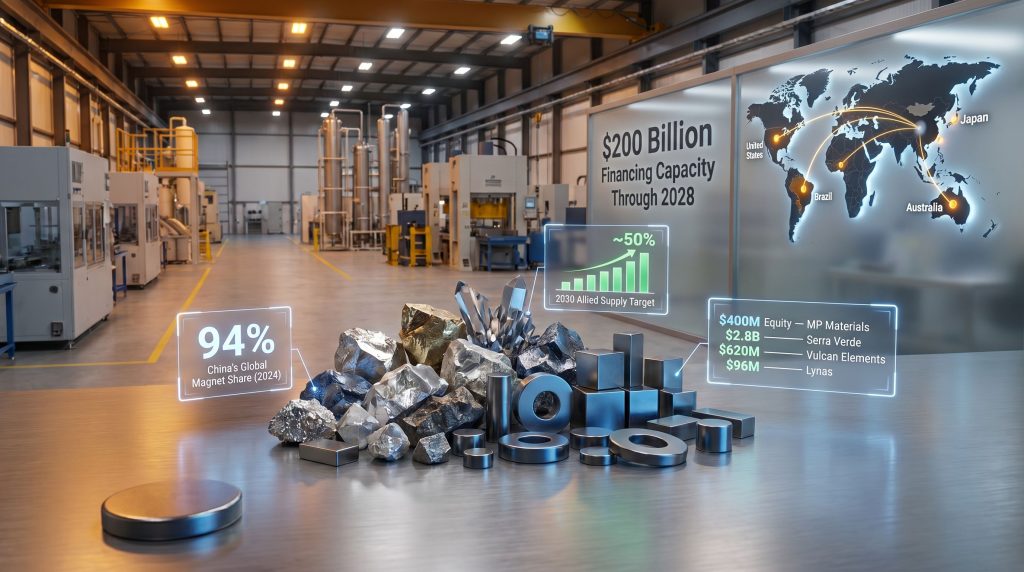
By 2024, the International Energy Agency reported that China controlled 94% of global rare earth magnet production. That figure is not simply a market share statistic. It represents near-total control over a material input that flows into missile guidance systems, jet engine components, electric vehicle motors, wind turbines, medical imaging equipment, and consumer electronics simultaneously. The dual-use nature of rare earth magnets means that any supply disruption hits both commercial and defence applications at the same time, compressing the window available for government response.
The strategic leverage embedded in that 94% figure became viscerally apparent in 2025. When China's rare earth strategy shifted toward restricting magnet exports in response to US tariff escalations, the impact on downstream industries was nearly immediate. Automotive manufacturers and defence contractors warned of impending production shutdowns. The episode ended when Washington agreed to pull back on tariff measures and technology export restrictions in exchange for resumed Chinese supply, an outcome that senior US national security officials subsequently described as an unacceptable demonstration of strategic vulnerability.
What Pentagon Deal Team Six Actually Is
The formal institutional response to that vulnerability arrived in April 2025 with the creation of the Economic Defense Unit, operating under the authority of Deputy Secretary of Defense Stephen Feinberg, a former private equity executive who brought Wall Street dealmaking instincts to a department more accustomed to procurement contracts and acquisition regulations.
Internally, the unit carries the nickname Pentagon Deal Team Six, a deliberate echo of the Navy's elite special operations unit, Seal Team Six. The name signals how the Pentagon conceptualises its mission: not as routine procurement policy, but as a rapid-response capability operating under emergency conditions.
The team is staffed predominantly by former Wall Street professionals who were specifically recruited because the financial instruments required to incentivise industrial supply chain development — including equity stakes, price floor guarantees, long-term purchase commitments, and conditional loan facilities — require expertise that traditional defence procurement personnel do not possess.
The scale of resources available to the unit is substantial. The Pentagon has indicated $200 billion in financing capacity over a three-year period, representing one of the largest directed industrial investment commitments in modern US peacetime history. The EDU coordinates with the Department of Commerce and the US International Development Finance Corporation, creating a whole-of-government investment architecture rather than a purely military programme.
Rush Doshi, who served as China director at the National Security Council under the Biden administration, has characterised the situation as requiring emergency-mode action, noting that the strategic timeline no longer permits the luxury of allowing market mechanisms to organically develop domestic supply chains at their natural pace. The judgement embedded in this position is that geopolitical risk now outweighs economic efficiency as the primary decision variable.
The Financial Toolkit: How the Pentagon Structures Its Deals
What distinguishes the Pentagon Deal Team Six approach from conventional government procurement is the sophistication and variety of the financial instruments being deployed. Rather than simply purchasing finished products through standard defence contracts, the EDU is intervening at multiple stages of the supply chain simultaneously.
| Financial Instrument | Strategic Purpose | Application Example |
|---|---|---|
| Equity Investment | Government ownership stake in producers | $400M investment positioning government as largest shareholder in US rare earth producer |
| Price Floor Guarantees | Stabilise production economics against market volatility | Applied to rare earth oxide products to underwrite commercial viability |
| Long-Term Purchase Commitments | Guaranteed offtake enabling capital investment | Ten-year purchase agreement covering 100% of magnet output from new facility |
| Conditional Loan Facilities | Fund processing and manufacturing scale-up | $620M conditional arrangement for US magnet producer |
| Allied Supply Agreements | Diversify non-Chinese sourcing internationally | $96M arrangement with Australian rare earth processor |
This multi-instrument approach reflects an important insight: different stages of the rare earth supply chain have different risk profiles and therefore require different financial interventions. Mining operations require long-term capital with patient returns. Processing facilities face commodity price volatility that makes private financing difficult without price floor protection. Magnet manufacturing requires guaranteed customers before capacity can be justified. The Pentagon is attempting to address all of these barriers simultaneously.
Breaking Down the Key Transactions
The MP Materials Agreement
The flagship deal in the Pentagon's rare earth programme involved a $400 million equity investment in MP Materials, the only active rare earth producer in the United States. This transaction was described at announcement as the first government equity investment of its kind in modern Pentagon history, positioning the US government to become the company's largest individual shareholder.
The structure goes beyond simple equity participation. The Pentagon also established a price floor for MP Materials' rare earth oxide products, insulating the company's production economics from the downward pricing pressure that Chinese producers have historically used to undercut Western competitors. Additionally, the government guaranteed that 100% of magnet output from MP Materials' new production facility will be purchased by defence and commercial customers for a period of ten years.
This integrated deal structure addresses the chicken-and-egg problem that has historically prevented Western rare earth processing investment: producers cannot secure financing without guaranteed customers, and customers cannot commit to non-Chinese supply without guaranteed production. The Pentagon's willingness to backstop both sides of the equation represents a fundamental departure from arms-length procurement practice.
The Serra Verde Acquisition
A subsequent transaction involved the $2.8 billion acquisition of Serra Verde, a Brazilian rare earth mining operation, by a US company. This deal reflects the strategic logic of securing feedstock diversity beyond domestic US production, building resilience against any single-country supply concentration. Brazilian antitrust authorities subsequently opened an investigation into the transaction, adding regulatory complexity to an already politically sensitive deal structure.
The Vulcan Elements Arrangement
A $620 million conditional loan arrangement with Vulcan Elements attracted significant scrutiny when it emerged that Donald Trump Jr. held a passive investment stake in the company through a fund. The Pentagon's response indicated that the stake was below the threshold that would have required mandatory disclosure during the vetting process and that, even with knowledge of the stake, the limited number of companies capable of performing Vulcan's function constrained the available alternatives.
Derek Scissors of the American Enterprise Institute has argued that the broader pattern of deal-making raises questions about whether financial gain rather than supply chain independence is driving some investment decisions. The Pentagon has rejected this characterisation, with spokesman Sean Parnell affirming that the department maintains strict impartiality and employs rigorous partner vetting procedures.
The Lynas Arrangement
According to Aviation Week, a $96 million agreement with Lynas Rare Earths provides a price floor guarantee designed to underwrite the company's production economics outside the influence of Chinese market pricing. This deal represents the allied-nation dimension of the EDU strategy, recognising that US domestic production alone cannot achieve sufficient scale within the target timeframe.
The REAlloys/Terves Initiative: Closing the Metallothermal Gap
Perhaps the least publicly understood but strategically significant element of the Pentagon's programme involves restoring the capacity for metallothermal reduction, the processing step that converts separated rare earth oxides into usable metal alloys. This capability, which Western industrial nations largely abandoned as Chinese processing became dominant, represents a critical mid-stream gap.
Metallothermal reduction involves high-temperature chemical reactions that strip oxygen from rare earth oxide compounds, yielding pure metal or alloy forms suitable for magnet manufacturing. The process requires specialised equipment, specific chemical inputs, and technical expertise that Western facilities discontinued developing over the past two decades. The REAlloys/Terves initiative targets a modular plant capacity of approximately 300 tonnes per year, designed to restore this critical processing capability within the domestic industrial base.
The focus on samarium and gadolinium metals through this initiative reflects a specifically military priority. Samarium-cobalt magnets, while more expensive to produce than neodymium-iron-boron alternatives, offer superior performance characteristics at elevated temperatures and in high-radiation environments, making them the preferred choice for missile guidance systems, jet engine actuators, and defence electronics where performance reliability under extreme conditions is non-negotiable.
The next major ASX story will hit our subscribers first
The Full Supply Chain: Where the Bottlenecks Actually Sit
Understanding the Pentagon's strategy requires a clear picture of where the supply chain vulnerabilities are most acute. The journey from ore deposit to finished defence component involves four distinct stages, each with different technical requirements and different degrees of Chinese dominance.
-
Mining and ore extraction: The stage where the West has the most existing capacity and the clearest path to expansion. Multiple non-Chinese deposits are active or development-ready across the US, Australia, and Canada.
-
Chemical separation and processing: The stage where Chinese dominance is most entrenched. Solvent extraction processes used to separate individual rare earth elements require significant chemical infrastructure and generate substantial waste streams.
-
Metallothermal reduction to metals and alloys: The most neglected stage in Western industrial capacity, where REAlloys/Terves is specifically targeting restoration.
-
Sintered magnet manufacturing: The final conversion step, where alloys are pressed, sintered, and magnetised into finished permanent magnets ready for integration into components.
A supply chain interruption at any one of these four stages is sufficient to halt production of finished defence components. China's 94% market share in magnet manufacturing reflects accumulated dominance across stages two, three, and four simultaneously, which is why the Pentagon's strategy must address all stages rather than simply incentivising more mining activity. Furthermore, rare earth supply chains of this complexity cannot be rebuilt within a single political cycle, underscoring the urgency behind the EDU's accelerated timeline.
Applications Driving Strategic Priority
The dual-use nature of rare earth magnets creates a particularly complex policy environment. The same neodymium-iron-boron magnets used in electric vehicle drive motors also appear in missile guidance fins, radar systems, and aircraft actuators. This overlap means that commercial demand and defence demand compete for the same non-Chinese production capacity, and any supply shock hits both sectors simultaneously.
| Application Category | Primary Rare Earth Elements | Strategic Sensitivity |
|---|---|---|
| Missile guidance systems | Samarium, Neodymium | Critical |
| Jet engine components and actuators | Samarium-Cobalt alloys | Critical |
| Electric vehicle drive motors | Neodymium, Dysprosium | High |
| Offshore wind turbine generators | Neodymium, Praseodymium | High |
| Medical imaging (MRI equipment) | Gadolinium | High |
| Consumer electronics | Lanthanum, Cerium, Neodymium | Moderate |
The inclusion of Dysprosium alongside Neodymium in high-performance motor applications deserves particular attention. Dysprosium is added to neodymium-iron-boron magnets to improve their resistance to demagnetisation at elevated temperatures, a property critical for EV motors that must operate across wide temperature ranges. China controls an even larger share of dysprosium supply than it does of neodymium, making this element a potential secondary chokepoint within the broader supply chain concern.
Governance Gaps and Legitimate Criticisms
The speed at which Pentagon Deal Team Six is deploying capital has generated substantive institutional criticism that goes beyond partisan opposition. Senator Roger Wicker, the Republican chairman of the Senate Armed Services Committee, stated publicly that very limited legal framework currently exists to govern the surge in government equity investments, calling for enhanced Congressional coordination before further capital commitments are made.
The Senate Armed Services Committee has publicly flagged that existing legal structures governing Pentagon equity investments are insufficient for the scale of capital now being deployed, calling for enhanced oversight mechanisms and Congressional coordination before the programme advances further.
The governance concerns are not abstract. They touch on several specific risks:
- Capability inflation: An environment where emergency funding is available creates incentives for companies to overstate their technical readiness and production timelines to qualify for investment
- Conflict-of-interest exposure: The Vulcan Elements situation illustrates how quickly private equity networks can create politically sensitive entanglements when government investment decisions intersect with politically connected investors
- Market signal distortion: Government price floors and guaranteed offtake may reduce the competitive pressure that drives efficiency and innovation in commercial markets
- Legal ambiguity: Pentagon equity investment in private companies sits in uncertain legal territory that existing procurement statutes did not anticipate
Chris Kennedy of Bloomberg Economics has noted that the programme represents something that would have been nearly impossible under previous Pentagon doctrine, which is both its strength and the source of its governance vulnerability. The departure from established institutional norms creates real risks of misallocation and accountability gaps that Congress is only beginning to address.
How Allied Strategies Compare
The United States is not operating in isolation. Allied nations are pursuing parallel but distinctly different approaches to rare earth supply security, each reflecting different industrial strengths and geopolitical positions.
| Country | Primary Strategic Approach | Key Competitive Strength | Notable Limitation |
|---|---|---|---|
| United States | Direct equity investment and offtake guarantees | Capital scale and deployment speed | Governance framework immaturity |
| Australia | Processing infrastructure and allied supply agreements | Established separation and processing capacity | Limited downstream magnet manufacturing |
| Japan | Long-term bilateral supply agreements and recycling programmes | Diversified sourcing and material efficiency | Limited domestic deposit base |
| European Union | Regulatory mandates and strategic stockpiling targets | Coordinated policy framework across member states | Fragmented industrial execution capacity |
Australia occupies a particularly important position in the allied supply strategy. With established separation capacity at facilities operated by Lynas Rare Earths, Australia provides a processing node outside of Chinese control that can be meaningfully scaled. The $96 million Lynas arrangement reflects Pentagon recognition that Australian processing capacity is a near-term strategic asset while domestic US processing is still being built.
Japan's experience from the 2010 China-Japan supply shock provides the most instructive historical precedent. Japanese manufacturers responded to that episode by investing in recycling programmes to recover rare earths from end-of-life products, developing substitution technologies that reduced per-unit rare earth consumption, and establishing long-term supply relationships with non-Chinese producers. These measures meaningfully reduced Japan's dependence on Chinese supply over the subsequent decade. Furthermore, America's rare earth supply chain faces similar imperatives, demonstrating that diversification is achievable but requires sustained commitment across multiple parallel strategies.
Can the 2030 Target Be Achieved?
The Pentagon's stated ambition — producing enough magnets to cover half of global demand by 2030 — is the metric against which the entire EDU programme will ultimately be judged. Independent assessment of this target must account for both the financial commitments being made and the physical, technical, and workforce constraints that govern how quickly processing capacity can actually be built.
Even optimistic scenarios require that every announced deal executes on schedule, that allied processing capacity scales as anticipated, that major automakers follow through on purchase commitments for non-Chinese magnets, and that no further Chinese supply disruptions compress the available ramp-up window. Each of these conditions represents a meaningful uncertainty.
As reported by the Japan Times, a more conservative but realistic framing suggests that partial independence, covering perhaps 30–40% of domestic demand from non-Chinese sources by 2030, is achievable if current programmes execute competently. Full independence from Chinese-processed material is likely a 2032–2035 outcome at best, given the metallothermal processing gap alone and the workforce development timelines required to staff new facilities.
The scenario analysis presented here represents analytical projection based on publicly available programme information and industrial precedent. It does not constitute financial advice or a statement of government policy. Actual outcomes will depend on programme execution, geopolitical conditions, and market factors that cannot be predicted with certainty.
Frequently Asked Questions
What is Pentagon Deal Team Six?
Pentagon Deal Team Six is the informal name for the Economic Defense Unit, a specialised team of former Wall Street professionals operating within the Pentagon. Formed in April 2025 and reporting to Deputy Secretary of Defense Stephen Feinberg, the unit deploys financial instruments including equity investment, price floors, and purchase commitments to build non-Chinese rare earth and magnet supply chains.
How much has the Pentagon committed to rare earth investment?
The Pentagon has indicated $200 billion in total financing capacity over a three-year period, though the amount actually committed across specific deals includes the $400 million MP Materials equity stake, the $620 million Vulcan Elements conditional loan, a $96 million Lynas arrangement, and involvement in the $2.8 billion Serra Verde acquisition.
Why does China control so much of the rare earth supply chain?
China built its dominance through decades of state-directed industrial policy that subsidised processing capacity, kept prices low enough to eliminate Western competition, and vertically integrated across all stages from mining through magnet manufacturing. The result was the gradual closure of Western processing facilities and the erosion of specialised workforce expertise.
What is a price floor guarantee in rare earth deals?
A price floor guarantee is a government commitment to purchase rare earth products at a minimum specified price regardless of market conditions. This mechanism protects producers from the downward price pressure that Chinese producers have historically applied to undercut Western competitors, making private investment in Western processing capacity commercially viable.
What is metallothermal processing and why does it matter?
Metallothermal processing refers to high-temperature chemical reduction processes that convert rare earth oxides into usable metal or alloy form. This mid-stream processing step is essential before rare earth metals can be formed into permanent magnets. Western industrial capacity for this process was largely discontinued as Chinese processing became dominant, creating a critical gap that current Pentagon programmes are specifically attempting to restore.
Strategic Scorecard: Where the Programme Stands
| Metric | Current Status (2026) | 2030 Target |
|---|---|---|
| China's share of global rare earth magnet production | 94% (IEA, 2024) | Reduce toward approximately 50% via allied supply chain |
| Active US domestic rare earth producers | One (MP Materials) | Multiple producers across all supply chain stages |
| Metallothermal processing capacity (non-Chinese) | Near-zero domestic capacity | Modular facilities targeting approximately 300 tonnes per year |
| Pentagon financing deployed | Billions committed across four-plus transactions | $200 billion total capacity over three years |
| Non-Chinese magnet production at scale | Minimal | Sufficient to cover approximately 50% of global demand |
The ambition embedded in Pentagon Deal Team Six is historically significant regardless of whether the 2030 target is achieved precisely on schedule. For the first time since China consolidated rare earth processing dominance, the United States is deploying government capital at a scale commensurate with the strategic problem. Whether the governance structures, industrial timelines, and geopolitical conditions align sufficiently to deliver the outcome sought remains the defining uncertainty in one of the most consequential supply chain competitions of the coming decade.
Want to Stay Ahead of the Next Major Mineral Discovery Reshaping Global Supply Chains?
As strategic commodities like rare earths move to the centre of geopolitical competition, identifying significant ASX mineral discoveries early has never been more critical — Discovery Alert's proprietary Discovery IQ model delivers real-time alerts the moment major discoveries hit the ASX, turning complex mineral data into actionable investment insights. Explore historic discoveries and the substantial returns they generated, then start your 14-day free trial at Discovery Alert to position yourself ahead of the market.