
June 16, 2026
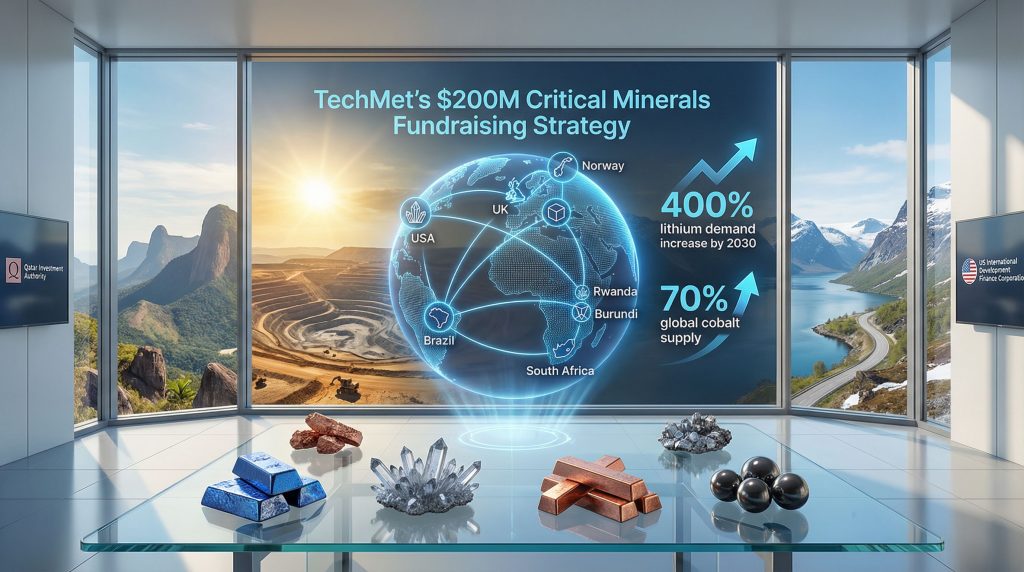
The global transition toward renewable energy and electrification has created unprecedented demand for critical minerals energy transition, forcing institutional investors to develop sophisticated allocation frameworks for strategic materials exposure. TechMet critical minerals fundraising represents a compelling example of how sophisticated capital deployment strategies address complex supply chain dependencies, geopolitical risks, and technological evolution patterns that reshape entire industries.
Modern portfolio theory applications in strategic materials differ fundamentally from conventional asset classes. Investors must evaluate not only price volatility and return correlations but also strategic value creation through supply chain security, technological advancement, and geopolitical alignment. This multidimensional analysis framework has attracted sovereign wealth funds, development finance institutions, and specialised investment vehicles seeking exposure to materials essential for economic security.
TechMet's Strategic Position in Critical Minerals Investment
Multi-Asset Portfolio Approach to Supply Chain Diversification
TechMet operates a diversified investment strategy spanning ten companies across the complete critical minerals value chain. The London-based investment vehicle has achieved a valuation exceeding $1 billion through systematic portfolio construction that integrates upstream mining operations, midstream processing infrastructure, and downstream recycling systems.
The company's geographic distribution strategy encompasses operations in Brazil, South Africa, and strategic interests in high-potential African markets including the Democratic Republic of Congo, Zambia, and Guinea. This approach creates operational resilience through jurisdiction diversification whilst maintaining focus on Western-aligned regulatory environments that support institutional investor requirements.
TechMet's portfolio companies include Brazilian Nickel operations and South Africa's Rainbow Rare Earths, representing strategic positions in battery metals and technology-critical materials. The integrated value chain model allows for operational synergies and risk mitigation across different stages of mineral processing and end-user delivery.
Institutional Backing Creates Fundraising Momentum
The company successfully completed a $300 million fundraising round in 2025, with Qatar Investment Authority contributing $180 million of the total capital raised. This sovereign wealth fund participation demonstrates institutional confidence in TechMet critical minerals fundraising strategies during a period of heightened supply chain awareness.
The US International Development Finance Corporation maintains its position as one of TechMet's largest investors, providing both capital and strategic alignment with US critical minerals security objectives. Additional institutional support comes from Mercuria Energy Group, S2G Investments, and Lansdowne Partners, creating a diverse investor base with complementary strategic interests.
CEO Brian Menell reported strong demand for additional investment beyond initial targets, leading to the current fundraising initiative seeking up to $200 million in supplementary capital. This oversubscription indicates favourable market conditions for critical minerals investment vehicles and institutional appetite for strategic materials exposure, as reported by Reuters.
When big ASX news breaks, our subscribers know first
Geopolitical Competition and Strategic Materials Investment
US-China Supply Chain Rivalry in African Markets
The Democratic Republic of Congo controls more than 70% of global cobalt supplies whilst ranking as the world's second-largest copper producer. This concentration creates strategic vulnerabilities for Western manufacturing industries dependent on battery metals and electrification infrastructure materials.
China's established dominance in critical minerals processing and refining creates bottlenecks for non-Chinese controlled supply sources. Western investment vehicles like TechMet represent efforts to develop alternative supply corridors that reduce dependence on Chinese-controlled processing capacity and infrastructure.
Furthermore, US strategic focus on Zambia, Guinea, and the Democratic Republic of Congo reflects recognition of African mineral reserves' importance for critical materials security. The executive order on critical minerals demonstrates government commitment to addressing these strategic challenges through policy initiatives.
Investment Vehicle Positioning for Government Policy Alignment
Development Finance Corporation participation in TechMet provides strategic alignment with US critical minerals security objectives whilst creating credibility for additional institutional investment. This government backing reduces perceived political risk and demonstrates policy support for Western-aligned supply chain development.
Sovereign wealth fund participation from Qatar Investment Authority indicates broader international recognition of critical minerals' strategic value. The combination of US development finance and Middle Eastern sovereign capital creates a unique funding structure that bridges geopolitical interests whilst maintaining commercial investment objectives.
Moreover, TechMet's compliance with Western-aligned jurisdiction requirements positions the investment vehicle to benefit from potential government support programmes, trade preferences, and strategic partnership opportunities that favour non-Chinese supply chain participants. This aligns with broader trends in copper & uranium investment strategies.
Investment Scenarios Driving TechMet's Capital Requirements
Portfolio Expansion Modelling
Capital allocation scenarios for TechMet's $200 million fundraising target focus on four primary strategic directions. Democratic Republic of Congo entry strategy represents the largest potential deployment, requiring $60-80 million over 18-24 months for establishing operations in the world's most significant cobalt-producing region.
| Scenario | Capital Allocation | Geographic Focus | Timeline |
|---|---|---|---|
| DRC Entry Strategy | $60-80M | Cobalt/Copper Operations | 18-24 months |
| Zambian Copper Scale-Up | $40-60M | Existing Asset Expansion | 12-18 months |
| Processing Infrastructure | $50-70M | Western Jurisdiction Facilities | 24-36 months |
| Technology Integration | $30-40M | Recycling/Recovery Systems | 12-24 months |
Zambian copper scale-up opportunities require $40-60 million investment over 12-18 months, focusing on expanding existing asset production capacity. Zambia offers compelling prospects for copper development with lower geopolitical risk compared to Democratic Republic of Congo operations.
Processing infrastructure development in Western jurisdictions demands $50-70 million over 24-36 months for establishing refining and processing capabilities outside Chinese-controlled supply chains. This strategic investment creates value-added processing capacity aligned with Western supply chain security objectives.
Risk-Adjusted Return Projections
Commodity price volatility significantly impacts investment timing and return calculations for critical minerals projects. Battery metals experience higher price volatility compared to traditional industrial commodities, requiring sophisticated hedging strategies and flexible capital deployment schedules.
Regulatory environment changes in target jurisdictions create implementation risk for large-scale mining and processing projects. Environmental compliance requirements, community engagement obligations, and changing fiscal terms affect project economics and return timelines.
Infrastructure development requirements vary significantly between jurisdictions, affecting total capital requirements and operational complexity. Remote mining locations require substantial investment in transportation, power generation, and processing infrastructure before commercial production begins.
Critical Minerals Strategic Value Assessment
Battery Metals Demand Trajectory Analysis
Lithium demand projections indicate substantial growth driven by electric vehicle adoption and grid-scale energy storage deployment. Industry analysis suggests battery metal requirements will far exceed current production capacity, creating supply bottlenecks and price premium opportunities for established producers.
Market Insight: Global battery metals demand acceleration creates premium valuation opportunities for Western-aligned supply sources, with institutional investors prioritising supply chain security over cost optimisation in strategic materials procurement.
Cobalt supply constraints outside Chinese-controlled sources limit Western manufacturers' access to essential battery materials. More than 70% of global cobalt production originates from the Democratic Republic of Congo, with significant Chinese ownership and processing control creating strategic vulnerabilities.
However, nickel industry challenges demonstrate similar concentration risks, with stainless steel production and battery applications competing for available supply. Integration across multiple battery metals through diversified portfolio approaches provides risk mitigation and operational synergies.
Rare Earth Elements and Technology Applications
Defence industry requirements for rare earth permanent magnets create strategic demand beyond commercial market applications. Military equipment, aerospace systems, and advanced weaponry depend on rare earth elements with limited alternative suppliers outside Chinese control.
Renewable energy infrastructure dependencies include wind turbine generators, solar panel manufacturing, and grid modernisation equipment requiring specific rare earth elements. Supply chain disruption in rare earth markets could significantly impact renewable energy deployment schedules and costs.
Technology sector applications span semiconductor manufacturing, telecommunications infrastructure, and advanced computing systems. Rare earth element availability affects technological advancement and competitive positioning in critical industries.
Industrial Metals Integration Opportunities
Copper's role in electrification infrastructure creates sustained demand growth across power generation, transmission systems, and electric vehicle charging networks. Grid modernisation requirements alone represent significant copper demand increases over the next decade.
Vanadium's emerging importance in grid-scale energy storage systems creates new demand categories beyond traditional steel applications. Flow battery technology deployment for renewable energy storage drives vanadium market development and price discovery.
Supply chain integration across multiple industrial metals provides portfolio companies with operational flexibility and market diversification benefits. Cross-commodity exposure reduces single-metal concentration risk whilst maintaining strategic materials focus.
Institutional Investor Evaluation Framework
Due Diligence Framework for Strategic Materials
Environmental, social, and governance compliance requirements in mining operations have become critical evaluation criteria for institutional investors. ESG frameworks specifically address mining industry challenges including environmental impact mitigation, community engagement, and operational transparency.
Jurisdiction risk assessment methodologies evaluate political stability, regulatory predictability, and contract enforcement reliability across target markets. Mining investments require extended operational timelines, making jurisdictional stability a primary risk factor for institutional capital allocation.
Long-term offtake agreement structuring provides revenue visibility and project financing capacity for large-scale mining developments. Institutional investors prioritise projects with established customer relationships and contracted revenue streams reducing market risk exposure.
Portfolio Risk Management Strategies
Risk mitigation approaches across TechMet's portfolio address commodity price volatility through diversified metal exposure spanning battery materials, industrial metals, and technology-critical elements. Geographic diversification reduces single-country exposure whilst maintaining strategic focus on Western-aligned jurisdictions.
| Risk Category | Mitigation Approach | Capital Impact |
|---|---|---|
| Commodity Price Volatility | Diversified metal exposure | 15-20% allocation buffer |
| Geopolitical Instability | Multi-jurisdiction strategy | Geographic risk premium |
| Regulatory Changes | Western-aligned focus | Compliance cost allocation |
| Technology Disruption | R&D partnership integration | Innovation investment ratio |
Regulatory compliance strategies emphasise Western-aligned jurisdiction focus to minimise regulatory uncertainty and policy risk. Operations in jurisdictions with established mining codes and predictable tax regimes reduce implementation risk and improve project economics.
Technology disruption mitigation involves research and development partnership integration, allowing portfolio companies to adapt to changing processing technologies and market requirements. Innovation investment ratios ensure technological competitiveness whilst managing development costs.
Market Dynamics Supporting Strategic Materials Investment
Investor Appetite for Strategic Materials Exposure
Sovereign wealth fund allocation trends toward critical minerals reflect recognition of strategic materials' economic security importance. Qatar Investment Authority's $180 million TechMet investment demonstrates institutional confidence in TechMet critical minerals fundraising strategies and long-term demand fundamentals.
Private equity interest in supply chain security investments has increased significantly as geopolitical tensions highlight strategic materials vulnerabilities. Investment vehicles focused on non-Chinese supply sources attract premium valuations from institutional investors prioritising supply chain resilience.
Corporate strategic investment from end-user industries creates additional demand for critical minerals exposure. Automotive manufacturers, technology companies, and renewable energy developers seek upstream integration to secure strategic materials access and reduce supply chain risk.
Competitive Landscape Analysis
Alternative investment vehicles in critical minerals space remain limited compared to traditional commodity sectors. TechMet's integrated portfolio approach and established institutional backing provide competitive advantages in attracting additional capital and strategic partnerships.
Government-backed financing mechanisms through development finance institutions create funding opportunities unavailable to purely commercial investment vehicles. US International Development Finance Corporation participation demonstrates government policy support for Western-aligned critical minerals development.
Market valuation benchmarks for similar portfolio companies indicate premium pricing for integrated critical minerals operations. Strategic value creation through supply chain security justifies higher valuation multiples compared to traditional mining investments.
The next major ASX story will hit our subscribers first
Capital Deployment Acceleration Strategy
Operational Scaling Opportunities
Brazilian Nickel facility expansion potential represents near-term production capacity increases within established operational frameworks. Existing infrastructure and regulatory approvals provide scalable growth opportunities with reduced development risk and shorter implementation timelines.
Rainbow Rare Earths production optimisation involves process improvements and capacity expansions at established South African operations. Operational excellence initiatives and technology upgrades can increase production volumes and reduce unit costs within existing facilities.
New asset acquisition pipeline development requires systematic evaluation of strategic opportunities across target jurisdictions. Additional portfolio companies would expand geographic diversification and commodity exposure whilst maintaining integrated value chain focus.
Strategic Partnership Development
Technology transfer agreements with Western manufacturers create value-added processing opportunities and market access for portfolio companies. Downstream integration through technology partnerships reduces dependence on commodity pricing and creates stable revenue streams.
Offtake contract negotiations with automotive original equipment manufacturers provide long-term revenue visibility for battery metals production. Electric vehicle sector growth drives sustained demand for lithium, cobalt, and nickel with predictable volume requirements.
Joint venture structuring for large-scale projects enables capital sharing and risk mitigation for major development initiatives. Partnership approaches allow access to larger projects whilst maintaining manageable capital requirements and operational complexity.
Long-Term Strategic Materials Investment Implications
Supply Chain Resilience Building
Western alliance coordination on strategic materials security creates policy support and funding opportunities for non-Chinese supply chain development. Government recognition of supply chain vulnerabilities drives strategic investment in alternative supplier networks.
Emergency stockpile contribution requirements may become policy mandates for strategic materials producers, creating additional revenue opportunities and government relationships. Strategic reserves development supports national security objectives whilst providing market stability.
Alternative supplier network development outside Chinese influence requires sustained investment and operational excellence to achieve cost competitiveness. Long-term success depends on technological advancement and scale economies in Western-aligned operations, reflecting broader mining industry evolution trends.
Investment Return Scenarios
TechMet's valuation exceeding $1 billion reflects premium pricing for Western-aligned critical minerals exposure. Market recognition of strategic value creates opportunities for superior returns compared to traditional commodity investments.
Investment Analysis: Portfolio company exit multiples for successful critical minerals operations may reach 3-5 times invested capital, driven by strategic premium valuations and sustained demand growth in essential materials sectors.
Initial public offering readiness timelines for portfolio companies depend on operational scale achievement and market conditions. Public market access provides liquidity opportunities whilst maintaining strategic materials sector exposure through retained ownership positions.
Future Fundraising Trajectory Modelling
Series expansion possibilities beyond the current $200 million target depend on market demand and portfolio company development success. Strong institutional appetite suggests additional fundraising capacity for accelerated growth and geographic expansion strategies.
Strategic acquisition opportunities in consolidating markets may require substantial additional capital for transformative transactions. Market consolidation trends create opportunities for well-capitalised players to achieve dominant positions in critical minerals sectors.
Consequently, competitive advantages through established government backing and diversified institutional investor base position TechMet for continued growth and market leadership in strategic materials investment. As noted by TechMet's official announcements, the company continues to evaluate strategic opportunities across its target markets.
Strategic Positioning in Critical Minerals Investment Evolution
TechMet's Competitive Advantages
Established government backing through US International Development Finance Corporation participation provides credibility, strategic alignment, and access to policy support mechanisms unavailable to purely commercial investment vehicles. This relationship creates sustained competitive advantages in target market development and institutional fundraising.
Diversified portfolio structure reduces single-asset concentration risk whilst maintaining strategic focus on critical minerals value chains. Ten-company portfolio spanning production, processing, and recycling creates operational resilience and market diversification benefits superior to single-asset investment approaches.
Western jurisdiction focus aligns with institutional investor requirements for regulatory predictability, environmental compliance, and operational transparency. This strategic positioning attracts premium valuations and expanded investor access compared to higher-risk jurisdictional approaches.
Market Timing Considerations
Critical minerals shortage projections support premium valuations and sustained investor interest in strategic materials exposure. Supply-demand imbalances across battery metals, rare earth elements, and industrial metals create favourable market conditions for established producers and integrated operators.
Government policy support through development finance institutions, strategic materials initiatives, and supply chain security programmes creates favourable investment environments for Western-aligned critical minerals development. Policy alignment reduces regulatory risk and enhances return potential.
Limited competition in Western-aligned investment vehicles creates market positioning advantages and pricing power for established players with proven operational capabilities and institutional backing. Market access barriers protect competitive positions whilst supporting premium valuations.
In conclusion, TechMet critical minerals fundraising demonstrates sophisticated capital deployment strategies addressing complex supply chain challenges whilst capitalising on favourable market conditions and institutional investor appetite for strategic materials exposure.
This analysis is based on publicly available information and industry research. Investment decisions should consider additional factors including detailed due diligence, professional advice, and individual risk tolerance. Critical minerals markets involve substantial volatility and operational complexity that may affect investment outcomes.
Ready to Capitalise on Critical Minerals Investment Opportunities?
Discovery Alert's proprietary Discovery IQ model delivers real-time alerts on significant ASX mineral discoveries, instantly empowering subscribers to identify actionable opportunities in critical minerals and battery metals ahead of the broader market. Begin your 14-day free trial today and position yourself to capture the next major breakthrough in Australia's strategic materials sector.