June 16, 2026
The Rate Cycle's Hidden Complexity: Why Monetary Policy in 2025 Is Unlike Any Prior Era
Every major monetary policy shift in modern history has been shaped by the debt environment it inhabits. The aggressive tightening cycles of the 1970s and early 1980s unfolded against a backdrop of relatively modest sovereign leverage. Today's policymakers face a structurally different challenge: navigating inflation control when government debt-to-GDP ratios have ballooned past 120% in the United States, making the traditional playbook not just difficult to replicate, but potentially destabilising if applied too bluntly.
Understanding the Kevin Warsh Fed rate cut view requires more than tracking inflation data. It requires examining the intersection of fiscal reality, technological transformation, geopolitical competition, and the psychological signals embedded in a new central banker's history, beliefs, and personal behaviour.
When big ASX news breaks, our subscribers know first
Kevin Warsh: Reading the New Fed Chair Beyond the Headlines
From Board Member to Chair: The Policy Philosophy Behind the Appointment
Kevin Warsh served on the Federal Reserve Board before departing in 2011. His exit is widely attributed to disagreement with the continuation of quantitative easing under then-Chair Ben Bernanke. This matters because it signals a deep-seated preference for balance-sheet discipline over prolonged monetary accommodation. His return to the chair position under a very different political and economic landscape invites a critical question: does his philosophy remain intact, or has the environment forced a recalibration?
Warsh has been publicly explicit about wanting to reduce the Federal Reserve's balance sheet by allowing bonds to mature rather than engaging in active market sales. He has also articulated a belief that artificial intelligence-driven productivity gains can organically reduce inflationary pressure, making aggressive rate hikes unnecessary. Critically, he frames inflation as primarily a fiscal problem, driven by excessive government spending rather than an overheating economy.
What Warsh's Personal Investments Reveal About His Convictions
One of the more underappreciated signals in the Kevin Warsh Fed rate cut view comes not from his speeches but from his investment history. A substantial portion of his wealth has been built through AI and cryptocurrency investments. This is not merely biographical trivia. It suggests a genuine conviction behind his AI productivity thesis, not a rhetorical position adopted for political purposes.
He is, as the saying goes, someone who has acted on conviction rather than just stated it. His 2011 resignation from the Federal Reserve is itself a data point in this regard: rather than formally dissenting within the board, he chose to leave, a far rarer and more emphatic expression of ideological commitment.
The distinction matters for investors. A Fed chair who genuinely believes AI will drive deflationary productivity gains is far less likely to impose aggressive tightening than markets currently anticipate, even if his public framing sounds hawkish.
What the Market Consensus Gets Right and Wrong on Rate Cuts
The Hawkish Case: Why Markets Are Pricing in Fewer Cuts
The prevailing market consensus heading into mid-2025 is that the Federal Reserve's next move is more likely to be a hike than a cut. The data supporting this view is not trivial:
- U.S. CPI running above 4% as of the most recent print
- Employment data revised upward by approximately 90,000 jobs, pointing to labour market resilience
- Elevated geopolitical risk, particularly around the Strait of Hormuz, adding inflationary pressure through energy and fertiliser supply disruptions
- Oil price volatility creating persistent cost-push inflation across supply chains
Rate Scenario Framework: What Each Path Implies
| Scenario | Implied Fed Action | Key Trigger |
|---|---|---|
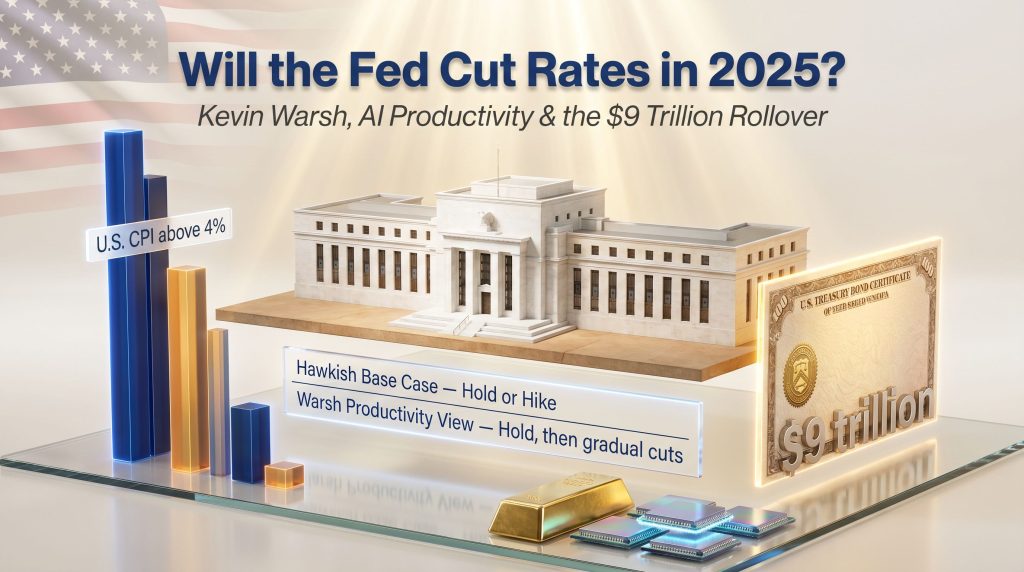
| Hawkish Base Case | Hold or Hike | Persistent CPI above 4%, strong employment |
| Warsh Productivity View | Hold, then gradual cuts | AI-driven deflation materialises |
| Geopolitical Shock | Emergency hold or cut | Oil price spike, financial instability |
| Fiscal Deterioration | Forced accommodation | Treasury market stress, deficit expansion |
Why the Non-Consensus View Deserves Serious Consideration
The argument that markets have Warsh wrong rests on several distinct pillars. First, the Volcker comparison fails on structural grounds. When Paul Volcker raised the federal funds rate to approximately 18% in the late 1970s to break inflation, U.S. government debt-to-GDP sat at roughly 30%. Today that ratio exceeds 120%. Applying equivalent tightening in this environment would impose interest servicing costs that could destabilise the Treasury market, not discipline it.
Furthermore, the dot-com era analogy also breaks down under scrutiny. During the late 1990s technology bubble, the U.S. administration did not frame the race to sell pet food online as existential to national security. The AI race is framed in precisely those terms. The practical implication is that deliberately choking liquidity at a time when major U.S. technology companies have committed hundreds of billions in data centre capital expenditure would risk handing the AI advantage to China, a politically untenable outcome.
| Factor | Dot-Com Era (2000) | Current AI Cycle (2025) |
|---|---|---|
| Earnings support | Minimal, revenue-light models | Strong EPS growth, real revenue expansion |
| Government strategic interest | Low | Framed as national security priority |
| Capital expenditure reality | Largely speculative | Hundreds of billions in committed infrastructure |
| Geopolitical context | Unipolar stability | Active U.S.-China technology competition |
| Valuation multiples | Thousands of times sales | Elevated but supported by revenue growth |
The U.S. Fiscal Architecture: Why Bonds Are the Real Story
Treasury Rollover Risk and the Liquidity Crunch
The Federal Reserve's ability to pursue balance-sheet reduction faces an immediate structural obstacle. Approximately $9 trillion in U.S. Treasuries require rollover within the next 12 months. Simultaneously, private capital demands are competing aggressively for available liquidity.
Major technology companies including Google have committed capital expenditures in the range of $80 billion, SpaceX has been raising capital in the vicinity of $70 billion, and significant IPO activity is anticipated from large AI-related companies. This environment makes deliberate balance-sheet contraction at the Federal Reserve level appear structurally problematic, regardless of ideological preference. In addition, the two-year yield outlook remains deeply sensitive to each data release, adding further complexity to near-term policy signals.
The Bond Bubble in Context
During the post-GFC era, approximately $18 trillion in bonds globally traded at negative yields. This represented a fundamental mispricing of risk on a scale without modern precedent. The unwinding of that anomaly is still in progress and still has a meaningful distance to travel.
The question is not whether bonds reprice further. It is which asset class absorbs the adjustment: equity valuations, the U.S. dollar, or nominal bond prices themselves.
The U.S. fiscal deficit is currently running above $2 trillion annually. Understanding the gold and bonds dynamics at play here is essential, as two distinct paths forward exist, and neither is straightforwardly comfortable for bond investors:
Path A: Strong Productivity Growth (Warsh's Preferred Scenario)
- AI-driven GDP expansion organically reduces the debt-to-GDP ratio
- U.S. dollar strengthens significantly
- Foreign nations are forced to sell U.S. Treasuries to defend their own currencies against dollar appreciation
- Net result: Treasury yields rise even in a positive economic outcome
Path B: Structural Deficit Expansion
- Annual deficit grows from $2 trillion toward $3 trillion or beyond
- Treasury issuance volume overwhelms market demand
- Nominal yields spike while real returns remain negative
- The currency absorbs the primary adjustment burden
The post-World War II precedent is instructive. U.S. debt-to-GDP last exceeded 120% in that era, and the resolution took the better part of four decades through deeply negative real interest rates and sustained nominal growth. Replicating that dynamic at scale is the core of Warsh's AI productivity bet.
AI, National Security, and the Fed's Impossible Dilemma
Why the U.S. Cannot Afford to Restrict AI Capital Formation
China currently produces approximately twice as much electricity as the United States. This single statistic underlies much of the U.S. strategic calculus around AI competition. It is widely understood to be a key reason why the U.S. administration moved to restrict semiconductor exports to China: with equivalent chip access and double the electricity generation capacity, the AI competition would already be effectively over.
For the Federal Reserve, this creates a near-impossible dilemma. Tightening monetary conditions aggressively would raise borrowing costs for the technology companies driving AI infrastructure investment, potentially slowing or redirecting that capital at precisely the moment when the national security argument for accelerating it is strongest. Consequently, the broader global monetary shift underway adds yet another layer of strategic complexity to this already fraught environment.
The World War II analogy is particularly relevant here. During the war, the U.S. government maintained explicit yield curve control, capping long-term Treasury yields to fund the wartime capital expenditure programme. While few expect a formal return to yield curve control today, the structural logic, funding a strategic national priority through accommodative monetary conditions, remains politically compelling.
The Cost-of-Storage Analogy: How AI Creates Deflation
Warsh's productivity thesis draws on a straightforward conceptual framework. Consider the cost of taking and storing a photograph in the 1980s: purchasing a camera, buying film, developing prints, and storing physical albums could represent a meaningful expense in today's equivalent dollars. Today that entire process costs effectively nothing.
Technology, when allowed to operate without regulatory interference, is structurally deflationary. The same dynamic, applied across healthcare, logistics, legal services, and manufacturing, is what Warsh believes will do the work of monetary tightening without the economic disruption of higher rates. The counterpoint is timing. Even if AI ultimately delivers a deflationary productivity boom, the bridge between now and that outcome involves substantial inflationary pressure from capital expenditure, energy demand, and skilled labour shortages.
The Skilled Labour Bottleneck: An Underappreciated Investment Theme
One of the more overlooked structural constraints in the current investment environment is the shortage of skilled trades. The data centre buildout requires enormous quantities of electricians, HVAC specialists, and related tradespeople. At precisely the moment when this demand is surging, a significant portion of the existing skilled trades workforce is approaching retirement age.
A generational shift toward university education over trade apprenticeships, particularly prominent roughly 10 to 15 years ago, has created a structural supply deficit that cannot be resolved quickly. This has portfolio implications that extend beyond obvious AI infrastructure plays. Companies that directly employ skilled tradespeople, rather than relying on contractors whose cost base will rise in parallel with demand, may represent an undervalued asset class. The same dynamic applies to mining operations, where shafts are getting deeper and the technical expertise required is increasingly scarce.
The next major ASX story will hit our subscribers first
Gold, Reserve Strategy, and the De-Dollarisation Undercurrent
Why Central Banks Are Rethinking Their Reserve Mix
The 2022 decision to sanction approximately $300 billion of Russian foreign exchange reserves represented a structural turning point in sovereign reserve strategy. It demonstrated to central banks globally that U.S. Treasury holdings are not a neutral store of value: they are subject to political risk. Since then, central bank gold reserves have grown materially, with China, Russia, and a range of emerging market nations increasing their gold allocations.
An additional development is the gradual elimination of the intermediary step in commodity trade. Historically, nations held U.S. Treasuries as a buffer because commodities were priced and traded in U.S. dollars. As more commodity trade shifts toward local currency settlement, the rationale for holding Treasuries as a reserve buffer weakens. Nations are increasingly bypassing the Treasury entirely and acquiring commodity assets, stakes in production companies, or the physical inputs directly.
Understanding What Gold Hedges and What It Does Not
Gold is a strong hedge against monetary inflation, the kind that occurs when central banks expand balance sheets and debase currency. It is a less reliable hedge against CPI inflation, because the policy response to elevated CPI typically involves rising interest rates, which increase the opportunity cost of holding a non-yielding asset and can suppress gold prices in the near term even while monetary debasement continues.
The recent gold price softness reflects a specific dynamic: sovereign nations facing geopolitical stress are prioritising the direct acquisition of oil, fertiliser, and critical inputs over gold purchases. Turkey has been among the notable sellers. This near-term reallocation of sovereign capital creates price pressure, but does not alter the medium-to-long-term structural thesis.
Near-term: Further softness possible, with the price potentially testing levels below $4,000 per ounce over a 3 to 6 month horizon.
Medium-to-long-term: The U.S. deficit trajectory, the acceleration of de-dollarisation, and ongoing central bank reserve diversification provide a structural bid that is unlikely to disappear.
What a Higher-for-Longer Environment Means for Portfolio Construction
Value vs. Growth in a Structurally Elevated Rate World
In an inflationary environment, a dollar generated today commands a premium over a projected future dollar. This has direct implications for equity portfolio construction:
- Value stocks with current cash flow generation benefit from the shift in discount rate assumptions
- Growth stocks reliant on discounted future cash flows face persistent multiple compression as rates remain elevated
- Hard asset businesses, including commodity producers and infrastructure-exposed companies, tend to benefit from competition for real inputs
- Critical mineral producers sit at the intersection of the AI buildout, geopolitical competition, and energy transition demand
However, it is worth noting that the critical minerals demand story extends well beyond any single rate cycle, underpinned by structural forces that are largely independent of near-term monetary policy decisions.
The Australia-U.S. Divergence: A Structural Contrast
The macro backdrop in Australia differs materially from the U.S. story. Where the U.S. is navigating high inflation alongside genuine economic strength driven by AI capital expenditure and energy production, Australia faces a more stagflationary dynamic: elevated inflation combined with softening growth, declining consumer confidence, and a housing market sensitive to rate movements and budget sentiment.
| Indicator | United States | Australia |
|---|---|---|
| Growth trajectory | Strong, AI capex and energy-driven | Soft, consumer confidence declining |
| Inflation dynamic | High inflation with high growth | High inflation with low growth |
| Rate cycle positioning | Hold or hike debate | Potentially near peak |
| Key economic driver | Technology, energy, defence | Housing sentiment, resources |
| Structural risk | Fiscal deficit expansion | Productivity weakness, budget headwinds |
Frequently Asked Questions: Kevin Warsh and the Fed Rate Outlook
Is Kevin Warsh a hawk or a dove on interest rates?
Warsh is broadly characterised as hawkish, with strong preferences for inflation control and balance-sheet normalisation. However, his AI productivity thesis introduces a genuinely nuanced position. He may favour holding rates steady or allowing gradual reductions over time if productivity gains materialise, rather than pursuing the kind of aggressive tightening that the consensus currently anticipates.
What is Kevin Warsh's position on quantitative easing?
Warsh has been openly critical of QE programmes that run for prolonged periods. His 2011 departure from the Federal Reserve is widely attributed to disagreement with continuing asset purchases under Bernanke. He favours allowing the balance sheet to normalise through bond maturation rather than active market purchases or sales.
Will the Fed cut rates in 2025 under Kevin Warsh?
The near-term consensus leans toward rates remaining on hold, with a mild tightening bias reflecting persistent inflation and strong employment data. The non-consensus view holds that the Kevin Warsh Fed rate cut thesis, rooted in AI productivity conviction and fiscal constraints on aggressive tightening, makes a gradual cutting cycle over a longer horizon more likely than markets currently price.
How does Warsh's appointment affect bond markets?
His preference for balance-sheet reduction places structural upward pressure on long-term Treasury yields. Combined with the challenge of rolling approximately $9 trillion in U.S. debt within 12 months, bond markets face a complex environment regardless of the short-term rate path.
What does the Fed rate outlook mean for commodity and resource investors?
A higher-for-longer environment supports value-oriented and hard-asset businesses. Commodity producers, critical mineral companies, and infrastructure-exposed businesses may benefit as capital rotates away from assets dependent on distant future cash flows.
Key Indicators Worth Watching in the Months Ahead
For investors attempting to get ahead of this debate, the following signals carry the most informational weight:
- Kevin Warsh's first major public policy speech, which will provide the clearest indication of how his pre-appointment views translate into operational monetary policy
- U.S. CPI trajectory, particularly whether services inflation shows meaningful deceleration
- Treasury auction demand as a real-time signal of bond market stress and foreign appetite for U.S. debt
- U.S. dollar index movements as a proxy for global reserve reallocation dynamics
- World Gold Council central bank purchase data for ongoing signals on sovereign reserve diversification
- Capital expenditure announcements from major U.S. technology companies as a gauge of AI infrastructure momentum
The most consistent principle across macro investing frameworks is the importance of aligning your time horizon with your thesis. A structural view on U.S. fiscal dynamics, AI-driven productivity, or commodity demand cycles may take years to fully materialise. The risk is not necessarily being wrong. It is being right too early while positioned for near-term confirmation.
This article is for informational and educational purposes only and does not constitute financial advice. All forecasts, scenarios, and analytical frameworks discussed involve uncertainty and should not be relied upon as predictions of future market outcomes. Readers should consider their own financial circumstances and consult a qualified financial professional before making investment decisions.
Want to Capitalise on the Next Major Mineral Discovery Before the Broader Market?
Discovery Alert's proprietary Discovery IQ model delivers real-time alerts on significant ASX mineral discoveries, transforming complex mineral data into actionable insights for both short-term traders and long-term investors — explore historic discoveries and their returns to understand the scale of opportunity, then begin your 14-day free trial at Discovery Alert to position yourself ahead of the market in this structurally complex macro environment.