June 16, 2026
The ASX's Structural Dependency on Commodity Cycles
Imagine two companies so large that their daily price movements can redirect billions of dollars of index capital within hours. That is not a hypothetical on the Australian Securities Exchange. It is the structural reality that every ASX investor navigates, whether they own mining stocks or not. When commodity markets shift, the ASX moves with them in ways that would be unthinkable in the United States or Europe. Understanding why this happens, and how to position around it, is one of the most underappreciated skills in Australian equity investing.
The recent session in which BHP and Rio Tinto lead the ASX higher is not merely a news story about two big miners having a good day. It is a case study in how geopolitical events, commodity price mechanics, bond market dynamics, and index construction interact to produce index-level moves that can catch passive investors and active traders alike off guard. Dissecting that mechanism reveals a great deal about how Australian equities actually work beneath the surface.
When big ASX news breaks, our subscribers know first
Why BHP and Rio Tinto Move the Entire ASX: Understanding the Mining-Market Multiplier Effect
The Outsized Index Influence of Australia's Two Mining Giants
The ASX 200 index is a market-capitalisation-weighted index, meaning the largest companies by total market value exert the greatest influence on its daily direction. BHP and Rio Tinto consistently rank among the top five largest companies on the entire exchange, and together they represent a combined index weight that dwarfs the equivalent resource-sector exposure in most other developed market benchmarks.
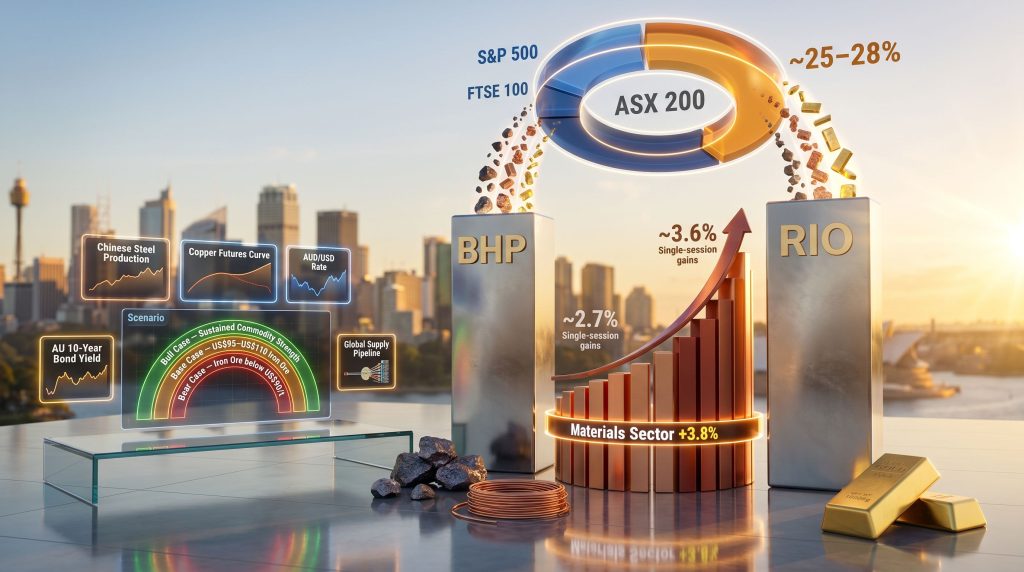
The materials and energy sectors together account for roughly 25 to 28% of ASX 200 weighting in normal market conditions. Compare that to the S&P 500, where the equivalent resource-linked sectors rarely exceed 6 to 7% of index weight. The practical consequence is that a commodity price shock that might produce a 0.3% move in the S&P 500 can generate a move two to three times that size in the ASX 200.
The session that put this dynamic on full display saw the ASX Materials sector advance approximately 3.8%, making it the best performer across all eleven GICS sectors. BHP climbed around 3.6% to set a fresh all-time high of A$65.18, while Rio Tinto added 2.7%. Those are not modest intraday gains for companies of this size. The sheer weight of these two names in the index ensured that their advance pulled the broader market back toward record territory.
Comparing Index Sensitivity: ASX 200 vs. Global Peers
| Index | Resource Sector Weighting (Approx.) | Sensitivity to Commodity Moves |
|---|---|---|
| ASX 200 | ~25–28% (materials + energy) | Very High |
| S&P 500 | ~5–7% (energy + materials) | Low–Moderate |
| FTSE 100 | ~15–18% (mining + energy) | Moderate–High |
| Hang Seng | ~10–12% (resources) | Moderate |
Key Insight: The ASX's structural overweight to commodity-linked equities means that global macro shifts, particularly those affecting iron ore, copper, and gold, translate into index-level moves with far greater velocity than in most other developed markets. Investors treating the ASX 200 as a diversified benchmark equivalent to the S&P 500 are systematically underestimating their commodity exposure.
What Drives BHP and Rio Tinto's Share Prices? A Multi-Variable Framework
The Three Commodity Pillars Behind Mining Valuations
Iron Ore: The Revenue Engine That Anchors Both Giants
Iron ore is the single most important commodity for both BHP and Rio Tinto, and the US$100 per tonne level functions as a widely watched psychological and financial threshold for earnings modelling. Above that level, both companies generate substantial free cash flow. Below it, margin compression begins to affect dividend capacity.
What makes the iron ore demand outlook particularly volatile, and therefore particularly important to monitor, is that the demand side is almost entirely concentrated in a single buyer. China accounts for roughly 70% of global seaborne iron ore trade, according to data from the World Steel Association. This concentration means that shifts in Chinese industrial policy, property sector activity, or steel mill operating rates can move global iron ore prices by several percentage points within days.
A less commonly understood dynamic is the relationship between China steel and iron ore production methods and ore quality. China's transition toward electric arc furnace steelmaking, which uses scrap metal rather than iron ore, is a long-term structural headwind for iron ore demand that is not yet fully reflected in most retail investor analyses. Furthermore, analysts have already flagged the risk of weaker iron ore pricing in the latter part of 2026 as global mine supply expands, which could compress margins for both BHP and Rio Tinto even if Chinese demand remains broadly stable.
Copper: The Electrification Premium Embedded in Mining Stocks
Copper's approximately 1.1% price appreciation in the session being examined reflects a dynamic that extends well beyond short-term trading sentiment. Copper is the foundational metal of the global energy transition. Every electric vehicle requires roughly four times as much copper as a conventional internal combustion engine vehicle, and every kilometre of high-voltage transmission grid infrastructure requires substantial copper wiring.
This structural demand premium gives copper a dual character that most other commodities lack. It responds to short-term geopolitical sentiment, as demonstrated by its move following diplomatic de-escalation, while simultaneously benefiting from decade-long infrastructure investment programs. The copper supply crunch creates a structural deficit that underpins the metal's long-term price floor, as the International Copper Study Group has consistently projected that global demand will outpace new mine supply over the medium term.
Gold: The Sentiment Amplifier in a Risk-Off World
Gold's approximately 2.5% single-session advance illustrates one of the metal's less commonly discussed behavioural characteristics. While gold is typically framed as a safe-haven asset that rises when investors are fearful, it can also rally sharply when geopolitical risk resolves, because resolution improves the global growth outlook while simultaneously reducing real interest rate expectations.
The relationship between gold and mining equities is particularly relevant here. When gold and equities rally together, as they did in this session, it often signals that the market is pricing in a combination of improved growth expectations and ongoing central bank accommodation. This dynamic tends to be more powerful and durable than a gold rally driven purely by fear.
How Geopolitical Catalysts Translate Into ASX Mining Rallies
The Macro Transmission Mechanism: From Diplomacy to Share Prices
Five Simultaneous Tailwinds From a Single Catalyst
The diplomatic agreement that preceded this particular session demonstrates how a single macro event can simultaneously activate multiple distinct valuation inputs for mining stocks. Investors who track only the headline commodity price move are capturing roughly one fifth of the actual mechanism.
The full transmission chain works as follows:
- Geopolitical de-escalation reduces the risk premium embedded in energy prices, pushing oil lower
- Lower oil prices reduce operational costs for miners, since diesel and energy are major components of mining operating expenditure, sometimes representing 20 to 30% of total cash costs
- Improved global growth expectations lift demand forecasts for industrial metals including copper and iron ore
- Risk appetite improvement attracts capital flows into commodity-linked equities, including ASX miners
- Bond yield compression reduces the discount rate applied to future mining cash flows, mechanically increasing their present value
All five of these inputs activated simultaneously in the session under analysis. That is an unusual and powerful combination. Understanding the transmission chain allows investors to anticipate how quickly these rallies can develop and how broadly they tend to extend across the sector.
Bond Yield Compression as a Secondary Catalyst
Australian government bond yields falling to approximately three-month lows during the same session created a secondary valuation tailwind that receives insufficient attention from retail investors focused purely on commodity prices. The mathematical relationship between bond yields and equity valuations is well established in institutional finance but remains underappreciated at the individual investor level.
When the discount rate applied to future earnings falls, the present value of those earnings rises, even with no change in the underlying commodity revenue assumptions. For large-cap miners with long production horizons and multi-decade asset lives, this yield sensitivity is material. A 50 basis point reduction in the discount rate applied to a 20-year iron ore cash flow model can increase the estimated fair value of a mining stock by a measurably significant margin, entirely independently of what iron ore is doing at the spot level.
BHP vs. Rio Tinto: A Comparative Strategic Profile
Side-by-Side Valuation and Performance Snapshot
| Metric | BHP (ASX: BHP) | Rio Tinto (ASX: RIO) |
|---|---|---|
| Recent All-Time High | A$65.18 | A$168.78 |
| Single-Session Gain | ~3.6% | ~2.7% |
| Primary Revenue Drivers | Iron ore, copper, coal | Iron ore, aluminium, copper |
| Institutional Fair Value View | Slightly below fair value | Approximately at fair value |
| Copper Exposure | High (South America, Olympic Dam) | Moderate (Oyu Tolgoi, Mongolia) |
| Aluminium Exposure | Minimal | Significant |
Strategic Differentiation: Commodity Mix and Geographic Exposure
The practical difference between owning BHP versus Rio Tinto is more nuanced than most retail investors appreciate. Both companies are heavily exposed to iron ore, and both will respond similarly to large moves in that market. However, their divergence becomes meaningful at the margin. According to Morningstar's comparative analysis, the two companies present subtly different investment propositions despite their surface-level similarities.
- BHP carries a broader commodity mix with meaningful copper exposure through Chilean operations and the Olympic Dam uranium-copper-gold polymetallic deposit in South Australia, positioning it as a more direct beneficiary of the electrification narrative
- Rio Tinto operates one of the world's largest aluminium and alumina businesses, providing exposure to bauxite and aluminium markets that have their own distinct demand cycles, partially independent of the steel and copper industries
- Rio Tinto's Oyu Tolgoi copper-gold mine in Mongolia is one of the largest undeveloped copper resources globally, providing a long-dated growth option that is not yet fully reflected in near-term earnings
- BHP's potash ambitions through the Jansen project in Canada represent a diversification into agricultural commodities, creating a future revenue stream with entirely different demand drivers to iron ore
Institutional research suggests both companies are currently assessed as broadly fairly valued, meaning the current commodity cycle is largely priced into their share prices. Furthermore, analysts have flagged valuation concerns for both miners, with downgrades to neutral reflecting the view that further upside requires commodity prices to outperform consensus forecasts or operational efficiency gains to deliver earnings above market expectations.
Dividend Yield Considerations for Income-Focused Investors
Both BHP and Rio Tinto operate progressive dividend frameworks linked to earnings and free cash flow. In high commodity price environments, both have historically supplemented ordinary dividends with special distributions, which can meaningfully boost total returns in strong years.
However, investors should model dividend sustainability against multiple commodity price scenarios. A sustained decline in iron ore prices below US$90 per tonne would likely trigger dividend reductions for both companies, as free cash flow generation would compress materially. Yield-focused investors chasing high payouts at cycle peaks have historically experienced both dividend cuts and capital losses simultaneously during commodity downturns.
What Happens When the Rally Broadens Beyond the Two Giants?
Reading Sector Breadth as a Market Health Indicator
The session in question was notable not just for the performance of BHP and Rio Tinto but for the fact that smaller base metals producers and mid-tier gold miners also participated in the advance. This breadth is analytically significant for a reason that institutional traders understand but retail investors often overlook.
When a materials sector rally is concentrated exclusively in the two index heavyweights, it frequently reflects passive fund rebalancing or ETF inflows rather than genuine commodity market optimism. Large index-tracking funds that are underweight BHP or Rio Tinto relative to their benchmark weight will buy those stocks mechanically regardless of their view on commodity prices.
Genuine commodity optimism, by contrast, flows through the entire sector because active managers and specialist commodity funds take positions across the market capitalisation spectrum simultaneously. When smaller gold explorers, junior copper developers, and mid-tier iron ore producers all advance alongside BHP and Rio Tinto, it provides confirmation that the underlying thesis is being embraced broadly rather than driven by passive mechanics.
Small and mid-cap ASX miners typically exhibit two to three times the percentage sensitivity of BHP or Rio Tinto to equivalent commodity price moves, reflecting higher operational leverage and greater speculative interest. This amplification creates meaningful return opportunities for investors with appropriate risk tolerance, provided they pay careful attention to balance sheet quality, production stage, and cash burn rates.
The next major ASX story will hit our subscribers first
Scenario Analysis: Three Paths Forward for ASX Mining Stocks
Strategic Scenario Modelling for BHP, Rio Tinto, and the Materials Sector
Scenario 1: Sustained Commodity Strength (Bull Case)
Conditions required: Chinese industrial demand stabilises or strengthens; the diplomatic agreements that triggered the recent rally prove durable; copper demand from electrification programs accelerates ahead of consensus forecasts.
Likely outcomes:
- Earnings upgrades for BHP and Rio Tinto above current analyst consensus
- Potential for special dividend distributions on top of ordinary payouts
- Share prices extend toward and potentially beyond current record highs
- Materials sector maintains index leadership, supporting ASX 200 in record territory
Probability assessment: Moderate. This scenario requires multiple independent conditions to hold simultaneously, making it achievable but not the most likely near-term path.
Scenario 2: Commodity Price Consolidation (Base Case)
Conditions required: Iron ore stabilises in the US$95 to US$110 range; copper holds near current levels; no major demand shock from China; geopolitical conditions remain broadly calm.
Likely outcomes:
- Earnings broadly in line with current market consensus
- Share prices trade in a range with mild positive bias
- Dividends maintained at current levels
- Broader ASX direction driven by financials and technology rather than materials
Probability assessment: High. This represents the most plausible near-term trajectory absent a major new catalyst.
Scenario 3: Commodity Correction (Bear Case)
Conditions required: Chinese steel demand weakens materially; iron ore falls and sustains below US$90 per tonne; the diplomatic agreement underlying the recent rally breaks down; global growth fears re-emerge.
Likely outcomes:
- Meaningful earnings downgrades for both BHP and Rio Tinto
- Share price pullbacks from record levels
- Dividend reductions possible if the correction is sustained
- Materials sector becomes an index drag; defensive sectors outperform
Probability assessment: Lower in the immediate term but elevated over a 12 to 18 month horizon given announced supply expansion projects from major global producers in Brazil, West Africa, and Australia itself.
Investor Caution: Cyclical stocks trading at or near all-time highs embed optimistic commodity assumptions. The share price investors pay today reflects expectations about tomorrow's iron ore and copper prices, not yesterday's performance. Monitoring commodity futures curves and Chinese production data provides a more reliable forward indicator than extrapolating recent share price gains.
What Should Investors Monitor After a Major Mining Rally?
The Five Forward Indicators That Determine Whether Gains Are Sustainable
1. Chinese Steel Production Data
Published monthly by China's National Bureau of Statistics, this is the single most important leading indicator for iron ore and, to a lesser extent, copper demand. Declining output volumes typically precede iron ore price weakness by four to eight weeks, giving attentive investors an early warning signal before it is fully reflected in spot markets or equity prices.
2. Copper Futures Curve Structure
The shape of the copper futures curve reveals more about near-term supply and demand balance than the spot price alone. A backwardated curve, where spot prices sit above future prices, signals genuine near-term supply tightness and supports current price levels. A shift toward contango suggests the market anticipates surplus supply building, which typically precedes price softening.
3. AUD/USD Exchange Rate
BHP and Rio Tinto earn revenues predominantly in US dollars while reporting and paying dividends in Australian dollars. A strengthening Australian dollar reduces the translated value of commodity revenues even when underlying commodity prices are stable or rising. Currency moves of 3 to 5% can meaningfully offset or amplify the impact of equivalent commodity price movements on reported earnings.
4. Australian 10-Year Government Bond Yield
The yield compression that supported the recent rally can reverse quickly if RBA signals shift or domestic inflation data surprises to the upside. Rising yields would mechanically reduce the present value of future mining cash flows, creating a headwind that acts independently of commodity prices.
5. Global Iron Ore and Copper Supply Pipeline
New mine approvals, feasibility study completions, and production ramp-ups from major global operators provide 12 to 24 month advance notice of potential supply-side pressure on commodity prices. Investors tracking project development timelines in Brazil's Carajas region, Chile's copper belt, and West Africa's emerging iron ore provinces gain a material informational advantage over those focused exclusively on near-term price data.
Frequently Asked Questions: BHP, Rio Tinto, and ASX Mining Rallies
Why do BHP and Rio Tinto have such a large impact on the ASX 200?
Both companies rank among the largest on the ASX by market capitalisation. Because the ASX 200 is weighted by market capitalisation, any percentage move in BHP or Rio Tinto has a proportionally larger effect on the headline index than an equivalent move in a smaller company. When BHP and Rio Tinto lead the ASX higher by several percentage points in a single session, the effect on the ASX 200 is immediate and measurable.
What commodity prices matter most for BHP and Rio Tinto?
Iron ore is the dominant revenue contributor for both companies, making it the most critical variable for earnings modelling. Copper is increasingly important, particularly for BHP, given its exposure through South American operations and the Olympic Dam polymetallic deposit. Gold, aluminium, coal, and energy commodities also contribute but with smaller relative weighting across the two portfolios.
Is it too late to invest in BHP or Rio Tinto after a major rally?
Institutional analysis suggests both companies are trading near fair value estimates at current levels. This means the existing commodity cycle is broadly priced into their share prices. Investors considering entry after a significant single-session advance should build their investment thesis around multiple commodity price scenarios rather than assuming recent gains will continue. Entry at cycle highs in commodities-linked cyclical stocks has historically produced suboptimal risk-adjusted returns unless backed by a view on sustained commodity price outperformance.
How does China's economy affect ASX mining stocks?
China is the world's largest consumer of iron ore, copper, and aluminium. Its industrial activity, property sector health, infrastructure investment levels, and steel production volumes directly influence the commodity prices that drive earnings for BHP, Rio Tinto, and the broader ASX materials sector. Even modest changes in Chinese policy settings can ripple through commodity markets within days, affecting ASX mining valuations before most retail investors have processed the news.
What is the relationship between bond yields and mining stock valuations?
When bond yields fall, the rate used to discount future corporate earnings decreases, which mathematically increases the present value of those earnings. For large-cap miners with multi-decade production horizons and substantial long-dated cash flows, yield compression can be a meaningful positive valuation catalyst entirely independent of commodity price movements. The reverse is equally true: rising yields create a valuation headwind even in stable commodity environments.
Key Takeaways: The Strategic Framework for Understanding Mining-Driven ASX Rallies
- The ASX's structural overweight to resources means commodity-driven sessions produce index-level effects that would be unrecognisable to investors accustomed to more diversified global benchmarks
- BHP and Rio Tinto's combined index weight creates a multiplier effect where their gains lift the ASX materially, and their declines drag it with equivalent force
- The full mechanism behind a commodity-driven mining rally typically involves five simultaneous inputs: higher commodity prices, lower input costs, improved demand expectations, compressed bond yields, and rising investor risk appetite
- Both companies are assessed as broadly fairly valued at current levels, suggesting further meaningful upside requires commodity price outperformance relative to consensus or earnings upgrades from operational improvements
- Broad sector participation, where smaller base metals producers and mid-tier gold miners advance alongside BHP and Rio Tinto, is a more reliable signal of genuine commodity optimism than concentration in the two index heavyweights alone
- China's monthly steel production data, the copper futures curve structure, and Australian 10-year bond yield movements are the three most important forward indicators for investors positioning in ASX mining stocks
This article provides general information only and does not constitute financial advice. All figures referenced are sourced from publicly available market data and analyst commentary. Investors should conduct their own research and seek professional advice before making investment decisions. Past performance of commodity prices and mining equities is not a reliable indicator of future outcomes. For further analysis of ASX-listed mining stocks across multiple commodity categories, visit Stocks Down Under.
Want to Catch the Next Major ASX Mineral Discovery Before the Market Does?
While BHP and Rio Tinto dominate index-level moves, some of the most significant returns in Australian resources investing have come from smaller explorers at the moment of discovery — and Discovery Alert's proprietary Discovery IQ model scans every ASX announcement in real time, instantly identifying high-potential mineral discoveries across more than 30 commodities and delivering actionable alerts directly to subscribers. Explore historic discovery returns on Discovery Alert's dedicated discoveries page to understand the scale of opportunity, and begin a 14-day free trial to position yourself ahead of the broader market.